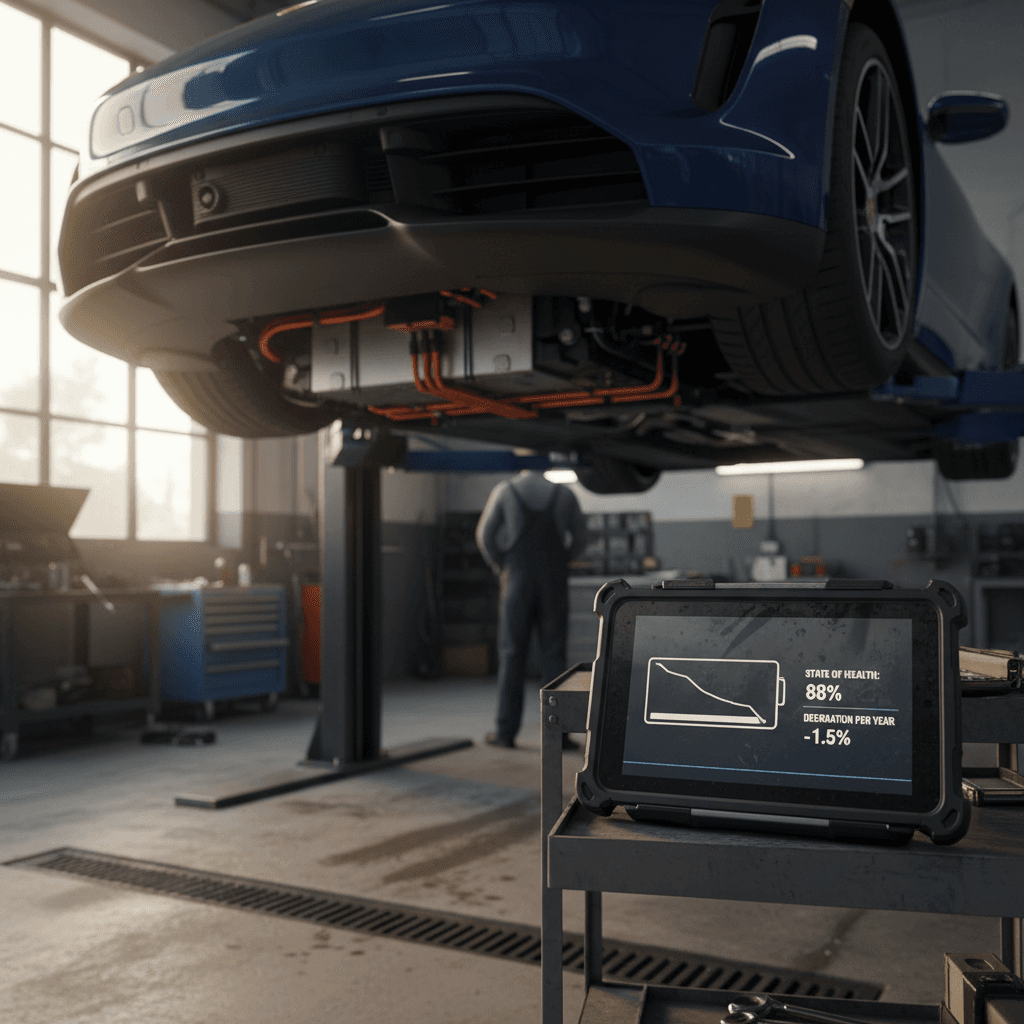
If you’re driving, or thinking about buying, a Porsche Taycan, you’ve probably wondered how much the battery degrades per year and what that means for range and resale value. The short answer: most Taycans are tracking around 2–3% battery capacity loss per year, with a bit more in the first couple of years and a slower curve after that, assuming normal use and charging habits.
Key takeaway upfront
How much does a Taycan battery degrade per year?
Porsche Taycan battery degradation at a glance
Across modern EVs, large studies of fleet data show batteries losing roughly 2–3% of capacity per year on average. The Taycan’s liquid‑cooled, high‑performance pack uses similar NCA/NCM chemistry to other premium EVs and is engineered to land in that same band rather than be an outlier.
That doesn’t mean your Taycan will drop exactly 2.5% every year like clockwork. Most packs show a steeper decline in the first 1–2 years, then a flatter curve: you might see something like ~5–8% loss early on, followed by very slow additional fade. Owners reporting 90–95% state of health (SoH) after 2–3 years and 20,000–40,000 miles are common, with some higher‑mileage cars in the high‑80s.
Don’t expect a perfectly straight line
Why Taycan battery degradation isn’t a simple fixed number
Main factors that speed up degradation
- Heat – High ambient temperatures and repeated hot‑soaked packs accelerate chemical aging.
- High state of charge (SoC) – Letting the car sit at or near 100% for days is tougher on the cells than sitting around 40–60%.
- Repeated DC fast charging – Using high‑power DC frequently, especially from low SoC to near full, adds more stress than slow AC charging.
- Deep cycles – Regularly running the pack down very low then back to full is harder on it than smaller mid‑range cycles.
Factors that help the Taycan age gracefully
- Smart buffers – Porsche keeps a chunk of capacity hidden at the top and bottom, so “100%” on the screen isn’t 100% of the cells.
- Strong thermal management – Liquid cooling and active temperature control help keep the pack in its comfort zone during fast charging and spirited driving.
- Conservative charge rates – The Taycan fast‑charges very quickly, but its software tightly controls current and temperature to limit long‑term damage.
- Software updates – Porsche has already rolled out updates that improve efficiency and range without changing the physical pack.
Location also matters. A Taycan garaged in a mild‑climate city, charged mostly on AC at 40–80% and driven regularly, will almost certainly age better than one parked outside in extreme heat, charged to 100% and left full for days, or fast‑charged daily on road‑trip‑style duty.
Practical rule of thumb
What Porsche’s warranty really says about battery life
Porsche Taycan high‑voltage battery warranty basics (U.S.)
How the Taycan’s battery warranty is structured and what it implies about expected degradation.
| Item | Coverage | What it means |
|---|---|---|
| Time limit | 8 years from in‑service date | Battery coverage runs well beyond the 4‑year basic warranty. |
| Mileage limit | 100,000 miles (approx.) | If you hit the mileage cap first, the battery warranty ends there. |
| Defect coverage | Materials & workmanship | Porsche will repair or replace packs with qualifying defects, not just wear. |
| Capacity guarantee | Around 70% net capacity by year 8 | If an official capacity test shows your pack below Porsche’s threshold, it’s considered "excessive" loss. |
| Market variations | Some markets use 160,000 km | The core 8‑year framework is similar globally, but mileage and legal language vary. |
Always confirm exact terms for your model year and market, but this is the typical U.S. framework.
Porsche’s U.S. warranty manual for the Taycan spells out 8 years / 100,000 miles of high‑voltage battery coverage, including protection against “excessive loss of capacity.” In practice, dealers see internal guidance that treats capacity dropping below roughly 70% of original net capacity within that window as a failure, not normal wear.
The key point: if Porsche is willing to guarantee about 70% capacity at eight years, its internal expectations for the fleet are better than that. Car companies don’t write warranties assuming half of their packs will be right on the brink of replacement.
Warranty doesn’t freeze your range
Real‑world owner data: What early Taycans show so far
Early‑build Taycans (2020–2021 model years) now have several years and meaningful mileage behind them, and the emerging pattern is encouraging. When owners request a capacity test or state‑of‑health reading at service, they commonly report numbers like:
- 2–3 years old, 15,000–30,000 miles: SoH in the low‑ to mid‑90s.
- 3–4 years old, 40,000–60,000 miles: high‑80s to low‑90s.
- High‑mileage outliers: some cars in the mid‑ to high‑80s, often with heavy fast‑charging, hot climates, or significant early life at 100% SoC.
There are isolated cases of Taycans showing more aggressive early drops, think SoH in the mid‑80s after just a few years. Those tend to trigger more detailed diagnostics, and in some cases, Porsche replaces individual modules or entire packs under warranty if they fall below spec.
Good news for used buyers
What battery degradation actually means for your range
Battery percentage is abstract; range is what you feel day to day. If your Taycan started with a usable range of about 240 miles in mixed driving and you’ve lost 10% capacity, you’re now looking at something more like 215–220 miles in similar conditions.
Rough range impact of capacity loss
| Capacity remaining | Approx. real‑world range* |
|---|---|
| 100% (new) | ~230–250 miles |
| 90% | ~205–225 miles |
| 80% | ~185–200 miles |
| 70% | ~160–180 miles |
*Real‑world range varies with speed, temperature, wheels/tires, elevation, and driving style.
When degradation actually matters
- Daily commuting – Even with 80–85% capacity, most owners still have comfortable margin for 40–60‑mile days.
- Road trips – As capacity drops, you may add one extra fast‑charge stop on a long route or shorten the distance between stops.
- Resale value – A car with documented 90%+ SoH will usually command a premium over a similar Taycan at 82%.
- Cold climates – Winter efficiency drops stack on top of battery aging, so older packs feel the pinch more in January than in June.
Don’t judge solely by guess‑o‑meter
How to slow Porsche Taycan battery degradation
Everyday habits to protect your Taycan battery
1. Use an 80% charge limit for daily driving
For routine use, set the charge limit to around <strong>80%</strong> in the Taycan’s charging settings. Save 100% charges for road trips or days when you need the full pack, and don’t let the car sit at 100% for long periods.
2. Favor AC charging at home and work
Level 2 AC charging is gentler on the cells than frequent high‑power DC fast charging. Using a home or workplace charger as your primary source is one of the easiest ways to keep annual degradation on the low side.
3. Avoid running down to 0% regularly
Occasional deep discharges won’t kill the pack, but repeatedly driving down to very low SoC and then charging all the way to full adds stress. Try to stay in a 20–80% band for everyday use when you can.
4. Be mindful of heat
If you live in a hot climate, parking in the shade or a garage and avoiding long periods fully charged in direct sun will reduce thermal stress. The Taycan’s thermal management helps, but it can’t change the weather.
5. Update software and follow service guidance
Porsche has issued software updates that improve efficiency, charging behavior, and battery management. Staying current and following the recommended service schedule helps the pack age as intended.
6. Plan fast‑charging like a road‑trip tool
The Taycan is built for DC fast charging, but treating it as a convenience for trips rather than a daily habit will pay off in long‑term health. When you fast‑charge, aim to arrive low and unplug around 70–80% for the fastest sessions.
Don’t obsess over perfection
Buying a used Taycan: How much degradation is too much?
For used‑EV shoppers, “Porsche Taycan battery degradation per year” is really code for one question: Is the pack still healthy enough to justify the price? To answer that, you want to look at both absolute SoH and context, age, miles, and how the car was used.
Used Taycan battery health: quick rule‑of‑thumb ranges
These aren’t official Porsche thresholds, but they’re a practical sanity check when you’re comparing cars.
Reassuring
~90–100% SoH
- Typical for relatively young, low‑mileage cars (e.g., 1–3 years, under ~25k miles).
- Great sign for CPO or one‑owner vehicles with gentle use.
- Expect strong range and resale value.
Worth a closer look
~82–89% SoH
- Common in 3–6‑year‑old Taycans with moderate‑to‑high mileage.
- Ask about charging habits, climate, and service records.
- Still solid for most use cases if priced correctly.
Proceed carefully
Below ~80% SoH
- Unusual in younger, lower‑mileage cars.
- Could indicate hard use, extreme climate, or a developing issue.
- Make sure you understand warranty status and get a professional battery assessment before buying.
Watch for “too good to be true” pricing
How Recharged measures Taycan battery health for used buyers
Because battery condition is the single biggest factor in used‑EV value, every Taycan listed on Recharged includes a Recharged Score Report with verified battery health. Instead of guessing from dash range or seller anecdotes, you see objective data and how it stacks up against similar cars.
- Independent battery diagnostics – We use high‑voltage battery health tests instead of relying solely on on‑screen estimates.
- State of Health in plain English – You see a clear SoH percentage along with what that means for expected range and everyday use.
- Comparisons to peers – Reports show how a given Taycan’s battery compares with others of similar age and mileage in our network.
- Fair market pricing – Battery condition feeds directly into our pricing models, so lower SoH is reflected in the asking price.
- Expert guidance – EV specialists walk you through the report, answer degradation questions, and help you decide whether a specific Taycan fits your needs.
Turn battery health into negotiating power
Ready to find your next EV?
Browse VehiclesFAQ: Porsche Taycan battery degradation per year
Frequently asked questions about Taycan battery degradation
Bottom line on Taycan battery degradation
Put it all together and the picture is reassuring: Porsche Taycan battery degradation per year is typically in the low single digits, with a modest early drop and a long, flat tail, backed by an 8‑year / 100,000‑mile capacity warranty. For current owners, a few simple charging and storage habits go a long way toward staying on the good side of that curve. For used‑EV shoppers, the key is to stop guessing and make battery health a data‑driven part of your decision.
If you’re considering a used Taycan, Recharged was built for exactly this moment. Every car comes with a Recharged Score Report, verified battery diagnostics, fair‑market pricing that accounts for degradation, and EV‑specialist support from first click to delivery. That way, you can focus less on worrying about kWh fade and more on enjoying one of the most engaging electric cars on the road.