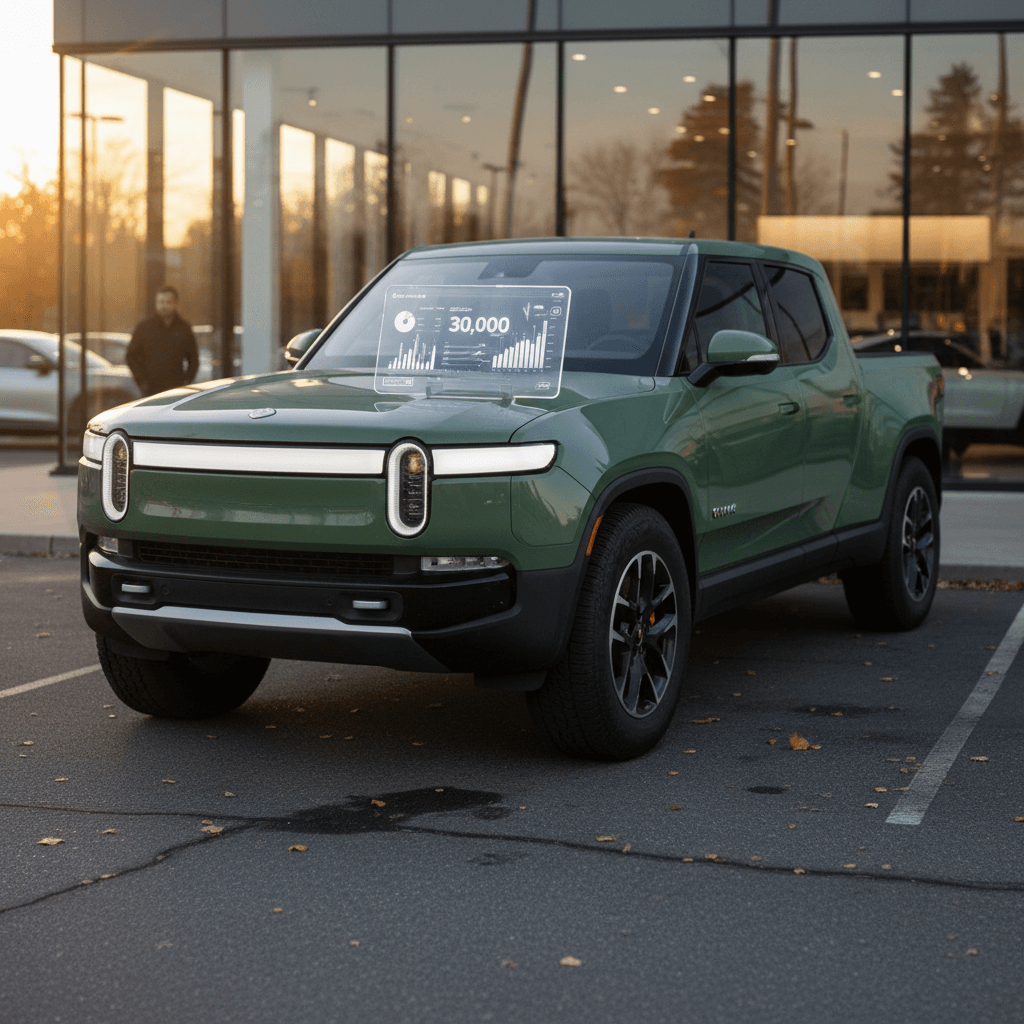
If you own a 2025 Rivian R1T, you’re holding one of the most talked‑about electric trucks on the road, and one of the trickiest to price. The 2025 model year is still nearly new, yet rapid EV price cuts and changing incentives mean your 2025 Rivian R1T trade in value can swing thousands of dollars between offers. This guide will help you understand what it’s really worth, what affects that number, and how to get the strongest offer when you’re ready to move on.
Quick context on timing
2025 Rivian R1T trade‑in value at a glance
2025 Rivian R1T value snapshot (early 2026)
Because 2025 R1Ts are still young in the used market, no single number fits every truck. As a working range, many clean‑title 2025 R1Ts in early 2026 are trading wholesale in the low‑$60,000s to low‑$70,000s, with retail asking prices sometimes stretching above that for rare specs. High‑miles work trucks or branded‑title vehicles can fall well below those numbers, while low‑mile, well‑optioned examples with Max pack and premium paint can be meaningfully higher.
Every data source slices the market differently
How much is my 2025 Rivian R1T worth on trade‑in today?
Approximate 2025 R1T trade‑in value ranges (early 2026)
These are directional, nationwide ballparks based on observed Rivian R1T resale trends, adjusted forward for 2025 models. Local markets, options, and condition can move you well above or below these numbers.
| Configuration | Typical miles (early 2026) | Trade‑in ballpark* | Notes |
|---|---|---|---|
| 2025 Dual‑Motor Large pack | 5,000–15,000 | $60,000–$66,000 | Most common spec; values lean higher with Tow Package, All‑Terrain tires, and driver‑assist options. |
| 2025 Performance Dual‑Motor Large/Max | 5,000–15,000 | $64,000–$72,000 | Extra power and Max pack range can add several thousand vs base Dual. |
| 2025 Quad‑Motor (where offered) | 5,000–12,000 | $70,000–$78,000 | Premium performance; limited supply can support stronger offers. |
| Work/Commercial use trucks | 15,000–30,000 | $55,000–$65,000 | Heavy use, cosmetic wear, and higher miles drag values down. |
| Branded title / prior major damage | Any | $40,000–$55,000 | Big discount even if repairs are done well. Battery inspection is critical. |
Use these ranges as a starting point, not a final offer. A real value needs a specific truck, VIN, miles, options list, and battery‑health picture.
How these ballparks compare to older R1Ts
Remember, these are wholesale‑style estimates, what a dealer or marketplace might be willing to pay to buy your truck outright. If you sell retail yourself or through a consignment‑style program, the price a future owner pays can be several thousand dollars higher; the difference between those numbers is the margin that pays for reconditioning, marketing, transport, and risk.

Key factors that move your 2025 R1T trade‑in value up or down
The biggest levers on your 2025 R1T’s value
Some you can’t change, some you absolutely can.
Mileage & usage
Mileage is still the first filter buyers use. Most 2025 R1Ts in early 2026 sit between 5,000 and 15,000 miles. Trucks over 25,000 miles in year one start getting compared to harder‑used work rigs and see steeper discounts.
Battery health & charging history
For an EV truck, the pack is the engine and transmission rolled into one. Frequent DC fast‑charging, deep discharges, or thermal issues can all show up in battery‑health diagnostics and hurt value.
Trim, options & software
Performance Dual or Quad‑motor setups, Max pack, premium audio, Off‑Road package, and driver‑assist suites typically add real money. Up‑to‑date software and completed recalls also help reassure the next owner.
Condition & cosmetic story
Dents, scratched interiors, curb‑rashed wheels, and cracked glass don’t just hurt curb appeal, on a high‑end truck they’re a red flag that it hasn’t been babied. Light cosmetic reconditioning before appraisal can pay off.
Title history & accidents
Clean, one‑owner Carfax or AutoCheck histories trade at a premium. Any accident or structural damage, even if repaired, narrows the buyer pool and pushes your trade‑in into discount territory.
Market supply & color/ spec
Like any specialty truck, the right spec matters. Desirable colors, wheels, and interior combinations can move quickly at strong money, while unusual builds may sit longer or need a softer price to sell.
Document what makes your truck special
Trade‑in vs private sale vs Recharged: Which pays more?
Traditional dealer trade‑in
- Pros: Fast and convenient; tax savings when you trade toward another vehicle in many states; one set of paperwork.
- Cons: Offers often sit at the lower end of market value, especially on niche EVs dealers don’t understand well.
- Best for: Owners prioritizing speed and simplicity over squeezing every last dollar from their R1T.
Private sale or marketplace / consignment
- Pros: Potentially the highest sale price if marketed well and priced realistically.
- Cons: More time, more tire‑kickers, and more work managing test drives, financing, and paperwork.
- Best for: Owners comfortable with a longer timeline who want to capture more of the truck’s retail value.
Recharged sits in the middle. You can get an instant offer if you want a quick exit, or use consignment‑style selling where Recharged markets your R1T nationwide, handles buyer questions, and manages paperwork, often yielding a higher number than a one‑shot dealer trade‑in, without you having to become your own sales department.
Where Recharged can help
Ready to find your next EV?
Browse VehiclesHow to estimate your own 2025 R1T trade‑in value (step‑by‑step)
DIY valuation for your 2025 Rivian R1T
1. Decode your exact configuration
Write down year, trim (Dual‑Motor, Performance Dual, Quad), battery pack size (Large or Max), wheel/tire package, interior, and major option groups. Two R1Ts with the same color can differ by $5,000+ in original MSRP, and today’s value, based on those details.
2. Pull several pricing‑guide numbers
Use a few well‑known pricing guides to check trade‑in and private‑party values for a similar 2024 R1T, then nudge those numbers up modestly for a 2025 with comparable miles. Guides are better at trends than precise EV pricing, so treat them as reference points, not gospel.
3. Scan recent real‑world listings
Look at current asking prices for 2023–2025 R1Ts with specs and mileage close to yours on EV‑focused sites, classifieds, and auction results. Subtract typical dealer margins and reconditioning ($3,000–$7,000) from strong retail listings to approximate what a dealer can afford to offer you.
4. Adjust for miles, condition, and history
If your truck has above‑average miles, noticeable wear, or a prior accident, shade your estimate down. If it’s a one‑owner, low‑mile, garage‑kept truck with fresh tires and no stories, lean toward the top of the range you’re seeing.
5. Factor in battery health and software
If you’ve had a recent pack‑health test or detailed diagnostic, like the Recharged Score, use that to justify value. A healthy pack with no thermal or voltage anomalies should trade stronger than an identical truck with unknown history.
6. Reality‑check with real offers
Once you have a number in mind, solicit a few concrete offers: a traditional dealer, an instant‑offer site, and a specialist like Recharged. If they’re all below your target, the market has spoken, and it’s time to decide whether to accept, list retail, or wait.
Use tax savings to your advantage
Simple moves to boost your 2025 R1T offer
- Fix easy, high‑impact cosmetic issues: a professional detail, paintless dent repair, and wheel touch‑ups often cost a few hundred dollars and can support a much stronger number on a $60,000‑plus truck.
- Replace obviously worn tires: a fresh, name‑brand set signals care and saves the next owner an immediate $1,200–$2,000 expense.
- Gather all keys, accessories, and charging equipment, including the mobile connector and any adapters you plan not to keep. Incomplete kits quietly cost you money.
- Make sure software is up to date and all recalls are completed, especially anything battery, charging, or safety related.
- Time your sale thoughtfully: values tend to be stronger just before peak road‑trip seasons and when new‑vehicle incentives are stable instead of in flux.
Don’t hide issues, price them in
Why battery health matters, and how the Recharged Score helps
On a 2025 R1T, the high‑voltage battery pack is the single most expensive component on the truck. That’s why serious buyers and specialized EV retailers focus hard on pack health rather than just odometer readings. Two trucks with identical miles can be worlds apart if one lived on a gentle home Level 2 diet and the other spent its life fast‑charging from 5% to 100% on road trips.
What a battery‑health report does for your 2025 R1T
Less guesswork, more confidence, for both sides of the deal.
Clarifies real degradation
Instead of guessing from range estimates, a proper diagnostic looks at cell balance, internal resistance, and usable capacity. That translates into a clearer picture of how much pack life is left.
Builds buyer confidence
When a buyer can see that your pack is healthy and charging normally, they’re less worried about surprise repair bills. That confidence often translates into a stronger willingness to pay.
Makes negotiation objective
With a shared, third‑party report, like the Recharged Score, you and the buyer are talking about facts instead of hunches. That usually means quicker deals and fewer price games.
Every vehicle sold on Recharged includes a Recharged Score Report with verified battery health and fair‑market pricing. If you sell your 2025 R1T through Recharged, via instant offer or consignment, that diagnostic work is baked in, which can set your truck apart from generic dealer inventory that has no deeper EV‑health story behind it.
Where 2025 R1T values are likely headed next
Broadly, Rivian R1T values have held up better than some mass‑market EVs and large electric SUVs, but they’re still subject to the same forces: changing new‑vehicle prices, incentives, interest rates, and the pace of new model introductions. Analysts looking at 2023–2024 R1T data see roughly 30% depreciation over the first three years in a typical‑use case, steeper than many gas pickups, but stronger than several high‑volume EVs that have been heavily discounted new.
- If Rivian continues to adjust new‑truck pricing and offer aggressive lease programs, used values will have to follow, especially for more common Dual‑Motor Large‑pack builds.
- Performance, Max‑pack, and well‑optioned Quad‑Motor trucks should remain more insulated thanks to limited supply and higher original sticker prices.
- Broader acceptance of electric pickups, plus improving charging infrastructure, supports demand, but fleet buyers and construction users will stay value‑sensitive.
- If interest rates ease from their mid‑2020s peaks, it becomes easier for buyers to finance expensive used EVs, which can firm up trade‑in numbers.
The age‑mile “sweet spot” for selling
2025 Rivian R1T trade‑in value FAQ
Frequently asked questions about 2025 R1T trade‑ins
Bottom line: Getting a fair trade‑in for your 2025 R1T
Putting a number on a 2025 Rivian R1T trade in value isn’t as simple as looking up a single book figure. You’re selling a cutting‑edge EV truck with unique equipment, evolving software, and a rapidly changing new‑vehicle price landscape. The smart play is to understand how your exact configuration, battery health, miles, and cosmetic story compare against current listings and guide values, then use a mix of real‑world offers to test that number.
If you want a fast, straightforward exit, a traditional trade‑in or instant offer will get you there, usually at the cost of leaving some money on the table. If you care more about maximizing value, a specialist EV marketplace like Recharged, with transparent battery‑health reporting, fair‑market pricing, financing options for buyers, and nationwide reach, can help your 2025 R1T stand out and command the strongest price the market will bear. Either way, going into the process informed puts you in the driver’s seat, not the appraiser.