The 2025 Rivian R1T is the rare truck that can pull off three different roles at once: silent luxury cruiser, desert-storm off-roader, and tech-forward family shuttle. In this 2025 Rivian R1T review, we’ll unpack how the heavily updated second-generation R1T actually lives in the real world, what’s brilliant, what’s compromised, and what you should know if you’re shopping one new or used.
Gen-2 R1T, explained
2025 Rivian R1T overview
2025 Rivian R1T: key numbers at a glance
Even in a world of Cybertrucks and electric Silverados, the 2025 Rivian R1T still feels like the most fully realized idea of what an electric pickup should be. It’s sized between a midsize and full-size truck, wears its outdoorsy design without apology, and backs it up with serious hardware: air suspension, a flat underbody, and motor options that range from more-than-enough to totally excessive.
Best all-rounder pick
What’s new for the 2025 Rivian R1T
2025 refresh highlights
More efficient, more powerful, and a bit more grown-up
New motor lineup
Rivian replaces the original motors with a new family of Dual, Performance Dual, Tri- and Quad-Motor setups. The Tri-Motor makes around 850 hp, while the new Quad-Motor rockets to roughly 1,025 hp.
Reworked battery packs
The Standard pack now uses LFP chemistry for durability and lower cost. The Large and Max packs are re-engineered, trimming weight while preserving strong range.
Chassis & tech updates
Revised air springs, dampers and hydraulic roll control improve comfort and body control. New matrix LED lights, a more efficient heat pump, and UI updates sharpen the experience.
The 2025 refresh isn’t cosmetic tinkering; it’s Rivian rewriting the truck’s mechanical and electrical underpinnings. The new motors are more powerful but also more efficient, the suspension tuning takes the edge off the earlier trucks’ jittery ride, and the updated lighting and driver-assistance tech finally feel aligned with the truck’s price point.
Watch the battery chemistry
Powertrain, performance and off-road capability
Motor options & performance
- Dual Motor (~533 hp, 610 lb-ft): Plenty for daily duty; feels like a fast luxury SUV.
- Performance Dual (~665 hp, 810 lb-ft): Noticeably snappier; still efficient, especially with Max pack.
- Tri-Motor (~850 hp, 1,103 lb-ft): Supercar-quick with instant passing power even at highway speeds.
- Quad-Motor (~1,025 hp, 1,198 lb-ft): Frankly absurd; 0–60 mph in the mid‑2s with the right tires.
On-road character
- Ride quality: The revised air suspension and hydraulic roll control give the 2025 R1T a calmer, less busy ride than early trucks, though it’s still firmer than a luxury SUV.
- Handling: With the battery down low, the truck feels planted and eager to change direction in a way body-on-frame pickups simply don’t.
- Noise: Cabin isolation is excellent. Wind and road noise show up before motor whine does.
Driven hard, the 2025 R1T feels like a sports sedan that fell in love with a REI catalog. The steering is precise, body motions are disciplined, and even the base Dual Motor will dust most V8 pickups from a stoplight. The Tri- and Quad-Motor trucks are arguably overkill, and delicious because of it, letting you teleport out of freeway clumps with a toe flex.
Off-road hardware, for real
- Multiple ride-height settings let you drop the truck for highway aero or raise it for serious trail work.
- Drive modes tune throttle, regen, and suspension for rock crawling, sand, snow, or efficiency cruising.
- Precise one-pedal driving off-road helps you pick your way down loose, steep descents without cooking the brakes.
Range, batteries and charging experience
2025 Rivian R1T battery options (approximate EPA estimates)
Exact range varies with wheels, tires, drive mode and temperature, but these are the headline numbers many shoppers will see.
| Battery pack | Chemistry | Usable capacity | Estimated range (R1T Dual) | Max DC fast-charge rate |
|---|---|---|---|---|
| Standard | LFP | ~92.5 kWh | ≈258 mi | 200 kW |
| Large | High-nickel | ~108.5 kWh | ≈330 mi | 220 kW |
| Max | High-nickel | ~140 kWh | Up to ≈420 mi | 220 kW |
Standard pack suits commuters; Max pack is the road-trip and towing hero.
Those are the brochure numbers. Real life is messier. Wheel choice alone can swing highway range by 40–60 miles; early testing has shown that going from chunky 20-inch all-terrains to 22-inch street rubber can add meaningful highway efficiency. Cold weather, mountain grades and high speeds will also bend the curve downward.
Quick charging reality check
Choosing the right R1T battery for your life
Mostly city and suburban driving
If you rarely drive more than 100–120 miles in a day and have reliable home charging, the <strong>Standard LFP pack</strong> is plenty. You’ll get long-cycle durability and lower cost.
Mixed commuting and weekend trips
If your weekends look like 200–250-mile round trips, the <strong>Large pack</strong> is the pragmatic middle ground, especially with 20-inch wheels.
Frequent road trips or towing
If you plan to tow regularly or cross states frequently, the <strong>Max pack</strong> is worth the price jump. Even after a 30–40% towing penalty, you’re left with usable range.
Shopping used
On a used R1T, ask for <strong>verified battery health</strong>, not just range estimates on the dash. A Recharged Score Report shows measured usable capacity so you know what you’re really buying.
Towing, hauling and real-world utility
Numbers first: the 2025 Rivian R1T is rated to tow up to 11,000 pounds and carry roughly 1,700 pounds of payload when properly equipped. That’s squarely in half-ton territory. The bed is only 4.5 feet long with the tailgate up, but the long, flat floor with the gate down accommodates lumber and bikes better than the spec sheet suggests.
The towing-range truth
- Smart, low bed height makes loading gear feel more like an SUV than a lifted truck.
- Lockable under-bed storage and the iconic gear tunnel swallow coolers, recovery gear or even a small e-bike.
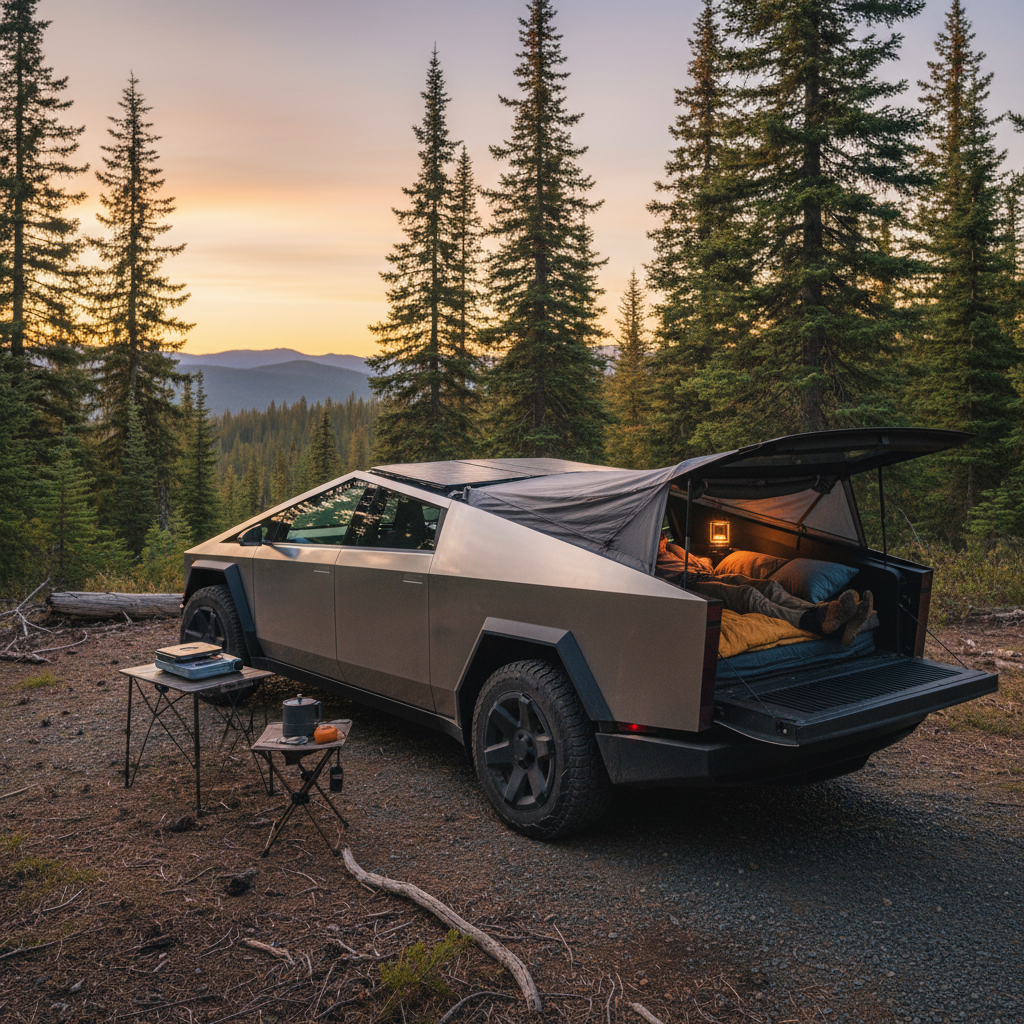
- Factory accessories, bed racks, camp kitchens, and now a dedicated iKamper tent, turn the R1T into a highly curated camping ecosystem rather than a blank canvas.
If you’re coming from a traditional pickup, the R1T feels more like a Swiss Army knife than a bare steel toolbox. Everything has a clever double use: the air suspension doubles as a self-leveling hitch helper, the built-in compressor inflates tires and paddleboards, and the gear tunnel doors make surprisingly good camp stools.
Interior, tech and comfort
Rivian’s cabin design remains one of the R1T’s standout virtues. It’s outdoorsy without being rustic, modern without feeling like you’re living inside a smartphone. Sustainable woods, vegan leather and a huge central touchscreen combine in a way that feels expensive but not fragile.
Living with the R1T from the driver’s seat
Where it nails the brief, and where it still annoys
Comfort & space
- Front seats: Supportive on long drives, with plenty of adjustment.
- Rear seats: Adult-friendly, but not as sprawling as a crew-cab F‑150.
- Ride height: Step-in height is friendly even for shorter drivers thanks to the air suspension’s lowest setting.
Infotainment & controls
- Gorgeous UI and snappy responses on the central screen.
- No physical climate or audio knobs, you live on the screen more than you might like.
- Over-the-air updates have steadily improved driver-assistance and route planning, but you’re still in Rivian’s ecosystem for almost everything.
Screen dependence is real
Noise isolation and overall refinement put the R1T closer to a German luxury SUV than a work-truck. There’s a sense that Rivian wanted you to be able to commute daily, haul kids, and then point the nose at a trailhead on Friday without needing two separate vehicles, and it largely succeeds.
Pricing, trims and key rivals
2025 Rivian R1T pricing snapshot (MSRP, US)
Exact pricing changes frequently, but this reflects typical 2025 window-sticker territory before incentives.
| Trim | Configuration highlight | Approx. starting MSRP* |
|---|---|---|
| Dual Standard | Dual Motor, Standard LFP pack | ≈ $71,700 |
| Dual Large | Dual Motor, Large pack | ≈ $78,700 |
| Dual Max | Dual Motor, Max pack | ≈ $85,700 |
| California Dune / Tri Max | Tri-Motor, Max pack, heavily optioned | ≈ $101,700+ |
| Quad Max (anticipated street pricing) | Quad-Motor, Max pack, performance focus | Well into six figures |
High, yes, but in line with similarly specced electric trucks.
It’s an expensive truck, but not an out-of-bounds one. A Ford F‑150 Lightning specced to match the R1T on equipment lands in similar money; a GMC Hummer EV regularly soars past it. Tesla’s Cybertruck undercuts the R1T in some trims, but lacks Rivian’s polished cabin and soft-road manners.
Ford F‑150 Lightning
- More traditional full-size footprint and bed.
- Better dealer availability but less distinctive cabin.
- Feels like a familiar truck that happens to be electric.
Tesla Cybertruck
- More range and efficiency in some configurations.
- Wild styling and polarizing ergonomics.
- Charging advantage on Tesla network, but rougher ride and interior.
Chevy Silverado EV / GMC Hummer EV
- Big, heavy and powerful, with impressive tow ratings.
- Interior quality varies, and prices climb quickly.
- Less cohesive adventure identity than the Rivian.
Where the R1T still wins
Ownership costs, reliability and daily living
Owning a 2025 Rivian R1T is not the same as owning a Camry with a bed. Energy costs are lower than a comparable gas truck, and there’s no oil to change, but tires, insurance and repairs live in luxury-vehicle territory. Early owners have reported more teething issues than with mainstream brands, everything from door seals to infotainment glitches, though Rivian’s mobile service tends to leave a good impression.
The running-cost reality
Where you save, and where you don’t
Costs that usually go down
- Fuel: Even with high electricity rates, most owners see hundreds of dollars in yearly savings versus a thirsty V8.
- Routine maintenance: No oil changes, fewer moving parts.
- Brakes: Strong regen means pads can last a very long time.
Costs that can go up
- Tires: Heavy EV + instant torque = faster tire wear, especially on 22-inch wheels.
- Insurance: High sticker prices and repair complexity can lift premiums.
- Repairs out of warranty: Still an unknown for many components; this is where buying used from a specialist like Recharged can de-risk things.
How Recharged helps used buyers
Day to day, the R1T is easy to live with if you have home charging. Plug it into a Level 2 overnight and you wake up to a “full tank” more days than not. If you rely heavily on public fast charging, you’ll want to map your routines around high-speed CCS or NACS stations and give yourself more buffer in winter.
Who should buy a 2025 Rivian R1T (and who should buy used)
Choosing your Rivian R1T path
Buy a new 2025 R1T if…
You want the latest Gen‑2 hardware: new motors, updated suspension and reworked battery packs.
You’re planning to keep the truck for a long time and value a full factory warranty.
You’re particular about spec, battery, wheels, color, interior, and don’t want to compromise.
You want the most up-to-date driver-assistance and infotainment features out of the box.
Shop used R1T (2022–2024, early 2025) if…
You like the R1T idea but want to let someone else take the steepest depreciation hit.
You’re flexible on color and options, but want proof the battery and high-voltage system are healthy.
You live near a Rivian service center or mobile-service hub and are comfortable with an upstart brand.
You buy through a specialist like Recharged that can provide diagnostics, financing, trade‑in support and nationwide delivery.
Leasing vs financing
2025 Rivian R1T FAQ
Frequently asked questions about the 2025 Rivian R1T
Final thoughts: Is the 2025 R1T still the benchmark?
The 2025 Rivian R1T isn’t perfect, it’s expensive, range shrinks dramatically with a big trailer in tow, and the all‑screen cockpit will never win over the analog faithful. But as an integrated idea of what an electric pickup can be, it remains the benchmark: a truck that can climb a fire road on Friday, glide silently through a Monday commute, and still feel special in your driveway on Wednesday.
If you’re shopping new, the 2025 updates make the R1T sharper, quicker and more efficient than ever. If you’re shopping used, the early trucks now represent compelling value, as long as you have clear visibility into battery health and service history. That’s where a platform like Recharged earns its keep, pairing transparent pricing and diagnostics with EV‑savvy guidance. For the right driver, the Rivian R1T isn’t just an electric truck; it’s the point where daily life and adventure finally overlap.