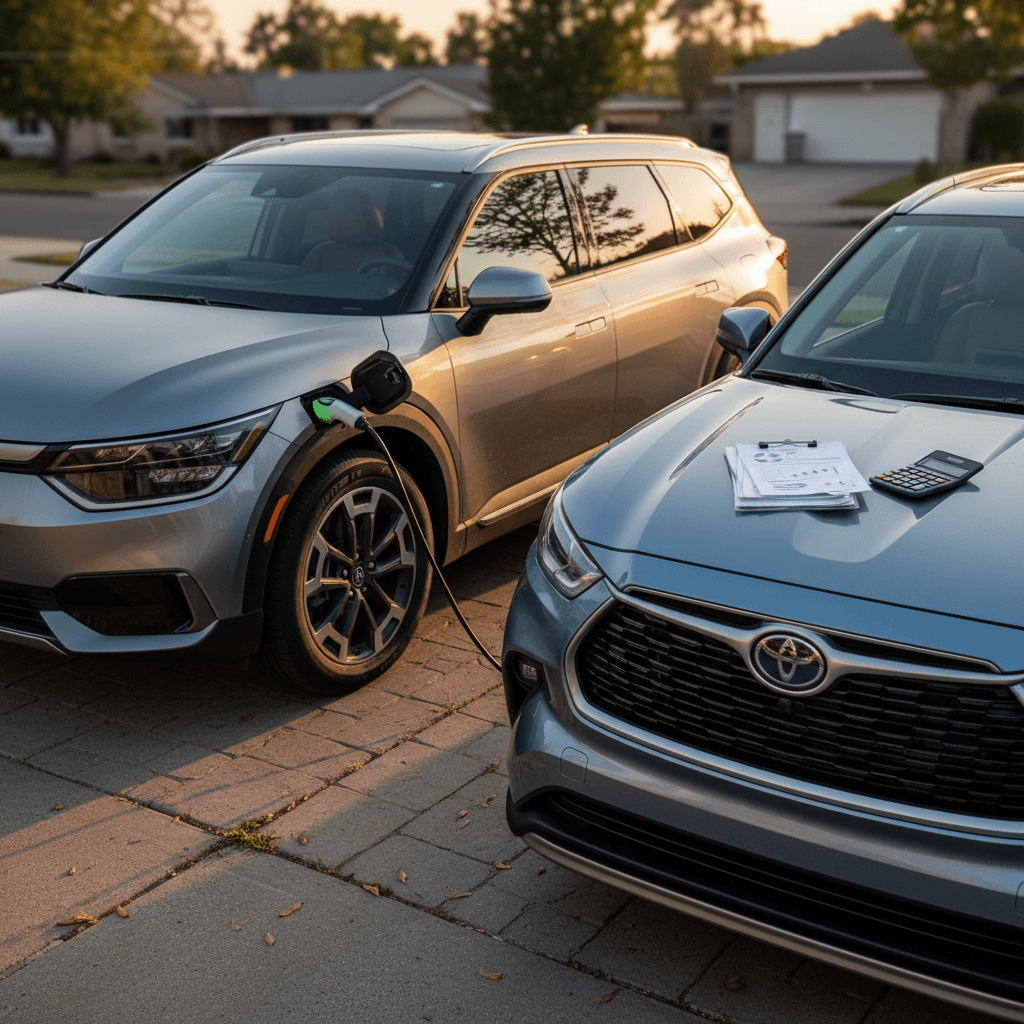
If you’re driving a Toyota Highlander and eyeing the Kia EV9, you’re probably wondering whether the jump to a three‑row electric SUV actually pays off. The headline question is simple, what are the real cost savings from switching from a Toyota Highlander to a Kia EV9?, but the answer depends on fuel, electricity rates, incentives, and how long you plan to keep the vehicle.
What this guide covers
Why compare a Toyota Highlander to a Kia EV9?
On paper, the Toyota Highlander and Kia EV9 might look like very different vehicles, one is a gasoline three‑row crossover, the other a fully electric SUV. But if you’re a family driver, they occupy the same role: comfortable, do‑everything family haulers with three rows, all‑weather capability, and long‑trip comfort. That makes them natural rivals when you’re deciding whether your next people‑mover should burn gasoline or electrons.
- Both offer three rows and family‑friendly interiors
- Both are available with all‑wheel drive
- Both can be road‑trip vehicles with 250+ miles of usable range
- Both appeal to buyers who keep cars 5–10 years and care about reliability and value
Think total cost, not just monthly payment
Upfront price: Highlander vs Kia EV9 and how to think about it
New‑car MSRPs move around, but the pattern is consistent: a new gas Highlander typically costs less up front than a new Kia EV9. A well‑equipped Highlander XLE or Limited often lands in the mid‑$40,000s to low‑$50,000s before fees, while a comparably equipped EV9 often sits in the mid‑$50,000s to low‑$60,000s. At first glance, the Highlander seems like the cheaper choice.
Typical new‑vehicle price ranges
- Toyota Highlander gas: often mid‑$40k to low‑$50k, depending on trim and options.
- Kia EV9: often mid‑$50k to low‑$60k for mainstream trims, higher for fully loaded versions.
Exact pricing depends on model year, local incentives, and dealer markups or discounts.
Why price is only half the story
When you compare a Highlander and an EV9 on price alone, the Highlander usually wins. But the EV9 pays you back over time via:
- Much lower fuel costs per mile
- Lower routine maintenance spending
- Potential federal and state EV incentives
- Less exposure to volatile gasoline prices
Don’t forget used pricing
Fuel vs. electricity: how much can you actually save?
Fuel is where switching from a Toyota Highlander to a Kia EV9 can save you serious money. To keep this practical, let’s use realistic but rounded U.S. averages and a common family‑driver pattern of 12,000 miles per year.
Sample annual fuel vs. electricity costs (12,000 miles/year)
Illustrative energy cost comparison: Highlander vs. EV9
These are example numbers using national‑style averages. Plug in your own mpg, gas price, and electric rate for a personalized view.
| Metric | Toyota Highlander (gas) | Kia EV9 (electric) |
|---|---|---|
| Energy efficiency | ~25 mpg combined | ~2.7 miles per kWh |
| Energy price assumption | $4.25 per gallon | $0.23 per kWh (home) |
| Annual miles driven | 12,000 miles | 12,000 miles |
| Annual energy used | 480 gallons | ~4,445 kWh |
| Annual energy cost | ≈ $2,040 | ≈ $610 |
| 5‑year energy cost | ≈ $10,200 | ≈ $3,050 |
All numbers are estimates; your actual costs will vary by region and driving style.
Run your own numbers in 5 minutes
Maintenance and repairs: where EV9 pulls ahead
Toyota has a well‑earned reputation for low maintenance costs, and the Highlander is one of the more reliable three‑row SUVs on the road. But even a reliable gas SUV has hundreds of moving parts that simply don’t exist in an EV. Over the long haul, that mechanical simplicity is where the Kia EV9 can quietly catch up on total cost of ownership.
Maintenance reality check: Highlander vs. EV9
What you’ll (mostly) stop paying for when you go electric
Toyota Highlander: Typical maintenance items
- Regular oil and filter changes
- Transmission fluid and service
- Engine air filters, spark plugs, belts
- Fuel system components and emissions equipment
- More frequent brake service in stop‑and‑go driving
Kia EV9: What goes away or slows down
- No oil changes or spark plugs
- No conventional transmission service
- Far less brake wear thanks to regenerative braking
- Fewer fluids overall (still coolant, brake fluid)
- Software updates can fix issues without parts
Long‑term maintenance savings
Insurance, registration and other ownership costs
Not every cost tips in the EV’s favor. When you move from a Highlander to an EV9, some line items might go up, especially in the early years, even as others drop.
- Insurance: New EVs can sometimes cost more to insure than mainstream gas SUVs because of higher repair costs and limited repair networks, though this varies heavily by ZIP code and driver profile.
- Registration and fees: Some states charge additional EV registration fees to replace lost gas‑tax revenue. Others offset that with incentives or discounted tolls and HOV access.
- Emissions and inspections: In some regions, EVs skip emissions testing, saving you modest annual hassle and fees.
Check local EV fees
Tax credits and incentives when switching to a Kia EV9
The Toyota Highlander, as a gasoline SUV, generally doesn’t qualify for federal EV tax credits. The Kia EV9 may qualify for federal, state, or local incentives depending on how it’s built, how you buy it, and when you take delivery. Incentive rules have changed frequently, so always confirm current eligibility before you sign anything.
Steps to understand your potential EV9 incentives
1. Confirm current federal rules
Visit the official federal EV incentive site or talk with your tax professional to see whether the Kia EV9 configuration you’re considering qualifies for a federal tax credit or point‑of‑sale rebate at the time you’re buying.
2. Check state and local programs
Some states, utilities, and local agencies offer rebates for EV purchases, EV leases, or home charger installation. These can range from a few hundred to several thousand dollars.
3. Understand lease vs. purchase differences
In certain rule sets, the tax benefit may be easier to realize through a lease because the credit can be captured by the leasing company and passed to you as lower payments.
4. Don’t double‑count incentives
Be careful not to subtract the same incentive twice in your mental math. If a dealer or marketplace already rolled it into your payment or price, you shouldn’t list it again as an extra discount.
Use incentives as a bonus, not the foundation
5‑year and 10‑year cost comparison: Highlander vs. EV9
Let’s bring the major cost buckets together, fuel/electricity, basic maintenance, and a rough nod to insurance and fees, to see how the Toyota Highlander and Kia EV9 can compare over the long run. These are illustrative examples, not precise forecasts, but they’re helpful for understanding the direction and scale of savings.
Example 5‑year and 10‑year ownership cost comparison
Assumes both vehicles are bought at similar equipment levels, driven 12,000 miles per year, and kept in good condition. Depreciation is highly variable, so this table focuses on operating costs you directly pay.
| Category | Toyota Highlander (5 yrs) | Kia EV9 (5 yrs) | Toyota Highlander (10 yrs) | Kia EV9 (10 yrs) |
|---|---|---|---|---|
| Energy (fuel/electricity) | ≈ $10,200 | ≈ $3,050 | ≈ $20,400 | ≈ $6,100 |
| Routine maintenance | ≈ $3,000–$4,000 | ≈ $1,500–$2,500 | ≈ $7,500–$9,000 | ≈ $3,000–$5,000 |
| Insurance & fees | Varies by driver/region | Varies by driver/region | Varies by driver/region | Varies by driver/region |
| Potential tax incentives | Not applicable | Could effectively reduce cost by several thousand in early years | Not applicable | No longer relevant for older vehicles |
All figures are rounded illustrations in 2020s‑style dollars and will vary in the real world.
Big picture on long‑term costs
Charging needs and home setup costs
To unlock the full savings from switching from a Highlander to an EV9, you’ll want a sensible charging plan. For most households with a driveway or garage, that means installing or using some form of Level 2 home charging, which lets you fully recharge overnight.

What it costs to charge an EV9 at home
A one‑time setup often unlocks years of lower fuel bills
Home charging hardware & installation
- Level 2 charger unit: Many models fall in the several‑hundred‑dollar range.
- Electrical work: Can range from simple (using an existing 240V outlet) to more involved panel upgrades.
- Permits: Some localities require an inspection or permit; costs vary.
Upfront installation can feel steep, but it’s often recouped through lower “fuel” costs within a few years.
Ongoing charging habits
- Overnight home charging: Typically cheapest and most convenient.
- Public DC fast charging: Great for road trips, but usually more expensive per kWh.
- Workplace or free charging: Some employers and shopping centers offer discounted or complimentary charging.
Be realistic about public fast charging
Resale value, battery health and buying used
One reason many families stick with a Highlander is its reputation for strong resale value. Early data suggest that mainstream EVs can depreciate more quickly than mainstream gas SUVs, especially in the first few years as technology evolves and incentives change. That can feel like a risk, but if you buy smart, it can turn into an opportunity.
If you’re buying new
- A new Highlander may hold its value more predictably than a new EV9.
- A new EV9 could see steeper early‑year depreciation, which matters if you trade frequently.
- If you plan to keep the vehicle 8–10+ years, early‑year depreciation matters less; operating costs matter more.
If you’re buying used
- You might buy a used EV9 that has already taken the biggest depreciation hit.
- Battery health becomes the key variable; a healthy pack can make a used EV9 a bargain.
- Platforms like Recharged provide a Recharged Score with verified battery diagnostics and fair pricing on used EV9s, helping you avoid expensive surprises.
Always get objective battery data on a used EV9
Who benefits most from switching from Highlander to EV9?
Ownership profiles: when an EV9 makes the most financial sense
High‑mileage suburban commuters
Drive 12,000–18,000 miles per year, mostly commuting and errands.
Have a garage or driveway where Level 2 charging is practical.
Plan to keep the next vehicle at least 5–8 years.
Want to tame unpredictable gasoline spending and lock in lower per‑mile energy costs.
Families who keep vehicles 8–12+ years
Traditionally keep Highlanders or similar SUVs for a decade or longer.
Care more about reliability and low running costs than the latest model every 3–4 years.
Comfortable with a modest learning curve around EV charging and trip planning.
Will benefit disproportionately from 10‑year fuel and maintenance savings.
Buyers considering late‑model used EVs
Open to buying a 2–4‑year‑old EV9 instead of a brand‑new Highlander.
Like the idea of letting someone else take the biggest depreciation hit.
Rely on trusted diagnostics, such as a Recharged Score report, to evaluate battery health.
Want a lower entry price plus EV‑level running costs.
Drivers with expensive local fuel and reasonable electricity
Live in areas with above‑average gasoline prices.
Have access to relatively affordable residential electricity or off‑peak rates.
Can do most of their charging at home, not on public DC fast chargers.
Stand to gain especially large fuel‑related savings by going electric.
How Recharged can help you run the numbers
Ready to find your next EV?
Browse VehiclesFrequently asked questions about Highlander vs. EV9 costs
Highlander to EV9 cost‑savings FAQ
Bottom line: is switching from a Highlander to an EV9 worth it?
For many American households, moving from a Toyota Highlander to a Kia EV9 means trading a lower upfront price for substantially lower operating costs and a different fueling experience. If you drive average‑to‑high annual miles, can install home charging, and plan to own the vehicle for at least five years, the EV9’s savings on fuel and maintenance can be large enough to justify, or even more than cover, its higher purchase price.
On the other hand, if you drive relatively few miles, can’t charge at home, or intend to keep your next vehicle only a couple of years, the Highlander’s lower purchase price and strong resale may still win on pure dollars and cents. The key is to run your numbers, not just national averages, and to compare realistic scenarios side by side.
If you’re leaning toward the EV side of the ledger, a well‑chosen used Kia EV9, especially one with a verified battery‑health report and transparent pricing, as you’ll find on Recharged, can deliver the best of both worlds: a modern three‑row EV at a sensible price, with day‑to‑day costs that undercut a gasoline Highlander for years to come.