If you own or are shopping for a 2025 Genesis GV60, you’ve probably heard rumblings about software updates, battery fixes, and even windshield trim that can try to make a break for freedom on the highway. This guide pulls together a clear, human-readable 2025 Genesis GV60 recalls list, explains what each campaign actually fixes, and shows you how to protect yourself as an owner or used‑EV shopper.
Quick takeaway
Overview: 2025 Genesis GV60 recalls so far
2025 Genesis GV60 recall snapshot
Genesis doesn’t always make it easy to understand which campaigns touch which model years. For the GV60, recall language often lumps 2023–2025 models together. That means even if a campaign was announced in 2023 or 2024, a 2025‑build GV60 can still be in the blast radius.
- Windshield and rear transverse trim that can loosen or detach at speed
- ICCU / 12‑volt issues that can cause a loss of motive power
- Instrument panel and center screens that may reboot or go dark while driving
- A mix of software and limited coverage campaigns that behave a lot like recalls, even if they’re labeled differently in dealer paperwork
Why the lists don’t always match
Recall 1: Windshield transverse trim that can detach
One of the most concrete safety recalls for the GV60 family is the windshield transverse trim issue. Hyundai Motor America filed paperwork covering 2023–2025 Genesis GV60 models where the upper windshield trim and related transverse pieces may not be attached firmly enough. At highway speeds, that strip can loosen, vibrate, and in the worst case separate from the car.
Windshield / rear trim recall at a glance
Details may be described differently depending on which notice or dealer system you’re looking at, but the core problem is consistent.
| Item | Details |
|---|---|
| Issue | Windshield or rear transverse trim may loosen or detach while driving |
| Model years | 2023–2025 Genesis GV60 (selected VIN range) |
| Risk | Detached trim can become road debris and increase the risk of a crash or injury |
| Fix | Dealer inspects trim attachment, replaces clips or trim pieces as needed |
| Owner cost | Free recall repair |
| Time in shop | Often under half a day if parts are on hand |
If you have a 2025 GV60 built in the recall production window, this inspection should already be documented on your service history.
Safety angle, not just cosmetics
Some 2025‑build GV60s also fall under a limited coverage campaign (often coded internally as L06G) that overlaps with this trim inspection and replacement work for vehicles built in a specific 2025 production window. On paper, that’s not an NHTSA safety recall, but in practical terms you still book a visit and get new parts if the inspection fails.
Recall 2: ICCU and 12‑volt issues that can cause power loss
If the GV60 has an Achilles’ heel, it’s the ICCU (Integrated Charging Control Unit) and its tangled relationship with the 12‑volt system. Across Hyundai, Kia, and Genesis E‑GMP EVs, there’s been a long‑running campaign around MOSFETs inside the ICCU that can overheat, degrade, and eventually stop adequately supporting the 12‑volt battery.
Earlier campaigns were published for 2022–2024 Hyundai/Kia EVs and 2023–2025 Genesis GV60, with updated recall numbers layering on top of one another as the fix matured. Even when you see model years "+ 2023–2024" in shorter summaries, the underlying technical bulletins and NHTSA documents frequently note that 2025 GV60 builds are included in the extended VIN range once production runs into 2024–2025.
- Warning messages about reduced power or a charging system fault
- The car refusing to ‘wake up’ after sitting for a short time
- A bricked 12‑volt battery just days or weeks after an earlier ICCU software update
- Loss of motive power if you keep driving through warnings instead of pulling over safely
What the ICCU actually does
ICCU / 12‑volt recall summary for GV60
Exact recall identifiers (like 24V868000 at NHTSA or Genesis campaign codes such as 021G and 025G) vary by document, but the themes are consistent.
| Item | Details |
|---|---|
| Issue | ICCU and associated components can overheat or fail, starving the 12‑volt system |
| Model years | 2022–2024 Hyundai/Kia E‑GMP EVs, plus 2023–2025 Genesis GV60 and siblings |
| Risk | Loss of motive power, no‑start conditions, dead 12‑volt battery |
| Fix | Software update to reduce stress on hardware; inspect and replace ICCU and related hardware where needed |
| Owner cost | Free recall / campaign repair |
| Owner time | Plan on leaving the car for at least half a day; hardware replacement can take longer |
If your 2025 GV60 hasn’t had this work completed, make it your first service priority.
Dead 12‑volt after ‘the fix’ isn’t always a new problem
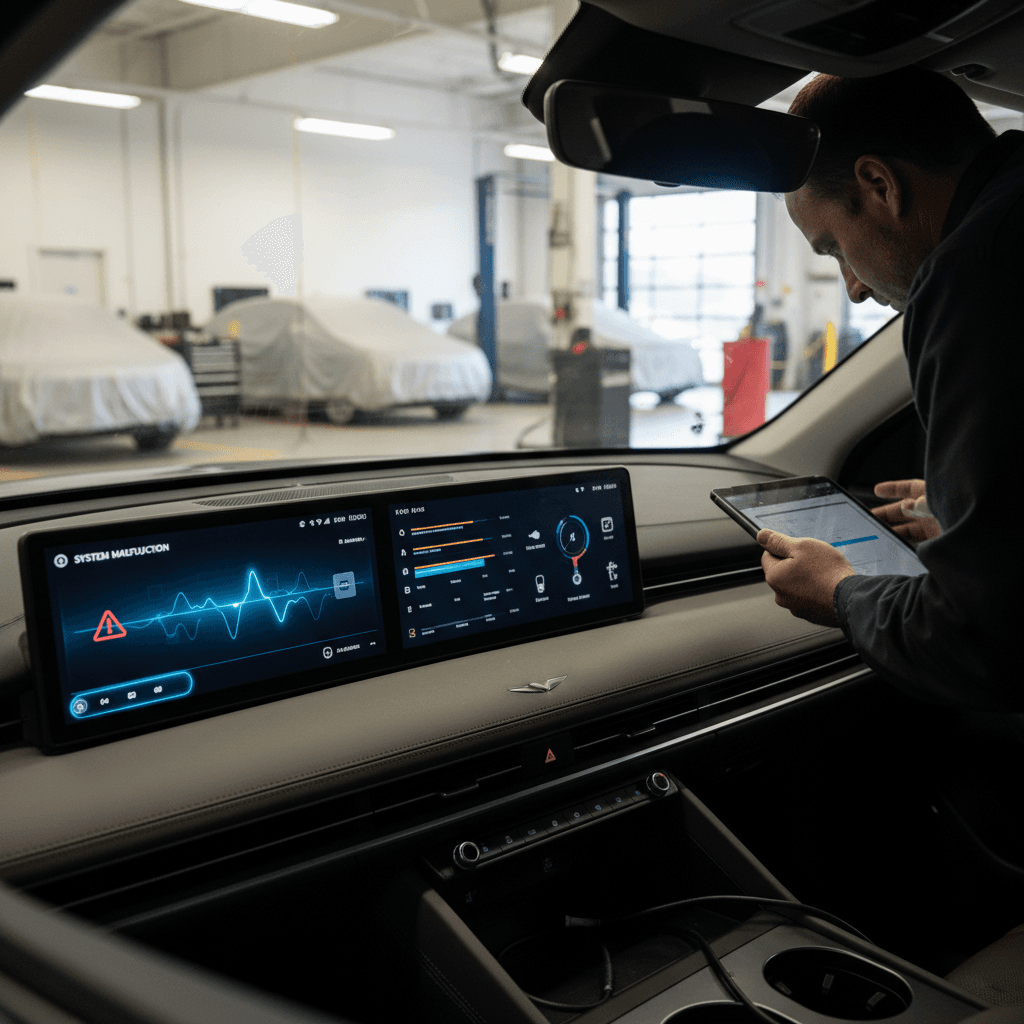
Recall 3: Instrument panel and center screens going dark
The most recent, headline‑grabbing action from Hyundai Motor Group covers roughly 83,000+ Genesis vehicles from the 2025 and 2026 model years. Official summaries talk about gauge clusters and infotainment displays that can reboot or go blank due to software bugs tied to high‑definition radio functions. Most of the public write‑ups focus on G80, GV70, GV80 and 2026 GV60, but the underlying theme is familiar to GV60 owners who’ve seen their screens flash or reset while driving.
For a 2025 GV60 specifically, your NHTSA VIN lookup may show no open screen‑related recalls yet, even though similar logic errors have already triggered earlier software campaigns on 2023–2024 GV60s. Genesis has shown a habit of rolling display and AVN fixes into over‑the‑air updates and dealer campaigns before a formal NHTSA action specifically names the GV60 for a newer model year.
- Instrument cluster briefly going black, then rebooting
- Center display freezing or losing CarPlay / Android Auto mid‑drive
- Warning lights flickering or failing to appear while the screen is out
- In rare cases, losing visibility into speed, gear selection, and key telltales while moving
What the recall is targeting
Genesis engineers traced many of the display failures to software logic errors that can crash or reboot the cluster and infotainment system. In some cases, the HD radio module appears to be the trigger; in others it’s broader AVN firmware instability.
What owners actually experience
From the driver’s seat, this all looks the same: sudden loss of your gauges, maps, or both. The car usually keeps driving, but you lose information you’re legally supposed to have, speed, warning lights, and in some cases even gear position feedback.
Simple mitigation until software is updated
Limited campaigns vs official NHTSA recalls
If you poke around Genesis paperwork for the 2025 GV60, you’ll see a soup of terms: safety recalls, service campaigns, limited coverage campaigns. To a lawyer, those are very different things. To you, they all mean the same Friday morning at the dealer waiting area.
How Genesis labels different kinds of fixes
The wording on your paperwork matters less than whether your specific VIN has had the work done.
Safety recalls
Filed with NHTSA, assigned a 24Vxxx or 25Vxxx number, and show up in federal databases. These are the serious issues where Genesis is legally required to notify owners.
Service campaigns
Manufacturer‑initiated fixes for known problems that don’t quite rise to formal recall status. Dealers are instructed to perform them when the car is in for service, even if you don’t complain.
Limited coverage campaigns
Targeted actions like L06G rear transverse trim for certain 2025 GV60 builds. Time‑limited and VIN‑specific, but from your perspective they behave just like a recall: inspection and repair at no cost.
Don’t get hung up on the label
How to check your 2025 GV60 for open recalls
Because the 2025 GV60 sits in overlapping recall windows, you can’t rely on model‑year lists alone. You need to look up your specific car. The process is simple, but there are a few ways to do it right, and a couple of shortcuts that can burn you.
Step‑by‑step recall check for a 2025 Genesis GV60
1. Grab the full 17‑digit VIN
You’ll find it on the driver’s side dashboard visible through the windshield, on the door jamb sticker, and on your registration or insurance card. For a used GV60 listing, insist on seeing the VIN before you make an offer.
2. Run it through the federal NHTSA lookup
Use the official NHTSA recall lookup site and enter the VIN. This catches all <strong>U.S. safety recalls</strong> that legally require notification. If something is open, it will show here even if a dealer hasn’t mentioned it yet.
3. Cross‑check with Genesis’s own recall page
Genesis maintains a parallel tool that can show <strong>manufacturer campaigns and limited coverage actions</strong> that don’t always appear immediately in NHTSA’s system. If there’s a trim, ICCU, or software campaign on your car, it should appear here.
4. Call or email a Genesis dealer’s service department
Ask them to pull your VIN and email you a <strong>full list of open campaigns and recalls</strong>. Save that email. It’s evidence if you later discover a campaign wasn’t performed before the car was sold to you.
5. Confirm completion dates in service records
On a used 2025 GV60, look for line items that reference recall or campaign codes and include <strong>dates and mileage</strong>. A missing completion entry for a known campaign is a red flag, even if someone verbally claims “it’s all up to date.”
How Recharged handles recall checks
Ready to find your next EV?
Browse VehiclesShopping a used 2025 GV60: what these recalls really mean
If you’re looking at a used 2025 Genesis GV60, this list can either scare you off or sharpen your negotiating instincts. A recall history doesn’t automatically make a car a bad bet. What matters is how the owner and dealer responded when Genesis raised its hand and admitted something needed fixing.
How recalls can work in your favor
- Known flaws get fixed. A car that’s had the ICCU, 12‑volt, and trim work completed may actually be a better bet than an early build that hasn’t seen the inside of a service bay.
- Paper trails tell stories. A thick stack of recall and campaign documentation suggests a diligent owner who responded to notices quickly.
- Negotiating leverage. If a dealer is sitting on an unsold 2025 GV60 with open campaigns, that’s a concrete reason to push on price or insist the work be done before delivery.
When recalls are a warning sign
- Open safety actions. Any GV60 with active safety recalls is a “no‑go” until they’re completed. Trim that can fly off and ICCU issues that can kill motive power are not theoretical problems.
- Repeat failures. If service records show multiple dead 12‑volt batteries or ICCU replacements, ask hard questions. Sometimes the fix is still catching up to reality.
- Dealer denial. If a seller dodges questions about recall paperwork or refuses to provide a fresh VIN printout, walk. There are other GV60s out there.
Because Recharged specializes in used EVs, including models like the GV60, we bake this into the buying experience. Every vehicle gets a Recharged Score battery health diagnostic, transparent pricing, and expert guidance on things like ICCU history, fast‑charging behavior, and how prior recalls have been handled. You’re not left squinting at cryptic service codes on your own.
Owner checklist: before and after recall work
Recalls are free, but they’re not frictionless. A little prep work can save you headaches, especially on a technology‑dense EV like the GV60.
GV60 owner checklist for recall visits
Confirm exactly which campaigns are being done
When you book the appointment, ask the service advisor to email you a list of <strong>campaign codes</strong> and a plain‑English summary of each one. Show up knowing what’s on the menu.
Ask about software versions and features
For display and AVN recalls, confirm which <strong>software version</strong> you’ll be on afterward and whether any features (like HD radio or specific apps) will behave differently.
Plan for a loaner or rideshare credit
ICCU‑related or trim repairs can take longer than a quick oil change equivalent. Ask in advance about loaner availability or alternative transport so you’re not stranded.
Do a thorough test drive afterward
After pickup, drive the GV60 on your normal routes. Pay attention to <strong>screen behavior, warning lights, charging performance, and any new noises</strong> from the front cowl or windshield area.
Keep digital and paper copies of everything
Scan or save all recall‑related invoices and work orders. These become part of the car’s story, and part of your leverage, if you ever sell or trade in. Recharged, for example, looks favorably on well‑documented recall histories when evaluating a trade‑in or consignment.
Don’t ignore warning lights after recall work
FAQ: 2025 Genesis GV60 recalls & reliability
Frequently asked questions about 2025 Genesis GV60 recalls
The 2025 Genesis GV60 is a deeply impressive EV built on a very modern architecture, and like a lot of first‑wave, high‑tech cars, it’s learning on the fly. Trim pieces, power electronics, and software sometimes need a second draft. If you keep up with recall work, insist on documentation, and use tools like the NHTSA lookup and Recharged’s battery‑health reporting, you can enjoy the GV60’s charm without inheriting someone else’s unfinished business.