If you’re shopping for the best used EV for road trips, you’re asking a more specific question than “Which EV has the biggest battery?” Long highway days expose every weakness in an electric car: real‑world range, charging curve, seat comfort, even how the car handles wind and rain. The good news is that several used EVs handle this better than many new ones, you just need to know what to look for.
Quick take
Why the “best used EV for road trips” is its own category
An EV can be a fantastic commuter and still be a frustrating road‑trip car. Around town you can live with slower charging and modest range because you’re mostly topping up at home. On the highway, you’re at the mercy of:
- Real‑world range at 70–75 mph, not the optimistic EPA number.
- Charging curve, how quickly the battery charges from 10–80%, not just peak kW.
- Charging network reliability along your route.
- Cabin comfort and noise over hours of driving.
- Cargo space for luggage, strollers, and camping gear.
EV road‑trip numbers that actually matter
What actually matters on an EV road trip
Five things to prioritize when you buy a used EV for road trips
Range is only one piece of the puzzle
Highway range, not brochure range
Fast & repeatable charging
Reliable network access
Seat comfort & noise
Cargo & passengers
Battery health & warranties
Think in legs, not total miles
Best used EVs for road trips: short list
Here are the standout used EVs that balance range, charging, comfort, and value for US road trips. We’ll get into why each one works, and what to watch for, below:
- Tesla Model 3 Long Range / Performance (2019+) – Best value long‑range sedan.
- Tesla Model Y Long Range (2020+) – Road‑trip‑friendly crossover with space.
- Hyundai Ioniq 5 (2022+) – 800‑volt fast‑charging champion.
- Kia EV6 (2022+) – Sportier twin to the Ioniq 5.
- Ford Mustang Mach‑E (2021+) – Comfortable, widely available used.
- Volkswagen ID.4 (2021+) – Relaxed cruiser; great if you don’t need speed.
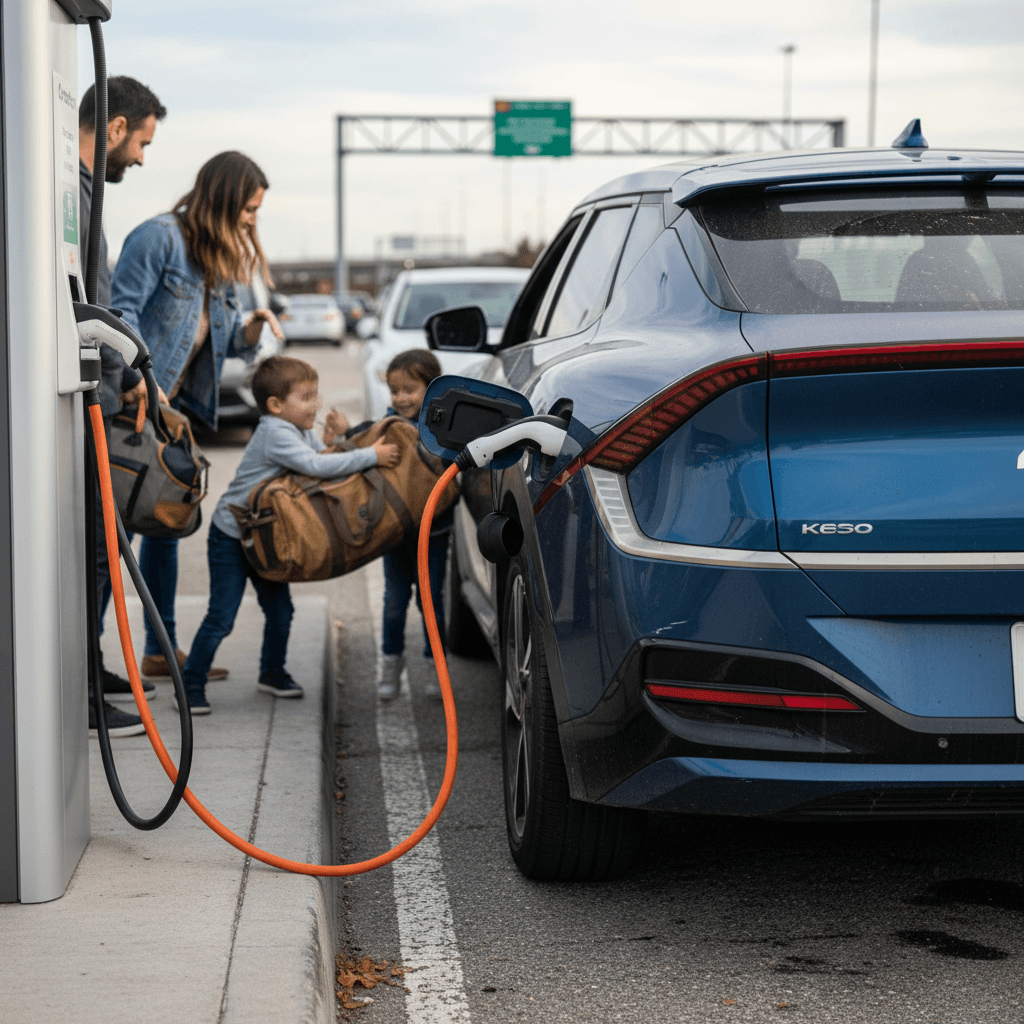
Tesla Model 3 & Model Y: Network advantage champions
Ask owners which is the best used EV for road trips and you’ll hear “Tesla” a lot, and that’s not accident or fanboyism. The combination of decent efficiency, long‑range trims, and the still‑excellent Supercharger network makes the Model 3 and Model Y extremely compelling used buys for highway driving.
Why Model 3 Long Range works so well
- Real‑world highway range: Many owners see roughly 250–300 miles at 70 mph in good weather with a healthy battery.
- Supercharger integration: Routing, stall availability, and preconditioning are baked into the navigation. You don’t juggle apps.
- Charging curve: Older Model 3s don’t hit the newest peak speeds, but they maintain respectable power through most of the 10–60% window.
- Used pricing: Depreciation plus periodic new‑car price cuts have pushed many 2019–2022 cars into reachable territory on the used market.
Why Model Y is a road‑trip sweet spot
- More space, similar range: The Long Range Y offers near‑Model‑3 efficiency with a hatchback and extra cargo height.
- Comfort: Higher seating position, more upright posture, and roomier rear seat make multi‑hour drives easier.
- All‑weather confidence: Many examples are AWD, and Tesla’s traction control in snow/rain is genuinely good.
- Charging access expanding: As other brands gain NACS access, Superchargers may be a bit busier, but Tesla owners will still have the smoothest integration for years.
Model 3/Y watch‑outs
Hyundai Ioniq 5 & Kia EV6: Fast‑charging road trip stars
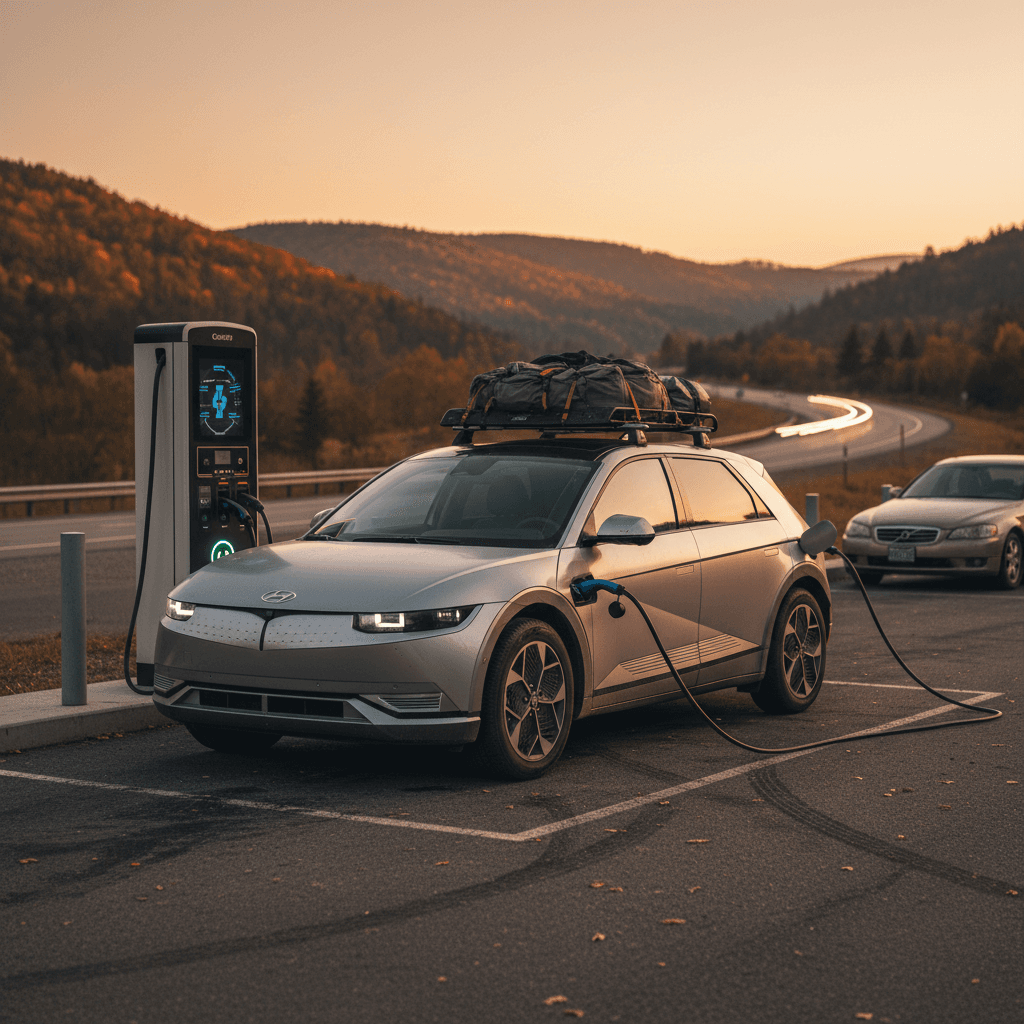
If you care more about minimizing charging time than squeezing every last mile out of a pack, the Hyundai Ioniq 5 and Kia EV6 deserve to be at the top of your used‑EV shopping list. Their 800‑volt electrical architecture lets them charge from roughly 10–80% in around 18–20 minutes on a strong DC fast charger, quicker than most Teslas and dramatically quicker than many first‑generation EV crossovers.
What makes Ioniq 5 & EV6 such good road‑trippers?
Same platform, slightly different flavor
Very fast charging
Solid practical range
Comfortable cabins
Family‑friendly packaging
Model‑year and trim tips for Ioniq 5 & EV6
Ford Mustang Mach‑E: Comfortable all‑rounder
The Ford Mustang Mach‑E isn’t the quickest charger in this group, but as a used road‑trip car it hits a pragmatic sweet spot: good range in its extended‑range trims, comfortable seats, a familiar Ford dealer network, and a driving experience that doesn’t feel like a sci‑fi experiment for EV‑shy passengers.
- Range: Extended‑range (ER) RWD trims are the best bet for long distances; AWD trims trade a bit of range for traction.
- Charging: Peak DC speeds lag behind Ioniq 5/EV6 and the very latest Teslas, but it’s still feasible to do 150–200 mile legs with 30–40 minute stops.
- Comfort: Softer suspension tuning than many EVs, reasonably quiet highway manners, and conventional controls help reduce fatigue.
- Used pricing: Plenty of supply on the used market, often at aggressive pricing versus similarly sized Teslas.
Mach‑E caveats
Volkswagen ID.4: Relaxed cruiser with space
The VW ID.4 is rarely anyone’s dream car, but that’s exactly why it works as a road‑trip tool. It’s comfortable, calm, and reasonably efficient at US highway speeds. If your style of road trip is more “set the cruise and talk to your passengers” than “blast across three states,” the ID.4 quietly does the job.
Strengths for road trips
- Comfortable ride: Softer tuning soaks up expansion joints and rough patches.
- Usable space: Plenty of rear legroom and cargo volume for a small family.
- Simple pace: Not especially quick, which can actually make long drives more relaxing.
Things to check used
- Software version: Later software updates significantly improved charging behavior and infotainment speed.
- Charging curve: ID.4 isn’t the fastest charger here; plan on slightly longer stops and shorter legs than in a Tesla or Ioniq 5.
- Dealer history: Because the platform was new, a clean service record matters more than on a mature model.
Battery health: The make‑or‑break used EV variable
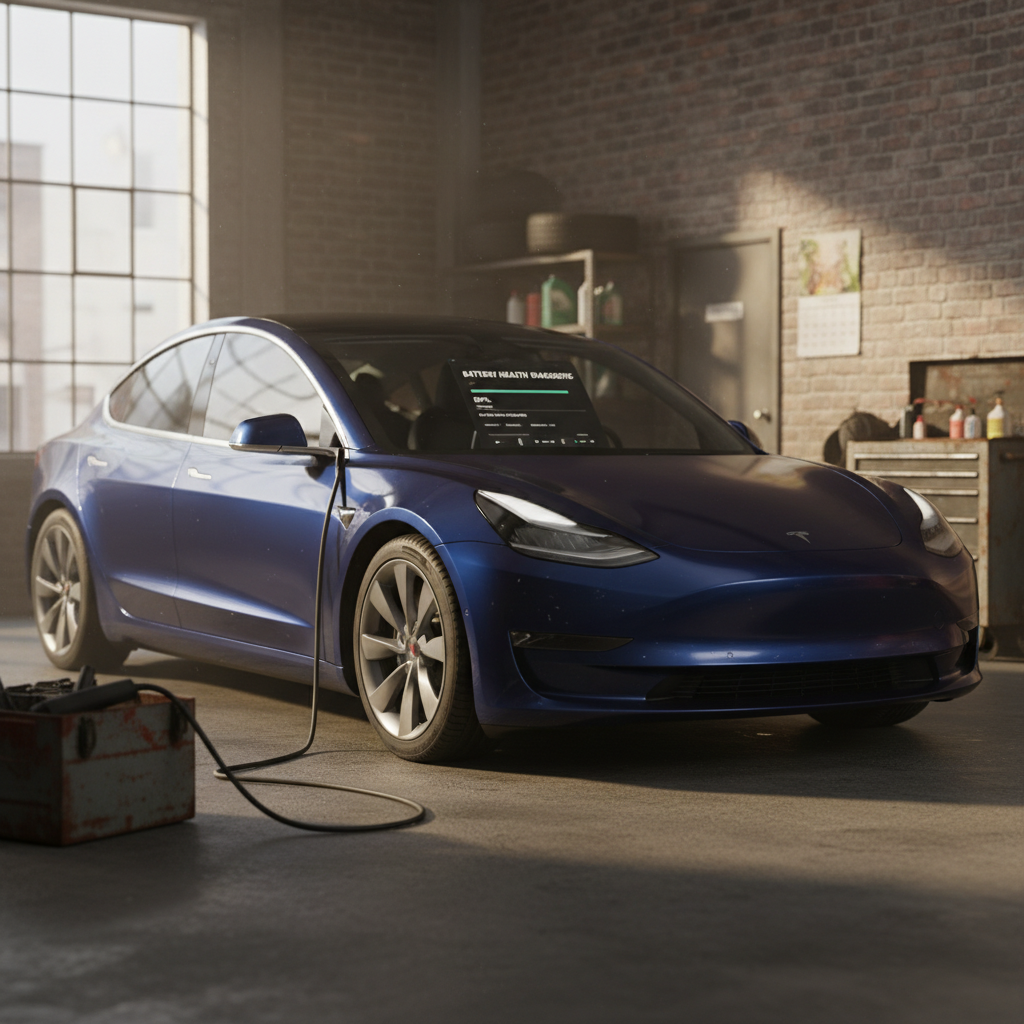
Two identical EVs on paper can behave very differently on a highway trip if one has a tired battery. A pack that’s lost 20–25% of its original capacity effectively shrinks your highway legs, forces more charging stops, and can make a 600‑mile day feel like a slog.
How to sanity‑check a used EV’s battery for road trips
Don’t just trust the dashboard guess‑o‑meter
Look at state of health (SOH) data
Compare to original specs
Check for warranty and fast‑charge history
Where Recharged fits in
How to choose the right used EV for your road trips
Used EV road‑trip checklist
1. Map your real road‑trip patterns
Before you fixate on specs, be honest about how you travel. Are your typical days 250 miles, or do you sometimes hammer out 600+ miles in one shot? Do you mostly drive in the West with long gaps between towns, or in the denser Northeast?
2. Set a minimum acceptable highway range
For most people, a used EV that can do <strong>at least ~220–240 miles at 70 mph</strong> in good weather with a healthy pack is plenty. If you insist on fewer stops or drive in sparse‑charger regions, aim higher.
3. Decide how much you care about charging speed
If you’re impatient or traveling with kids, prioritize cars like the Ioniq 5/EV6 that can recharge very quickly. If you don’t mind 30–40 minute breaks, a wider range of used EVs opens up.
4. Test seats, noise, and ergonomics
Do a long test drive that mimics a real leg of your trip. Check if the seats bother your back, how loud the cabin is at 75 mph, and whether climate controls are easy for your co‑driver to use.
5. Check battery health and warranty window
Ask for data on remaining capacity and any battery or high‑voltage repairs. Prefer cars still inside their <strong>original 8‑year/100k‑mile (or similar) battery warranty</strong> if you’ll be piling on miles.
6. Plan around the networks you’ll actually use
Look at your most common corridors (for example, Richmond to Florida beaches or Denver to Moab). Check coverage for Tesla Supercharger, Electrify America, EVgo, and regional networks. Certain models have clear advantages in specific regions.
Planning charging stops like a pro
Even the best used EV for road trips will feel painful if you wing it. Fortunately, modern route‑planning tools make long EV drives surprisingly straightforward once you understand a few principles.
Popular tools for planning EV road trips
Use more than one app the first few times you plan a new route, then settle on the combo that matches your preferences.
| Tool | Best for | Works with | Notes |
|---|---|---|---|
| Built‑in navigation | Simple, automatic planning | Specific vehicle only | Teslas and some newer EVs can route via chargers and precondition the battery. |
| A Better Routeplanner (ABRP) | Nerd‑level optimization | Most EVs | Lets you model degradation, weather, and driving style for more accurate plans. |
| PlugShare | Checking station reliability | Any EV | Crowdsourced reviews/photos; great for avoiding sketchy sites on family trips. |
| Charge‑network apps | Pricing & availability | Specific networks | Electrify America, EVgo, and others show stall status and prices in real time. |
Many of these tools can be used together: for example, plan in A Better Routeplanner, then sanity‑check charger reviews in PlugShare.
A realistic road‑trip rhythm
FAQ: Used EVs for road trips
Frequently asked questions about used EVs and road trips
Bottom line: Pick the EV that matches your road‑trip style
The best used EV for road trips isn’t just the one with the biggest battery, it’s the one whose strengths line up with how you actually travel. For many drivers, that means a long‑range Tesla 3 or Y for the simplicity of Superchargers and baked‑in trip planning. For others, it’s the ultra‑fast‑charging Hyundai Ioniq 5 or Kia EV6, a comfortable Ford Mustang Mach‑E, or a laid‑back Volkswagen ID.4.
Whatever you choose, don’t skip the fundamentals: confirm real battery health, think about where you’ll charge, and test whether the car is comfortable for the people who’ll spend hours in it. If you’d rather not decode all of that on your own, browsing used EVs on Recharged gives you transparent battery diagnostics, expert EV‑specialist support, and a smooth, fully‑digital buying experience, so the hardest part of your next road trip is deciding where to stop for dinner, not where you’ll plug in.