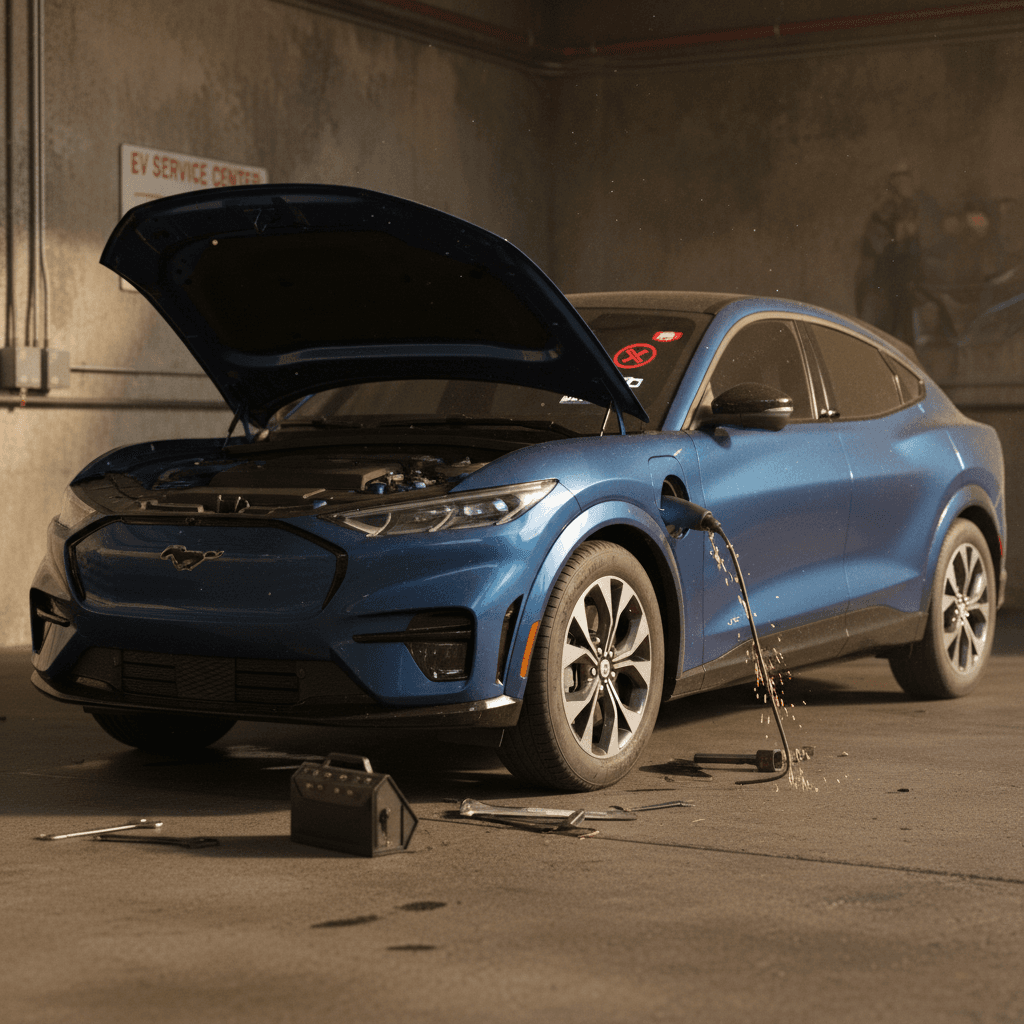
The 2025 Ford Mustang Mach‑E lives at the intersection of promise and paranoia. On paper you get sharp styling, big‑screen theatrics, and real EV performance. Online, you get horror stories about door latches that won’t open, battery contactors that tap out, and software updates that seem to make things worse before they get better. If you’re trying to understand **2025 Ford Mustang Mach‑E problems and fixes**, this guide walks you through what’s real, what’s rare, and what a smart owner, or used‑EV shopper, can do about it.
Model years vs. calendar years
Overview: How Worried Should You Be About 2025 Mach‑E Problems?
2025 Mustang Mach‑E Problem Snapshot
If you zoom out, the 2025 Mustang Mach‑E isn’t a disaster, but it is a complicated first‑generation EV riding on a steep learning curve. Most of the headline problems fall into four buckets: door latches and 12‑volt power, high‑voltage battery contactor and HVBJB durability, software and OTA glitches, and brake/roll‑away or driver‑assist behavior. The good news: almost all of the serious issues are addressed by recalls or technical service bulletins (TSBs). The bad news: you have to verify that your specific car is actually fixed.
Start every diagnosis with a VIN check
All Known 2025 Mustang Mach‑E Recalls at a Glance
Major 2025 Model Year Mustang Mach‑E Recalls (Abridged)
This table focuses on recalls that explicitly list 2025 Mustang Mach‑E or practically affect 2025‑spec hardware/software.
| Issue | Campaign scope (model years) | Typical symptoms | Risk level | Owner fix path |
|---|---|---|---|---|
| Door latch / 12‑volt drain | 2021–2025 Mach‑E | Doors stuck closed or open after 12‑V failure; door buttons unresponsive | High (entrapment / egress issue) | Software and possibly hardware updates at a Ford dealer |
| High‑voltage battery contactor / HVBJB | 2021–2025, especially extended‑range & GT | “Stop Safely Now”, sudden loss of power, won’t restart after DC fast‑charging or heavy acceleration | High (loss of propulsion) | Recall to replace HVBJB and update powertrain software |
| Roll‑away risk / park system | 2024–2026 Mach‑E | Vehicle can roll after being shifted to Park under certain conditions | High (crash risk) | Dealer‑installed software and/or hardware update |
| OTA / driver‑assist malfunction | Primarily earlier years but software shared | Warning lights, disabled ABS/ESC after update, BlueCruise glitches | Medium–High | Dealer reflash or forced OTA rollback/redo |
| Rear‑view camera software | Earlier Mach‑E years; software base may carry forward | Backup camera freezes or doesn’t display | Medium (visibility in reverse) | OTA update or dealer software flash |
Always confirm active recalls for your individual vehicle using its VIN, campaign coverage can be production‑date specific.
Recall names change, problems don’t
Door Latch & 12‑Volt Battery Problem: When the Doors Won’t Open, or Won’t Stay Shut
One of the most unsettling Mustang Mach‑E problems is the electronic door latch system. The Mach‑E uses electronic buttons and pull tabs instead of purely mechanical handles. When the 12‑volt battery voltage drops too low or the software controlling the latches misbehaves, you can end up with doors that won’t open from the outside, won’t open from the inside, or occasionally won’t stay latched as expected.
- Applies to: 2021–2025 Mustang Mach‑E (2025s are part of a broad campaign, not an isolated case).
- Typical symptoms: car unlocks but door buttons do nothing, doors stuck closed after the car sits, or warnings about door latches and 12‑V system.
- Underlying issue: the control logic for the electronic latches can get confused when the low‑voltage battery sags or when certain modules crash. In some cases, a drained 12‑V leaves you with no power to actuate the latch at all.
Why this is a safety recall, not a “nuisance”
How to spot it early
You’ll usually get some warning before your Mach‑E turns into a locked glass terrarium. Slow or inconsistent responses from the door buttons, “accessory not available” messages, or FordPass alerts about low 12‑volt battery health are all yellow flags. If you open the car with the key fob and nothing inside wakes up, no screens, no chimes, that’s a sign the 12‑V is already too low to run the latches reliably.
Door latch & 12‑V fixes
Practical fixes for Mach‑E door latch & 12‑V issues
1. Check for active recalls first
Use your VIN on Ford’s recall site. If there’s an open campaign touching the door latches, 12‑V system, or body control module, schedule that before paying for diagnosis.
2. Test the 12‑volt battery
Even on a 2025, the 12‑V battery can be weak, especially if the car sits. A dealer or independent shop can load‑test it. Replacing a tired 12‑V battery is usually cheap insurance.
3. Install the latest software
Make sure OTA updates are enabled and that your Mach‑E has completed recent campaigns. A dealer can check module versions and manually reflash if OTA is stuck.
4. Learn the emergency mechanical release
Ford hides mechanical releases for the front doors inside the cabin. Know where they are and how to use them, especially if you routinely carry rear passengers who can’t operate the front tabs.
5. Log intermittent issues
If the doors misbehave only sometimes, document dates, temperatures, and status messages with photos. This paper trail matters if you need goodwill repairs after warranty.
High‑Voltage Battery Contactor & HVBJB Issues
Deep in the Mach‑E’s high‑voltage system sits the High Voltage Battery Junction Box (HVBJB) and its contactors, essentially the heavy‑duty switches that connect or disconnect the main traction battery. Early Mach‑Es suffered overheating and failure in this assembly, especially after repeated DC fast‑charging and hard acceleration. Ford has iterated the hardware and issued multiple recalls, but even 2025 owners still report occasional HVBJB‑related failures.
What “Stop Safely Now” usually means
- Applies to: Primarily 2021–2022, but recall campaigns and hardware updates extend coverage through some 2025 builds, especially extended‑range and GT trims.
- Symptoms: abrupt loss of propulsion, car coasts to the shoulder, may or may not restart after a key cycle; sometimes triggered by a DC fast‑charge followed by highway driving.
- Root cause: overheating or premature wear in the HVBJB and contactors, plus earlier software that didn’t manage heat as conservatively as later calibrations.
HVBJB fixes and owner strategy
What to do if you suspect an HVBJB issue
1. Don’t keep driving through warnings
If you see repeated high‑voltage system warnings or “Stop Safely Now” messages, treat them as serious. Pull over safely and call roadside assistance rather than forcing the car to limp home.
2. Confirm recall and TSB status
Ask a Ford service advisor to pull your VIN’s recall and TSB history, specifically for HVBJB or high‑voltage battery contactor campaigns. Ensure both the hardware replacement and the latest software update have been completed.
3. Expect a hardware swap, not just software
The more robust fix is a new HVBJB with redesigned contact surfaces, plus updated control software. If a dealer only performs a software patch on a 2025 that still has older junction‑box hardware, push for clarification.
4. Watch DC fast‑charging behavior
Frequent high‑power DC fast‑charging isn’t ideal for any EV. On the Mach‑E, if you notice power loss shortly after fast‑charging sessions, mention that pattern to your service advisor, it’s a clue pointing at the HVBJB.
5. For used buyers: demand documentation
If you’re considering a used 2025 Mach‑E, ask for service records that confirm HVBJB recall completion. A professional battery health report like the Recharged Score can also flag abnormal behavior early.
Software, OTA Updates, and Infotainment Glitches
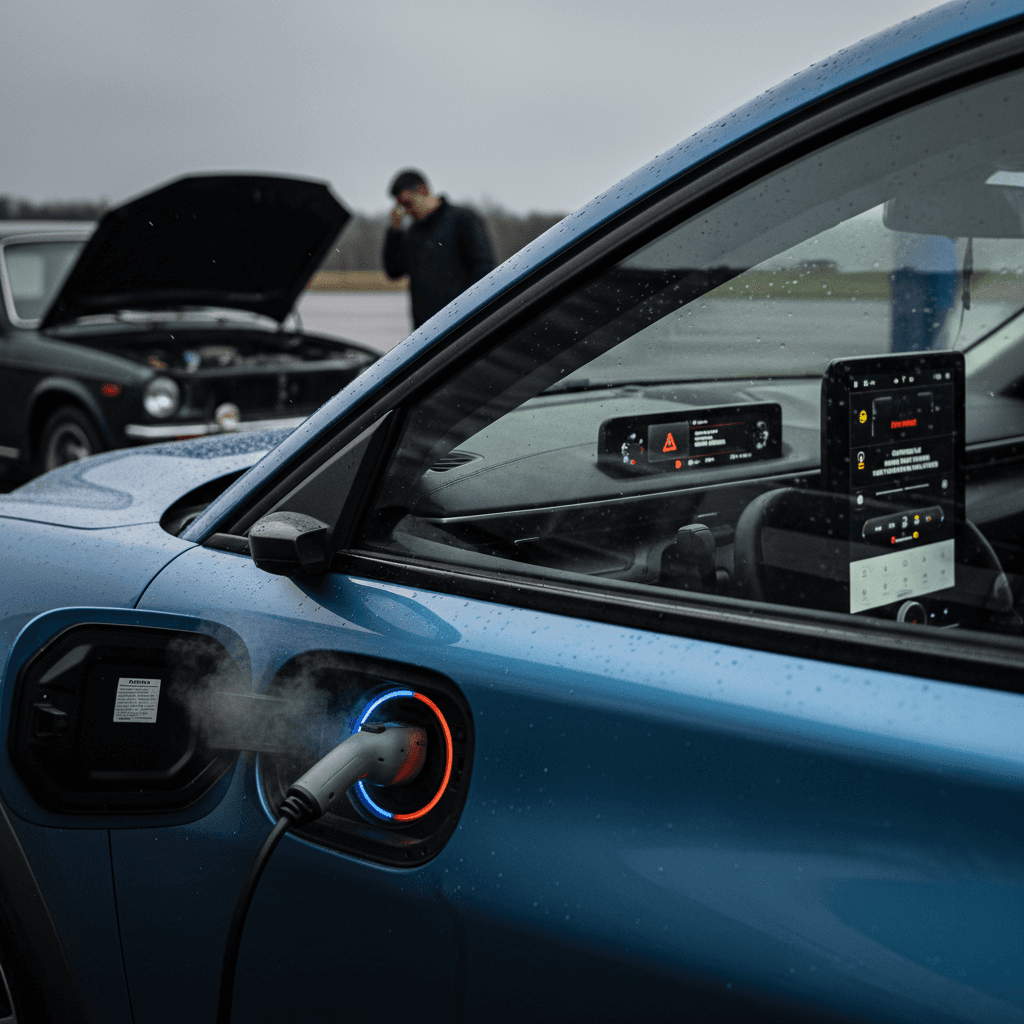
If the Mach‑E has a personality quirk, it lives in the software. Owners across early years and into 2025 report infotainment freezes, sluggish or stuck over‑the‑air (OTA) updates, and occasional drive‑mode or one‑pedal‑driving resets after an update. Most of this is nuisance‑level stuff, but some glitches have temporarily disabled critical systems like ABS or stability control, triggering recalls.
- Screen freezes at startup, CarPlay fails to load, or the entire SYNC 4A system reboots mid‑drive.
- OTA updates download but never complete; the car repeatedly says “update available” and then rolls back.
- Driver‑assist settings (like BlueCruise or lane centering) mysteriously toggle off or behave differently after a big software push.
The three‑finger salute
Best practices for keeping Mach‑E software sane
Keeping 2025 Mach‑E software stable
1. Enable automatic updates, but read the notes
Turn on auto‑updates so your 2025 Mach‑E gets security and bug fixes, but read the release notes in the FordPass app before accepting major revisions.
2. Give the car time and power
OTA installs are sensitive to 12‑V battery state and connectivity. Park where the Mach‑E has a strong cellular or Wi‑Fi connection and enough high‑voltage charge; avoid short, frequent key cycles during an in‑progress update.
3. Document module versions
Before and after big updates, snap photos of your Software Update and About screens. If an update corrupts a module, those screenshots help the dealer identify what changed.
4. Don’t ignore persistent faults
If ABS, ESC, or airbag lights come on right after an update and stay on, book service. Ford has already had to patch OTA‑induced faults on earlier Mach‑Es; 2025 is not immune to regressions.
5. For chronic issues, ask for a hard reflash
If your car lives in update limbo, ask the dealer to connect Ford’s FDRS tool and force a full module update rather than waiting for another OTA attempt.
Braking, Roll‑Away Risk, and Driver-Assist Concerns
The Mach‑E’s driver‑assist suite, BlueCruise, adaptive cruise, lane centering, can make highway driving eerily calm. But when these systems misbehave, or when the electronic park system doesn’t do its one job, things get serious quickly. Recent recalls have targeted a **roll‑away risk** where certain vehicles, including 2024–2026 Mustang Mach‑E, can move after drivers think they’ve put the car in Park.
- Early driver‑assist crashes highlight that hands‑free systems still require active supervision; the Mach‑E is no exception.
- Software glitches have, in isolated incidents, disabled ABS, ESC, and traction control until a fix was applied.
- The roll‑away campaigns address rare situations where the car can lose the correct park state, especially on grades or after certain control‑module faults.
Treat driver‑assist as a helper, not a chauffeur
What owners should do
- Check for any outstanding brake, stability control, or roll‑away recalls and schedule them immediately.
- Always engage the parking brake when you park on an incline, yes, even in an EV with an electronic shifter.
- If your Mach‑E rolls even slightly after you select Park, or the dash shows a mismatch between the shifter position and gear, don’t ignore it. That’s a warranty conversation.
- After any major OTA update, test brake feel and driver‑assist behavior in a safe, empty parking lot before you trust it at highway speeds.
Everyday Owner Complaints: Ride, Range, and Charging Behavior
Not every 2025 Mustang Mach‑E complaint is a federal case. A lot of what you’ll see in owner forums sits in the gray area between “quirk” and “defect.” These show up too consistently not to mention:
Common but non‑catastrophic 2025 Mach‑E complaints
Annoying? Yes. Deal‑breaking? Usually not.
Aggressive efficiency guardrails
Ford’s energy management is conservative. In cold weather, owners report significant temporary range loss and slower DC fast‑charging speeds than the badge suggests.
Firm, sometimes choppy ride
Depending on wheel size, the Mach‑E can feel busier over broken pavement than rival crossovers. Test drive on your real roads, not just the dealer’s smooth loop.
Picky public‑charging behavior
Some owners report failed charge sessions or handshake issues at non‑Ford DC fast‑chargers. Often this is network‑side, but the Mach‑E’s software doesn’t always fail gracefully.
The upside to the downside
How to Diagnose and Fix 2025 Mach‑E Problems
With the 2025 Mustang Mach‑E, the line between “glitch,” “wear item,” and “warranty recall” is thin. The smartest thing you can do is approach issues methodically so you don’t pay for problems Ford is already on the hook to fix.
Step 1: Separate high‑voltage from low‑voltage problems
Many scary warning messages, random shutdowns, stuck doors, failure to start, are really 12‑volt battery or software issues, not main battery failures. Have a shop that understands EVs test both the 12‑V and the high‑voltage pack. A full health report will show if the big battery is happy and point blame elsewhere if it is.
Step 2: Let recalls and TSBs do their job
Once you know which recalls apply, insist on getting them done before any out‑of‑pocket troubleshooting. For something like HVBJB or door‑latch behavior, the official repair sequence matters: software first, then hardware, then verification.
Owner playbook: Fixing 2025 Mach‑E issues without losing your mind
Keep a running log
Note date, mileage, weather, what you were doing, and any warning lights whenever something weird happens. Photos of the instrument cluster are gold.
Use FordPass strategically
FordPass holds service history, recalls, and update status. Screenshots from the app help you prove patterns if a dealer brushes off intermittent issues.
Find an EV‑literate dealer
Not all Ford dealerships are created equal. Look for one that sells and services a lot of Mach‑Es and F‑150 Lightnings; they’re more likely to have techs who live in FDRS all day.
Escalate politely, early
If your service advisor says “could not duplicate” but the car is clearly misbehaving, ask to ride along with a technician or open a case with Ford corporate while you’re still under warranty.
For used buyers, demand data
A true battery health and fault‑history report (like the Recharged Score that comes with every Recharged vehicle) can reveal whether a car is a quiet commuter or a problem child in disguise.
Buying a Used 2025 Mustang Mach‑E: What to Check
Shopping used is where the 2025 Mach‑E gets genuinely interesting. Thanks to heavy early depreciation, you can get a lot of EV for the money, if you avoid the landmines. Think of it as casting for a long‑term house guest: you don’t just look at the outfit; you look at the references.
Four critical checks for a used 2025 Mach‑E
If the seller can’t answer these, walk away.
1. Full recall & TSB completion
Ask for a printout of completed recalls and TSBs. HVBJB, door‑latch, and roll‑away campaigns should all show as completed. If the seller looks surprised by those terms, that’s your first data point.
2. Independent battery health report
The main pack is the most expensive component. A report that measures usable capacity, fast‑charge behavior, and cell balance, like the Recharged Score, tells you whether the car has been abused or pampered.
3. Real‑world software behavior
On the test drive, power the car down and up a few times. Watch for frozen screens, delayed wake‑up, or repeated error messages. Ask when the last OTA or dealer software update was performed.
4. Price vs. risk calculus
Because Mach‑Es depreciate heavily, a well‑documented 2025 with fresh recalls and clean battery data can be a bargain. A sketchy one at a too‑good price is just someone else’s headache with your name on it.
Where Recharged fits in
FAQ: 2025 Ford Mustang Mach‑E Problems and Fixes
Frequently Asked Questions
Bottom Line: Is the 2025 Mach‑E a Bad Bet?
The 2025 Ford Mustang Mach‑E is not the quiet, drama‑free Corolla of EVs, and it doesn’t pretend to be. It’s a stylish, early‑generation electric crossover built by a company still climbing the software‑defined‑vehicle learning curve. That means real problems: door latches tied to a finicky 12‑V system, a high‑voltage junction box that needed mid‑life surgery, software that occasionally steps on the wrong rake.
But it also means you can drive something genuinely interesting, with serious performance and a usable fast‑charging footprint, at used‑car prices that would have been unthinkable a few years ago. If you make peace with its appetite for software updates, insist on proof of completed recalls, and get objective battery health data before you sign, a 2025 Mach‑E can be a smart, even shrewd, choice.
Whether you hunt one down yourself or let Recharged do the weeding for you, the formula is the same: verify, don’t assume. In a world of increasingly complex EVs, the owners who sleep best at night aren’t the ones with the “perfect” cars, they’re the ones who know exactly what they’re driving.