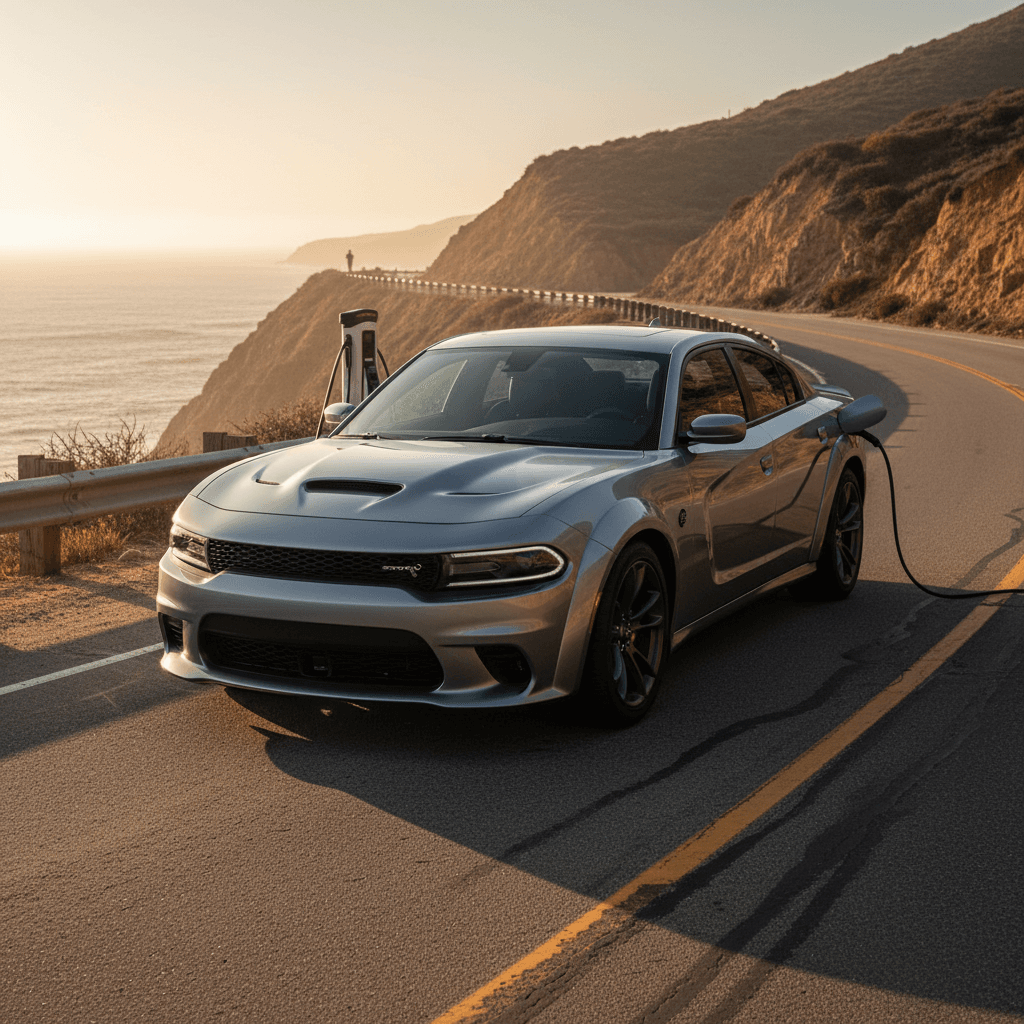
The 2025 Dodge Charger Daytona is the first all-electric version of Dodge’s big muscle car, and its specs are as wild as the styling. If you’re trying to make sense of 2025 Dodge Charger Daytona specs, horsepower, torque, battery size, range, charging speed, weight, and dimensions, this guide pulls everything into one place and explains what it actually means for your daily drive.
Two flavors of electric muscle
2025 Dodge Charger Daytona specs at a glance
Key 2025 Charger Daytona numbers
Quick orientation
Powertrains, horsepower and torque
Under the skin, every 2025 Dodge Charger Daytona uses Stellantis’s STLA Large EV platform with a dual‑motor all‑wheel‑drive setup, one electric drive module at each axle. Both motors are rated at roughly 335 hp and 300 lb‑ft each, but the way Dodge tunes and boosts them separates R/T from Scat Pack.
2025 Charger Daytona powertrain specs
Key horsepower and torque figures for R/T and Scat Pack trims.
| Spec | R/T | Scat Pack |
|---|---|---|
| Drivetrain | Dual‑motor AWD | Dual‑motor AWD |
| Peak horsepower | 456 hp | 630 hp (590–630 hp depending on tune) |
| Peak torque | 404 lb‑ft | 627 lb‑ft |
| Power Shot boost | 15‑second overboost via steering‑wheel button | 15‑second overboost via steering‑wheel button |
| Transmission | Single‑speed direct drive | Single‑speed direct drive |
| Top speed | 137 mph | 134 mph |
| 0–60 mph (approx.) | 4.7–4.9 seconds | 3.2–3.4 seconds |
Outputs shown are for 2025 models without optional Direct Connection over‑the‑air power upgrades.
About the Banshee that never was
On the road, the R/T’s 456 hp already feels like more than enough for public streets. The big story is how quickly the instantaneous 404 lb‑ft of torque moves nearly three tons of car; launches are authoritative, even if you never touch Power Shot. The Scat Pack turns things up to absurd: its 630 hp and 627 lb‑ft give you “old Hellcat, new electrons” vibes, complete with a synthesized exhaust note meant to keep traditional muscle‑car fans from mourning the missing V8.
Battery pack, range and efficiency
Every 2025 Charger Daytona uses a large 100.5‑kWh battery pack (about 93.9 kWh usable) running on 400‑volt architecture. That’s on the big side even for a full‑size EV, which helps range but also explains the car’s hefty curb weight.
Battery and range specs
Battery capacity and approximate EPA range estimates for 2025 Charger Daytona trims.
| Spec | R/T | Scat Pack |
|---|---|---|
| Battery capacity (gross) | 100.5 kWh | 100.5 kWh |
| Battery capacity (usable) | ~93.9 kWh | ~93.9 kWh |
| Estimated range | ~308–317 miles | ~216–260 miles |
| MPGe city / hwy / comb. | 104 / 91 / 98 (est.) | 82 / 73 / 78 (est.) |
Official EPA figures may vary slightly by wheel/tire and options, but these are the headline numbers Dodge and independent tests are pointing to.
Why the ranges differ so much
In practical terms, you can think of the R/T as a ~300‑mile car in mixed driving if you’re reasonably gentle, and the Scat Pack as more of a ~220–250‑mile car if you actually use the performance you’re paying for. Cold weather, big wheels, or constant high‑speed runs will chip away at those figures, just as they do in any EV.
Charging speed: home and DC fast charging
Level 2 home and public AC charging
The Charger Daytona carries an onboard charger rated around 11 kW. On a typical 240‑volt Level 2 setup at home or work, that means:
- About 5.5–7 hours from roughly 10% to 80% charge
- Roughly 30–35 miles of range per charging hour on an R/T
- Less on a Scat Pack, because each mile uses more energy
If you have a 40–60‑amp home circuit and a quality Level 2 charger, overnight fills from low battery are easy.
DC fast charging on the road
Dodge quotes a peak DC fast‑charge rate of about 183 kW on a 350‑kW station. Real‑world testing shows:
- 5% → 80% in roughly 30–35 minutes on a strong charger
- About 115 miles added in 30 minutes on an R/T
- Up to 160–170 miles gained over an hour, starting near empty
It’s competitive, but not class‑leading; most rivals charged on 800‑V systems can add similar range in less time.
Connector standards and road‑trip planning
If you’re coming from a gas Charger, the rhythm is different. You don’t brim the pack every day; you plug in overnight and leave each morning with a “full tank.” Long road trips will require more planning than a quick splash of 93 octane, but if you choose hotels and stops with fast chargers, the Daytona can be a perfectly usable interstate cruiser.
Dimensions, weight and practicality
The 2025 Charger Daytona is huge even by American standards, longer and wider than the outgoing gas Charger, and right up there with full‑size luxury sedans in footprint. That gives you big‑car presence and cabin space, but there’s no getting around the number on the scale.
2025 Dodge Charger Daytona dimensions
Exterior and interior dimensions are broadly shared between R/T and Scat Pack trims.
| Spec | Measurement |
|---|---|
| Body style | 2‑door coupe (hatchback trunk opening) |
| Wheelbase | 121.0 in |
| Overall length | 206.6 in |
| Overall width (body) | 79.8 in |
| Overall width (with mirrors) | 84.3 in |
| Height | ≈59.0 in |
| Ground clearance | ≈5.5–5.6 in |
| Curb weight | ~5,698–5,838 lb |
| Passenger volume | ≈103 cu‑ft |
| Cargo volume (rear seats up) | ≈22.8–23 cu‑ft |
| Cargo volume (rear seats folded) | ≈37 cu‑ft |
| Seating capacity | 5 |
Numbers may vary slightly by wheel/tire and options, but the basic body shell is the same across trims.
Hatch trunk, not a tiny slot
At nearly 5,800 pounds, the Charger Daytona weighs as much as some three‑row electric SUVs. You feel that in tight parking garages and during quick direction changes, but the flip side is a planted, stable highway ride that suits long‑distance driving.
Chassis, brakes and performance numbers
Underneath, the Charger Daytona rides on a multi‑link suspension front and rear with big four‑wheel discs and standard all‑wheel drive. Different trims get different tire packages, brake sizes, and drive modes, which is where the personality split really shows up.
Chassis and performance highlights
Same basic hardware, very different tuning between R/T and Scat Pack.
Acceleration
- R/T: ~4.7–4.9 sec 0–60 mph
- Scat Pack: ~3.2–3.4 sec 0–60 mph
- Power Shot overboost sharpens launches
Brakes & grip
- Big vented discs at all four corners
- Performance tires on Scat Pack
- Mechanical limited‑slip differential (rear)
Drive modes
- Adjustable steering and throttle mapping
- Launch control on performance trims
- Configurable traction/stability systems
Muscle‑car numbers, EV repeatability
How the 2025 Charger Daytona compares to other EVs
Specs never live in a vacuum. To understand the Charger Daytona, it helps to see where it lands against other performance EVs like the Tesla Model S, Hyundai Ioniq 5 N, and Kia EV6 GT.
Charger Daytona vs other performance EVs (big picture)
Approximate specs for popular performance‑oriented EVs sold in the U.S.
| Model | Horsepower | 0–60 mph | Est. range | Curb weight |
|---|---|---|---|---|
| Dodge Charger Daytona R/T | 456 hp | ~4.8 s | ~308–317 mi | ~5,700 lb |
| Dodge Charger Daytona Scat Pack | 630 hp | ~3.3 s | ~216–260 mi | ~5,800 lb |
| Tesla Model S Dual Motor | ~670 hp | ~3.1 s | ≈390 mi | ~4,800 lb |
| Tesla Model S Plaid | ~1,020 hp | <2.0 s (with prep) | ≈359 mi | ~4,760 lb |
| Kia EV6 GT | 576 hp | ~3.4 s | ≈206 mi | ~4,800 lb |
| Hyundai Ioniq 5 N | 641 hp (overboost) | ~3.2 s | ≈221 mi | ~4,800 lb |
Figures rounded for simplicity; individual trims and wheel/tire packages can shift numbers slightly.
Where the Charger shines, and where it doesn’t
Ownership costs, tax credits and daily living
On price, early cars landed in the $60,000–$75,000 neighborhood depending on trim and options, with the R/T at the lower end and Scat Pack reaching well into premium‑car territory. Because the Charger Daytona is built in North America and uses a large battery, many trims initially qualified for a federal EV tax credit, but incentive rules have changed more than once, so you’ll want to confirm what’s available the year you buy.
- Electricity is typically cheaper per mile than premium gas, especially if you can charge overnight on a time‑of‑use rate.
- There’s no oil to change, and brake wear can be lower thanks to regenerative braking.
- Insurance may be higher than for a base gas sedan, because of the Charger’s price and performance image.
- Tires, especially on the Scat Pack, are wide, soft, and not cheap to replace. Budget accordingly.
Big power, big tires, big replacement costs
If you live in an apartment or don’t have easy home charging, the Charger Daytona becomes harder to recommend as a daily unless your workplace offers reliable Level 2 charging. This is a big, heavy EV that’s happiest when it can sip electrons every night instead of relying on pricey, occasionally crowded DC fast chargers.
Buying a 2025 Charger Daytona new vs used
The first wave of 2025 Charger Daytonas will be new‑car only, but given typical depreciation on performance models, they’re likely to show up on the used market fairly quickly. That’s where shopping with solid battery data matters just as much as knowing the horsepower number on the badge.
Checklist for future used Charger Daytona shoppers
1. Check real battery health
Ask for a verified battery report, not just a dash estimate. At Recharged, every EV gets a <strong>Recharged Score</strong> with detailed battery diagnostics so you can see how much capacity the pack is still holding.
2. Compare range to the original spec
Take the car on a mixed‑driving test loop and compare projected range at high state of charge to the original ~300‑mile (R/T) or ~220‑plus‑mile (Scat Pack) estimates. Big gaps may hint at heavy fast‑charging or hard use.
3. Inspect tires, brakes and suspension
A Scat Pack driven like a track toy can go through consumables quickly. Look for uneven tire wear, noisy suspension, and tired brakes, then price the car accordingly.
4. Review software and recall history
Because the Charger Daytona is a new‑generation EV, keep an eye out for software updates or campaigns that address early bugs. Make sure the car you’re considering is fully up to date.
5. Evaluate charging fit for your life
Before you fall in love with the exhaust‑note simulation, make sure the CCS charging port and your local infrastructure fit your routine. If most of your driving is local and you can charge at home, ownership is much easier.
How Recharged can help
Ready to find your next EV?
Browse VehiclesFAQ: 2025 Dodge Charger Daytona specs
Frequently asked questions about Charger Daytona specs
The 2025 Dodge Charger Daytona doesn’t try to be a sensible compact commuter. On paper, its specs read like a love letter to muscle‑car excess, 456 to 670 horsepower, a 100‑kWh‑plus battery and nearly 5,800 pounds of electric brawler. But if those numbers fit your idea of fun, understanding how the R/T and Scat Pack differ in power, range, charging and day‑to‑day livability will help you pick the right one. And when you’re ready to explore real‑world examples with verified battery health and transparent pricing, keeping an eye on the used EV market at Recharged will make that jump into electric muscle far less of a gamble.