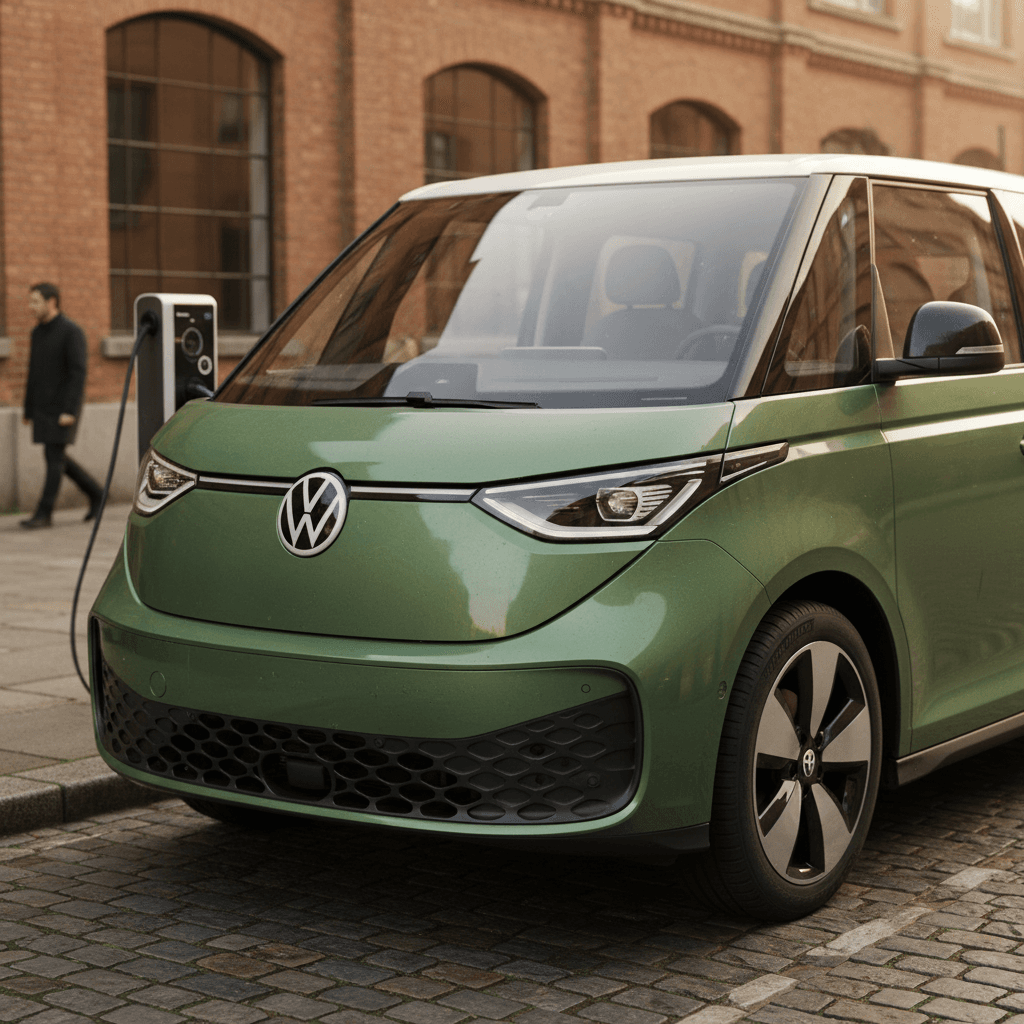
If you love the idea of an electric Microbus but don’t love new‑car pricing, a used 2024 Volkswagen ID. Buzz is probably on your radar. The first U.S. model year is just starting to appear on the used market, which raises a simple question: is the ID. Buzz actually a smart used EV buy, or just a cool nostalgia piece?
In one sentence
Used 2024 Volkswagen ID. Buzz: Quick Take
Key numbers for a used 2024 ID. Buzz
On paper, the ID. Buzz looks like the only game in town: a fully electric three‑row van that calls back the original Bus. On the road, it feels more like a relaxed family cruiser than a hot‑rod EV. As a used buy, the big questions are range, charging speed, early‑production reliability, and how hard that first wave of depreciation hits.
Where Recharged fits in
2024 ID. Buzz basics: battery, range, trims
In the U.S., the 2024–2025 Volkswagen ID. Buzz arrives only as the long‑wheelbase passenger model. All versions share the same roughly 86‑kWh usable battery pack and are built on VW’s MEB electric platform, which also underpins the ID.4 crossover.
2024 Volkswagen ID. Buzz (U.S.) – key specs at a glance
High‑level specs relevant when you’re shopping used. Exact feature content varies by trim and options.
| Item | Rear‑wheel drive (RWD) | All‑wheel drive (AWD 4Motion) |
|---|---|---|
| Horsepower | 282 hp (single rear motor) | 330 hp (dual motors) |
| Drive layout | Rear‑wheel drive | All‑wheel drive |
| Battery (usable) | ~86 kWh | ~86 kWh |
| EPA combined range | ≈234 miles | ≈231 miles |
| 0–60 mph (approx.) | ~7.4 seconds | ~6.0 seconds |
| Seats | Up to 7 | Up to 7 |
Always verify equipment against an individual vehicle’s window sticker or build sheet.
From a used‑buyer perspective, the RWD Buzz is the efficiency play while the AWD Buzz trades a few miles of range for stronger acceleration and all‑weather traction. Because both use the same pack, you’re not juggling multiple battery sizes the way you might on some other EVs.
Watch the options list
How the used ID. Buzz drives and rides
Ride and handling
The ID. Buzz drives like a tall, friendly wagon, not a top‑heavy van. The battery in the floor keeps the center of gravity low, so it feels settled in corners. Steering is light and accurate, tuned more for ease than for sport, which is exactly what you want when you’re shuttling kids or heading to the campsite.
Noise and comfort
Without a gas engine to mask sounds, you notice wind and tire noise more than in a typical minivan, but Volkswagen has done a good job with insulation. On the highway, the Buzz is quiet enough for normal conversation in all three rows, and the seats are shaped for long days, not just quick errands.
Compared with a traditional minivan like a Toyota Sienna or Honda Odyssey, the Buzz feels more upright and a bit more playful from behind the wheel. Compared with smaller EV crossovers, it’s obviously larger, but visibility is excellent and the turning circle is surprisingly tight for something that looks like a rolling living room.
Where it shines
Space, seating and real‑world practicality
What the ID. Buzz is like to live with
Think "apartment on wheels" more than "minivan with sliding doors."
Genuinely adult‑friendly third row
Unlike many three‑row EVs, adults actually fit in the way‑back. The long wheelbase gives generous legroom, and the tall roof keeps headroom limo‑like.
Flexible cargo space
With all three rows up, cargo is road‑trip‑sized rather than warehouse‑sized. Fold or remove the third row and you open up serious space for bikes, DIY runs, or camping gear.
Easy access
Big sliding side doors and a low, flat floor make it easy for kids, pets, and grandparents to climb in. Wide openings are a plus in tight parking lots.
Cabin design is pure modern VW: straightforward, airy, and dotted with clever storage. The flat floor means middle‑seat passengers aren’t straddling a tunnel, and there are plenty of cubbies and USB‑C ports for devices. The second row slides to balance legroom with cargo, and in some configurations you can remove seats entirely for maximum load space.
Car seats and kids
Real‑world range, charging and road trips
On paper, the U.S. ID. Buzz is rated around 231–234 miles of EPA range, depending on drivetrain. In the real world, our own testing and others’ highway loops suggest that at 70–75 mph you should plan more on roughly 180–200 miles between fast‑charge stops in good weather, and less in cold conditions.
Range and charging expectations for a used ID. Buzz
At home, the Buzz is happiest on a Level 2 charger. On a 40‑amp circuit (about 9.6 kW), you can expect to go from low state‑of‑charge to near full overnight. If your commute is modest, even a 32‑amp unit is plenty to replace daily miles while you sleep. If you’re new to home charging, start with our home EV charger installation guide.
Cold‑weather reality check
Road‑tripping a used ID. Buzz: simple playbook
1. Plan fast‑charge stops by time, not just miles
Use an EV‑savvy planner (A Better Routeplanner, PlugShare, or the built‑in nav) and target stops every 120–150 miles instead of running the pack down to single digits.
2. Favor higher‑power DC stations
Look for 150‑kW or faster sites on major corridors. The Buzz can use slower chargers, but your stops will stretch.
3. Precondition when you can
If available in your software build, use battery preconditioning before a fast charge to hit closer to peak rates, especially in cold weather.
4. Align charging with meals and kid breaks
If you stop when everyone’s ready to stretch, not when the pack is empty, the Buzz’s range looks a lot more livable.
Reliability, battery health and safety
The ID. Buzz is still young enough that we don’t have 10‑year reliability stories, but we do know a few important things. First, it’s built on the same MEB platform as the ID.4, which has now been on the road long enough that most early teething issues are software‑related rather than fundamental mechanical flaws. Second, the Buzz has already earned a five‑star Euro NCAP safety rating, with strong scores for adult and child protection and active‑safety tech.
Battery warranty basics
How to think about battery health on a used Buzz
Capacity is your fuel tank, know how much is left.
Normal, gradual loss
Most EVs lose a chunk of capacity in the first few years, then the curve flattens. A used 2024 Buzz with, say, 5–10% loss is usually well within expectations.
When to dig deeper
If you see unusually rapid loss, big swings in estimated range, or a car that won’t charge to its advertised maximum, you want a detailed diagnostic before you buy.
How Recharged checks Buzz batteries
Used values, depreciation and ownership costs
Like many new‑generation EVs, the ID. Buzz has seen meaningful early depreciation. That can sting for first owners but creates opportunity if you’re shopping used. Price cuts on new inventory in late 2025 and into 2026 have pulled used prices down, especially on higher‑spec trims and AWD models.
The good news
- Fuel savings: Electricity is typically cheaper per mile than gas, especially if you can charge at home on off‑peak rates.
- Lower routine maintenance: No oil changes, fewer moving parts, and gentle driving behavior mean less wear.
- Depreciation already hit: Buying in year two or three lets you avoid the steepest part of the curve.
Budget realistically for
- Higher insurance than an equivalent gas van, due to vehicle value and repair costs.
- Out‑of‑warranty items like tires, brakes, and suspension, this is a heavy vehicle, and consumables reflect that.
- Public fast‑charging costs if you road‑trip often and can’t rely on cheap home juice.
Not all used prices are bargains yet
Checklist: what to inspect on a used ID. Buzz
Pre‑purchase checklist for a used 2024 ID. Buzz
1. Confirm battery health and remaining warranty
Ask for a recent battery health report or have one generated. Check in‑service date and mileage to see how much of the 8‑year/100,000‑mile battery warranty remains.
2. Review charging history
Cars that lived on DC fast charging 100% of the time can age packs faster. Occasional road‑trip fast charging is fine; a mix of AC home charging is ideal.
3. Check software version and features
VW has been rolling out software updates that improve charging behavior and driver‑assist performance. Verify that important recalls or updates have been completed.
4. Inspect tires and brakes closely
The Buzz is heavy and torquey. Uneven tire wear or early brake issues can hint at alignment problems or very hard use, especially on fleet or rental units.
5. Test all doors, seats and latches
Make sure sliding doors operate smoothly, seat mechanisms lock firmly, and the third row folds and latches as designed. These are hard‑working parts in family duty.
6. Drive at highway speed
Listen for wind whistles or rattles, check lane‑keeping and adaptive cruise behavior, and watch range estimates as you settle into 65–75 mph.
Be wary of mystery imports and incomplete histories
Who a used ID. Buzz is perfect for (and who it isn’t)
Great fit
- Families and caregivers who want real three‑row space, easy access, and a calm driving experience.
- Weekend adventurers who road‑trip but don’t mind planning charging around meal and stretch breaks.
- Small businesses that blend people and gear, boutique shuttle services, adventure guides, or mobile studios.
Maybe look elsewhere
- If you regularly drive 300+ miles in one shot with limited fast chargers, a longer‑range EV or plug‑in hybrid might suit you better.
- If you need to tow heavy loads, the Buzz isn’t the right tool; consider an electric pickup or SUV with rated tow capacity.
- If your budget is tight and you can live with less space, a used ID.4 or other compact EV will be cheaper to buy and run.
Used 2024 ID. Buzz: FAQ
Frequently asked questions about used 2024 ID. Buzz models
Bottom line: Is a used 2024 ID. Buzz worth it?
If you judge it purely on numbers, miles of range, kilowatts of charging, dollars per cubic foot of cargo, the used 2024 Volkswagen ID. Buzz is a good EV, not a breakthrough one. Where it wins is in how it makes every drive feel: easy, friendly, and just a little bit special. If your daily life fits within its real‑world range envelope and you value space and character over cross‑country legs, a carefully chosen used Buzz can be a fantastic long‑term companion.
The key is to buy with your eyes open: verify battery health, understand charging where you live, and make sure the price reflects both its strengths and its early‑adopter quirks. Work with an EV‑focused retailer like Recharged, and you’ll get the data, support, and transparent pricing you need to decide whether this cheerful electric bus belongs in your driveway.