If you’re shopping used EV SUVs, the 2024 Fisker Ocean is a weird mix of **jaw-dropping battery size** and **troubled brand history**. On paper, its range numbers look heroic, especially the Extreme model’s 360‑mile EPA rating. But once you get an actual Ocean on the road, how far will it really go on a charge?
Quick takeaway
Overview: Why the 2024 Fisker Ocean’s Range Matters
The Fisker Ocean is a mid‑size electric SUV built by Fisker Inc., which filed for bankruptcy protection in mid‑2024 after a rocky launch. That makes **battery size, range, and long‑term usability** absolutely critical if you’re considering a used Ocean. There’s no thriving dealer network waiting in the wings if you misjudge how far it can actually go.
At its best, the Ocean offers one of the biggest packs in its class, over **106 kWh of usable energy** in the AWD models, combined with a relatively sleek shape. That combination is why the EPA rated the 2024 Ocean Extreme at **360 miles of range** on 20‑inch wheels. But real roads, real weather, and real speeds tell a slightly different story.
Bankruptcy matters for range, too
Battery Size and EPA Range by 2024 Fisker Ocean Trim
Fisker sold the Ocean in four main trims for 2023–2024: Sport, Ultra, Extreme, and the launch‑edition One. Underneath the styling, there are two very different battery setups:
2024 Fisker Ocean battery and EPA range by trim (USA)
Key specs that frame any 2024 Fisker Ocean range test: battery chemistry, usable capacity, and official EPA numbers.
| Trim (2024 US) | Drive | Battery chemistry | Usable capacity (approx.) | EPA range rating* | Headline power |
|---|---|---|---|---|---|
| Sport | FWD | LFP (lithium iron phosphate) | ~75 kWh | 231 miles | ~275 hp |
| Ultra | AWD | NMC (nickel manganese cobalt) | ~106–107 kWh | 350 miles | ~468 hp |
| Extreme | AWD | NMC | ~106–107 kWh | 360 miles | 564 hp (Boost) |
| One (launch edition, similar to Extreme) | AWD | NMC | 106.5 kWh | 360 miles | 564 hp (Boost) |
All figures are manufacturer or EPA ratings; real‑world range will vary with speed, temperature, and driving style.
Two packs, very different personalities
Ocean battery and range highlights
How Far It Really Goes: Real-World Range Tests
Once early 2024 software updates landed, more owners and journalists began doing proper **2024 Fisker Ocean range tests**. Unsurprisingly, most couldn’t hit the big 360‑mile number in day‑to‑day driving, but the results were still respectable.
Real-world 2024 Fisker Ocean range test results
What reviewers and early owners actually saw on the road
Highway road test (AWD)
Several long‑distance reviewers with AWD One/Extreme models reported **300–310 miles** on a full charge when driving mostly highway at typical US speeds (70–75 mph), in mild weather, starting around 100% and stopping near 5–10%.
Mixed driving (AWD)
Owners who split driving between city and suburban roads often report **3.0–3.3 mi/kWh**, which works out to roughly **310–340 miles** on the 106.5 kWh usable pack when conditions are good.
Cold‑weather reality
In winter climates, that same AWD Ocean can drop into the **240–270‑mile** range on a full charge if you’re doing freeway speeds with heat on. That’s true of most EVs with big packs.
A few early owners shared long‑term averages north of **3.1 mi/kWh**, suggesting roughly **330–340 miles** per charge in milder weather. Others, especially those who live on the left lane at 80 mph, saw **range in the 200s**. The takeaway isn’t that the Ocean is unusually bad or good, it’s that your right foot and your climate matter more than the spec sheet.
Rule of thumb for the big‑battery Ocean
Highway vs City: Where the Ocean Shines (and Struggles)
Highway range: Good, not magical
The Ocean’s shape is bluff and SUV‑ish, and that hurts efficiency once you’re past 70 mph. In independent highway loops at typical American freeway speeds, testers often saw **2.7–3.0 mi/kWh**.
On the **106.5 kWh** usable pack, that works out roughly to:
- 2.7 mi/kWh → ~288 miles
- 3.0 mi/kWh → ~320 miles
That’s solid for a two‑row SUV, but not class‑leading compared with a Tesla Model Y or Hyundai Ioniq 5 NACS‑equipped models.
City & suburban driving: Quiet strength
Where the Ocean does better is **lower‑speed and stop‑and‑go driving**, especially in mild weather. With regen turned up and speeds under 55 mph, owners can nudge **3.3–3.5 mi/kWh** from the AWD pack, translating to **340 miles or more** if you use most of the battery.
If your life is mostly commutes, errands, and school runs rather than 400‑mile interstate hauls, the Ocean’s big battery feels genuinely generous.
5 Factors That Hit a Fisker Ocean’s Range Hard
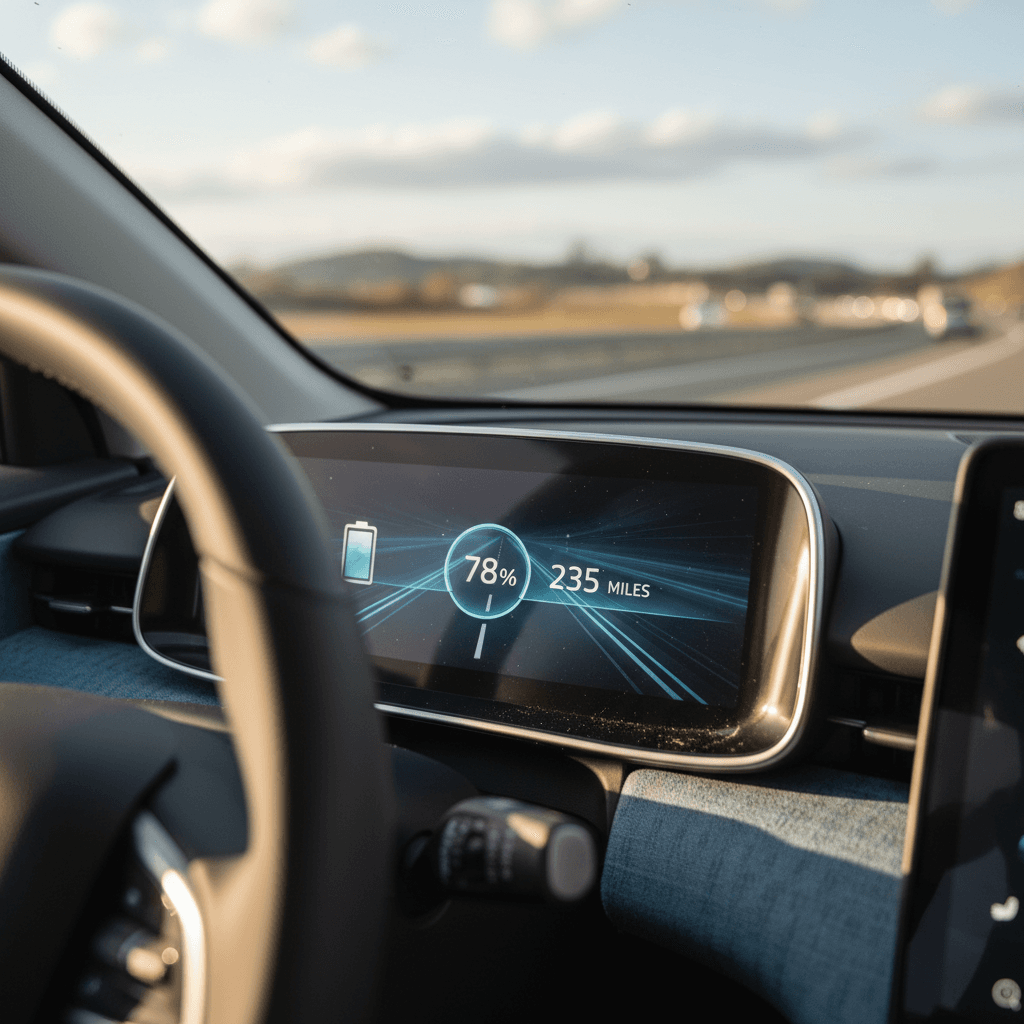
Every EV has an Achilles’ heel or three. For the 2024 Fisker Ocean, these are the big five range killers you’ll feel most on long trips:
The Ocean’s biggest range killers
1. Speed above 70 mph
Push a tall SUV like the Ocean past **70–75 mph**, and aerodynamic drag ramps up quickly. That’s when you see consumption sag to the **2.5–2.7 mi/kWh** range, shaving 40–60 miles off a full charge compared with gentler driving.
2. Cold weather and cabin heat
Like most EVs without an oversized heat pump advantage, the Ocean can lose **20–30% of its range** on cold, windy highway runs. Short trips are worst because the cabin and battery never really warm up.
3. Big 22‑inch wheels and tires
If you’re looking at a used Ocean with the flashier 22‑inch wheels, know that they hurt efficiency versus 20‑inch wheels, extra weight, wider rubber, and more aerodynamic drag. Expect to lose **10–20 miles of real‑world range** just from wheel choice.
4. Roof racks and cargo boxes
Throw a cargo box or bike rack on the roof and you’ve basically turned your slippery-ish SUV into a shed. Across EVs, roof accessories can knock **5–15%** off highway range; the Ocean is no exception.
5. Poor route and charge planning
With a big pack, it’s tempting to run from 100% down to single digits. But optimal road‑trip strategy is usually **shorter hops between 10–70%** state of charge, taking advantage of peak DC speeds and avoiding the slow charging tail above ~80%.
Don’t ignore weight
Maximizing Range in a Used Fisker Ocean
If you’re eyeing a used 2024 Fisker Ocean, you’re probably doing it for one of two reasons: **headline range** or **a steep post‑bankruptcy discount**. Either way, you’ll want every mile you can coax out of that battery. Here’s how to stack the deck in your favor.
Practical ways to stretch Ocean range
Most of these cost nothing but attention
Choose the right trim and wheels
If range is your priority, seek out an **AWD Ultra/Extreme/One** with **20‑inch wheels**. The Sport’s smaller LFP pack is fine for shorter commutes, but it doesn’t leave much headroom for winter or road trips.
Use Eco/low‑power modes
Dial back drive modes and climate where possible. Softer throttle, gentler HVAC, and smart use of seat and steering‑wheel heaters can be good for **an extra 10–20 miles** on a long day.
Plan for fast‑charge sweet spots
On road trips, aim to charge between **10–70%** whenever you can. That keeps you in the Ocean’s strongest DC charging window and minimizes time crawling from 80% to 100% for just a few more miles.
How Recharged can help
Ready to find your next EV?
Browse VehiclesHow the Ocean Compares to Rival EV SUVs
Purely on paper, the 2024 Fisker Ocean Extreme lands near the top of the EV‑SUV range charts. A 360‑mile EPA rating puts it in striking distance of long‑range versions of the Tesla Model Y and Mercedes‑Benz EQE SUV, and ahead of most Hyundai/Kia offerings.
2024 Fisker Ocean vs popular EV SUVs: EPA range snapshot
Approximate EPA combined range ratings for comparable 2‑row electric SUVs with their longest‑range batteries.
| Model / Trim | Drivetrain | Usable battery (approx.) | EPA range (longest trim) | Real-world highway takeaway |
|---|---|---|---|---|
| Fisker Ocean Extreme/One | AWD | 106.5 kWh | 360 mi | ~300–320 mi at 70–75 mph in good weather |
| Fisker Ocean Ultra | AWD | 106.5 kWh | 350 mi | Very similar to Extreme; ~290–315 mi typical |
| Fisker Ocean Sport | FWD | 75 kWh | 231 mi | Comfortable commuter, marginal winter road‑trip machine |
| Tesla Model Y Long Range | AWD | ~75–80 kWh | 310–330 mi | More efficient; typically 270–300 mi at 70–75 mph |
| Hyundai Ioniq 5 RWD Long Range | RWD | ~77 kWh | 303 mi | High‑speed efficiency close to Tesla, smaller pack than Ocean |
| Kia EV6 RWD Long Range | RWD | ~77 kWh | 310 mi | Similar story to Ioniq 5; great road‑trip manners |
Numbers are approximate US EPA combined ratings for 2024 model year where available; always check specific wheel size and configuration.
Range isn’t everything
Battery Health, Software Updates, and Fisker’s Troubled Story
Fisker’s bankruptcy complicates the usual range conversation. When you’re buying, say, a used Hyundai Ioniq 5, you can assume ongoing **software updates**, battery warranty support, and a roadmap for future improvements. With the Fisker Ocean, you’re largely freezing the car in the state it was left in when Fisker shut down.
- The big NMC pack in AWD models should age similarly to other large EV batteries if it’s not abused, avoiding constant 0–100% swings and extreme heat helps.
- The LFP pack in the Sport is more tolerant of **frequent 100% charges**, but it starts with a smaller range buffer.
- Some early Oceans shipped with buggy range estimates and inconsistent software. Later 2023–2024 builds with updated software generally behave better.
- Future over‑the‑air improvements are unlikely, so whatever quirks your Ocean has now may be permanent.
Battery inspection is non‑negotiable
Should You Buy a Used Fisker Ocean for Its Range?
So after all the 2024 Fisker Ocean range tests, what’s the verdict? If you strip away the corporate drama and just look at the hardware, the big‑battery AWD Ocean is a **legit long‑range EV**, able to cover **300‑plus miles** on a charge in decent conditions. The Sport, meanwhile, is a fine daily‑driver with range similar to many compact EVs, just don’t ask it to be your winter cross‑country hero.
Who the Ocean still makes sense for
- High‑mileage commuters who want to charge less often and can snag an AWD model at a post‑bankruptcy bargain price.
- Road‑trip fans who value a big buffer between DC fast‑charge stops and don’t mind planning around CCS networks.
- Tech‑curious buyers who are comfortable owning an orphan brand in exchange for lots of battery per dollar.
Who should probably look elsewhere
- First‑time EV owners who want a dealer on every corner and a straightforward warranty path.
- Drivers who live in **very cold climates** and need predictable winter road‑trip range.
- Anyone who’s allergic to quirks; the Ocean can still feel like an early‑access product in places.
If you’re curious about a used Fisker Ocean but want a second opinion, that’s exactly what Recharged was built for. Our EV‑specialist team can help you compare a specific Ocean’s **battery health, real‑world range, and pricing** against more mainstream alternatives, and even arrange **financing, trade‑in, and nationwide delivery**. Range is only one piece of the puzzle, but with the right data, it doesn’t have to be a gamble.