If it feels like you just finished paying off 2022’s fuel spike, you’re not imagining things. In spring 2026, U.S. gas prices have shot back above $4 a gallon on average, with many drivers in coastal and high‑tax states paying well over that. So why are gas prices so high in 2026, and what can you realistically do about it?
Key context for 2026
Overview: Why gas is so expensive in 2026
The price you see on the gas station sign is the end result of a complicated stack of costs. In 2026, four forces are doing most of the damage to your wallet:
- Geopolitical shocks in the Middle East, especially the 2026 Iran war and disruption around the Strait of Hormuz, have pushed crude oil prices sharply higher.
- Refining bottlenecks in the U.S. and abroad mean fewer refineries are turning crude into gasoline, so margins and wholesale prices stay elevated.
- Taxes and regulations add anywhere from a few dozen cents to nearly a full dollar per gallon depending on your state.
- Strong demand from big, thirsty vehicles, pickup trucks and SUVs, keeps gasoline consumption high even as EVs slowly gain share.
Remember the rule of thumb
Short answer: the main reasons gas prices are so high
What’s in a gallon of gas in 2026? (Typical U.S. breakdown)
Those percentages shift week to week and state to state, but they illustrate the basic point: you’re not just paying for crude oil. In 2026, crude is expensive, refineries are making strong profits, and taxes have ratcheted up in many states, so the total price per gallon climbs even faster.
Global crises and crude oil prices
Crude oil is the starting point for gasoline prices, and 2026 has been a rough year on that front. After a relatively calm 2024–2025, the Iran war and strikes on energy infrastructure in the Gulf jolted markets. Attacks and shutdown risks near the Strait of Hormuz, the narrow chokepoint that handles roughly a fifth of the world’s oil trade, have traders pricing in the risk that some barrels simply can’t get to market.
How global events translate into your local gas price
Oil markets are global, even if you never leave your state
1. Supply fears
When war or sanctions threaten major producers, traders bid up crude oil futures to secure supply. That raises the baseline cost for every barrel refineries buy, even if actual physical shortages are limited.
2. Shipping disruptions
Closures or military risks near chokepoints like the Strait of Hormuz increase tanker insurance and rerouting costs. Those extra dollars per barrel show up later in the price of gasoline and diesel.
3. Market psychology
Even the fear of a prolonged conflict can keep prices high. Funds and producers watch the same headlines you do, and they’re often willing to pay a premium to avoid being caught short.
Why prices jump faster than they fall
Refining bottlenecks and limited capacity
Even if crude oil were cheap, you’d still need enough refineries to turn it into gasoline, diesel, and jet fuel. Over the last decade, and especially since COVID, refining has become a major choke point.
- Several older U.S. refineries have closed or converted to produce renewable diesel or petrochemicals instead of gasoline, trimming total capacity.
- Planned maintenance and unplanned outages concentrate more demand on the refineries that remain, particularly along the Gulf Coast and in California.
- When demand rebounds, like it has with strong travel and freight in early 2026, refineries can run near their limits, making wholesale gasoline prices jump disproportionately.
Why California and the West Coast hurt more
When crude is high but refining is normal
Prices still rise, but they tend to move more in step with global oil benchmarks. Relief comes faster once crude falls again.
- Common after short‑lived geopolitical scares.
- Refinery margins stay closer to normal.
When refining is tight (2026)
Even if crude stops climbing, limited refining capacity keeps pump prices elevated. Gasoline futures can outperform crude because refiners know drivers and truckers have few alternatives in the short term.
- Exactly what we’ve seen heading into spring 2026.
Taxes, fees, and why some states pay much more
On top of crude and refining, every gallon of gas includes taxes and fees. The federal gas tax has been stuck at 18.4 cents per gallon since the 1990s, but state and local add‑ons have quietly climbed for years to fund highways, transit, and climate programs.
Illustrative 2026 gasoline tax burden by state
These figures are rounded examples based on published 2026 state and federal tax schedules; your exact local rate may differ.
| State example | Approx. total taxes/fees per gallon | What it means at $4 base price |
|---|---|---|
| Low‑tax state (e.g., parts of the South) | $0.40–$0.50 | Pump price around $4.40–$4.50 |
| Mid‑tax state (e.g., Midwest average) | $0.60–$0.70 | Pump price around $4.60–$4.70 |
| High‑tax state (e.g., California) | $0.80–$0.90+ | Pump price can approach or exceed $5.00 |
State taxes explain a big part of the gap between a $3.70 fill‑up in one state and $5.20 just across the border.
Don’t forget special blends and credits
Demand, SUVs, and driving habits
High prices usually push people to drive less or buy more efficient vehicles. That’s happening at the margins, but in the U.S. market of 2026, big trucks and SUVs still dominate new‑vehicle sales. Many of those vehicles get well under 25 mpg, some under 20, especially in city driving.
- More Americans are back to pre‑pandemic commuting and road‑tripping, boosting gasoline demand.
- The market has shifted toward crossovers, SUVs, and full‑size pickups, which use more fuel per mile than compact sedans or hybrids.
- Electric vehicles are growing, but they still make up a minority of vehicles on the road, so gasoline demand hasn’t fallen as fast as many expected.
Where EVs and hybrids already make a difference
How long could high gas prices last?
No one can time energy markets with precision, but you can understand the basic scenarios. In early April 2026, analysts are focused on three big variables: the duration of the Iran conflict, how quickly shipping through the Strait of Hormuz normalizes, and whether global economic growth slows enough to cool fuel demand.
Three realistic paths for gas prices from here
Not predictions, scenarios to help you plan
1. Conflict eases
If tensions in the Middle East ease and tankers move freely again, crude could pull back. Prices at the pump might slip under $4 nationally later in 2026, though high‑tax and West Coast states would likely still see elevated prices.
2. Prolonged disruption
If the Strait of Hormuz stays partially constrained or more infrastructure is damaged, analysts warn of spikes toward extreme oil prices. In that world, $4–$5 gas could feel like the new normal for a while.
3. Economic slowdown
A mild global slowdown or recession would typically reduce fuel demand, taking some pressure off prices. The trade‑off, of course, is weaker job and income growth.
What this means for your decisions
Budget survival guide for $4+ gasoline
High gas prices hit different households in different ways. If you drive 12,000 miles a year in a 20‑mpg SUV, that’s about 600 gallons annually. At $4.00 vs. $3.00 a gallon, you’re spending roughly $600 more per year just to go the same distance. Here are concrete steps to soften the blow, whether or not you’re ready for an EV yet.
Practical ways to cut fuel costs in 2026
1. Kill the wasteful trips first
Combine errands, carpool when it’s convenient, and question every solo drive. Cutting just 10% of your miles is like getting a permanent 10% discount on fuel.
2. Drive smoother and slower
Aggressive starts and 75+ mph highway cruising can burn 10–25% more fuel. Use cruise control on open roads and leave more following distance so you brake less.
3. Check tires and maintenance
Under‑inflated tires and overdue tune‑ups slice into fuel economy. A quick pressure check and basic service can pay for itself surprisingly fast when gas is over $4.
4. Shop smarter, not just cheaper
Use apps like GasBuddy or AAA to compare nearby stations instead of driving miles out of your way. A 5–10 cent difference is worth it; a 40‑minute detour isn’t.
5. Re‑evaluate the second (or third) car
If you own multiple vehicles, prioritize the one with better fuel economy for daily driving. In some households, selling a rarely used gas‑guzzler and sharing one efficient car + rideshare is a real option.
6. Start a dedicated “fuel buffer” fund
Treat high gas prices like a recurring bill you can plan for. Setting aside $20–$40 per paycheck into a separate account smooths out the shock when prices spike again.
Beware “false savings” at the pump
Is it time to switch from a gas car to an EV?
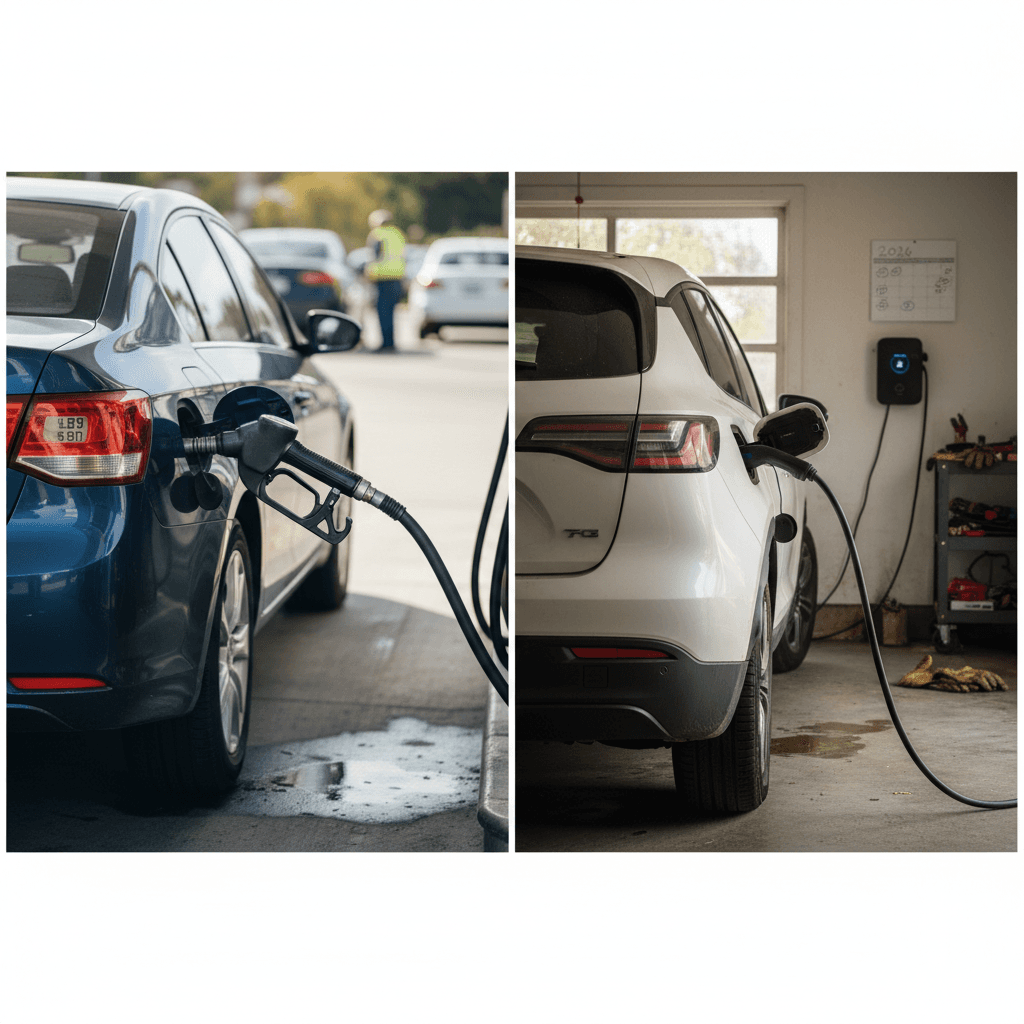
High fuel prices have a way of forcing the issue. If you’ve been “EV‑curious” for a while, 2026’s gas spike might be the nudge that makes the math work. The key is to compare total cost of ownership, not just the sticker price of the car.
Typical gas SUV
- Annual miles: 12,000
- Real‑world fuel economy: ~20 mpg
- Gas at $4.00/gal → about $2,400/year in fuel
- Regular oil changes, transmission service, exhaust, and more wear items over time
That’s roughly $200/month just for fuel, before maintenance.
Typical used EV
- Annual miles: 12,000
- Home charging at a national‑average electricity rate
- Often the equivalent of $40–$80/month in electricity, depending on your rates
- No oil changes, fewer moving parts, and regenerative braking that can extend brake life
Your exact numbers will vary, but it’s common for EV drivers to cut their “fuel” spend by 60–80% compared with a similar gas vehicle.
Used EVs are where the math gets interesting
How Recharged helps if you decide to go electric
If $4+ gasoline has you seriously rethinking your next vehicle, you don’t have to jump into the EV world blind. This is exactly the gap Recharged was built to fill: making used EV ownership simple and transparent for everyday drivers, not just early adopters.
Why a used EV from Recharged can be a smart hedge against fuel prices
Lower running costs, less guesswork
Battery health you can trust
Every EV on Recharged comes with a Recharged Score Report that includes verified battery health. Instead of guessing how much range a used EV really has left, you see objective diagnostics up front.
Financing built for EVs
Recharged offers financing and a fully digital buying experience, so you can compare monthly payments against what you’re currently spending on gas. For many shoppers, the fuel savings help offset the payment.
Trade‑in & nationwide delivery
You can get an instant offer or consignment for your current gas vehicle and have your used EV delivered nationwide. If you’re near Richmond, VA, you can also visit the Recharged Experience Center for in‑person help.
Ready to find your next EV?
Browse VehiclesThinking ahead on home charging
FAQ: High gas prices in 2026
Frequently asked questions about 2026 gas prices
High gas prices in 2026 aren’t an illusion or a simple case of “greedy stations.” They’re the visible result of war, shipping risks, limited refining capacity, taxes, and our collective love affair with big, powerful vehicles. You can’t control those forces, but you can control how exposed your budget is to the next price spike. Whether that means tightening up your driving habits, shopping more carefully for your next gas vehicle, or finally running the numbers on a used EV, the best time to rethink your fuel strategy is before prices go even higher. And if an EV is on your radar, Recharged is built to make that transition clearer, calmer, and far more transparent than the typical car‑buying experience.