If you’re shopping for a used EV, the 2023 Nissan Ariya is probably on your radar for one simple reason: **it’s gotten cheap, fast**. Attractive pricing will make anyone brave, but the real question is whether the 2023 Nissan Ariya reliability rating should give you confidence, or pause, before you sign anything.
Bottom line up front
2023 Nissan Ariya reliability at a glance
Key 2023 Nissan Ariya reliability numbers
Read through owner stories and you see a split personality. There are drivers quietly clocking **20,000–50,000 mostly drama‑free miles**, and then there are a smaller number who’ve seen **warning lights, 12‑volt failures, or even traction‑motor replacements** in the first few years. That’s the backdrop to the 2023 Nissan Ariya reliability rating: statistically fine, emotionally unpredictable.
New model, steeper risk curve
How the 2023 Nissan Ariya scores for reliability
J.D. Power: solid owner satisfaction, average defects
J.D. Power gives the 2023 Nissan Ariya an **overall score of 82 out of 100**, with **74/100 for Quality & Reliability**, 88/100 for Driving Experience, and 87/100 for Resale. In their world, 74/100 on quality is “Average,” not a disaster. It means owners aren’t burying Nissan dealers under waves of warranty claims, but the Ariya is also not a Lexus‑style paragon of defect‑free existence.
Consumer Reports: “about average” reliability
Consumer Reports lumps the 2023 Ariya into the **“about average” reliability** bucket as well. Dig into their trouble spots and you’ll see a familiar EV cocktail: a few **in‑car electronics issues**, some **exterior trim and lighting complaints**, and a **small but real number of electric drive‑motor failures** that required replacement under warranty.
Why scores matter, but only so much
Recalls that affect the 2023 Ariya
By early 2026, the 2023 Nissan Ariya has **four NHTSA safety recalls** tied to it. Recalls aren’t automatically a red flag, some are simple software flashes done in 20 minutes, but they do tell you what Nissan misjudged out of the gate.
Major U.S. recalls for the 2023 Nissan Ariya
Exact recall repair details depend on build date and VIN. Always run a VIN check to confirm status.
| Recall theme | What can go wrong | Typical fix | Why it matters to you |
|---|---|---|---|
| Steering‑wheel attachment | On a small number of early builds, the steering wheel might not be properly secured and could loosen or detach. | Dealer inspects steering column, replaces steering wheel/fasteners as needed. | Serious safety item; confirm it’s been done before you buy. |
| Software / EV system logic | Faulty control‑unit logic can trigger EV‑system warnings, limp modes, or no‑start conditions. | Control‑module reprogramming with updated software. | If unfixed, you can be stranded despite a healthy high‑voltage battery. |
| 12‑volt battery / power‑management behavior | Weak 12‑volt support may cause “EV System Off” or no‑start events even though the traction battery is fine. | Updated charging strategy, 12‑volt battery inspection or replacement. | A marginal 12‑volt can make an otherwise healthy Ariya feel haunted. |
| Lighting / exterior trim‑related campaigns | Isolated issues with exterior lights or body trim retention. | Component inspection and replacement of affected parts. | Annoying but minor; more about cosmetic quality than core reliability. |
These are the headline campaigns you’ll see on a 2023 Ariya’s Carfax or NHTSA report.
Used‑buyer move: insist on proof
Common 2023 Nissan Ariya problems
If you swim through owner forums, Reddit threads, and survey comments, the Ariya’s pattern isn’t catastrophic failure rates. It’s a mix of **very happy owners** and a **minority with genuinely bad luck**. Here are the issues that come up repeatedly on 2023s.
Most common 2023 Ariya reliability complaints
Not every Ariya will see these problems, but these are the patterns to know.
Weak or failing 12‑volt battery
The 12‑volt battery on some 2023 Ariyas seems undersized or poorly managed.
- Triggers “EV System Off” or “Service EV System” messages
- Can leave the car totally bricked after parking
- Often fixed by replacing the 12‑volt and updating software
Annoying and tow‑truck worthy, but usually not a sign the high‑voltage pack itself is bad.
Software glitches & warning messages
Owners report random chimes, sensor errors, or traction‑control noises that vanish before the dealer can replicate them.
- Occasional no‑start after DC fast charging
- In‑car electronics/infotainment hiccups
- NissanConnect app losing connection or data
Mostly quality‑of‑life issues, but they erode confidence when you don’t know which warning matters.
Rare traction‑motor or junction‑box failures
A small but real subset of 2023 owners report serious EV‑system failures:
- Persistent EV‑system error messages
- Reduced power or no drive
- Traction motor or junction box replaced under warranty
These are big‑ticket repairs that can sideline the car for weeks while parts ship.
The good news side of the ledger
- Many 2023 Ariya owners report **zero reliability issues** after the first year and tens of thousands of miles.
- Most problems so far are **caught during warranty**, not after it expires.
- There’s no widespread pattern of **battery pack degradation** or chronic leakage/failures on 2023 builds.
If you get a “good” Ariya…
Battery life, degradation and EV warranty
Underneath the Ariya’s reliability chatter is the question that really drives used‑EV value: **what’s the battery going to look like in year eight?** So far, early real‑world data from 2023 Ariyas is reassuring.
Early degradation data: boring, in a good way
Owners with 2023 Ariyas built in mid‑to‑late 2023 and **20,000–30,000+ miles** are reporting **battery health in the 96–100% range** on dealer diagnostics or OBD‑based tools, and many say they’re still seeing close to EPA range in normal weather. That matches broader early‑life Ariya data: whatever you think of the software, the pack and thermal management seem fundamentally competent.
Ignore the scary guess‑o‑meter
2023 Ariya battery warranty basics
2023 Nissan Ariya EV and battery warranty overview
Exact coverage details vary slightly by region; this table reflects U.S. 2023 Ariya terms.
| Coverage | Typical term for 2023 Ariya | What it covers | Why it matters on a used car |
|---|---|---|---|
| EV system (battery, motor, inverter) | 8 years / 100,000 miles from in‑service date | Defects in materials/workmanship for high‑voltage components. | Shields you from early, expensive failures like traction motors or packs. |
| Battery capacity warranty | Up to 8 years / 100,000 miles, down to a specified bar/SOH threshold | Protection against **abnormal** loss of capacity beyond normal degradation. | Gives you recourse if the pack loses an unreasonable chunk of range early. |
| Bumper‑to‑bumper | 3 years / 36,000 miles | Most non‑wear items on the car. | Many 2023s are now aging out of this, so history matters more. |
| Powertrain (non‑EV) | 5 years / 60,000 miles | Coverage on non‑EV drivetrain components where applicable. | Less critical on a pure EV, but still relevant for ancillary hardware. |
Always confirm remaining warranty by VIN, especially on Canadian imports or prior‑fleet cars.
Watch for edge‑case warranty gaps
How reliable is the Ariya vs other EV SUVs?
Against mainstream EV rivals
In the 2023 compact/midsize EV‑SUV crowd, Tesla Model Y, Hyundai Ioniq 5, Kia EV6, Volkswagen ID.4, the Ariya lands **squarely in the middle** on reliability risk.
- Better than early‑build ID.4s and some first‑gen Mach‑Es in terms of catastrophic drivetrain problems.
- Roughly similar to Hyundai/Kia siblings, which have their own recalls and 12‑volt/busbar stories.
- Generally below the Model Y for long‑term data volume, but also not stained by as many panel‑gap memes.
Versus Nissan’s own track record
Nissan as a brand currently sits around **average** in big reliability studies, neither a disaster nor a halo brand. The Ariya continues that theme: the underlying hardware appears decent, but the launch was marred by recalls, slow parts pipelines, and dealerships scrambling to catch up on EV expertise.
If you’re expecting Leaf‑like simplicity with luxury‑SUV polish, the Ariya mostly delivers. If you’re expecting Lexus‑level dependability, it doesn’t.
Think risk band, not magic number
What to check on a used 2023 Ariya
If you’re evaluating a 2023 Nissan Ariya at a dealer lot or online, the difference between a smart buy and an expensive science project is in the homework you do up front.
Pre‑purchase checklist for a 2023 Ariya
1. Verify recall completion by VIN
Run the VIN through NHTSA’s recall tool (or ask the seller for a printout) to confirm all **steering, software, and lighting** campaigns have been done. No exceptions here, especially the steering‑wheel recall.
2. Ask for a battery‑health report
Request a **formal battery diagnostic**, not just a salesperson’s word or the dash range estimate. At Recharged, this lives inside the <strong>Recharged Score Report</strong>, so you can see measured state‑of‑health, not vibes.
3. Stress‑test the 12‑volt system
Before purchase, let the car sit, then start it multiple times. Watch for **EV‑system warnings, slow wake‑up, or no‑start behavior**. Ask if the 12‑volt battery has been replaced and when.
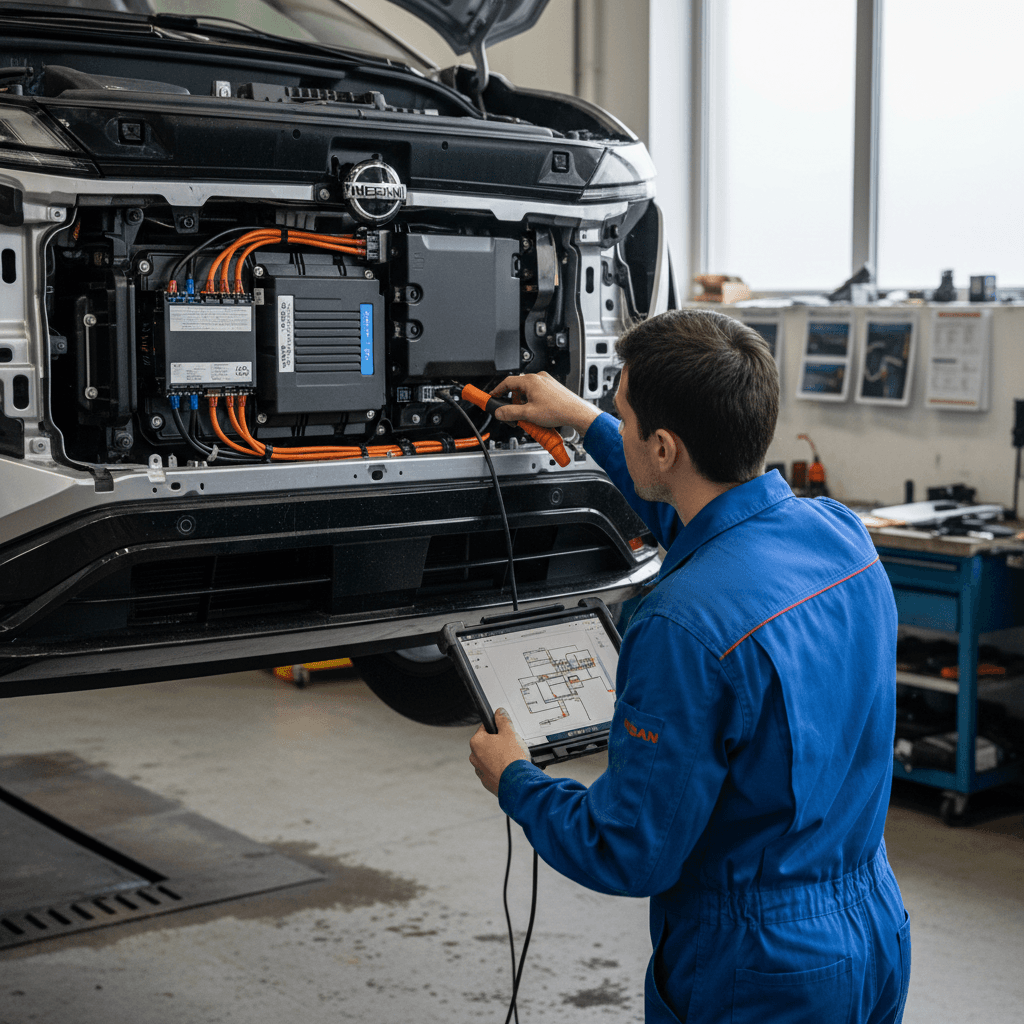
4. Scan for stored fault codes
A quick scan with an OBD adapter can reveal **recently cleared EV‑system errors** or sensor issues. If you see a history of traction‑motor or junction‑box codes, dig deeper, or walk.
5. Inspect trim, lighting and seals
Look for loose exterior trim, misaligned panels, or moisture in lamps. Minor issues aren’t deal‑breakers, but they tell you how carefully the car has been assembled and repaired.
6. Confirm warranty status in writing
Have the dealer or Nissan customer support confirm **in writing** the remaining EV, battery, and capacity warranties, down to the in‑service date. This matters a lot on a 2023 where the odometer can already be high.
When the 2023 Ariya is a good used buy
Here’s where the 2023 Nissan Ariya reliability rating actually works in your favor: the combination of **average reliability perception** and **thin brand cachet** means used prices have fallen faster than some rivals. The market is quietly offering you a discount for taking on a bit of risk.
Situations where a 2023 Ariya makes sense
You want value and comfort, and you’re okay doing your homework.
You’re getting a real discount
The Ariya becomes compelling when it’s **meaningfully cheaper** than an equivalent Ioniq 5, EV6, or Model Y with similar range and options.
If pricing is only a token discount, you’re taking on the same risk for less upside.
You have clear service history
Ideal candidates have:
- All recalls documented as completed
- No repeat EV‑system faults on record
- Documented 12‑volt replacement, if applicable
Think “boring Carfax, boring ownership.” That’s what you want.
Battery health checks out
A 2023 Ariya with an **8‑year EV warranty still in force** and strong battery‑health data is a very different proposition from a mystery import with gaps in coverage.
This is exactly what the Recharged Score is designed to demystify for used buyers.
When to skip the 2023 Ariya
Viewed coldly, the 2023 Nissan Ariya is a **medium‑risk, high‑comfort EV**. The reliability rating says “average,” which in practice means the worst‑case stories are real but not common, and the best‑case experience is a calm, quiet electric SUV that just does its job. If you use that knowledge to demand documentation, a discount, and real battery‑health data, the 2023 Ariya can be one of the smarter value plays in the used‑EV world.