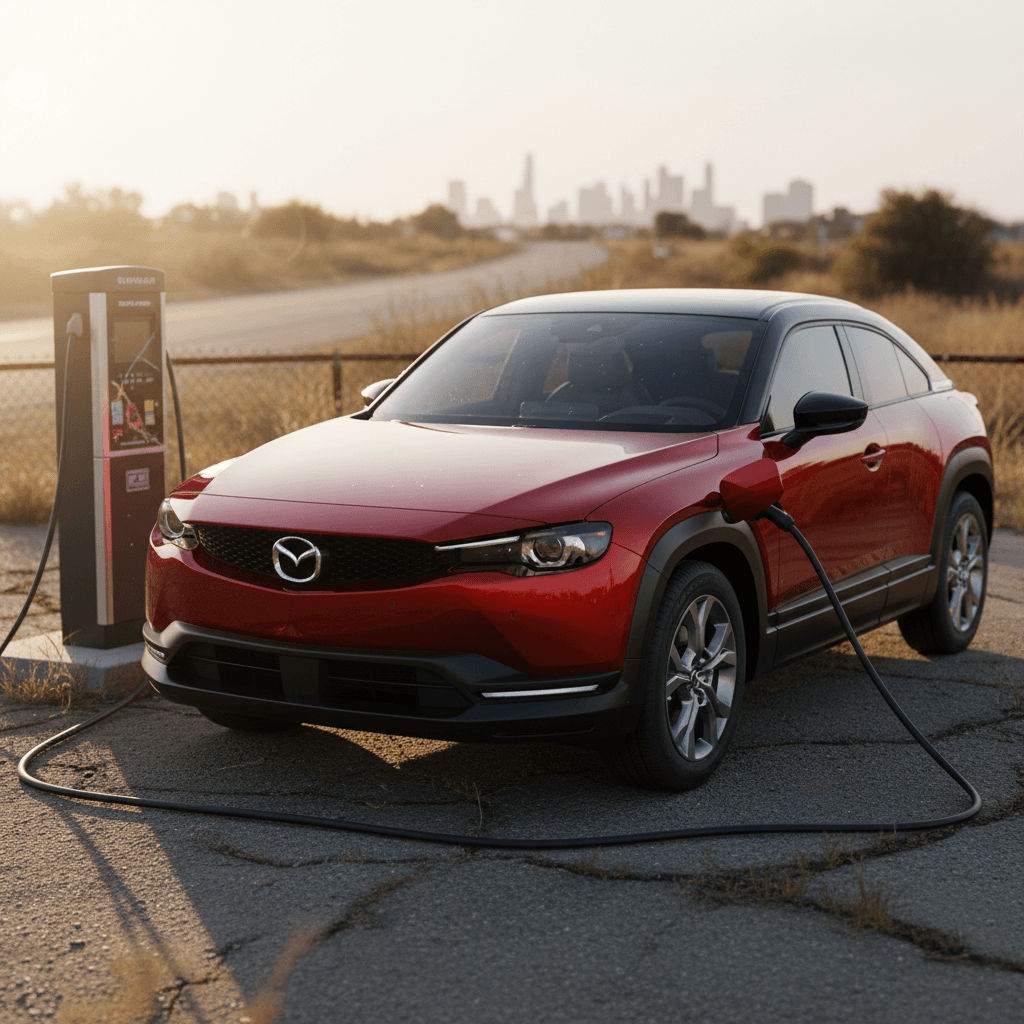
The 2023 Mazda MX-30 is one of the strangest EVs of the last decade. It looks terrific, feels upscale inside, drives like a real Mazda, and then hits you with an EPA range of just 100 miles, the lowest of any 2023-model-year EV sold in the U.S. Mazda discontinued it here after 2023, but on the used market this oddball can be either a smart urban runabout or a complete mismatch, depending on your life.
Quick verdict
2023 Mazda MX-30 review: what you’re getting into
Mazda’s first mass‑produced EV for the U.S. arrived in 2021 as a California‑only compliance car and exited stage left after the 2023 model year. Officially, Mazda says it’s refocusing on plug‑in hybrids like the CX‑90 and CX‑70; unofficially, the MX-30’s sales numbers, roughly 600 total in the U.S., tell you everything you need to know.
The 2023 MX-30 carried over almost unchanged from 2022. You still get a 35.5 kWh battery (about 33–34 kWh usable), a single 143‑hp front motor, and an EPA‑rated 100 miles of range. DC fast‑charging tops out at 50 kW, good enough for a quick top‑off but glacial versus modern rivals. What Mazda did pour money into was design, chassis tuning, and cabin materials, the parts that don’t show up on a spec sheet but absolutely matter behind the wheel.
Remember: it’s discontinued
Key specs: Mazda MX-30 2023 at a glance
2023 Mazda MX-30 EV: core numbers
2023 Mazda MX-30 EV key specs vs class norms
How the MX-30’s hardware stacks up against the small‑EV crowd.
| Spec | 2023 Mazda MX-30 EV | Typical small EV rival (Bolt EUV / Niro EV) |
|---|---|---|
| Battery capacity | 35.5 kWh | 60–65 kWh |
| EPA range | 100 miles | 247–253 miles |
| 0–60 mph | ≈8.5–8.7 seconds | 7.0–7.5 seconds |
| Max DC charge rate | 50 kW | 100–150 kW |
| Onboard AC charger | 6.6 kW | 7.2–11 kW |
| Base MSRP when new | ≈$34,000 | ≈$28,000–$40,000 |
Figures are for U.S. 2023 MX-30 EV; competing models shown for context.
Design & interior: boutique on a budget
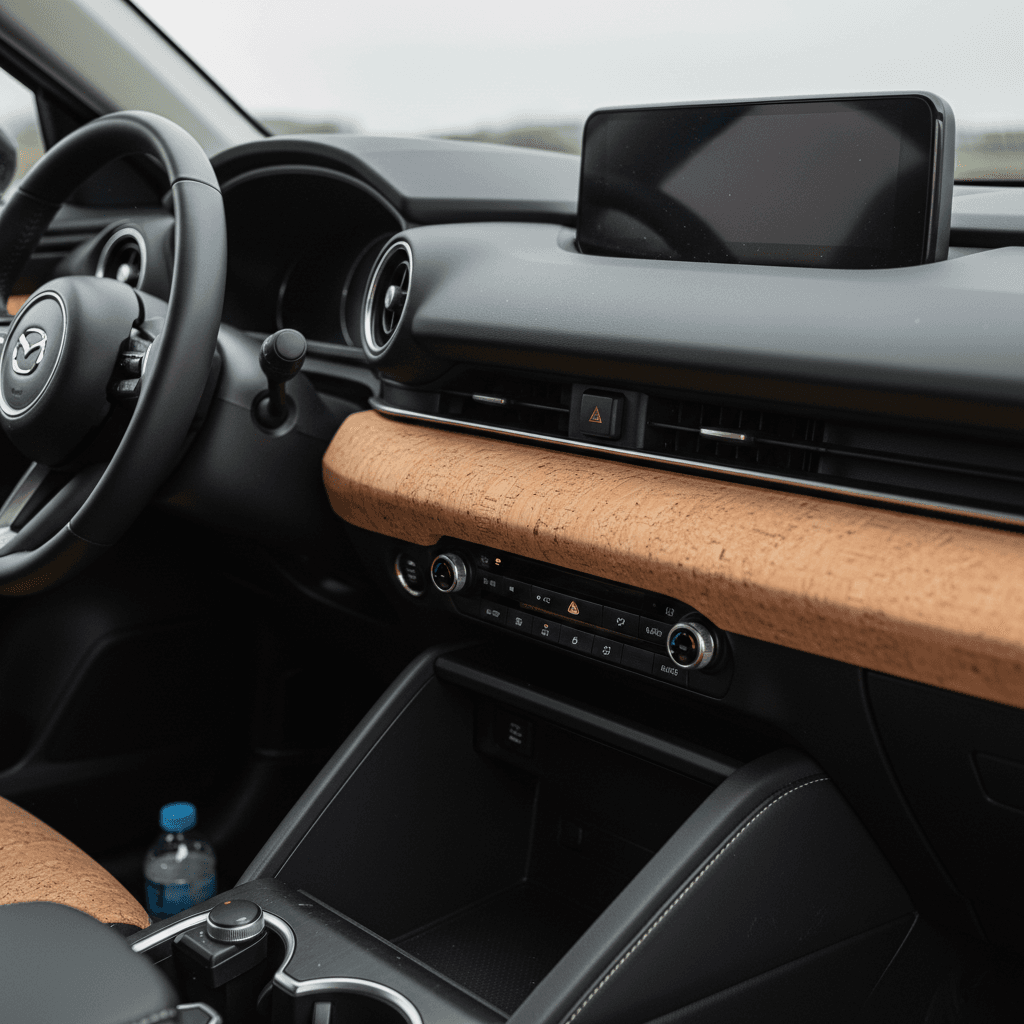
If you buy cars with your eyes and fingertips, the 2023 Mazda MX-30 makes a strong first argument. It’s a subcompact crossover on paper, but in person it looks like a concept car someone accidentally green‑lit for production: short overhangs, tight surfacing, a floating roofline, and those rear‑hinged “freestyle” back doors that open like a modern RX‑8.
Inside, Mazda went full Scandi‑cafe. There’s a floating center console trimmed in real cork, a nod to Mazda’s 1920s origins as a cork company, paired with woven door fabrics and soft‑touch materials where you expect hard plastic in this price class. The effect is calming rather than shouty, a welcome change from EV interiors that try too hard to look like Silicon Valley.
Front row
- Supportive seats with a typically Mazda driving position, low, centered, and sporty.
- Plenty of headroom despite the coupe roofline; adults up front won’t complain.
- Slim A‑pillars and a relatively upright dash make it easy to place in traffic and tight parking garages.
Back seat & cargo
- Rear‑hinged doors look cool but require the front doors to be opened first, fine for kids, fussy for adults.
- Legroom is tight and the small rear windows make it feel enclosed for taller passengers.
- Cargo room is hatchback‑generous for groceries and weekend bags but not a full‑on family hauler.
Test the rear doors before you commit
Driving experience: Mazda magic, limited muscle
Mazda has a house style behind the wheel: light but precise steering, a chassis that actually seems interested in corners, and pedals with real feel. The 2023 MX-30 preserves that DNA. At city and suburban speeds it feels lithe and eager, with Electric G‑Vectoring Control Plus subtly trimming motor torque to settle the car as you turn in. It’s one of the few small EVs that feels tuned by people who enjoy driving.
Power, however, is modest. With 143 horsepower and 200 lb‑ft of torque going to the front wheels, 0–60 mph lands in the mid‑to‑high eights, fine for merging if you plan ahead, underwhelming if you’re cross‑shopping modern EVs that can sandblast their tires at every green light. Top speed is governed around 90 mph, which tells you all you need to know about Mazda’s intended use case: urban and near‑suburban duty, not bombing the interstate.
How the MX-30 feels on the road
Not fast, but thoughtfully tuned.
In the city
Here the MX-30 is in its element. Instant but modest torque, tight turning radius, and compact dimensions make it easy to thread through traffic and parking garages.
On the highway
Stable and quiet enough, but acceleration from 60–80 mph takes patience. Range shrinks alarmingly at 70+ mph, so long highway stints are not its game.
On back roads
Chassis balance and steering feel are genuinely good. If you enjoy driving, you’ll appreciate the MX-30’s composure and the way it talks to you through the wheel.
The artificial engine note
Range & charging: the dealbreaker
This is where the 2023 Mazda MX-30 stops being quirky and starts being compromised. With a 100‑mile EPA range, it has the shortest legs of any 2023 EV sold in the U.S. In real life, that means 70–80 miles of highway range at typical American speeds and a bit more if you stick to city streets and drive gently.
- Battery: 35.5 kWh gross (mid‑30s usable) lithium‑ion pack under the floor
- EPA efficiency: 92 MPGe combined, unimpressive given the small battery
- Level 2 AC charging: about 5 hours from empty to full at 240V (6.6 kW onboard charger)
- DC fast‑charging: max 50 kW, roughly 20–80% in 35–40 minutes on a compatible charger
Plan for a big buffer
When the range works
- You have a short, predictable commute, say, 20–30 miles round trip, with home Level 2 charging.
- There’s a backup gas or long‑range EV in the household for road trips and long‑day errands.
- You mostly drive in town at 30–45 mph, where the MX-30’s efficiency is at its best.
When it absolutely doesn’t
- You regularly do 70–80‑mile round trips at highway speeds.
- You rely on inconsistent public charging or live in an apartment with no guaranteed overnight plug.
- You’re buying your first and only car and expect it to handle everything from Costco runs to weekend getaways.
Home charging is non‑negotiable
Safety, tech, and everyday usability
Where the MX-30 redeems some of its practical sins is in safety and standard equipment. Even the base trim arrived well loaded, and the 2023 Premium Plus package effectively turned this into a near‑luxury subcompact.
Notable 2023 MX-30 features
Much more generous than the range suggests.
Standard safety tech
- Automatic emergency braking with pedestrian detection
- Lane‑departure warning & lane‑keep assist
- Adaptive cruise control
- Available Blind Spot Assist & Front Cross Traffic Alert (Premium Plus)
Infotainment & connectivity
- Center screen with Mazda Connect interface
- Apple CarPlay & Android Auto
- Optional Bose 12‑speaker audio
- Mazda Connected Services for remote climate and charging control via app
Comfort & convenience
- Heated front seats and available heated steering wheel
- Floating console with extra storage and USB ports
- Available 360º parking camera and front parking sensors
- 5‑star frontal and side crash ratings
Battery warranty coverage
Ownership costs & depreciation: why used pricing matters
When new, the 2023 Mazda MX-30 started just over $34,000 before incentives, with the Premium Plus trim nudging past $37,000. For that money you could buy a Chevrolet Bolt EUV with 2.5 times the range, or a Kia Niro EV that would drive from Los Angeles to San Diego and back without recharging. The market noticed; depreciation has been steep.
The upside is that on the used market, a low‑mileage MX-30 today can undercut many rivals by thousands of dollars. Factor in low maintenance (no oil changes, fewer moving parts) and cheap electricity versus gas, and total cost of ownership can actually be very favorable, provided the car genuinely fits your use case. Insurance should be in line with other subcompact crossovers; parts availability is decent thanks to shared components with Mazda’s other small SUVs, though some unique body bits may take longer to source over time.
Cost questions to answer before buying a used MX-30
1. How many miles do you really drive per day?
Look at actual data from a smartphone app or your current car’s trip computer over a month. If your longest single‑day drives routinely exceed 60–70 miles, the MX-30 will feel tight.
2. What’s the real purchase price?
Because the MX-30 depreciated quickly, focus on the out‑the‑door used price, not what it cost new. A big discount versus rivals is what makes the compromise palatable.
3. Do you have a backup vehicle?
If there’s a gas car or long‑range EV in the household, the MX-30 can live happily as a commuter or city runabout. If it’s your only car, you’re taking on more risk.
4. Can you install Level 2 charging?
Factor in the cost of a 240V circuit and charger if you don’t already have one. A short‑range EV without home charging is a very specific kind of stress test.
Who the 2023 MX-30 actually works for
Every EV is a lifestyle quiz. With the 2023 MX-30, the first question is: are you honest with yourself about how you live? If so, and if your life falls into one of a few narrow lanes, the MX-30 can be a delight rather than a liability.
Best (and worst) fits for a 2023 MX-30
Think of it as a specialized tool, not a Swiss Army knife.
Great fit
- Homeowners with a garage and easy Level 2 charging.
- Households that already own a road‑trip‑ready car.
- Urban drivers who rarely exceed 40–50 miles a day.
- Enthusiasts who value design and driving feel over brute stats.
Poor fit
- One‑car households in spread‑out suburbs or rural areas.
- Drivers relying mostly on public DC fast charging.
- Frequent weekend travelers or gig‑economy drivers.
- Anyone anxious about seeing 30–40 miles remaining on a gauge.
How the MX-30 compares with alternatives
Viewed purely as transportation, the 2023 MX-30 is outgunned. Its closest rivals in size and price, Chevrolet Bolt EUV, Hyundai Kona Electric, Kia Niro EV, offer more than double the range, faster charging, and better straight‑line performance. Where the Mazda pushes back is in feel and finish.
2023 Mazda MX-30 vs common small EV alternatives
High‑level comparison for shoppers cross‑shopping used EVs in the same price ballpark.
| Model | Approx. EPA range | Battery size | Max DC charge | Character |
|---|---|---|---|---|
| Mazda MX-30 (2023) | 100 miles | 35.5 kWh | 50 kW | Beautiful interior, great handling, severely limited range |
| Chevrolet Bolt EUV | 247 miles | 65 kWh | 55 kW | Practical, efficient, value‑packed but more ordinary to drive |
| Hyundai Kona Electric | 258 miles | 64 kWh | ≈75 kW | Quick, efficient, conventional crossover shape |
| Kia Niro EV | 253 miles | 64.8 kWh | ≈85 kW | Spacious cabin, more family‑friendly packaging |
Exact used prices vary by market and condition; this is a directional comparison.
Head vs heart
Buying a used MX-30 with Recharged
Because the 2023 MX-30 is a discontinued, short‑run EV, condition and battery health matter more than usual. Two cars with the same odometer reading can have very different remaining range and degradation profiles depending on how they were charged and driven.
Every MX-30 bought or sold through Recharged comes with a Recharged Score Report that includes a verified battery‑health diagnostic, detailed charging history where available, and fair‑market pricing based on real EV transaction data. Our EV specialists can help you model your real daily mileage, talk through home‑charging options, and decide if the MX-30’s limitations are something you’ll work around, or grow to resent.
How Recharged de‑risks a quirky EV
2023 Mazda MX-30 FAQ
Frequently asked questions about the 2023 Mazda MX-30
Final thoughts: a charming cul-de-sac
The 2023 Mazda MX-30 is a lovely answer to a question almost nobody in America was asking: what if your EV felt like a carefully crafted boutique object, but only drove 100 miles on a good day? As a new‑car proposition, that was a non‑starter. As a used EV with heavy depreciation baked in, it becomes more interesting, provided you walk into the relationship with eyes wide open and a clear understanding of your daily driving.
If you want a single do‑everything car, there are better EVs and PHEVs in Mazda showrooms and beyond. But if you’re shopping for an affordable, stylish urban runabout to complement another vehicle, and the numbers genuinely work for your life, a carefully vetted MX-30 can be a satisfying, slightly eccentric choice. That’s where a platform like Recharged shines: matching you with the right used EV, verifying the battery and pricing, and making sure that when you fall for something quirky, it’s still a smart decision on paper.