If you’re looking at a 2022 Chevrolet Bolt EV, you’ve probably heard two things: it’s an efficient, affordable long‑range EV, and it’s been through a major battery recall. In this guide, we’ll walk through the most common **2022 Chevrolet Bolt EV problems and fixes**, how the battery recall really works, and what you should look for if you already own one or you’re shopping used.
Big picture on 2022 Bolt EV reliability
Quick take: how reliable is the 2022 Chevy Bolt EV?
2022 Chevy Bolt EV: reliability snapshot
On balance, the 2022 Bolt EV is one of the **better years to own**, thanks to updated interior tech and lower pricing. But you can’t ignore its recall history. Before you sign anything, or before you assume your car is fine, you need to confirm battery software updates, scan for steering and brake issues, and look for water intrusion around the lamps and roof.
1. Battery recall and fire risk: what 2022 owners must know
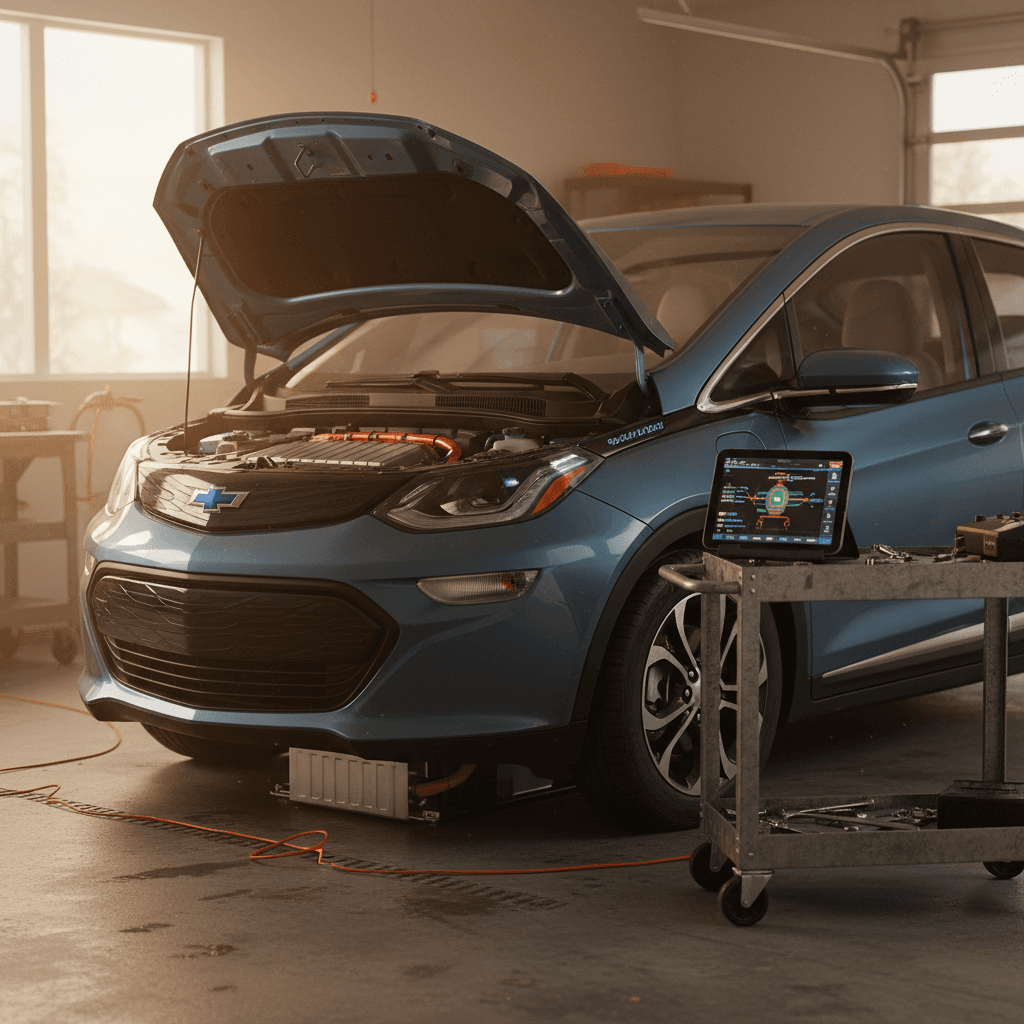
General Motors extended its high‑voltage battery recall to **every 2017–2022 Bolt EV and Bolt EUV**, after rare manufacturing defects in LG battery modules were linked to fires. Early on, GM planned to replace every pack. More recently, they’ve shifted to software diagnostics on many 2020–2022 cars to monitor and limit charging if the system sees anything suspicious.
- The defect involved two manufacturing issues in some cells that, when combined, could cause a thermal event (battery fire), even when the car was parked and unplugged.
- As part of the original campaign, many 2017–2019 cars received **full battery pack replacements**; some 2020–2022 cars did as well, especially if the system flagged a bad module.
- In 2024, GM issued an updated remedy for **2020–2022 Bolts**, reprogramming multiple control modules so the car can detect abnormal cell behavior and automatically limit state of charge or disable the pack if needed.
- Because of this history, **battery recall status is the number‑one thing to check** on any 2022 Bolt EV.
Don’t ignore battery software updates
How to check your 2022 Bolt EV for open battery recalls
Step‑by‑step: confirm battery recall completion
1. Grab the VIN
You’ll find the 17‑digit VIN at the base of the windshield on the driver’s side, on the door jamb sticker, and on your registration or insurance documents.
2. Run the VIN through GM’s recall tool
Visit Chevrolet’s recall lookup site, enter the VIN, and confirm whether any **open recalls or service campaigns** remain, especially anything mentioning “high voltage battery,” “HPCM2,” “BECM,” or “battery monitoring software.”
3. Ask the dealer for a service history printout
If you already own the car, call a Chevy dealer and ask for a **warranty service history**. Look for codes indicating the battery recall has been completed and whether the pack was replaced or only reprogrammed.
4. Check the charge limit behavior
Fully charge the car, if safe to do so, and confirm whether it allows you to reach the expected 100% setting and ~259‑mile range estimate. Sudden new limits or warnings can indicate the car’s software has detected a potential issue.
5. Watch for warnings while parked
Even after the fix, stay alert for unusual smells, smoke, or warnings in the dash or app when the car is charging or parked. If anything seems off, **unplug, move the vehicle away from structures if safe, and contact a dealer immediately.**
Battery‑health transparency when buying used
2. Steering rack problems and wandering feel
A growing number of owners of 2022–2023 Bolt EV and EUV models report **steering racks that don’t self‑center properly** after turns, or a vague “wandering” feel at highway speeds. In some cases, drivers say the car slowly drifts out of its lane if they loosen their grip on the wheel.
- Steering wheel fails to return to center after a left or right turn.
- Car feels like it’s “hunting” or meandering on straight roads, requiring constant correction.
- Occasional binding or notchy feel in the wheel, especially at low speeds.
- Dealer diagnosis of a **faulty steering rack**, with relatively expensive out‑of‑warranty repair quotes.
Why a bad steering rack is serious
What to do if your 2022 Bolt EV wanders or won’t self‑center
1. Rule out simple alignment issues
If you feel mild drift or uneven tire wear, start with a **four‑wheel alignment** and tire pressure check at a trusted shop. Inexpensive tires or uneven inflation can exaggerate wandering.
2. Test self‑centering in a safe area
In an empty parking lot, make gentle left and right turns at low speed. When you release steering pressure, the wheel should smoothly move back toward center. If it sticks or returns sluggishly, note exactly what happens.
3. Document the behavior
Record short videos from the driver’s seat (safely, with a passenger if possible) showing the wheel’s failure to return and any on‑screen warnings. Documentation helps the dealer and supports any warranty or goodwill claim.
4. Request a rack inspection at a Chevy dealer
Ask the service department to **inspect the steering rack and intermediate shaft**. Mention that other 2022–2023 owners have had confirmed rack failures, so they understand this isn’t just a subjective complaint.
5. Explore warranty or goodwill options
If your car is near the end of its basic warranty, ask the dealer and GM customer assistance about **goodwill assistance** if they confirm a steering rack defect. Having a well‑documented service history and low mileage helps your case.
3. Headlight, DRL, and water‑intrusion complaints
Lighting issues aren’t as dramatic as battery fires, but they’re common enough on newer Bolts that they’re worth a close look. Owners of 2022 EVs and EUVs frequently mention **condensation in the headlights or DRLs**, and occasional **water leaks** around the roof seams or hatch area.
- Fogging or beads of moisture inside headlight or daytime running light (DRL) lenses, especially after rain or car washes.
- Headlight output that feels dim or has a very sharp cutoff, making nighttime visibility feel worse than expected.
- Water dripping into the cargo area or around the C‑pillars after heavy rain, usually due to small gaps in roof or hatch seals.
- Intermittent lighting warnings if moisture reaches bulb sockets or connectors.
Normal fog vs. real problem
Fixing 2022 Bolt EV lighting and water‑leak issues
1. Inspect all lamps closely in daylight
Look for pooled water, mineral streaks, or “tide marks” inside the headlight or taillight lens. These indicate moisture that’s been there a while, not just normal post‑wash fog.
2. Run a hose test around roof and hatch
With a helper inside the car, lightly spray water around the **roof seams, liftgate, and taillights**. Your helper should watch for drips or damp spots in the headliner and cargo area.
3. Document and schedule a dealer visit
Take clear photos or videos of any moisture or leaks and schedule a visit while the car is still under warranty. Seals and housings are much cheaper to address now than after corrosion sets in.
4. Ask for lamp or seal replacement under warranty
Persistent moisture issues often qualify for **lamp assembly replacement**. Roof or hatch leaks can be handled with seal resealing, panel adjustment, or in rare cases, repaint/reseal work.
5. Protect interior surfaces
Until the leak is fixed, keep absorbent towels in affected areas and avoid parking under trees where debris can clog drains. This won’t solve the root cause but can reduce mold and staining.
4. Electronics glitches, warning lights, and "phantom" alerts
Like many modern EVs, the 2022 Bolt EV relies heavily on software. Owners sometimes report **random warning lights** for ABS, traction control, parking brake, or even messages about a “transmission” on a car that doesn’t have a conventional gearbox. Often, these are **software logic quirks or momentary sensor hiccups** rather than actual component failures.
- ABS or traction‑control warning lights that come on briefly and then clear on the next drive cycle.
- Parking brake warnings displayed in the app or cluster even when the brake is functioning normally.
- “Unable to shift” or similar transmission‑related messages caused by shared software used across GM models, even though the Bolt uses a single‑speed drive unit.
- Occasional infotainment freezes, Bluetooth glitches, or CarPlay/Android Auto disconnects.
Why software matters more on newer Bolts
How to handle 2022 Bolt EV warning lights and glitches
1. Don’t panic, note the exact message
When a warning appears, safely pull over if necessary and **photograph the dash and infotainment screen**. Note speed, weather, and what you were doing (charging, braking, cruising).
2. See if it clears on the next restart
Some transient faults disappear when you turn the car off and back on. If the message is gone and doesn’t return, mention it at your next service but don’t assume a major failure.
3. Check for software campaigns
Ask your Chevy dealer to look for **open software updates and technical service bulletins (TSBs)** related to the warnings you’ve seen. Many owners report that updated control‑module software greatly reduces nuisance alerts.
4. Insist on a scan and printed report
Have the dealer scan all modules and give you a **DTC (diagnostic trouble code) printout**. This helps you track repeat issues and can protect you if a component fails just out of warranty.
5. For persistent faults, push for a clear diagnosis
If the same warning comes back repeatedly, ask the service advisor to escalate with GM engineering if needed. The goal is a **specific failed part or documented software fix**, not “no trouble found.”
5. Brake noise, sticking calipers, and one‑pedal driving
Electric vehicles like the 2022 Bolt EV use **regenerative braking** heavily, which means the physical brake pads and rotors get less use than on a gas car. That’s good for wear, but it can lead to **surface rust, sticky calipers, or noisy brakes**, especially in wet or salty climates.
- Grinding or scraping noises after the car has been parked for a few days, which often improve after a few firm stops.
- A sticking front caliper leading to uneven pad wear or a hot wheel after a drive.
- Soft‑feeling pedal if air has entered the system during previous service.
- Owner confusion between normal regen behavior and actual brake problems.
Use the brakes on purpose
Keeping your 2022 Bolt EV brakes healthy
1. Listen after overnight parking
If you hear grinding only for the first few stops on a damp morning, it’s often just **surface rust**. If the noise continues after several miles, have the brakes inspected.
2. Feel each wheel after a drive (carefully)
After a normal drive, carefully hover your hand near each wheel. One wheel that’s significantly hotter than the others may indicate a **sticking caliper** or dragging pad.
3. Schedule periodic brake inspections
Even if your pads have plenty of life left, ask for a **brake inspection every 12–18 months** so a technician can clean and lubricate the caliper slides and check for uneven wear.
4. Address ABS or brake warnings promptly
Warning lights tied to ABS, stability control, or the parking brake deserve immediate attention. Many causes are minor (like a wheel‑speed sensor), but they affect safety systems.
6. Other notable 2022 Bolt EV problems (less common)
Beyond the headline issues, a small percentage of 2022 Bolt EV owners report additional problems. Most are isolated, but when you’re shopping used, or trying to sort out a troublesome car, it helps to know what’s out there.
Less‑common 2022 Bolt EV issues to be aware of
Not everyone will see these, but they’re worth checking for during a test drive or inspection.
Individual bad battery cells
A handful of owners have had a brand‑new 2022 pack develop a single failed cell, forcing full pack replacement. With updated monitoring software, the car should flag this early, but it’s one more reason to verify recall work and monitor range over time.
HVAC or heat pump quirks
Some drivers report weak cabin heat or noisy blower motors. Always test the HVAC in both heating and cooling modes, including defrost, before buying.
Rattles and interior noises
Like many compact cars, the Bolt can develop trim rattles over rough pavement. A careful test drive on varied roads will reveal squeaks around the dash or cargo area.
Keeping your 2022 Bolt EV healthy: preventive tips
One upside of an EV like the 2022 Bolt is low routine maintenance, no oil changes, timing belts, or spark plugs. But that doesn’t mean you can ignore it. A little attention goes a long way toward avoiding expensive surprises.
Smart charging habits
- For daily use, keep your charge target around 70–80% instead of 100% to reduce long‑term battery stress.
- Avoid letting the car sit at 0% or 100% for days at a time, especially in extreme heat.
- Use DC fast charging when you need it, but don’t rely on it exclusively for daily commuting.
Routine inspections
- Check tires, brakes, and suspension annually or at least every 12,000 miles.
- Have the cabin and high‑voltage cooling systems inspected per the maintenance schedule.
- Ask your dealer at each visit to confirm all software updates and recalls are current.
Good news on maintenance costs
Buying a used 2022 Chevy Bolt EV: checklist and pricing traps
The 2022 model year is a sweet spot in the Bolt lineup: refreshed styling and interior, long range, and often **attractive used‑car pricing** after federal and state incentives influenced original buyers. But the same things that make it appealing also attract problem cars that haven’t had recall work or repairs done correctly.
Used 2022 Bolt EV buyer checklist
Key items to verify before you commit to a specific car.
| Item | What to Check | Why It Matters |
|---|---|---|
| Battery recall status | Run the VIN through GM’s recall tool and confirm all battery campaigns are complete. | Unresolved campaigns can limit charging, affect safety, or reduce resale value. |
| Battery health & range | Compare real‑world range at ~80–100% charge to expectations; review any independent battery‑health report. | A weak pack can turn a bargain into a bad deal, and is expensive to replace out of warranty. |
| Steering behavior | Test self‑centering and straight‑line stability at highway speed. | Catches potential steering‑rack issues that can cost thousands to address. |
| Lighting & leaks | Look for condensation in lamps, stains in headliner, or damp cargo carpet. | Early signs of water intrusion that can lead to electrical problems and mold. |
| Brake feel & noise | Listen for grinding or pulling; review any brake service history. | Helps you avoid immediate brake work, especially in rust‑prone regions. |
| Software updates | Ask for dealer service records showing recent firmware updates. | Ensures you benefit from GM’s latest fixes for charging, monitoring, and warning‑light logic. |
Bring this list, or a printed inspection sheet, with you when you inspect and test‑drive a used 2022 Chevrolet Bolt EV.
Don’t buy blind from generic marketplaces
How Recharged helps you avoid problem cars
If all of this sounds like a lot to track, you’re not wrong. The 2022 Bolt EV can be a terrific value, but only if you start with the right car. That’s why every used EV sold through Recharged comes with a **Recharged Score Report** that goes far beyond a basic Carfax or a quick test drive.
What you get with a Recharged‑inspected 2022 Bolt EV
Designed to de‑risk used EV ownership, especially on recall‑heavy models like the Bolt.
Battery health you can see
The Recharged Score includes **independent battery health diagnostics**, so you know how much usable capacity remains, not just what the dash guess‑o‑meter says.
Recall & safety verification
We verify that **all safety recalls and software campaigns** have been completed, including the latest high‑voltage battery and monitoring updates for 2022 Bolts.
Financing, trade‑in & delivery
You can finance your Bolt EV, apply your trade‑in or instant offer, and arrange **nationwide delivery** or pickup at our Richmond, VA Experience Center, all with EV‑specialist support.
Ready to find your next EV?
Browse Vehicles2022 Chevy Bolt EV problems & fixes: FAQ
Frequently asked questions about 2022 Chevy Bolt EV problems
The 2022 Chevrolet Bolt EV is one of the most compelling used‑EV values on the market, efficient, practical, and often very affordable. Its history of battery recalls and a handful of steering, lighting, and electronics issues means you can’t treat it like just another used hatchback, but with the right checks and fixes, it can deliver years of low‑cost, low‑drama driving. Whether you’re vetting your current Bolt or shopping for your first used EV, taking a structured approach, and leaning on independent tools like the Recharged Score, turns a complicated recall story into a car you can buy and drive with confidence.