If you own a 2021 Hyundai Kona Electric and are thinking about trading it in for something newer, or just cashing out, your biggest question is obvious: what’s my 2021 Hyundai Kona Electric trade-in value today? In early 2026, the answer depends heavily on mileage, condition, battery health, and where you sell it. This guide walks you through real-world value ranges, what dealers actually look at, and how to get the strongest offer for your Kona EV.
Quick snapshot
2021 Kona Electric trade-in value today
2021 Hyundai Kona Electric value at a glance (2026)
Public pricing guides like Kelley Blue Book and others show national average trade-in values for 2021 Kona Electrics in the low-teens for typical mileage and "good" condition, with higher numbers for very clean, low-mile examples and lower numbers for high-mile or rough vehicles. Many 2021s still book surprisingly strong given their age, thanks to decent range and an 8–10 year battery warranty window that’s still active.
Start with an online estimate, then reality-check it
Why the 2021 Kona Electric holds its value
The 2021 Hyundai Kona Electric hit a sweet spot: useful real-world range, a compact crossover body style, and a still-current feature set. Many 2021 cars feel a generation old by now; the Kona EV doesn’t. That helps support trade-in and resale values even as newer models and tax incentives reshuffle the market.
Reasons 2021 Kona Electric values are relatively strong
These fundamentals help your trade-in number more than color or wheels ever will.
Competitive range
Long battery warranty
Low running costs
Of course, EV prices as a whole have moved around sharply since 2021, especially after new EV price cuts and tax-credit reshuffles. That means your Kona’s resale and trade-in value is also influenced by what a buyer could instead get in a newer EV, often at a discounted price once incentives are factored in.
Price ranges: what your 2021 Kona Electric might be worth
Approximate 2026 value ranges for 2021 Hyundai Kona Electric
High-level U.S. ranges to help you sanity-check offers. Your exact numbers will depend on trim, options, condition, mileage, battery health, and local EV demand.
| Scenario (2021 Kona Electric) | Odometer (approx.) | Condition example | Likely trade-in range | Likely retail / marketplace ask |
|---|---|---|---|---|
| Low miles, SEL or Limited, strong battery | 25,000–40,000 mi | Very clean, no accidents, full service history | $15,000–$19,000 | $18,000–$23,000 |
| Average use, clean SEL / Ultimate | 45,000–70,000 mi | Minor wear, no major damage | $11,000–$16,000 | $15,000–$19,000 |
| High miles or cosmetic issues | 75,000–110,000+ mi | Noticeable wear, prior repairs, or minor accidents | $8,500–$13,000 | $12,000–$16,000 |
| Outstanding condition, rare low miles | Under 25,000 mi | Like-new, one-owner, perfect history | $18,000+ (select markets) | $22,000+ where demand is strong |
Illustrative ranges only, not formal appraisals. Always get a live offer for your specific VIN.
Values can swing fast
You’ll also see different numbers depending on where you look: book values (Kelley Blue Book, Edmunds, etc.), dealer trade-in bids, and real transaction prices on used EV marketplaces. None of them is “right” on its own. The real picture comes from comparing all three and seeing what buyers are actually willing to pay for a 2021 Kona Electric like yours.
What dealers actually look at when pricing your Kona EV
What a traditional dealer sees
- Wholesale auction data: What similar Kona EVs are crossing the block for right now.
- Reconditioning cost: Tires, brakes, detailing, bodywork, software updates, and any EV-specific checks.
- Risk cushion: Because many dealers are still learning EVs, they often underprice your trade to protect themselves.
- Local demand only: If EVs move slowly in their area, they’ll bid cautiously, even if your car is excellent.
What an EV-focused buyer like Recharged sees
- Battery and charging health: How many good, warrantied miles are realistically left in the pack.
- True retail potential: What informed EV shoppers are paying nationally for similar 2021 Kona Electrics.
- Trim and options: Features like active safety, heated seats, and driver-assist systems that matter in the EV used market.
- Digital retailability: How your specific car will present online with a detailed Recharged Score Report and transparent battery diagnostics.
The more a buyer understands EVs, and the Kona Electric specifically, the more they’re willing to pay for a well-kept 2021. That’s why owners often see a bigger gap between dealer trade-in and specialized EV marketplaces than they would on a comparable gas Kona.
Battery health: how much it can move your value
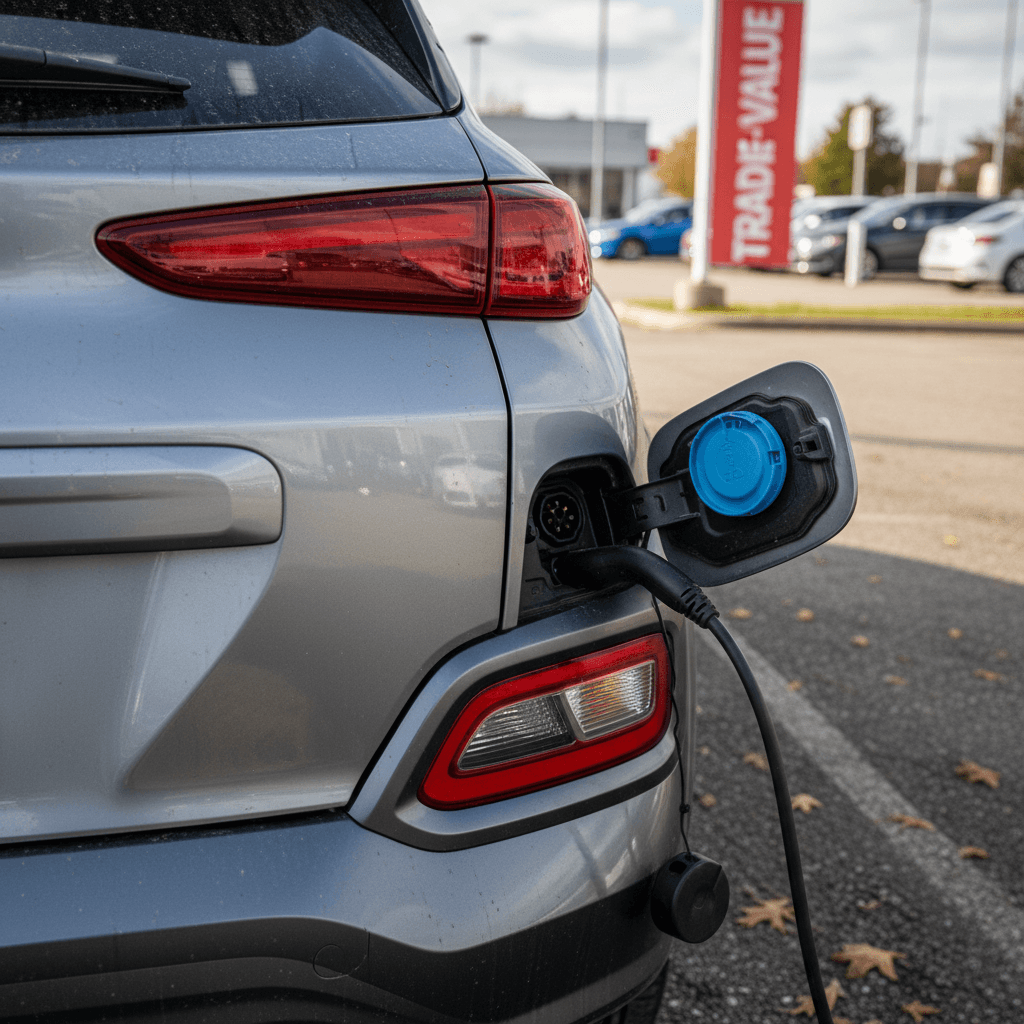
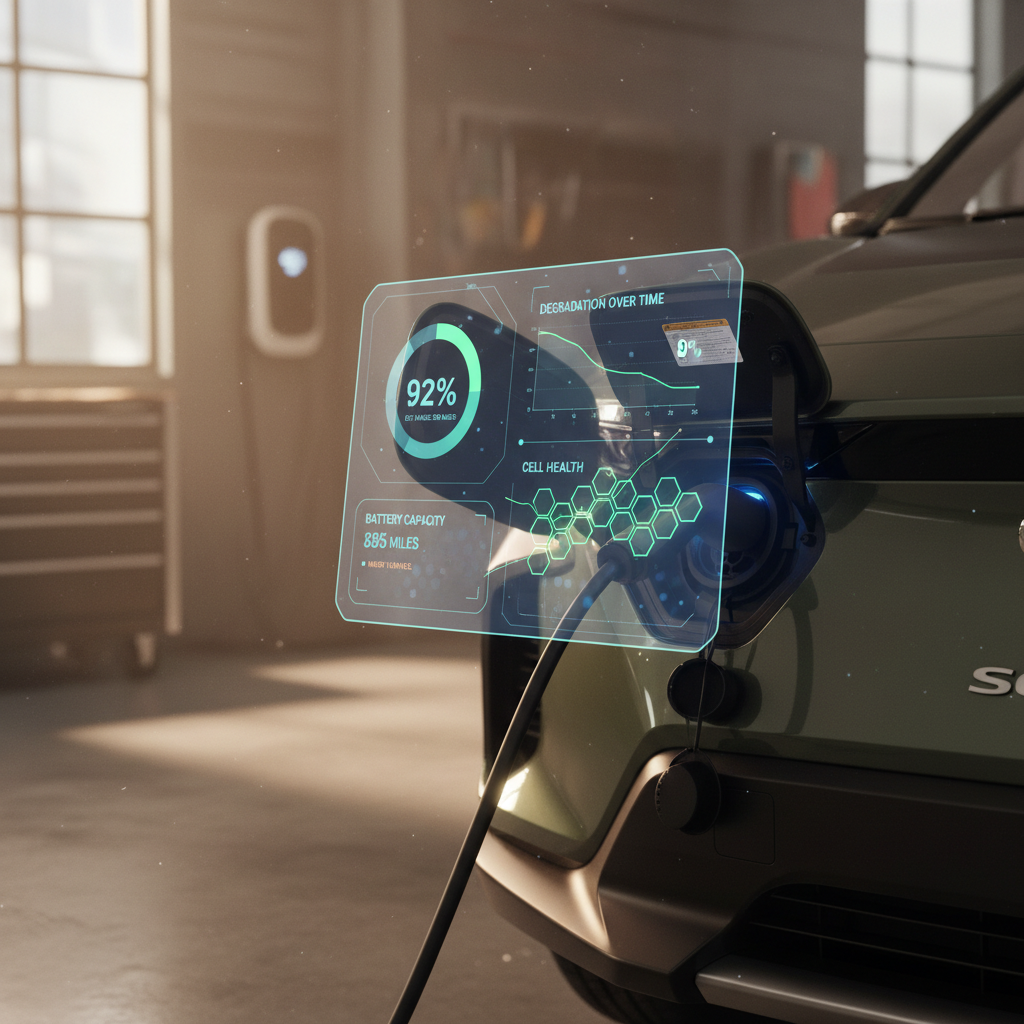
On a gas car, condition is mostly paint, interior, and service history. On a 2021 Kona Electric, the battery pack is the star of the show. A car that looks perfect but has a tired battery is a much harder retail sale than one that’s cosmetically average but has a strong, warrantied pack.
- Most 2021 Kona Electrics in the U.S. carry an 8–10 year / 100,000 mile high-voltage battery warranty from the original in-service date, which is still active for many cars in 2026.
- Real-world reports show many Kona packs retaining well over 90% state of health after three to five years when maintained normally.
- If an inspection or prior paperwork shows a warranty battery replacement, that can actually help value, your 2021 might have a much newer pack than its model year suggests.
- Conversely, evidence of rapid degradation, repeated fast-charging-only use, or battery warnings in the history can push offers significantly lower.
How Recharged uses battery data
How to get the best 2021 Kona Electric trade-in offer
Smart moves before you get quotes
1. Pull realistic value benchmarks
Check several sources, KBB/Edmunds-style guides, EV-specific sites, and recent Kona Electric listings, to understand <strong>what 2021s are actually selling for</strong>, not just listed at.
2. Gather records and warranty info
Have service invoices, recall paperwork, tire receipts, and <strong>warranty documents</strong> ready. If your 2021 has had battery work under warranty, that detail matters.
3. Get the car looking its best
A professional detail, light paintless dent repair, and fresh floor mats are usually cheaper than the discount a buyer will demand for a dirty or tired-looking cabin.
4. Fix small, high-visibility items
Replacing worn wiper blades or repairing curb-rashed wheels can pay for itself in a better first impression. Skip big cosmetic projects unless they’re truly inexpensive.
5. Get a battery health report
If possible, have a <strong>recent battery health check</strong> from a dealer or an independent EV specialist. At Recharged, we perform our own diagnostics and share that in your Recharged Score Report.
6. Collect multiple offers, not just one
Get quotes from at least <strong>one local dealer, one online instant-offer service, and an EV-focused marketplace</strong>. The spread between them tells you where the real money is.
Where Recharged fits in
Ready to find your next EV?
Browse VehiclesTrade-in vs selling to Recharged vs private sale
Ways to sell your 2021 Kona Electric, compared
Each path balances convenience, price, and effort differently.
| Option | Typical price vs best case | Time & effort | Pros | Cons |
|---|---|---|---|---|
| Traditional dealer trade-in | Lowest (often thousands under potential) | Fastest | One-stop transaction when you’re already buying another car; no advertising, no strangers. | Offers often assume the worst on EVs; limited understanding of battery health; you’re negotiating on two deals at once. |
| Sell to Recharged (instant offer) | Higher than most dealer trades | Fast | EV experts; offers based on real battery diagnostics and national demand; fully digital process with available nationwide pickup. | May still be a bit under what you could get if you’re willing to wait for a top-dollar retail buyer. |
| Recharged consignment / marketplace listing | Near top of market | Moderate | Professional listing, Recharged Score Report, and EV-specialist support; you keep more of the upside without managing every step yourself. | Takes longer than an instant trade; you’ll wait for the right buyer. |
| Private-party sale (DIY) | Potentially highest | Most work | You control the ad, price, and negotiation; no middleman. | You handle calls, test drives, paperwork, and risk; many shoppers don’t fully understand EVs or battery health. |
For many EV owners, the sweet spot is a specialist marketplace that understands battery health and EV shoppers, rather than a traditional trade-in or pure DIY sale.
Warranty, mileage, and options: how they impact value
Key levers on a 2021 Kona Electric’s value
You can’t change model year, but you can understand how the rest works against you or for you.
Mileage bands
Warranty runway
Trim & equipment
Don’t underestimate clean history
Common mistakes that cost Kona Electric owners money
- Taking the first offer from the dealer that’s selling you a new car, without shopping it against at least two other channels.
- Assuming EVs are all treated the same as gas cars on trade. Many dealers still undervalue older EVs simply because they don’t know how to price battery health and range.
- Ignoring cosmetic issues that are cheap to fix. A $250 wheel repair and a full detail can move your car into a higher perceived tier in the appraiser’s mind.
- Waiting until after a big price cut on new EVs or a tax-credit change that suddenly makes newer models much cheaper, dragging used prices down with them.
- Not bringing documentation of battery warranty work, software updates, and regular maintenance that would reassure a cautious buyer.
Be careful with “free” add-ons at trade-in
FAQs: 2021 Hyundai Kona Electric trade-in value
Frequently asked questions about 2021 Kona Electric trade-ins
Bottom line: What to expect for your 2021 Kona Electric
In 2026, the 2021 Hyundai Kona Electric trade-in value sits at an interesting crossroads. It’s old enough that depreciation has done some work, but new enough, and efficient enough, that demand remains solid, especially for clean, low-mile examples with healthy batteries and plenty of warranty runway. That’s good news if you own one.
If you want to keep life simple, a traditional dealer trade will move the car quickly, but likely at the bottom of its realistic value range. If you’re willing to spend a little more time, exploring offers from an EV-focused retailer like Recharged or listing via consignment can help you capture far more of what your 2021 Kona Electric is actually worth.
Before you sign anything, benchmark your car with a few online tools, gather your records, and get at least one offer from an EV specialist who understands battery health. That way, whether you trade, sell, or upgrade through Recharged, you’ll walk into the negotiation knowing exactly what your Kona EV deserves, and what a fair deal really looks like.