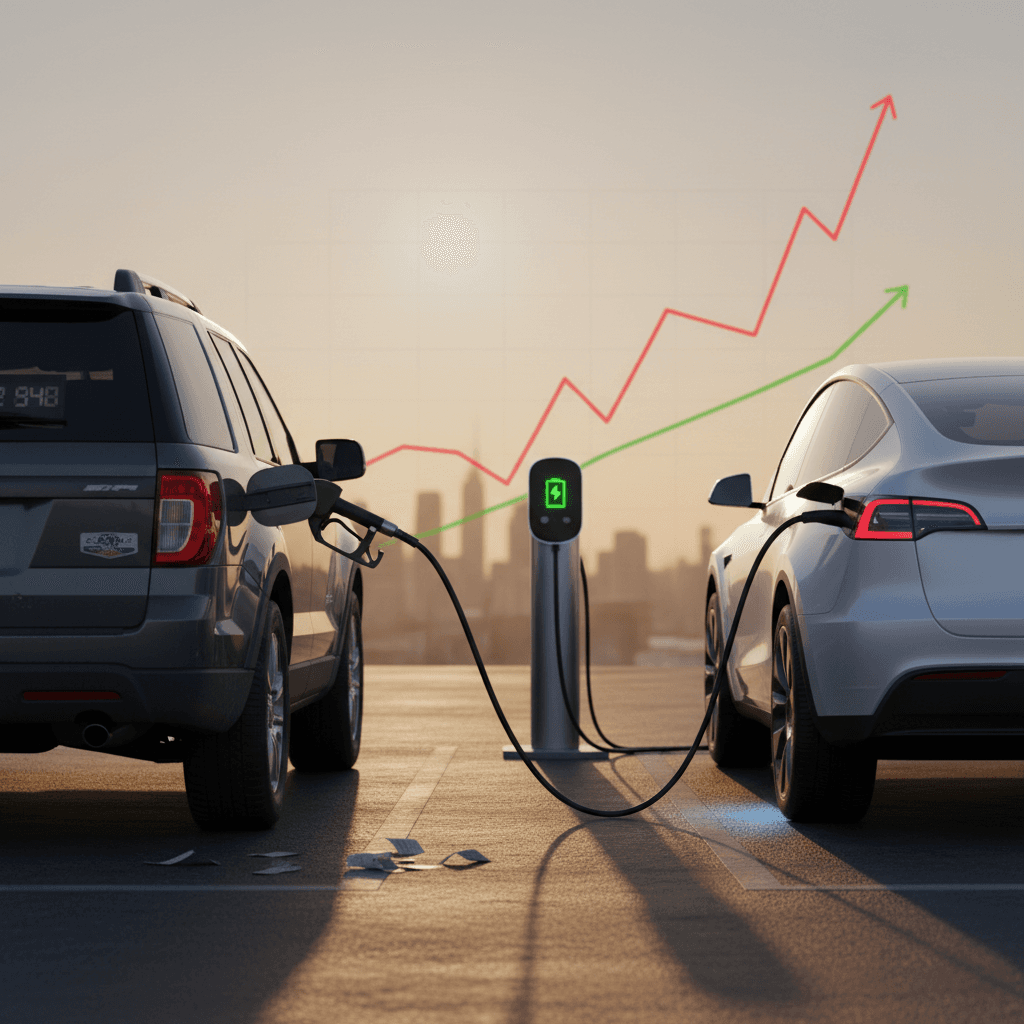
If you’re cross-shopping a traditional 20 mpg gasoline SUV against an electric SUV, the first question that usually pops up is simple: how much cheaper is it to “fuel” the EV each year? In this guide, we’ll compare a 20 mpg SUV vs an electric SUV annual fuel cost using realistic U.S. gas and electricity prices, then show you how the math changes with your commute, home charging, and road trips.
What this article covers
Why compare a 20 MPG SUV vs an electric SUV?
A lot of popular midsize and full-size gasoline SUVs, especially older ones, land right around 20 miles per gallon combined. That makes 20 mpg a useful benchmark if you’re upgrading from a family hauler or 3-row crossover and wondering whether an electric SUV will actually save you money every year.
- 20 mpg is typical for many V6 and smaller V8 SUVs from the last decade.
- Electric SUVs commonly average about 3 miles per kWh in real-world mixed driving.
- Fuel and electricity prices have both moved sharply in recent years, so using current numbers matters.
- Used electric SUVs are dropping in price, which means energy savings now play a bigger role in the total picture.
Quick rule of thumb
Key assumptions and quick answers
Baseline assumptions for this comparison
We’ll walk through several mileage and price scenarios in detail, but it helps to start with the headline. Using those assumptions and 15,000 miles per year as a “typical driver” scenario:
At 15,000 miles per year: 20 mpg SUV vs electric SUV
Using $3.50 per gallon gas and $0.13 per kWh home electricity
20 MPG gasoline SUV
- Fuel used: 750 gallons per year
- Annual fuel cost: $2,625
- Cost per mile: about $0.18
Electric SUV (3 mi/kWh)
- Energy used: 5,000 kWh per year
- Annual home-charging cost: $650
- Cost per mile: about $0.04
Big-picture takeaway
Step-by-step math: 20 MPG SUV annual fuel cost
Let’s start with the gasoline side. You only need three numbers to estimate your annual fuel cost in a 20 mpg SUV:
- How many miles you drive per year (we’ll use 10,000 / 15,000 / 20,000 miles).
- Your SUV’s fuel economy (we’ll use 20 mpg).
- Your average price per gallon of gas (we’ll start with $3.50, then show higher prices).
Annual fuel cost for a 20 MPG SUV
Assumes regular unleaded at $3.50 per gallon. Adjust the gas price column for your local conditions.
| Miles per year | MPG | Gallons per year | Annual fuel cost @ $3.50/gal | Cost per mile |
|---|---|---|---|---|
| 10,000 | 20 | 500 | $1,750 | $0.18 |
| 15,000 | 20 | 750 | $2,625 | $0.18 |
| 20,000 | 20 | 1,000 | $3,500 | $0.18 |
Multiply gallons per year by your local price per gallon to customize these numbers.
How to do the math yourself
What if gas is cheaper?
If gas drops to $3.00 per gallon, that same 20 mpg SUV at 15,000 miles per year costs:
- 750 gallons × $3.00 = $2,250 per year
- Cost per mile: about $0.15
What if gas is more expensive?
If gas spikes to $4.50 per gallon, the same driving becomes:
- 750 gallons × $4.50 = $3,375 per year
- Cost per mile: about $0.23
That’s a swing of more than $1,100 per year just from fuel prices moving.
Step-by-step math: electric SUV annual charging cost
Now let’s run the same exercise for a typical electric SUV. Most mainstream electric SUVs, think Hyundai Ioniq 5, Tesla Model Y, Ford Mustang Mach-E, tend to deliver around 2.5–3.5 miles per kWh in real-world mixed driving. We’ll use a middle-of-the-road 3 mi/kWh to keep the math simple.
- We’ll assume you do most of your charging at home at $0.13 per kWh.
- We’ll again use 10,000 / 15,000 / 20,000 miles per year.
- We’ll ignore occasional DC fast charging for a moment, then add it back in later.
Annual electricity cost for an electric SUV (home charging)
Assumes 3 miles per kWh efficiency and $0.13 per kWh residential electricity.
| Miles per year | Efficiency (mi/kWh) | kWh per year | Annual cost @ $0.13/kWh | Cost per mile |
|---|---|---|---|---|
| 10,000 | 3.0 | 3,333 | ≈ $433 | ≈ $0.04 |
| 15,000 | 3.0 | 5,000 | $650 | ≈ $0.04 |
| 20,000 | 3.0 | 6,667 | ≈ $867 | ≈ $0.04 |
If your EV is less efficient (say 2.5 mi/kWh) or your rates are higher, your numbers will scale up proportionally.
Nighttime and EV rates can make it even cheaper
Side-by-side examples: 20 MPG SUV vs electric SUV
Putting the pieces together, here’s how a 20 mpg gasoline SUV compares to an electric SUV at different annual mileage levels, assuming $3.50 gas, $0.13/kWh home electricity, and 3 mi/kWh efficiency for the EV.
20 MPG SUV vs electric SUV annual energy cost
Assumes 100% home charging for the EV at $0.13/kWh. In reality, most owners use a mix of home, workplace, and some public fast charging.
| Miles per year | 20 MPG SUV cost | Electric SUV cost | Annual savings | Savings per mile |
|---|---|---|---|---|
| 10,000 | $1,750 | ≈ $433 | ≈ $1,317 | ≈ $0.13 |
| 15,000 | $2,625 | $650 | $1,975 | ≈ $0.13 |
| 20,000 | $3,500 | ≈ $867 | ≈ $2,633 | ≈ $0.13 |
Annual savings are the difference between the gas SUV’s fuel cost and the EV’s charging cost.
Annual savings in plain English
How your driving patterns change the math
Of course, nobody’s life fits neatly into a spreadsheet. Your actual cost difference will depend heavily on how far you drive, where you charge, and how often you take long road trips. Here are the big levers.
Three common SUV driving profiles
See which profile looks most like your household.
Short-commute family
- 8,000–10,000 miles per year
- Mostly city and suburban driving
- Rarely uses highway DC fast charging
EV still wins on cost, but the absolute dollar savings per year are smaller because you simply don’t drive as much.
Typical commuter
- 12,000–15,000 miles per year
- Mix of highway and local driving
- Home charging most nights
This is the “sweet spot” where EV vs gas savings become very noticeable in your monthly budget.
Road-trip heavy
- 18,000–25,000+ miles per year
- Frequent long highway trips
- More public fast charging
Gas bills can get painful in a 20 mpg SUV. EVs still generally win on total energy cost, but savings depend on how often you pay premium rates at fast chargers.
The impact of DC fast charging
If you mostly charge at home
Home charging is where electric SUVs shine. Your cost per mile stays low and predictable, and you can take advantage of off-peak rates. For many owners, more than 80–90% of charging happens in their driveway or garage.
If you rely on public charging
Apartment dwellers or frequent road-trippers will lean on public Level 2 and fast charging more often. Your savings vs a 20 mpg SUV will depend on your local network pricing, but electricity is still a more efficient way to move energy into a vehicle than burning gasoline.
Beyond fuel: maintenance and other savings
Fuel (or electricity) is just part of the ownership story. Electric SUVs cut several recurring maintenance items that are baked into gas SUV ownership. Over a typical five-year period, that can tilt the scales even further toward the EV, especially if you’re comparing against an older 20 mpg SUV that’s out of warranty.
Maintenance differences that favor electric SUVs
No oil changes
Electric SUVs don’t need engine oil changes, spark plugs, or many of the tune-up items a gasoline drivetrain requires. That alone can save a few hundred dollars a year for higher-mileage drivers.
Less brake wear
Regenerative braking recovers energy and slows the vehicle using the electric motor. That means brake pads and rotors on an EV often last significantly longer than on a comparable gas SUV.
Fewer moving parts
An EV drivetrain has far fewer moving parts than a conventional engine and transmission. There’s no exhaust system, fuel injection, or complicated emission controls to maintain.
Routine checks still matter
You’ll still need tires, cabin filters, and occasional coolant or brake fluid service. Budget for maintenance, just know that the everyday schedule tends to be lighter and simpler than for a gasoline SUV.
How Recharged helps you see the full picture
Used electric SUVs: where the savings get interesting
Because new EV prices have softened and more leases are returning, the used electric SUV market has become especially compelling. You’re no longer paying an early-adopter premium, but you still capture most of the fuel and maintenance savings over a 20 mpg SUV.
Why a used electric SUV can beat a 20 MPG SUV on cost
Real-world advantages that matter to your budget.
Lower purchase price
Known battery health
Financing plus fuel savings
When you run the numbers over five to eight years, a reasonably priced used electric SUV can undercut the total cost of owning a thirsty 20 mpg SUV by thousands of dollars, even before you account for potential local incentives.
Common pitfalls when comparing fuel and charging costs
When shoppers try to compare a 20 mpg SUV vs an electric SUV annual fuel cost, a few recurring mistakes tend to skew the results. Here’s what to watch for so your own math stays honest.
Avoid these mistakes in your cost comparison
Ignoring your actual miles per year
Using 12,000 miles as a default when you really drive 20,000 will massively understate both your gas bill and your potential EV savings. Start with your real odometer history if you can.
Mixing national and local prices
National averages are fine for a starting point, but your <strong>local</strong> gas and electricity prices matter more. Rural areas, big coastal cities, and deregulated electricity markets can look very different.
Assuming 100% free charging
Some EV buyers assume workplace or public chargers will always be free. That’s rarely true long-term, and policies change. Base your math on realistic, sustainable pricing structures.
Forgetting about winter and climate
Extreme heat or cold can affect both MPG and EV efficiency. An electric SUV that averages 3.0 mi/kWh in mild weather might drop closer to 2.5 mi/kWh in a harsh winter, still usually cheaper than a 20 mpg SUV, but worth factoring in.
Don’t cherry-pick the best or worst cases
FAQ: 20 MPG SUV vs electric SUV annual fuel cost
Frequently asked questions
Bottom line: should you switch to an electric SUV?
When you line up a 20 mpg SUV vs an electric SUV on annual fuel cost, the numbers are hard to ignore. At typical U.S. energy prices and 15,000 miles per year, you’re looking at roughly $2,600+ in gasoline versus about $650 in home electricity. Even if you bump up electricity costs or factor in some fast charging, the EV usually wins handily on energy alone, often by $1,500–$2,000 per year.
Layer in lower routine maintenance, the potential for incentives, and the rapidly improving selection of used electric SUVs, and it’s clear why more shoppers are deciding their next family hauler will plug in instead of fill up. If you’re ready to see how the math works on specific vehicles, browsing used electric SUV listings from a transparent marketplace like Recharged, complete with verified battery health, fair-market pricing, and EV-specialist support, can turn those spreadsheet savings into a real-world upgrade.
Ultimately, the right choice comes down to your mileage, charging access, and budget. But if your current SUV averages around 20 mpg and you drive a typical number of miles per year, an electric SUV isn’t just a cleaner option, it’s very often the cheaper one to live with as well.