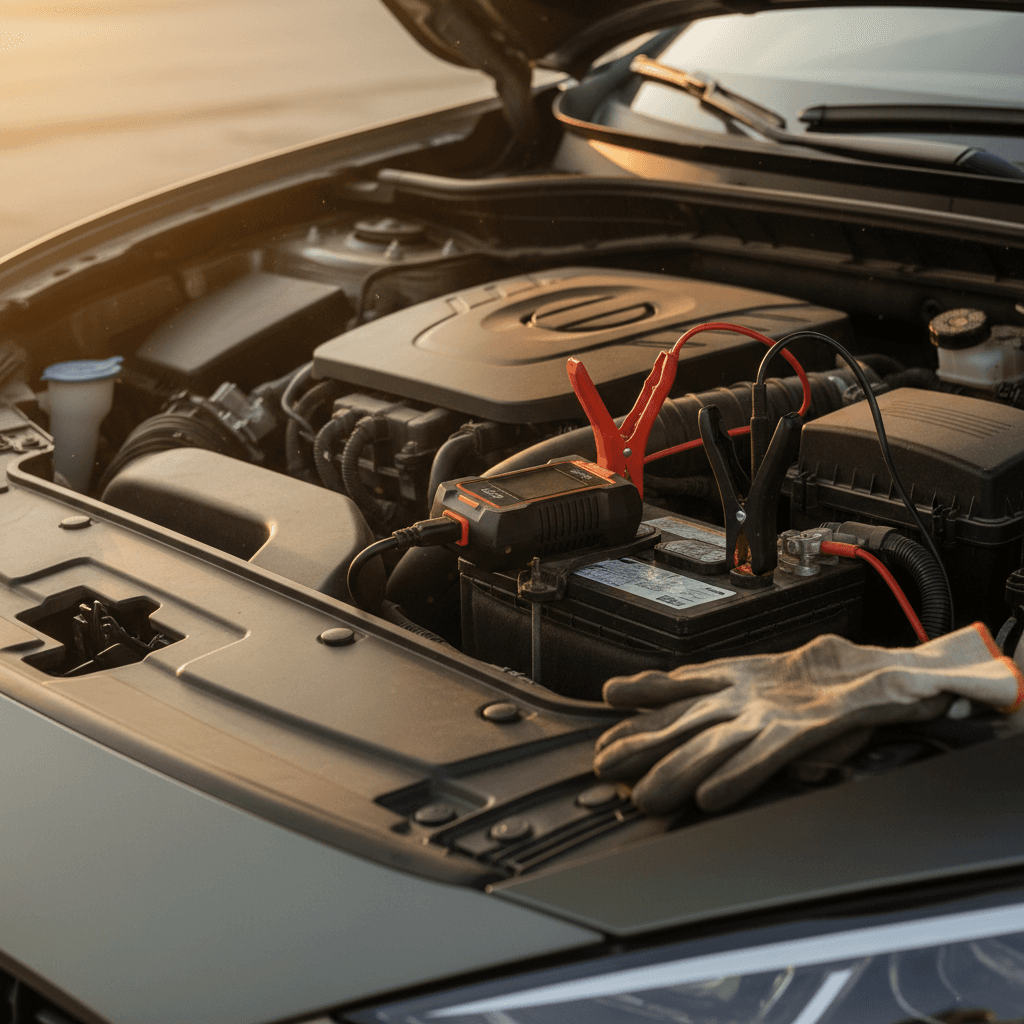
Search data says “12 voltage battery charger,” but what most drivers actually need is a smart, safe 12-volt battery charger that won’t cook their car’s little under-hood workhorse. Whether you’re keeping a parked EV alive over a long trip, nursing an aging 12V battery through winter, or rescuing a weekend toy from the brink, the charger you buy, and how you use it, matters.
Quick takeaway
Why 12-Volt Batteries Still Matter in EVs
Pop the hood on most modern EVs and you’ll still find a familiar black brick: a 12-volt auxiliary battery. It doesn’t power the wheels; it powers the brains. The 12V battery runs control modules, door locks, lights, telematics, and crucial relays that allow the big high-voltage pack to wake up. When that little battery dies, your 300-mile EV becomes a 4,500-pound paperweight.
- Controls ECUs, relays, and safety systems
- Keeps locks, alarms, and telematics online while parked
- Allows the high-voltage pack to “boot” and start charging or driving
- Can fail sooner than the main battery, especially in extreme climates
EV-specific caution
What Is a 12-Voltage Battery Charger, Really
In plain terms, a 12-volt battery charger is a device that brings a discharged 12V battery back up to a healthy state of charge. The search phrase “12 voltage battery charger” is just an awkward way of saying the same thing: a charger designed for batteries with a nominal voltage of 12 volts.
The important bit isn’t the headline number on the box; it’s how that charger delivers power over time, its charging profile. A good modern charger watches voltage and sometimes temperature, adjusts current automatically, and knows when to ease off. A bad one just dumps current until something gets hot or fails.
What a 12V Battery Charger Actually Does
Under the plastic housing, it’s doing more than you think
Raises State of Charge
The charger feeds DC power back into the 12V battery, nudging it from a deeply discharged state toward a healthy resting voltage around 12.6–12.8V for lead-acid.
Controls Current
Better chargers taper current as the battery fills, preventing overheating and minimizing plate damage, especially important for AGM and gel batteries.
Protects the Battery
Smart chargers include overcharge protection, short-circuit protection, and reverse-polarity detection to protect both the battery and the vehicle.
Types of 12V Battery Chargers Explained
Walk down the virtual aisle for “12 voltage battery charger” and you’ll see a zoo of boxes and buzzwords. Strip away the packaging and most of them fall into a few clear categories.
Common 12V Battery Charger Types
How different 12V chargers behave and when to use them
| Charger Type | Typical Amps | Best For | Pros | Cons |
|---|---|---|---|---|
| Trickle Charger | 0.5–2A | Long-term storage of older cars | Cheap, simple | Can overcharge if left on indefinitely; not ideal for modern batteries |
| Smart / Multi-Stage | 2–10A | Daily drivers, EV 12V batteries, modern cars | Automatically adjusts; safe to leave connected; desulfation modes | Costs more than basic trickle chargers |
| High-Amp "Boost" | 15–40A+ | Quick recovery, shop use | Fast charge times | Easier to overheat or damage small or weak batteries if misused |
| Jump Starter (Lithium Pack) | Peak 400–2000A | Emergency starts, portable backup | Tiny, portable, can double as power bank | Not a charger by itself; still need a charger to fully refill the battery |
| Lithium-Specific Charger | Varies | 12V LiFePO4 house or accessory batteries | Correct profile for lithium chemistry | Often unsuitable for lead-acid batteries in cars and EVs |
For modern EVs and daily drivers, a smart multi-stage charger is usually the safest choice.
Real-world rule of thumb
How to Choose the Right 12V Charger for Your Car or EV
Choosing a 12-volt battery charger isn’t about buying the biggest number on Amazon. It’s about matching the charger to your battery type, capacity, and use case. Start by reading the fine print on the battery sticker and the owner’s manual; then work backward to the right box.
12V Battery Charger Buying Checklist
1. Confirm Your Battery Chemistry
Is your 12V battery a standard flooded lead-acid, AGM, gel, or lithium (LiFePO4)? Many EVs and modern cars use AGM for durability. Your charger must explicitly support the chemistry you have.
2. Match Charger to Battery Size
Battery capacity is measured in amp-hours (Ah). As a rough guide, aim for a charger that delivers 10–20% of that number. A 60Ah battery pairs well with a 6–10A smart charger.
3. Look for Smart, Multi-Stage Charging
Features like bulk/absorption/float stages, automatic shut-off, and temperature compensation are your friends. They extend battery life and reduce the risk of overcharge.
4. Check for AGM / EV Compatibility
If your car or EV uses an AGM 12V battery, make sure your charger has an AGM mode. Some chargers also advertise “start/stop” or “EV-safe” profiles that play nicely with sensitive electronics.
5. Decide Between Portable and Permanent
A small, portable charger you clip on as needed is fine if you check the car regularly. For seasonal or long-term storage, consider a hard-wired pigtail or permanently mounted maintainer.
6. Prioritize Safety Features
Must-haves: reverse-polarity protection, spark suppression, short-circuit protection, and over-temperature shutdown. Nice-to-haves: built-in diagnostics, display of voltage and state-of-charge.
For EV owners
- Look for a charger rated safe for vehicles with sensitive electronics.
- Check your manual for approved charge points, often dedicated jump posts rather than the battery terminals.
- Use a smart maintainer if your EV will sit for weeks without being driven or charged.
For gas & hybrid drivers
- If you mainly park outside in winter, prioritize a 6–10A smart charger to recover from cold-weather voltage dips.
- Classic or collector cars stored for months do better with a low-amp maintainer than repeated jumps.
Using a 12V Battery Charger: Step-by-Step
Hooking up a 12-volt battery charger isn’t complex, but this is low-voltage electricity wrapped around some very expensive electronics. A little discipline here saves you from the sort of stories you never want to tell your insurance company.
Step-by-Step: Safely Charging a 12V Battery
1. Read the car and charger manuals
Boring, yes. Necessary, also yes. Confirm approved charge points, battery chemistry, and any warnings about external charging, especially on EVs and hybrids.
2. Park safely and power down
Switch the car off, remove the key or key fob from the vehicle, and set the parking brake. On EVs, make sure the high-voltage charging cable is unplugged unless the manual explicitly says otherwise.
3. Connect clamps in the right order
On most setups: connect positive (+, red) to the battery or approved terminal first, then negative (−, black) to the designated ground or negative post. Don’t let clamps touch each other.
4. Select the correct mode
Set the charger to the right battery type (flooded, AGM, gel, or lithium) and, if adjustable, an appropriate amp setting for your battery size.
5. Plug in and let the charger work
Only after clamps are secure do you plug the charger into AC power. Smart chargers will usually show charging stage and estimated status. Resist the urge to constantly disconnect and reconnect.
6. Wait for float or full-charge indication
Once the charger shows full or enters float/maintenance mode, you can unplug from AC. Then remove the negative clamp, then positive, avoiding contact between clamps and metal surfaces.
Do not use a 12V charger like a jump pack
Safety Rules You Shouldn’t Ignore
Twelve volts sounds harmless compared with the 400V battery pack in many EVs, but under the hood the 12V system can still deliver hundreds of amps. That’s enough to weld metal and turn a screwdriver into modern art.
- Never connect a charger with reversed polarity. Modern chargers will usually scream at you, but don’t test them.
- Avoid sparks near an open, flooded lead-acid battery, hydrogen gas plus spark equals the sort of chemistry experiment you don’t want.
- Don’t clamp directly to painted aluminum parts or random brackets; use proper grounds or designated posts.
- Keep chargers off the ground when possible and away from standing water or soaked concrete.
- Route cables so you can’t trip over them, slam them in a hood, or shut them in a door.
Hint for apartment and condo dwellers
Common Mistakes People Make With 12V Battery Chargers
Most 12V batteries don’t die heroically; they’re slowly tortured by partial charge, heat, and neglect. A few avoidable mistakes show up again and again in service bays.
Classic 12V Charger Mistakes
If you recognize yourself here, you’re not alone
Cooking the battery
Leaving an old-school trickle charger connected for weeks without a float mode can overcharge and dry out a battery, especially in warm garages.
Wrong chemistry setting
Charging an AGM or lithium battery on a generic, high-voltage setting can shorten its life or trigger protective shutdowns.
Expecting miracles in 20 minutes
Dragging a deeply discharged 12V battery back to life at 2A takes time. If you need instant gratification, you need a jump starter, not just a charger.
Charging instead of replacing
If a battery refuses to hold a charge after several proper charge cycles, it’s probably at end-of-life. No charger can reverse physical plate damage or severe sulfation.
How 12V Battery Health Affects Used EVs
On a used EV, everyone obsesses over the high-voltage pack, and they should. But a sickly 12V battery is the little villain behind many “mystery” warnings, random resets, and no-start situations. It’s also one of the simplest things to diagnose and fix.
At Recharged, every vehicle gets a Recharged Score Report with verified battery health on the main pack plus a detailed inspection that flags weak 12V batteries and charging system issues. That means fewer surprises when you hit the start button on a cold Monday morning.
What to ask when buying a used EV
In an EV, the 12V battery is like the drummer in a rock band: nobody notices it when it’s doing its job, but when it quits, the whole show falls apart.
FAQ: 12-Voltage Battery Chargers
Frequently Asked Questions About 12V Battery Chargers
The Bottom Line on 12V Battery Chargers
A 12-volt battery charger is one of those unglamorous tools that quietly dictates whether your mornings start with a drive or a swear word. The right charger, used correctly, keeps your 12V battery healthy, protects your electronics, and buys you years of reliable starts, whether you’re driving a V8 truck or a gently used EV you found through Recharged.
If you’re already in the market for a used electric vehicle, remember that the 12V story is just one chapter. A Recharged vehicle comes with a Recharged Score battery health report, transparent pricing, and EV-specialist support so you’re not guessing about the high-voltage pack, or the little 12V that wakes it up. Keep a smart charger in the garage, and you’ll be ready for the long run.