If you’re wondering “when was the first electric car made?” you’re not alone. With EVs all over dealership lots and used-car sites today, it’s easy to assume they’re a brand-new idea. In reality, electric cars go back to the 1800s, long before Teslas, tax credits, or even gas stations.
Quick context
Short answer: When was the first electric car made?
- Inventors were experimenting with small electric road vehicles by the 1830s–1840s.
- French inventor Gustave Trouvé demonstrated an electric tricycle on the streets of Paris in 1881.
- German manufacturer Andreas Flocken built the Flocken Elektrowagen in 1888, widely regarded as the first electric production car.
- In the United States, chemist William Morrison unveiled a successful six‑passenger electric wagon around 1890, kicking off the American EV industry.
So if you want a single, defensible date for the first electric car you’d recognize as a car, most historians point to 1888 and the Flocken Elektrowagen. But if you’re talking about the concept of electric road vehicles, the story starts decades earlier.
How to phrase it
Early electric vehicle experiments: 1830s–1880s
By the early 19th century, batteries and electric motors were new, experimental technologies. A handful of engineers began asking an obvious question for their time: if electricity can move a train or a trolley, can it move a carriage?
From lab benches to the street: early EV experiments
These projects didn’t create a true “car market,” but they proved the idea could work.
1830s–1840s: Electric models and locomotives
By the 1830s, inventors in Europe and the U.S. were building small electric locomotives and carriage models. These were often demonstration devices powered by primitive batteries, important scientifically, but not practical daily transport.
1881: Trouvé’s electric tricycle
In 1881, French inventor Gustave Trouvé fitted a rechargeable-battery-powered motor to a tricycle and test‑drove it on a Paris street. It’s one of the first documented electric vehicles driven in public traffic.
Electric trams and trolleybuses
At the same time, engineers were electrifying public transport, from electric trams in the 1870s–1880s to experimental trolleybuses. Those projects gave inventors confidence that batteries and motors could power road vehicles, too.
Why these weren’t “cars” yet
The first electric production car: 1888 Flocken Elektrowagen
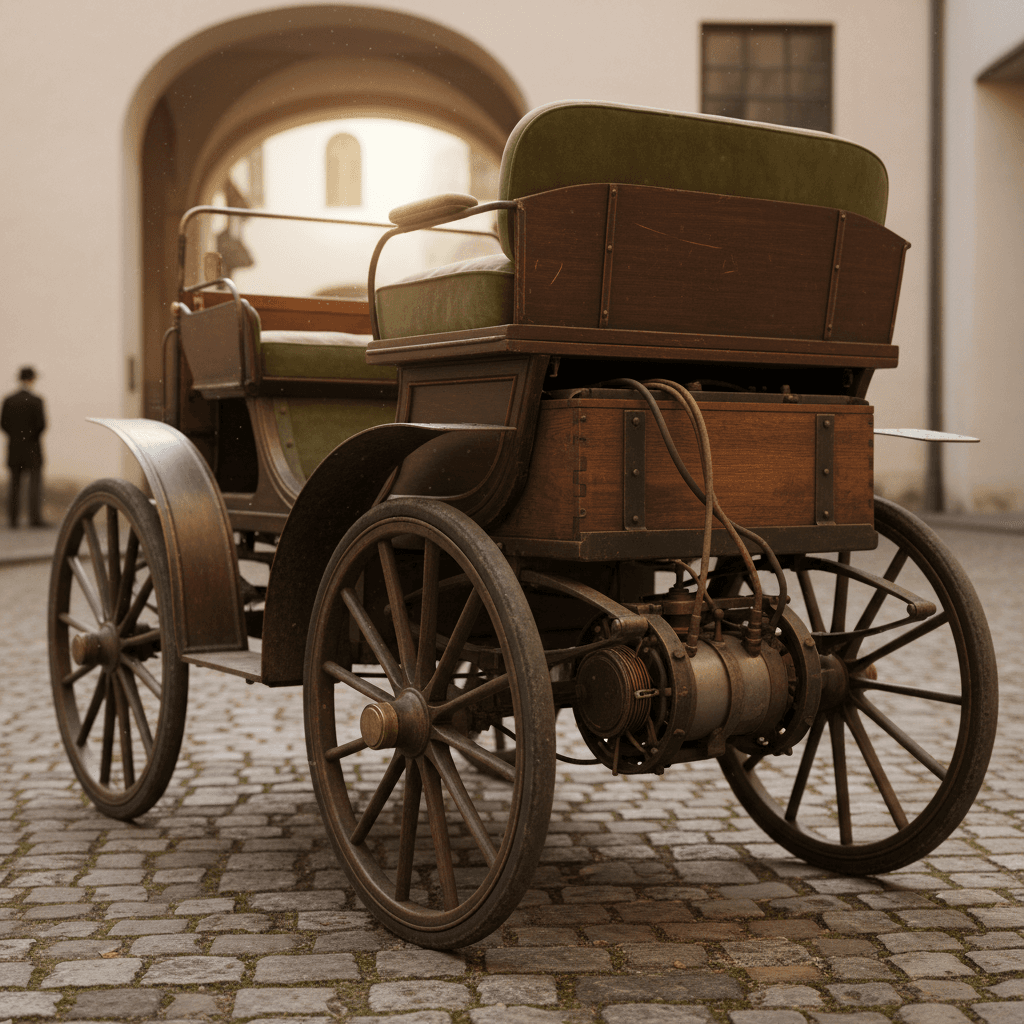
The turning point comes in 1888, in the German town of Coburg. Engineer and factory owner Andreas Flocken built a four‑wheeled, carriage‑style electric vehicle now known as the Flocken Elektrowagen. It used a roughly 0.9 kW motor driving the rear axle via belts and reached about 15 km/h (around 9 mph).
Why historians highlight Flocken
- Built in 1888 in Coburg, Germany.
- Four wheels and carriage‑like body, similar in layout to later automobiles.
- Electric motor driving the rear axle with belt transmission.
- Top speed about 15 km/h (9 mph).
- Considered by many automotive historians as the first recognizable, production‑style electric car.
“The Flocken Elektrowagen is generally accepted as the first production electric car, bridging the gap between experimental carriages and a repeatable product.”
America joins in: William Morrison’s 1890 electric car
Here in the United States, the electric car story really takes off around 1890. Iowa chemist William Morrison built a six‑passenger electric wagon that looked like a horse carriage but ran entirely on batteries. It wasn’t glamorous, but it could hit about 14 mph and, more importantly, it worked reliably enough to attract attention on city streets.
Why Morrison’s 1890 EV mattered
Morrison’s car caught the eye of entrepreneurs who saw a business opportunity in quiet, easy‑to‑drive vehicles that didn’t need cranking or gear‑shifting. Within a few years, American firms were building electric carriages, delivery wagons, and eventually electric taxis.
Turn-of-the-century EV boom: 1890s–1910s
By the late 1890s and early 1900s, electric cars weren’t just scientific experiments, they were a real slice of the new car market. At the first major U.S. auto show in 1900, roughly a third of the vehicles on display were electric. City dwellers liked them because they were clean, quiet, and easy to operate compared with steam or gasoline cars.
How early electric cars were used
Electric vehicles filled specific niches during the first automotive era.
| Use case | Example | Why electric made sense |
|---|---|---|
| City taxis | Bersey Electric Cab (London), Electrobat taxis (U.S.) | Short, predictable routes and easy overnight charging. |
| Wealthy urban households | Luxury electric carriages | Quiet, odorless operation and no hand cranking. |
| Local deliveries | Light electric trucks and vans | Stop‑and‑go city driving, low speed, high torque. |
| Hotel and depot shuttles | Station runabouts and hotel cars | Short hops between depots, hotels, and stations. |
Early EVs served real customers, even if they didn’t win the long‑term market, yet.
Why buyers liked early EVs
- No hand crank: Gas cars of the era could literally break your arm starting.
- Cleaner in cities: No exhaust fumes or oil leaks on the driveway.
- Easier to drive: No shifting gears or managing steam pressure.
- Good for short trips: Range was enough for daily urban errands.
Where they struggled
- Limited range: Rural driving and long trips were difficult.
- Slow charging: Batteries took hours to recharge.
- Higher upfront price: Early electric cars often cost more than gas cars.
- Few charging points: Outside wealthy cities, electricity access was spotty.
Bottom line for this era
Why early electric cars faded away
Given how promising those early EVs looked, another common question is: if electric cars have been around since the 1880s, why did gas win the 20th century? The answer is a mix of technology, infrastructure, and cost.
Key reasons early EVs lost ground
1. Cheaper gasoline cars
When Henry Ford launched mass‑produced gasoline cars like the Model T in 1908, prices dropped sharply. By 1912, a gas car might cost a fraction of an electric roadster, putting electrics at a major price disadvantage.
2. Electric starter for gas engines
In 1912, the electric starter made gasoline cars far easier and safer to start, removing one of the biggest user‑experience advantages electric cars enjoyed.
3. Better roads and longer trips
As road networks expanded in the 1910s and 1920s, Americans wanted to drive farther. Early EV ranges and limited charging meant gas cars were simply more practical outside urban cores.
4. Cheap, abundant oil
Oil discoveries and an expanding network of gas stations made fueling a gasoline car quick, cheap, and convenient, advantages early EVs couldn’t match with the batteries of the time.
By the 1930s, EVs were nearly gone
How this history connects to today’s new and used EVs
The 19th‑century inventors behind the Flocken Elektrowagen and Morrison’s wagon were solving the same core problem as EV engineers today: how to package batteries, motors, and controls into a practical vehicle ordinary people can live with.
Then vs. now: early EVs compared with today’s market
Knowing where EVs started helps you make sense of the choices on today’s lot, especially if you’re shopping used.
Battery tech
Then: Heavy, low‑capacity lead‑acid batteries limited range to short city routes.
Now: Lithium‑ion packs deliver ranges commonly between 200 and 300 miles, with DC fast‑charging on many models.
Performance & use
Then: 10–15 mph speeds were fine for crowded, horse‑filled streets.
Now: Modern EVs can out‑accelerate many sports sedans while handling daily commuting, road trips, and cargo duty.
Ownership & resale
Then: Tiny production runs, no real used market, and no standardized service.
Now: A growing used EV market means more choice, and more need for solid data on battery health.
Where Recharged fits in
Timeline of key early EV milestones
Early electric vehicle timeline at a glance
From experiments to production cars, here are the milestones that answer “when was the first electric car made?”
| Year | Event | Why it matters |
|---|---|---|
| 1830s–1840s | Early electric locomotives and model vehicles | Shows that electric motors and batteries can move vehicles, but only in very controlled settings. |
| 1880 | Gustave Trouvé develops a compact electric motor | Makes small, mobile electric drives possible. |
| 1881 | Trouvé’s electric tricycle tested on Paris streets | One of the first documented electric vehicles driven in normal city traffic. |
| 1888 | Andreas Flocken builds the Flocken Elektrowagen | Widely regarded as the first electric production car, four wheels, practical layout, small series of vehicles. |
| 1890 | William Morrison’s six‑passenger electric wagon in Iowa | Kicks off American interest in practical electric cars. |
| 1890s | Electrobat taxis and other electric cabs | Proves electric vehicles can earn money in daily commercial service. |
| 1900 | About one‑third of cars at America’s first major auto show are electric | Electric cars are a mainstream option in the young car market. |
| 1912–1935 | Gas cars get cheaper and easier; early EVs disappear | Mass‑produced gasoline cars, cheap fuel, and better roads push EVs to the margins for decades. |
Notice how the story shifts from one‑off experiments to practical, repeatable vehicles by the late 1880s and 1890s.
FAQ: First electric car questions answered
Frequently asked questions about the first electric car
Thinking about your own EV? What to do next
Knowing when the first electric car was made isn’t just trivia. It shows that EVs aren’t a fad, they’re part of a long, stop‑and‑start innovation story stretching back to the 1800s. The difference now is that the technology and the market have finally caught up with the idea those early inventors proved on cobblestone streets.
Practical next steps if this history has you EV‑curious
1. Clarify how you’ll use an EV
Think about your daily mileage, access to charging at home or work, and how often you take long trips. That will help you decide whether a compact commuter, crossover, or long‑range model makes sense.
2. Explore used EV options
A growing supply of off‑lease EVs has brought more models and price points into the used market. Browsing a curated marketplace like <strong>Recharged</strong> can give you a feel for what’s out there without spending weekends hopping dealer lots.
3. Look beyond model year to battery health
Two EVs from the same year can perform very differently if their batteries were treated differently. With Recharged, every car comes with a <strong>Recharged Score Report</strong> that includes verified battery diagnostics, so you can compare vehicles on more than just mileage and paint color.
4. Consider financing and trade‑in options
Just as early EV buyers had to weigh new technology against cost, today you’ll want to compare financing offers, potential trade‑in value for your current vehicle, and total cost of ownership. Recharged can help with <strong>financing, trade‑ins, instant offers, and nationwide delivery</strong> so the numbers are clear before you sign anything.
From Coburg to your driveway
Ready to find your next EV?
Browse Vehicles