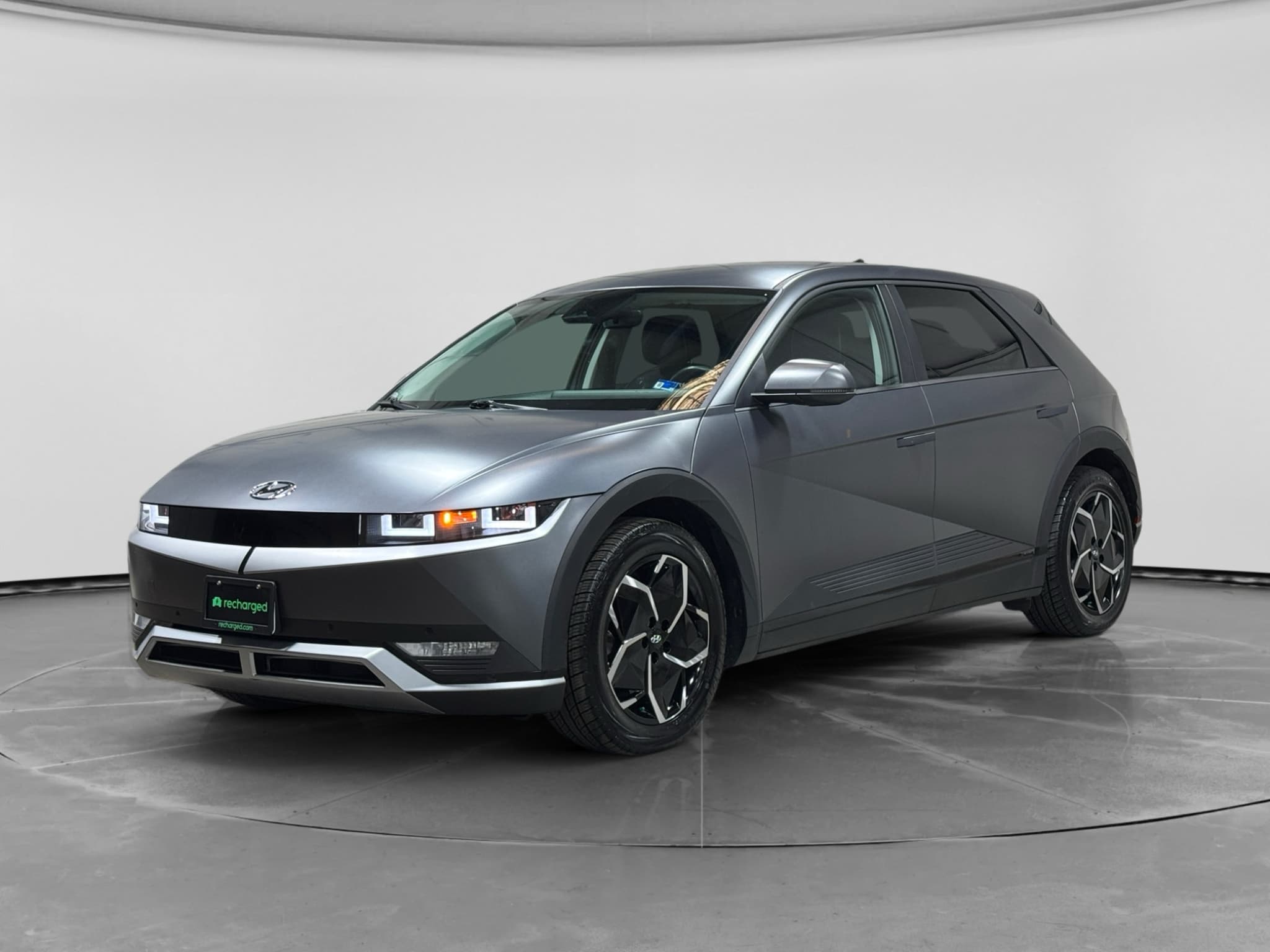
Your IONIQ 5’s value starts with comparable retail listings, but it can’t be pinned down accurately from the model name alone. Mileage, model year, equipment, drivetrain, cosmetic condition, vehicle history, location, tires, and battery diagnostics all shape the final number. A strong valuation compares your car with genuinely similar vehicles rather than treating every IONIQ 5 as interchangeable.
Recharged market data sets the starting point
Recharged data places the current retail asking-price range for matching Hyundai IONIQ 5s at $23,598 to $34,498. Across 34 matching listings, the average asking price is $28,560 and the median is $28,126. These are live retail asking prices, not completed sale prices, trade-in amounts, or guaranteed seller payouts.
Battery data adds important context to that retail range. Across 229 Hyundai IONIQ 5 Recharged Score inspections, tested remaining battery capacity averaged 98% of original capacity, with a median of 100% and observed results from 88% to 100%. Tested real-world range averaged 265 miles, while individual results ran from 220 to 318 miles.
Retail price is not your payout
The takeaway is straightforward: the live retail market gives you a useful ceiling and comparison point, while your car’s specific details determine where it belongs, and what a buyer or dealer can pay for it. Verified battery capacity and tested range can make your IONIQ 5 easier to evaluate because they replace guesswork with measured results. Learn more about how EV battery health is measured before comparing offers.
A clean-looking IONIQ 5 still needs an EV-specific evaluation. Verified battery capacity, tested range, mileage, condition, history, and equipment together tell a much better value story than the badge alone.
Recharged data
Used Hyundai Ioniq 5 battery health
98%
avg remaining capacity
From Recharged battery inspections, not manufacturer estimates.
- Lowest
- 88%
- Median
- 100%
- Highest
- 100%
- Est. range
- 265 mi avg
- Cell balance pass
- 100%
- Quick charges
- 24 avg
- Slow charges
- 74 avg
Average cell imbalance: 3.0 mV
Based on vehicles Recharged tested
Recharged data
Used Hyundai Ioniq 5 prices at Recharged
$28,126
median list price
Current list prices for matching inventory at Recharged.
- Lowest
- $23,598
- Average
- $28,560
- Highest
- $34,498
Average Recharged Score on these listings
4.9 / 5
Range
4.7 – 5.0
Based on available listings
Every EV is battery-tested with a Recharged Score. Nationwide delivery.
What moves an IONIQ 5’s value?
The biggest value drivers are your car’s exact configuration, mileage, physical condition, history, battery results, and local demand. A valuation tool that asks only for the model and odometer reading may give you a broad estimate, but it can miss meaningful equipment and condition differences. Use the estimate as a starting point, not a promise.
Details that sharpen the estimate
Model year and configuration
Match the model year, drivetrain, equipment level, exterior color, and factory options as closely as possible.
Mileage and use
Record the current odometer reading and describe how the vehicle has been used rather than rounding down.
Battery condition
Use an EV-specific diagnostic that measures remaining capacity and tested real-world range.
Exterior and interior
Disclose dents, scratches, wheel damage, glass damage, stains, odors, and worn upholstery.
History and title
Have the title status, accident history, service records, and any open loan information ready.
Tires, keys, and accessories
Note tire condition and include every key, charging cable, adapter, and original accessory still with the car.
Build a defensible valuation
A defensible value comes from matching your car to comparable listings and then adjusting for its condition and ownership details. Start with IONIQ 5s of a similar model year, drivetrain, mileage band, and equipment level; an unusually cheap or expensive example may not be truly comparable. The Recharged retail median of $28,126 is helpful context, but it isn’t a substitute for evaluating your particular vehicle.
- Confirm your VIN, exact configuration, current mileage, and title status.
- Photograph every side of the vehicle, the cabin, wheels, tires, odometer, and visible damage in clear daylight.
- Gather service records, both keys, charging equipment, and any documentation for repairs or accessories.
- Get a battery-health report that measures remaining capacity and tested range instead of relying only on the dashboard estimate.
- Compare more than the headline number by reviewing fees, inspection conditions, transportation requirements, and payment timing.
Don’t subtract a random amount from a retail listing and call the result a trade-in value. Selling costs and risk vary by vehicle and sales channel, so the cleanest answer comes from a vehicle-specific appraisal. If you’re weighing convenience against potential proceeds, review the differences between trading in and selling your car before accepting an offer.
Which selling route fits you?
The right selling route depends on whether you value speed, convenience, market exposure, or control over the transaction. An instant offer minimizes the work, while consignment or a private sale can involve more time and coordination. Compare the complete transaction, not merely the advertised price.
Ways to sell your Hyundai IONIQ 5
Choose the route that best matches your timing and tolerance for managing the sale.
| Selling route | Best for | Typical speed | Main trade-off |
|---|---|---|---|
| Recharged offer or consignment | EV-focused support | Fast to medium (days to weeks) | Offer vs. added exposure |
| Dealer trade-in | One-stop replacement | Usually fast | Less price control |
| Online car buyer | Simple remote process | Usually fast | Terms may change after inspection |
| Private sale | Maximum control | Variable | You manage the transaction |
Timelines and outcomes depend on vehicle condition, documentation, location, and buyer demand.
Recharged supports both an instant-offer path and consignment, so you can prioritize speed or broader market exposure without navigating the EV details alone. Every valuation should clearly separate the likely seller payout from a vehicle’s eventual retail asking price. See the practical steps in our guide to selling an electric car.
How should you prepare for an offer?
You should prepare by making the car easy to identify, inspect, and transfer. Use accurate photos, report damage before the inspection, and disclose title or loan details early; surprises can slow the process or change a preliminary estimate. Remove personal data from the infotainment system only after you’ve saved anything you need and the sale is ready to close.
Cleanliness helps an evaluator see the vehicle clearly, but expensive cosmetic work doesn’t automatically return every dollar you spend. Ask before repairing scratches, replacing tires, or purchasing missing accessories solely for the sale. A transparent, well-documented IONIQ 5 with a verified battery report gives an evaluator the clearest basis for a firm number.
The best valuation package is simple: accurate vehicle details, honest condition photos, ownership documents, and a battery report. That lets us spend less time resolving unknowns and more time determining what the car is worth in today’s market.
Instant offer, trade-in, or consignment. Pickup available.
Hyundai IONIQ 5 value FAQ
Your next step to a real number
The best valuation is one built around your specific IONIQ 5, not a generic model average. Recharged’s current listings and battery inspections establish useful benchmarks, but your payout depends on the vehicle’s configuration, mileage, condition, history, location, and verified battery results. Gather those details and request a vehicle-specific appraisal before treating any online estimate as money in hand.