The Porsche Taycan is one of the most engaging EVs on the road, but it’s also one of the most complex. As early owners have learned, that combination can mean unique Porsche Taycan common problems and fixes you should understand before you sign for a new or used one.
Who this guide is for
Overview: Is the Porsche Taycan unreliable?
When the Taycan launched for 2020, it set new standards for performance and fast charging. Over the last few years, though, a clear pattern of issues has emerged: high-voltage battery and charging faults, 12‑volt battery failures, software glitches, and camera/infotainment problems. Many of these have been addressed with recalls and over-the-air updates, but used buyers still need to verify that work was done.
Porsche Taycan issue snapshot (2020–2025 builds)
The good news is that most Taycan issues are fixable, and many are covered by warranty or recall campaigns. The key is to be proactive: keep software up to date, respond quickly to warning messages, and, if you’re buying used, insist on service records and an independent health check such as a battery diagnostic and cosmetic/mechanical inspection like the Recharged Score.
Quick reference: common Taycan problems and fixes
Most common Porsche Taycan problems and typical fixes
Use this table as a starting point; details for each issue follow in later sections.
| Problem | Typical Symptoms | Likely Cause | Usual Fix |
|---|---|---|---|
| High-voltage battery recall / fire risk | Recall notice, dealer outreach, guidance to limit charge level | Potential internal short circuit in battery modules on certain 2020–2024 cars | Software update plus, in some cases, replacement of affected battery modules at no cost under recall |
| 12‑volt battery failure | Car “bricked,” no start, dead screens, doors may not unlock, multiple error messages | Weak or failed 12‑volt battery that powers control modules | Jump/boost to access frunk, test and replace 12‑volt battery; check for software updates that improve 12‑V management |
| Charging problems (home & DC fast) | Charging stops early, “Charging error” messages, slow DC charging, won’t start session | Faulty onboard charger, software bugs, or station compatibility issues | Update vehicle software, try other stations, inspect charge port and cables; replace onboard charger or inlet if defective |
| Infotainment / PCM glitches | Frozen screen, slow startup, missing CarPlay, backup camera delay | Software instability in the Porsche Communication Management (PCM) system | Software update or module reflash; in severe cases, replacement of PCM unit |
| Rear‑view camera failure (recall) | Blank or intermittent rear camera image when in reverse | Signal noise or software fault between cameras and control unit | Dealer-applied software update under safety recall |
| Suspension & ride-height warnings | Uneven stance, ride too harsh/too soft, “Chassis error” messages | Faulty air suspension height sensors or air struts, rear‑axle steering issues | Sensor/valve replacement, occasional air strut or rear‑steer repair |
| Battery degradation / range loss | Noticeably less range than earlier in ownership at similar conditions | Normal aging plus occasional software calibration quirks | Battery health check, software update, and in rare cases module replacement under warranty |
| Charging-port door or latch issues | Port door won’t open/close, stuck in winter, warning messages | Mechanical wear, ice buildup, or sensor faults | Lubrication and cleaning, door mechanism adjustment, or latch replacement |
Real repair costs vary by dealer, warranty status, and model year. Always get a written estimate before approving work.
How Recharged helps used Taycan buyers
High-voltage battery problems and fire recall
The Taycan’s big high‑voltage pack is the heart of the car, and the focus of one of its most serious issues. Porsche has recalled 2020–2024 Taycan models because some packs can suffer an internal short circuit that increases the risk of a thermal event (fire) without much warning. The remedy involves new diagnostic software and, in some cars, replacement of one or more battery modules.
- You may get a recall letter in the mail, a message in your Porsche app, or a notice when you log into your My Porsche account.
- In the interim, some owners have been instructed to limit maximum state of charge (often to 80%) until the fix is installed.
- For connected cars, Porsche can monitor data remotely to decide whether a battery module swap is needed after the software update.
Safety first with HV battery recalls
Outside of the recall, outright high‑voltage battery failures are relatively rare, but they are expensive when they occur. The high‑voltage warranty (typically 8 years/100,000 miles in the U.S.) is your safety net. If a seller can’t document warranty status and recall completion, treat that as a red flag and factor in extra risk, or walk away.
12‑volt battery failures and “dead” Taycans
The Taycan uses a conventional 12‑volt battery in addition to its high‑voltage pack. When that small battery fails or runs down, the car can appear completely dead even if the big battery still has 70% charge. Owners describe coming back after a few days parked to a Taycan that won’t “wake up,” with dark screens and no response to the power button.
How to recognize a Taycan 12‑volt battery problem
You often get little warning before the car bricks itself.
Car won’t start
Key & door quirks
Random warnings
The root causes range from normal age‑related decline (two to five years is common) to parasitic drains like dashcams, always‑connected apps, or keys stored too close to the car. Earlier software versions also managed 12‑volt charging less effectively, which Porsche has tried to correct with updates.
Fixing and preventing Taycan 12‑volt battery problems
1. Safely access the 12‑volt battery
If the car is fully dead, you may need to use the mechanical key and a booster pack to open the frunk and access jump points. Follow the owner’s manual carefully, incorrect boosting can damage electronics.
2. Test the 12‑volt battery
Have the battery load‑tested. If it’s weak or fails the test, replacement is the only real fix. In Europe, typical costs range from the equivalent of $400–$600 installed; U.S. dealer pricing can be higher.
3. Update vehicle software
Ask the dealer to check for the latest software that manages the interface between the high‑voltage pack and the 12‑volt system. Updated logic can help prevent repeat failures.
4. Reduce parasitic loads
If you park for days at a time, unplug non‑OEM dashcams, avoid frequently waking the car with the app, and don’t store the key within ~30 feet of the car to limit wake‑ups.
5. Use long‑term storage best practices
For multi‑week parking, set the traction battery around 40–60% and, if possible, leave the car plugged in so it can maintain the 12‑volt. Check your manual for Porsche’s latest guidance.
6. Document incidents for warranty
If your Taycan repeatedly bricks itself, keep records. Multiple repairs for the same issue can strengthen a warranty or lemon‑law case if it’s never fully resolved.
Charging problems: DC fast and home charging
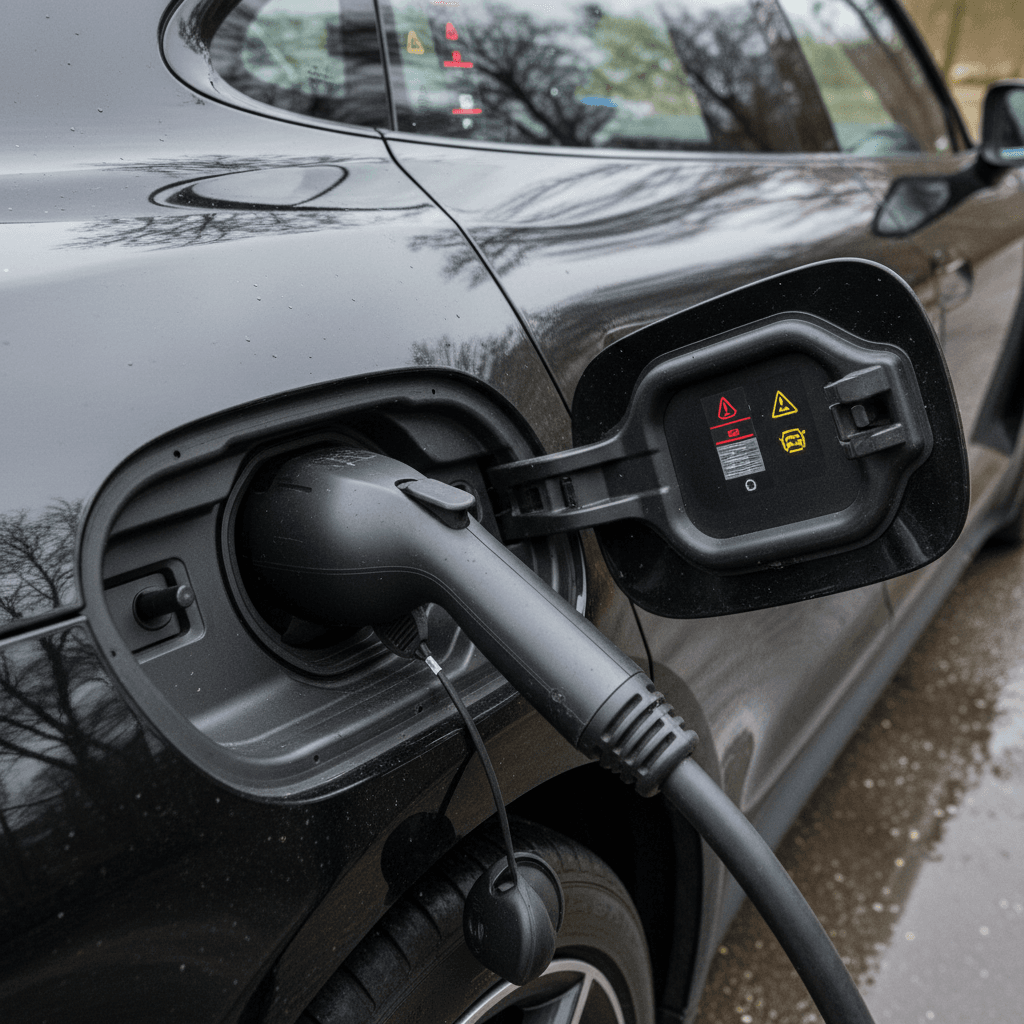
Because the Taycan is such a strong DC fast‑charger, especially on 2023+ cars, owners notice quickly when charging performance slips. Common complaints include sessions that won’t start, “Charging error” messages, or DC fast speeds far below what road tests suggest the car should deliver.
Typical Taycan charging symptoms
- DC fast session won’t start or stops almost immediately at Electrify America or other networks.
- Home charging stops early or the car reports a charging fault but the wallbox seems fine.
- DC speeds capped well below the 200+kW you expect, even with a warm battery and low state of charge.
Underlying causes
- Software bugs in early cars that mis-handle station communication or battery temps.
- Aging or failing onboard AC charger causing Level 2 problems.
- Connector wear, debris in the charge port, or bent pins.
- Station-side problems: overheating plugs, derated hardware, or network glitches.
Quick troubleshooting before you blame the car
- Keep your Taycan on the latest software; Porsche has steadily improved charging behavior over multiple updates.
- Inspect the charge port for dirt, corrosion, or damage, especially if you drive in winter climates.
- Have the onboard charger and inlet checked if Level 2 charging is unreliable at multiple chargers.
- If the car throws a persistent charging error, don’t keep forcing sessions; schedule service so data logs can be pulled before they’re overwritten.
Software, infotainment, and camera issues
The Taycan’s digital cockpit is a showpiece, but it’s also a source of headaches. Owners report frozen or laggy screens, random reboots, missing CarPlay connections, and backup cameras that take too long to appear, or don’t appear at all when shifting into reverse.
Common Taycan software and camera problems
Most are annoying more than dangerous, but a few are now under recall.
PCM & infotainment glitches
Rear‑view camera failures
Don’t ignore camera problems
Most software issues are fixed via over‑the‑air updates or quick dealer reflashes, and they’re usually covered under warranty. If you’re buying used, scroll through the service history for software campaigns and infotainment module replacements; a car that’s already had these fixes done is generally a plus, not a minus.
Suspension and ride-height faults
Taycans with adaptive air suspension or rear‑axle steering deliver an exceptional ride, until they don’t. Owners sometimes see “Chassis error” or ride‑height warnings, or notice the car sitting unevenly after parking overnight.
Taycan suspension issues to watch for
These tend to show up as the miles accumulate.
Uneven stance
Harsh or floaty ride
Dash warnings
Common culprits include faulty air suspension sensors, leaking air struts, or issues with the rear‑axle steering actuators. Out of warranty, a single corner repair can land in the low four figures, so on a used Taycan it’s important to road‑test the car over broken pavement and speed bumps and visually inspect for uneven ride height.
Battery degradation, range loss, and efficiency
All lithium‑ion batteries lose capacity over time, and the Taycan is no exception. Many owners report modest range loss, on the order of 10–15% after several years, which is in line with other performance EVs. But sudden drops in displayed range or big swings in efficiency after a software update may point to calibration quirks rather than a failing pack.
Normal vs abnormal Taycan battery aging
- Avoid living at 100% charge; for daily use, 20–80% SOC is easier on the pack.
- Frequent DC fast charging is fine on road trips, but relying on it daily will accelerate wear compared with Level 2 home charging.
- In cold weather, precondition the car while plugged in to reduce range‑sapping cabin and battery heating loads.
- If you see a big efficiency change right after a software update, ask your dealer whether a calibration reset is available.
For used‑car shoppers, a third‑party battery health report is one of the best tools you can have. Recharged uses its Recharged Score diagnostics to measure usable capacity and charging behavior so you can compare one Taycan against another on more than just mileage and cosmetics.
Costs, warranty, and recall coverage
Porsche maintenance and repair costs sit at the premium end of the spectrum, and the Taycan is no exception. The bright side is that many of the serious issues, battery‑related recalls, rear‑camera problems, airbag defects, are addressed free of charge under recall or warranty. Your job is to make sure those boxes are checked.
Approximate Taycan repair costs when out of warranty
These are broad ballparks meant only to illustrate relative scale. Actual bills can vary widely.
| Repair | Typical Out-of-Warranty Cost (USD) | Notes |
|---|---|---|
| 12‑volt battery replacement | $400–$800+ | Higher at some U.S. dealers; includes parts, coding, and labor. |
| Onboard AC charger replacement | $1,500–$3,000 | Covers part and labor; sometimes more if related wiring or inlet is damaged. |
| PCM / infotainment unit replacement | $1,500–$2,500 | Often preceded by attempts to fix with software updates. |
| Air suspension sensor or valve | $700–$1,200 per corner | Costs escalate if the full air strut or rear‑steer hardware must be replaced. |
| High‑voltage battery module replacement | Warranty/recall dependent | Typically handled under HV warranty or recall; out-of-pocket replacement can be extremely expensive. |
Always request a diagnostic work order and written estimate from your Porsche dealer or independent EV specialist before approving major repairs.
Leverage warranty and recall coverage
What to check on a used Porsche Taycan
A well‑maintained Taycan can be a bargain compared with its original sticker price, but only if you separate the heroes from the headaches. Here’s how to vet a used Taycan like a pro.
Used Porsche Taycan inspection checklist
1. Run the VIN for recalls and campaigns
Confirm that all battery, camera, airbag, and software recalls are complete. Ask for dealer printouts or screenshots of the service history.
2. Demand a battery health report
Request documentation of both <strong>high‑voltage and 12‑volt battery health</strong>. On Recharged, the Recharged Score includes detailed battery diagnostics so you’re not guessing about pack condition.
3. Inspect charging behavior
Test the car on a Level 2 charger and, if possible, a DC fast charger. Watch for error messages, slow charging, or sessions that drop unexpectedly.
4. Exercise all electronics
Cycle every screen, camera, and feature: PCM, backup camera, surround view, keyless entry, HVAC, seat heaters, lift system. Make sure the car wakes quickly and behaves consistently.
5. Evaluate ride and stance
Park on level ground and visually check ride height at all four corners. On the test drive, listen for knocks or clunks and feel for a consistent ride over bumps.
6. Look for water or corrosion
Check around the charge port, trunk, and underbody for signs of corrosion or water intrusion, especially in snow‑belt cars where road salt is common.
7. Review ownership and charging history
Lightly used Taycans that spent most of their time on home Level 2 charging and have consistent service records are generally safer bets than ones that lived on road‑trip fast chargers with sporadic maintenance.
8. Get an independent EV inspection
Use a third‑party like Recharged or a trusted EV‑savvy shop to perform a pre‑purchase inspection. A structured report can uncover issues that a quick dealer walk‑around won’t show.
Why shop a Taycan through Recharged
FAQ: Porsche Taycan common problems
Frequently asked questions about Porsche Taycan problems
Bottom line: should you buy a used Taycan
The Porsche Taycan is not a set‑it‑and‑forget‑it commuter appliance. It’s a sophisticated, high‑performance EV that rewards engaged owners, and punishes neglect. If you understand the most common Porsche Taycan problems and fixes, stay ahead of software updates, and insist on documentation for recalls and battery health, you can enjoy one of the most compelling electric cars on the market without losing sleep every time a warning light flickers on.
If you’re shopping used, lean on data rather than hope. A structured inspection, verified battery‑health report, and transparent pricing analysis like the Recharged Score can tell you in advance whether a particular Taycan is a keeper or a costly gamble. Go in with clear eyes, and the right Taycan can deliver years of drama on the road, not in the repair bay.