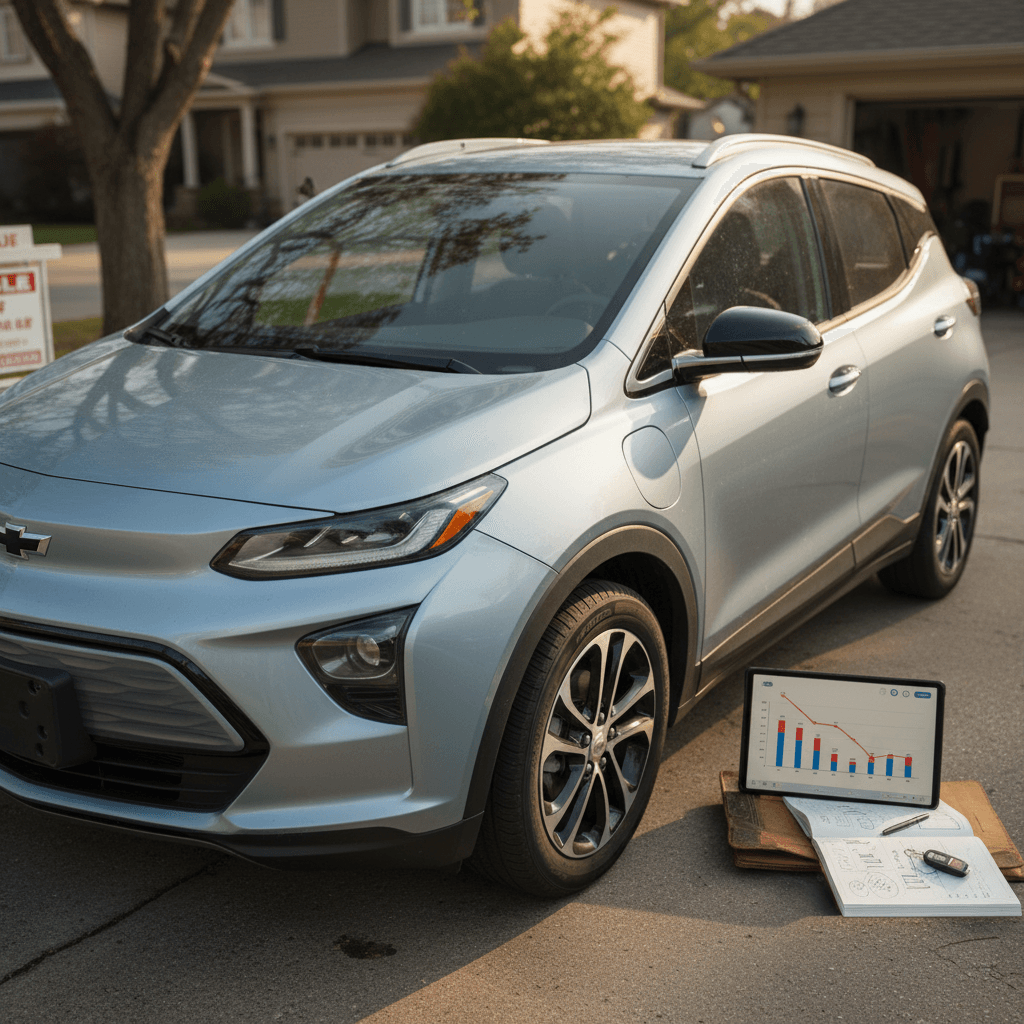
If you’re wondering, “What is my Chevy Bolt EUV worth right now?” you’re not alone. Between GM ending production of the current Bolt EUV and teasing a new model, plus fast-moving EV incentives, values are shifting faster than most price guides can keep up.
Quick note on timing
Chevy Bolt EUV value at a glance (2025)
Typical 2025 Chevy Bolt EUV value ranges
Across U.S. listings and value guides, a typical Chevy Bolt EUV in early 2025 lands in the high teens to mid‑$20,000s. CarGurus pegs the average used Bolt EUV around the high‑$18,000s, while Recharged’s own pricing guide shows late Bolt and Bolt EUV models (2022–2023) generally falling between $21,000 and $28,000 when mileage and condition are reasonable.
Fast way to ballpark your value
What actually drives your Bolt EUV’s worth
- Model year and trim (LT vs Premier)
- Battery health and remaining high‑voltage battery warranty
- Odometer mileage and how the car has been used
- Accident, recall, and service history
- Options like Super Cruise, sunroof, or Bose audio
- Whether you sell via trade‑in, private party, or an online marketplace
- Local demand for affordable EVs and home charging in your area
With an EV like the Bolt EUV, battery health and warranty status matter more than chrome wheels ever will. A clean history, up‑to‑date recall work, and a strong remaining battery warranty can easily swing the price by a couple thousand dollars compared with a similar‑looking Bolt EUV with a weaker battery report or accident on the record.
Don’t price it like a gas crossover
How much is my Chevy Bolt EUV worth by model year?
You won’t get a VIN‑specific number from a single article, but you can get into the right neighborhood. Here’s how 2022–2023 Bolt EUV values typically stack up in early 2025 if you’re in the U.S. and the car is in good, accident‑free condition with average miles (about 12,000–15,000 per year).
2025 value bands for Chevy Bolt EUV
Approximate U.S. price ranges assuming clean history, average miles, and solid battery health. Your real number will slide up or down based on the details of your car and your local market.
| Model year & trim | Typical miles (2025) | Trade-in range | Private-party range | Dealer retail range |
|---|---|---|---|---|
| 2023 Bolt EUV LT | 15,000–25,000 | $15,000–$18,000 | $18,000–$21,000 | $20,000–$23,000 |
| 2023 Bolt EUV Premier | 15,000–25,000 | $17,000–$20,000 | $20,000–$24,000 | $22,000–$26,000 |
| 2022 Bolt EUV LT | 25,000–35,000 | $14,000–$17,000 | $17,000–$20,000 | $19,000–$22,000 |
| 2022 Bolt EUV Premier | 25,000–35,000 | $16,000–$19,000 | $19,000–$23,000 | $21,000–$25,000 |
Use these as ballparks, not promises. A strong battery report or a rough Carfax can easily move you out of these bands.
How these compare to price guides
If your car is unusual, very low mileage, heavily optioned, or in a hot EV market, you can land above these ranges. High miles, cosmetic issues, or a rough battery report will put you toward the bottom, or even below, the bands.
Trade-in vs private sale vs online offer
Trade-in to a dealer
Fastest, least hassle. You’ll usually get the lowest dollar amount, because the dealer has to recondition the car, carry warranty risk, and make a margin.
- Best when you’re already buying something else.
- Great if your car needs cosmetic work you don’t want to do.
- Expect $1,500–$3,000 less than a solid private‑party sale.
Private-party sale
Highest potential price, but you do the work, photos, ads, test drives, paperwork.
- Good for clean, attractive cars in popular colors.
- Expect to field questions about range and battery, not just cupholders.
- Worth it if you’re willing to invest the time.
Online instant offer or consignment
Some platforms (including Recharged) blend convenience with fair market pricing.
- Online evaluation based on VIN, history, and battery health.
- Options for instant offers or consignment where a pro sells the car for you.
- Often lands between typical trade‑in and private‑party money.
Where Recharged fits in
Ready to find your next EV?
Browse VehiclesBattery health: the silent price changer
Two Bolt EUVs can have the same model year, same mileage, and wildly different resale values because of one thing: high‑voltage battery health. Most shoppers don’t want to buy an electric car that already feels tired.
How battery health changes what your Bolt EUV is worth
Rough examples for a 2022–2023 Bolt EUV with average miles
Battery at ≥ 95% of original capacity
Your car feels nearly as strong as new.
- Range aligns with EPA numbers in normal weather.
- Buyers are confident keeping it for years.
- Expect to be near the top of value bands.
Battery around ~90% capacity
This is normal, everyday wear.
- Range is slightly reduced but still practical.
- Price usually sits in the middle of the band.
- Strong records and good cosmetics can offset small loss.
Battery below ~80–85% capacity
Now buyers notice.
- Range feels short for road trips.
- Shoppers will compare it against newer EVs.
- Expect meaningful discounts vs similar cars with stronger packs.
Why generic guides miss this
Recharged’s Score Report is built to solve exactly this problem. It uses EV‑specific diagnostics to measure your Bolt EUV’s usable battery capacity and fast‑charging behavior, then bakes that into pricing alongside mileage and history. That’s the number EV‑savvy buyers really care about.
Mileage, condition, and features that move the needle
Checklist: how your specific Bolt EUV stacks up
1. Start with your odometer
A 2023 Bolt EUV with 30,000 miles will usually be worth more than one with 60,000, even if both run fine. EV shoppers still watch mileage, even though motors and one‑pedal driving reduce mechanical wear.
2. Look for accident or flood history
Any structural damage, airbag deployment, or flood branding on the title will drag your value down. A minor cosmetic scrape, properly repaired, matters less but still nudges the price.
3. Check for completed recall work
The Bolt family’s battery recalls put shoppers on high alert. Completed recall repairs and documentation can reassure buyers and support a stronger price than a similar car with open recalls.
4. Take an honest walk-around
Curb rash on wheels, cracked glass, mismatched paint, and worn interior trim suggest the car wasn’t loved. Spending a few hundred dollars on detailing and touch‑ups can be worth more than that in resale value.
5. List your options and packages
Features like <strong>Super Cruise</strong>, panoramic sunroof, adaptive cruise, or Bose audio can move you a notch upward within a price band. Be ready to show window stickers or build sheets if you have them.
6. Gather your paperwork
A tidy folder (or PDF) of service receipts, charging history if you have it, and warranty documents tells buyers they’re dealing with a careful owner, and that can translate into real money.

Recalls, warranty, and the upcoming 2027 Bolt
GM ended production of the current Bolt EUV after the 2023 model year, then announced a redesigned Bolt returning for the 2027 model year with a different battery chemistry and NACS fast‑charging. That one‑two punch, discontinuation followed by a more advanced successor, has been a headwind for older Bolt EUV values but hasn’t crushed them.
Three big storylines buyers are watching
Each one can tilt what your current Bolt EUV is worth
Past battery recalls
Shoppers have heard about Bolt fires. Showing recall work completed helps keep your car in the “safe bet” column instead of the “maybe not” pile.
Remaining battery warranty
The high‑voltage battery warranty (often 8 years/100k miles from in‑service date) is a security blanket. More warranty left = more value.
2027 Bolt buzz
The incoming 2027 Bolt with NACS fast‑charging and a fresh battery tech makes your car feel older on paper, but also keeps the Bolt name in the spotlight, which can support demand for clean used examples.
Check your in‑service date
How to check your Bolt EUV’s value step-by-step
Here’s a straightforward way to answer, with real data, “What is my Chevy Bolt EUV worth?” without falling down an internet rabbit hole.
Step-by-step: build a realistic value for your Bolt EUV
1. Gather the basics
Write down your VIN, exact trim (LT or Premier), model year, current mileage, and your ZIP code. You’ll need all of these for accurate pricing tools.
2. Pull your history report
If you don’t already have one, grab a Carfax or AutoCheck. Check for accidents, ownership count, and open recalls. A one‑owner, accident‑free history supports the upper end of value bands.
3. Run 2–3 online appraisals
Use at least two sources (Edmunds, CarGurus, and others) plus the <a href="https://recharged.com/articles/chevy-bolt-price-guide">Recharged Chevy Bolt price guide</a>. Average the numbers, ignoring any outlier that seems too good, or too bad, to be true.
4. Adjust for battery reality
If you have a recent battery health report, compare it to typical capacity for your model year. Stronger‑than‑average? You can ask a bit more. Noticeably weaker? Price more conservatively to avoid endless haggling.
5. Walk your local market
Search for similar Bolt EUVs within 100–250 miles, same year, similar miles, comparable options. Ask what you’d pick if you were buying today, and price your car realistically alongside those listings.
6. Decide how you’ll sell
If you want convenience, lean toward <strong>trade‑in or an instant offer</strong>. If you’re chasing every last dollar, aim for a private sale. Recharged can meet you in the middle with EV‑specific valuation and consignment options.
When it makes sense to sell your Bolt EUV
EV values are volatile, but your life probably isn’t built around the used‑car market. Still, there are a few windows where the math tilts clearly toward selling or trading your Chevy Bolt EUV.
Good times to sell
- Before warranty runs thin: If you’re within 1–2 years of your battery warranty expiring and you’re already thinking of a change, selling early can keep you in a stronger price band.
- With low miles and clean history: A lightly used, recall‑complete Bolt EUV with a strong battery is exactly what many buyers are hunting for.
- When local demand is hot: Spiking gas prices or new fast‑charging options in your area can briefly push EV demand, and pricing, higher.
Times to think twice
- Right after a big repair: You rarely get 100% of repair cost back in resale value. It can be worth keeping the car a bit longer to enjoy what you just paid for.
- During incentive shake‑ups: Sudden changes to federal or state EV incentives can temporarily spook buyers or flood the market. Watch how local asking prices behave before rushing to list.
- If your battery is marginal: If you’re already unhappy with range, selling might still be smart, but expect buyers to be just as cautious as you are.
Try running the numbers both ways
FAQ: Chevy Bolt EUV value questions
Chevy Bolt EUV value: your questions answered
Bottom line on what your Chevy Bolt EUV is worth
Your Chevy Bolt EUV’s true worth in 2025 isn’t a single magic number, it’s a range shaped by year, miles, history, and especially battery health. Most owners will find themselves somewhere between the high‑$ teens and mid‑$20,000s, with late‑model, low‑mile EUVs in clean condition nudging toward the top.
The smartest move is to treat online price guides as inputs, not gospel. Cross‑check a few sources, walk your local listings, then let a battery health report and EV‑savvy valuation refine the number. If you’d like a data‑backed answer instead of a guessing game, Recharged can help you understand, optimize, and then unlock what your Bolt EUV is really worth, on terms that fit how you want to sell or trade.