If you’re wondering, “what is a normal battery degradation rate for an EV?”, you’re not alone. Battery health is the number-one fear buyers have about electric cars, especially used ones. The good news: real-world data from thousands of vehicles shows that modern EV batteries typically lose only around 1–3% of capacity per year, and most will comfortably outlast the car.
The short answer
What is EV battery degradation, really?
EVs use lithium‑ion battery packs made up of hundreds or thousands of individual cells. Over time, chemical changes inside those cells reduce how much energy they can hold. That gradual loss of usable capacity is called battery degradation.
- It’s not your battery “going bad overnight” – it’s a slow, predictable fade.
- You usually notice it as reduced range (for example, a car that once did 260 miles now does 235–240).
- Degradation also affects fast‑charging speed slightly, but range loss is what most drivers feel day to day.
Think of it like the fuel tank in a gasoline car quietly shrinking over the years. The car still runs just fine, it just won’t go quite as far on a “full tank” as it did when it was brand new.
Initial drop vs. long cruise
So what is a “normal” battery degradation rate?
What current data says is “normal”
Pulling together recent fleet analyses and community data, here’s what a normal degradation pattern looks like for a modern, liquid‑cooled EV battery driven and charged in a typical way:
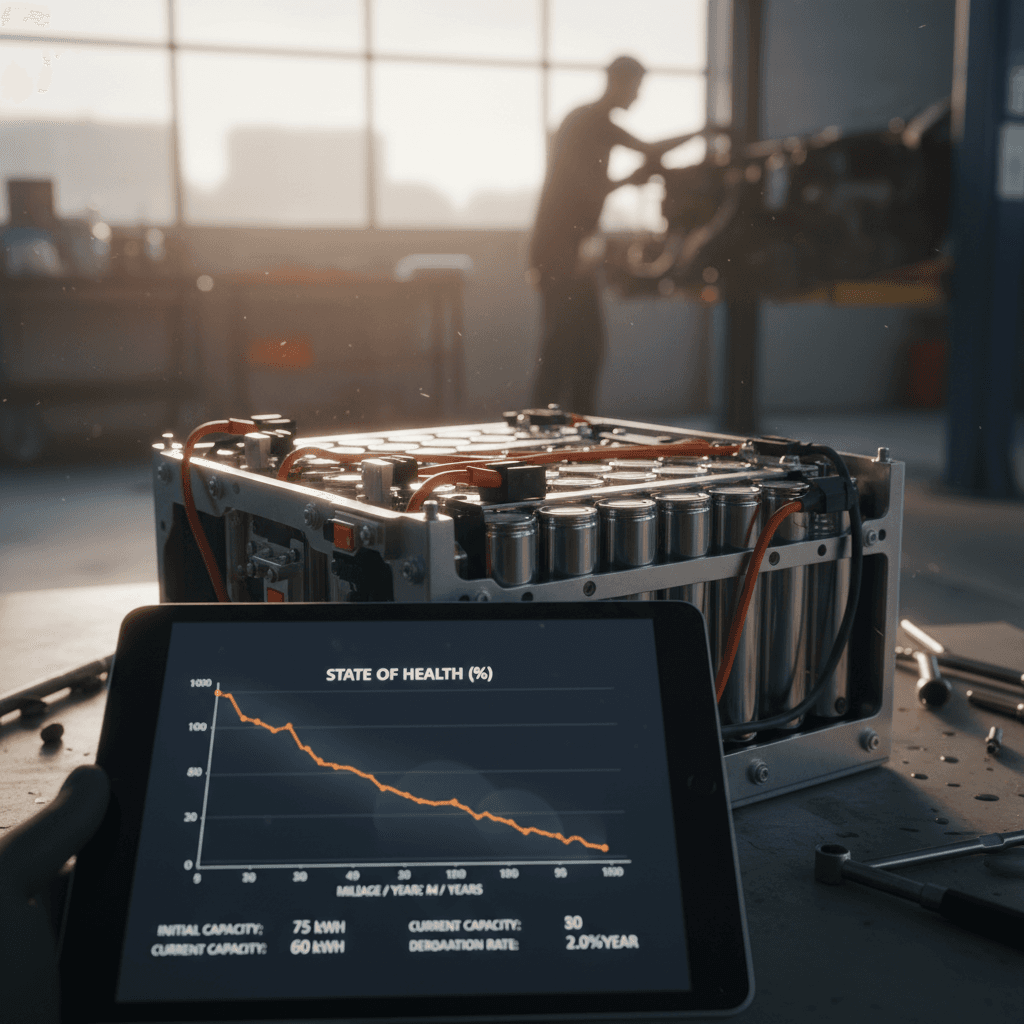
- First year: 2–5% capacity loss is common as the pack “settles in.”
- Years 2–5: degradation usually slows to around 1–2% per year.
- Years 6–10: 1–3% per year is typical, depending on climate and fast‑charging habits.
Across that whole span, studies of thousands of vehicles show average long‑term degradation clustered around 1.8–2.3% per year. Some models do even better, averaging close to 1% per year under gentle use.
When it’s not normal
How much range loss is normal by year and mileage?
Capacity loss is one thing; what you really care about is range. Here’s a ballpark look at what a normal battery degradation rate feels like in miles on a typical 250‑mile EV bought new today.
Example: Normal range loss on a 250‑mile EV
Approximate real‑world range over time if degradation stays in the normal band and there are no major defects.
| Age or mileage | Normal remaining capacity | Approx. usable range from 250 mi new | What most drivers notice |
|---|---|---|---|
| 1 year / ~10,000 mi | 95–97% | 238–243 miles | Almost no difference day to day |
| 3 years / ~36,000 mi | 92–95% | 230–238 miles | A few less miles on road trips |
| 5 years / ~60,000 mi | 88–92% | 220–230 miles | You might add one quick top‑up stop a year |
| 8 years / ~100,000 mi | 80–88% | 200–220 miles | Planning becomes a bit more intentional on long drives |
| 10 years / 120,000+ mi | 75–85% | 185–210 miles | Still fine for commuting; road trips take more planning |
Your numbers will vary by model, climate, and driving style, but this shows the general curve most owners experience.
For high‑mileage drivers, community datasets from long‑term owners tell a similar story: many modern EVs still retain 85–90% of their original capacity after 150,000–200,000 miles, which is well into “lifetime of the vehicle” territory for most people.
Older designs are the exception
Why some EV batteries degrade faster than others
Not all packs live the same life. Two EVs with the same odometer reading can have very different battery health depending on technology, cooling, and environment. Here are the big levers.
Design and environment factors that matter most
You can’t change these after the fact, but you can factor them into a buying decision.
Thermal management
Modern EVs use liquid cooling to keep the pack in a happy temperature zone. Earlier or budget models that rely on air cooling are much more vulnerable to degradation, especially in hot climates.
Climate and storage
Spending lots of time above ~85°F, especially parked at a high state of charge, accelerates chemical aging. A similar EV garaged in a temperate climate will often show several points less degradation after 8–10 years.
Battery chemistry
Nickel‑rich chemistries (NCA, NCM) offer high energy density and strong performance, but can be more sensitive to abuse. LFP packs tolerate high state of charge and frequent fast‑charging better, though they’re heavier.
Battery management software
The car’s battery management system (BMS) decides how fast to charge, how low to allow discharge, and how to protect the cells. Conservative tuning may feel slower at the plug, but usually pays you back in longevity.
Beware of chronic overheating
Habits that speed up, or slow down, battery degradation
You can’t change your battery chemistry, but you have a lot of control over how quickly it ages. The same car can be a 20‑year workhorse or a prematurely tired commuter depending largely on how it’s charged and driven.
Everyday habits that influence battery health
Keep daily charging between ~20% and 80%
For most EVs, living in the middle of the battery is easier on the cells. Use scheduled charging so your car reaches 80–90% right before departure rather than sitting at 100% for hours.
Use DC fast charging as a tool, not a lifestyle
Occasional fast‑charging is absolutely fine. Making 150–250 kW DC sessions your default for short, everyday trips adds heat and stress that can accelerate degradation over the long term.
Avoid regularly running below 10%
Deep discharges put more strain on the chemistry, especially when combined with high power demand. It’s okay to see single‑digit percentages occasionally, just don’t live there.
Protect the battery from extreme heat and cold
Whenever you can, park in the shade or a garage. In winter, precondition the car while plugged in so the battery warms up before you drive or fast‑charge.
Let the car manage itself
Modern EVs are pretty smart. Respect the car’s charging recommendations, software updates, and “battery conditioning” messages, they’re all there to keep degradation in the normal band.
Don’t obsess over every percent
A little degradation is normal and expected. Worrying about every mile of range often leads to odd habits that make owning an EV less enjoyable for no real gain.
The realistic goal
Shopping for a used EV: how worried should you be?
Battery degradation is where used EV shopping gets interesting. Two identical cars on paper, a pair of 5‑year‑old crossovers with 60,000 miles, can tell very different stories once you look under the skin.
Signs degradation is normal
- Capacity or range has dropped roughly 10–20% after 5–8 years.
- Remaining range still easily covers your daily driving.
- Battery health report shows a smooth, gradual decline.
- No history of repeated battery or charging faults.
Signs to dig deeper
- Battery health below ~80% in under 6 years without a clear reason.
- Rapid drop in indicated range over just a few months.
- Car spent its life in a very hot climate and fast‑charged heavily.
- Seller can’t or won’t provide recent battery health data.
In other words, some degradation is not a deal‑breaker. What matters is whether the battery still fits your lifestyle and whether the loss is in line with what we’d call “normal” for that model and mileage.
Match the car to your use case
How Recharged measures battery health on used EVs
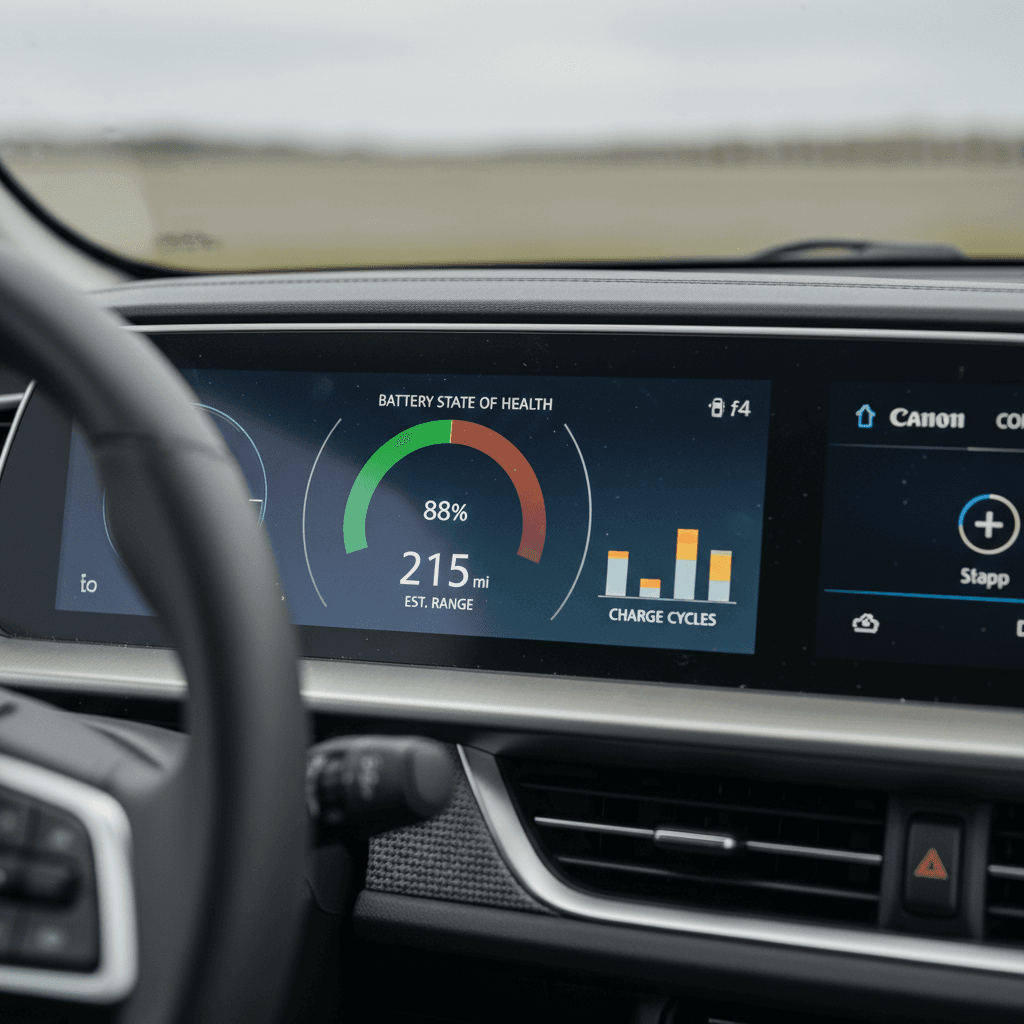
Because battery condition is the heart of a used EV’s value, Recharged builds it into every vehicle we list. Instead of guessing from dash estimates alone, we pull direct data from the car and run it through our Recharged Score process.
Inside the Recharged Score battery health check
Designed to separate “normal wear” from “this might be a problem.”
1. Raw battery data
We read state of health, pack voltage, cell balance, and charging history where available, rather than relying only on the range shown on the dash.
2. Model‑specific benchmarks
A 10‑year‑old air‑cooled hatchback and a 4‑year‑old liquid‑cooled crossover don’t age the same. We compare the car against normal degradation curves for that generation and chemistry.
3. Transparent report
Every Recharged vehicle includes a battery health summary in the listing, so you can see at a glance how much capacity is left and how that stacks up to similar cars.
From there, our EV specialists help you interpret what those numbers actually mean for your commute, climate, and charging options. Combined with financing, trade‑in, and nationwide delivery, the goal is simple: make used EV ownership feel as straightforward as buying a great used gas car, just cleaner and cheaper to run.
FAQ: Normal EV battery degradation explained
Frequently asked questions about normal battery degradation
Bottom line: what “normal” battery degradation looks like
A healthy EV battery doesn’t fall off a cliff. With today’s technology, a normal battery degradation rate means roughly 1.5–2.5% capacity loss per year on average, with a small early drop and a long, slow fade after that. After 8–10 years, most well‑treated EVs still have 75–88% of their original capacity, more than enough for commuting and everyday life.
If you’re shopping used, focus less on the myth that “EV batteries don’t last” and more on the actual data for the specific car in front of you: its state of health, model‑specific norms, climate history, and your own range needs. That’s exactly the gap Recharged is built to close, with verified battery diagnostics, fair market pricing, financing, trade‑in options, and EV‑savvy guidance from the first click to the day the car arrives in your driveway.