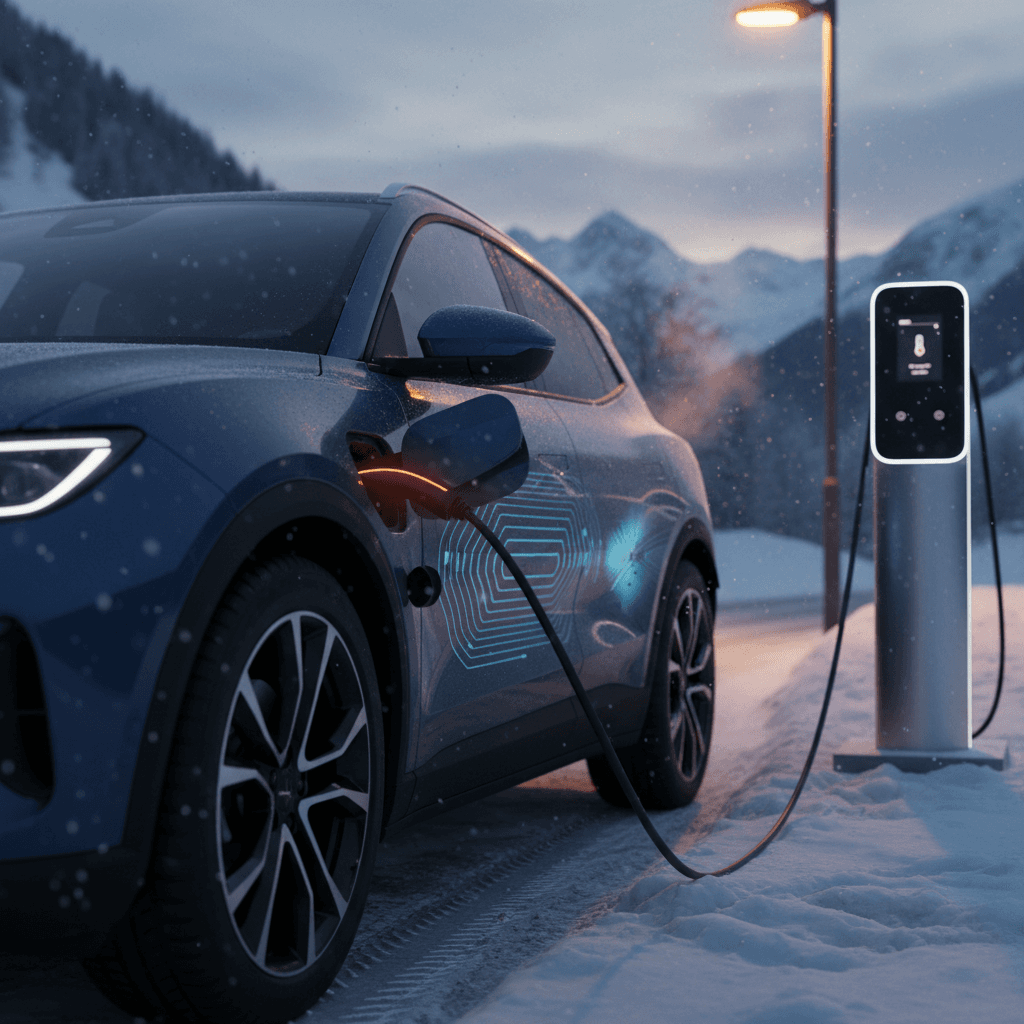
You plug into a DC fast charger, the screen says “preconditioning battery for fast charging”, and…nothing dramatic happens. Charge power is low, the fan roars, and your coffee gets cold while the car “thinks.” What exactly is going on under the floorpan when your EV preconditions the battery, and why should you care?
Short answer
What does “preconditioning the battery for fast charging” actually mean?
In plain language, battery preconditioning is your EV’s way of saying: “Let me get my battery to the right temperature before we hit it with a firehose of electrons.” Modern lithium‑ion cells have a fairly narrow comfort zone for fast charging, roughly in the neighborhood of 40–50°C (about 104–122°F) for many packs. Outside that range, especially when it’s very cold or very hot, forcing high charge power can cause permanent damage, so the car refuses to do it.
When you see a message like “conditioning battery for optimum DC charging” or “preconditioning for Supercharging”, the car is using its thermal-management system, coolant loops, pumps, heaters, sometimes a heat pump, to warm or cool the pack toward that sweet spot. Only after the pack nears its target temperature will the EV allow the charger to ramp from a trickle to the full advertised power.
Why preconditioning matters for fast charging
Three big reasons EVs precondition before a fast charge
It’s not just engineering fussiness; it’s about safety, speed, and longevity.
1. Protecting the battery
2. Maximizing charge speed
3. Consistent road-trip planning
Cold is the real villain
How EVs precondition the battery before a fast charge
Different brands use different tricks, but the broad playbook is the same: move heat into or out of the pack just before a fast charge, using energy that would otherwise be spent less efficiently.
- Coolant loops and pumps: Fluid runs through channels in the pack, moving heat between the battery, inverter, motors, and (in heat‑pump cars) the cabin HVAC system.
- Battery heaters: Many EVs have dedicated resistive heaters or use AC ripple current from the charger to warm the pack, especially in vehicles with LFP batteries that are more temperature‑sensitive.
- Heat pump systems: Newer EVs from Tesla, Hyundai, Kia, Ford, Polestar and others often use heat pumps to scavenge waste heat and move it into the battery or cabin with far less energy than a simple resistive heater.
- Smart software: When you navigate to a DC fast charger, the car looks at outside temperature, pack temperature, distance and expected arrival state of charge, then decides when to start the process so the battery is ready right as you plug in.
Heating the pack (most common)
In winter, preconditioning usually means warming the pack. The car may:
- Route motor and inverter waste heat into the battery loop.
- Use onboard heaters or charger current to add heat.
- Reduce cabin heating so more energy goes into the pack.
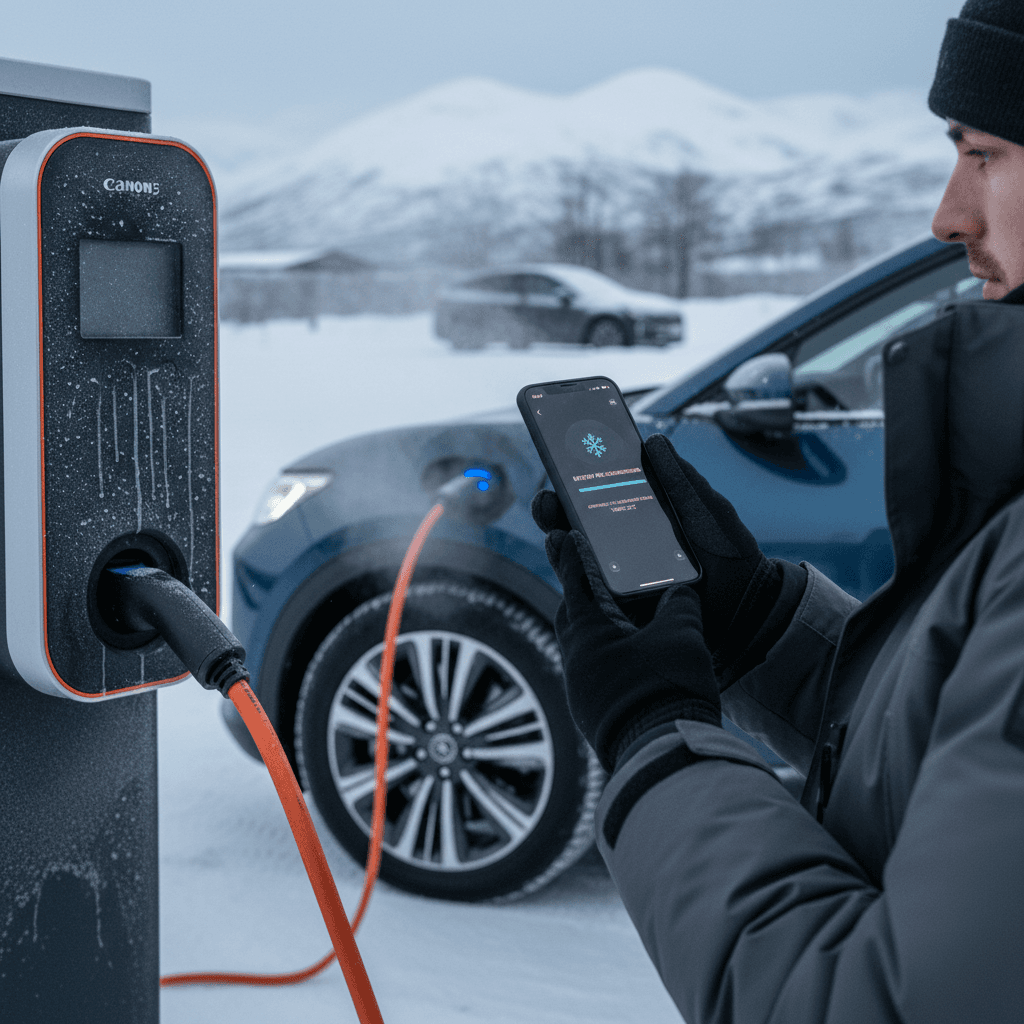
You’ll often hear stronger fan noise and see a snowflake or battery‑warming icon on the dash or in the app.
Cooling the pack (on hot days)
In high heat, preconditioning can also mean cooling the battery before fast charging. Your EV might:
- Spin up the A/C compressor to pull heat out of the pack.
- Reduce charge power temporarily to avoid overheating.
- Run the cooling system even after you unplug to bring temps back down.
You may notice the radiator fans and A/C running hard even while you’re parked at the charger.
Why the first 5–10 minutes feel slow
When your car will precondition automatically
Manufacturers don’t all use the same terminology, but most modern EVs will precondition the battery automatically when certain triggers line up. Here’s how it typically works in the real world.
Common ways EVs trigger automatic preconditioning
Your owner’s manual has the fine print, but this is the general pattern across today’s EVs.
| Trigger | What usually happens | Typical use case |
|---|---|---|
| Navigating to a DC fast charger | The car starts heating or cooling the pack some minutes before arrival based on distance and temperature. | Road‑trip stops at Tesla Superchargers or CCS stations. |
| Scheduled departure with climate on | Car warms (or cools) the cabin and often brings the battery into a better temperature range while plugged in. | Cold mornings at home; leaving with a warm cabin and more regen available. |
| Extreme cold while plugged in | Some EVs will “protect charge” by gently warming the pack if it gets dangerously cold while at low state of charge. | Overnight parking outdoors in sub‑freezing conditions. |
| High‑power fast‑charge session in hot weather | The car will ramp up cooling as power climbs, and may taper early if temps get too high. | Summer highway drives with back‑to‑back fast‑charge stops. |
Not every model has every feature, but the logic is surprisingly similar from brand to brand.
Good news: you rarely need to micromanage it
How long battery preconditioning usually takes
Typical preconditioning times in everyday use
These are ballpark figures, not promises. Your results will depend on battery chemistry, pack size, starting temperature, and whether the car is already warmed up from driving. In practice, you mostly feel this as “my first winter fast charge was painfully slow, and the second one was much better.”
Short drives to a fast charger
Signs your battery is still too cold or too hot
- Low power despite a big charger: The station may be rated at 150–350 kW, but your car hovers at 30–60 kW for a long time. That’s often a cold pack, not a “bad” charger.
- On‑screen warnings: Many EVs show messages like “Battery temperature low, heating for fast charging” or “Charging power reduced due to battery temperature.” That’s preconditioning and thermal protection in action.
- Blue or snowflake icons on the battery gauge: These usually mean part of the battery’s capacity is unavailable because it’s cold; fast charging will be limited until the icon disappears.
- Fans and pumps running hard: Loud cooling fans or the sound of coolant circulators, even after you unplug, often mean the car is managing a hot pack.
- Charge curve that drops early: On a hot day, you may see high power initially that tapers much earlier than usual. That’s the car protecting itself from excessive heat.
Don’t try to “hack” thermal limits
Owner checklist: using preconditioning like a pro
Simple habits that make fast charging…fast
1. Always navigate to the fast charger
Even if you know exactly where it is, let the car’s built‑in nav route you there. That’s often the only way to trigger full preconditioning for DC fast charging.
2. Arrive between 10–40% state of charge
Fast chargers are most effective when the battery is partly depleted. Arriving at 5–20% in cold weather gives the car time to warm the pack and still make use of peak power.
3. Precondition while still plugged in at home
On winter mornings, use your app’s “precondition” or “schedule departure” feature while the car is charging. You’ll start with a warm pack, more regen, and less stress on the battery.
4. Don’t overdo cabin heat during preconditioning
Seat and steering‑wheel heaters use far less energy than blasting hot air. If you’re road‑tripping in the cold, let the car focus more of its energy on the battery, not the windshield vents.
5. Give it time after a long cold soak
If the car has sat for many hours in sub‑freezing temps, expect the first fast charge to be slower. Let the car finish its preconditioning instead of unplugging early in frustration.
6. In extreme heat, avoid topping to 100% on DC
High temps plus high state of charge are hard on lithium‑ion cells. On hot days, stop your DC fast charges around 70–80% and finish the rest on Level 2 if you need a full battery.
Preconditioning and battery health on used EVs
If you’re shopping for a used EV, battery preconditioning is more than a neat tech trick, it’s a window into how the previous owner may have treated the pack. Cars that regularly precondition before fast charging and rely on slower home charging the rest of the time generally age more gracefully than cars that are fast‑charged from cold or heat‑soaked states all the time.
At Recharged, every vehicle comes with a Recharged Score battery health report. We use professional diagnostics to understand how the pack has fared over its life, not just what the dashboard guessometer says. That gives you a clearer picture of remaining capacity and helps you choose a car whose charging behavior, and past usage, match the kind of trips you actually take.
How this ties into real ownership
If you’re unsure how a particular model handles preconditioning, an EV‑savvy retailer can walk you through a live demo: navigate to a hypothetical fast charger, watch the battery icons and temperatures, and see how quickly the car ramps power. That’s exactly the sort of hands‑on walkthrough Recharged’s EV specialists provide, whether you’re buying entirely online or visiting our Experience Center in Richmond, VA.
FAQ: battery preconditioning for fast charging
Frequently asked questions about battery preconditioning
Key takeaways
- Preconditioning the battery for fast charging means your EV is actively heating or cooling the pack to a safe, efficient temperature window before allowing high DC power.
- It’s most noticeable in cold weather, where a non‑preconditioned pack can charge painfully slowly and temporarily lose usable range.
- You usually trigger full preconditioning by navigating to the DC fast charger in your car’s built‑in nav, then letting the software manage temperature on the way.
- Typical preconditioning times range from 15–30 minutes in mild weather to 30–60 minutes after a deep cold soak, depending on the car and conditions.
- Used EV shoppers should care about how a car has been charged and preconditioned over its life; tools like the Recharged Score battery report give a clearer picture than a simple guess at remaining range.
The next time your dash flashes “preconditioning battery for fast charging,” you’ll know it isn’t wasting time, it’s doing the unseen work that makes fast charging fast, and keeps your expensive battery pack healthy for the long haul. Learn to work with it, and your winter road trips, summer fast‑charge stops, and everyday charging routine all get a lot smoother.