If you’re planning a road trip in a Volkswagen ID.4 or shopping for a used one, you’ll quickly run into the same question: how fast does it really charge in the wild? Official numbers tell one story, but real-world VW ID.4 charging speed tests can look very different depending on the battery, charger, and conditions.
Key takeaway
VW ID.4 charging speed at a glance
Headline VW ID.4 fast-charging stats
Volkswagen’s own specs say recent 82 kWh ID.4s can fast charge from 10–80% in roughly 28–30 minutes on a high-power DC charger. Independent testing of the ID.4 Pro shows an average of about 120–125 kW from 10–80%, with a peak around 140 kW, and roughly 28–32 minutes for that 10–80% window under good conditions. That puts the ID.4 in the middle of the compact EV SUV pack: quicker than some older rivals, slower than the very fastest Korean and Tesla platforms, but predictable and consistent once you know its habits.
VW ID.4 batteries and max charging power
Before you obsess over speed tests, it helps to understand which battery pack is in your ID.4 and what its official charging ceiling looks like. Volkswagen has offered two main pack sizes in North America, plus different supplier hardware over the years.
VW ID.4 batteries and max DC fast-charging power
Approximate specs for common North American VW ID.4 variants. Exact figures can vary by model year and software.
| Model / Pack | Usable battery (kWh) | EPA range (RWD, approx.) | Max DC rating | Typical 10–80% time |
|---|---|---|---|---|
| ID.4 Standard / Limited (62 kWh) | ~62 | ~200–209 miles | 100–140 kW (by year) | ~30–40 min |
| ID.4 Pro / Pro S (early 82 kWh, LG pack) | ~77–82 | ~260–275 miles | Up to ~135–141 kW | ~30–36 min |
| ID.4 Pro / Pro S (newer 82 kWh, SK On pack) | ~82 | ~291 miles RWD / ~263 AWD | 175–200 kW peak | ~25–30 min |
| 2024–2025 ID.4 Pro (typical U.S. spec) | ~82 | ~291 miles RWD / ~263 AWD | Up to 175 kW | “under 30 minutes” 5–80% on a strong charger |
Use this as a guide when comparing your own charging logs to VW’s claims.
Model-year fine print
Real-world DC fast charging speed tests
So what happens when you pull into a DC fast charger with an ID.4 that’s nearly empty? Let’s walk through a representative charging speed test for a recent 82 kWh ID.4 Pro on a modern 150–350 kW public station.
A sample VW ID.4 charging speed test
What you’ll typically see on a healthy 82 kWh pack and strong charger
Start: 10% state of charge
You arrive with about 10% battery left, a good target for quick charging because the ID.4 can pull maximum power at low state of charge if the pack is warm.
Peak: ~140–175 kW
Plugged into a 150 kW+ station, a healthy 82 kWh ID.4 often snaps to 140–175 kW for the first several minutes, then gently tapers as it approaches 40–50%.
Finish: 80% in ~28–32 minutes
In many real-world tests, the 10–80% window lands in the 28–32 minute range, adding roughly 175–200 miles of usable highway range.
Independent charging curve analyses of the ID.4 Pro show that from 0–80%, the car can add about 66 kWh in roughly 30–32 minutes, averaging just over 120 kW. From 10–80%, the average power is even higher, and 10–90% still clocks in under three-quarters of an hour when the charger and conditions cooperate.
Aim for 10–70% on road trips
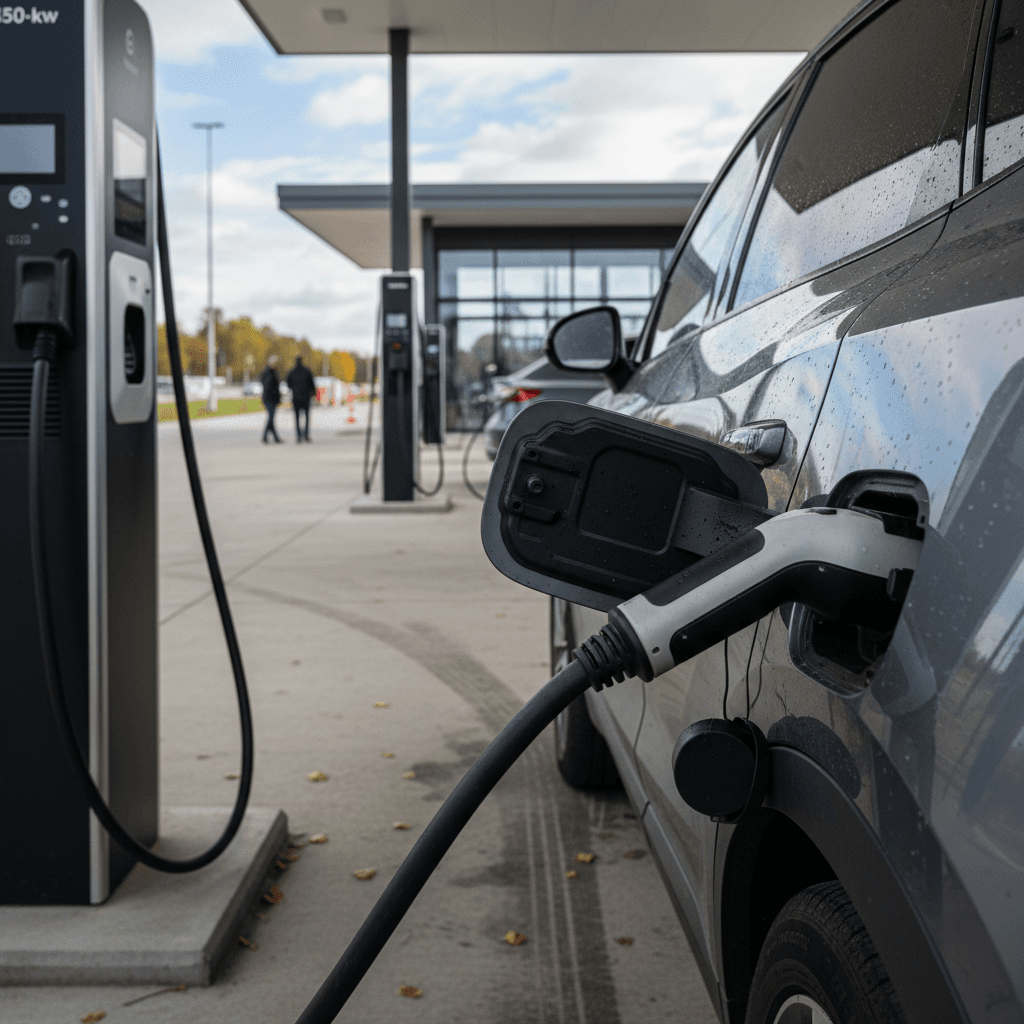
Understanding the VW ID.4 charging curve
Every EV follows a charging curve, a pattern that shows how many kilowatts it can accept at each state of charge. A car with a lower peak but a flat, consistent curve can beat a rival that spikes briefly and then crashes down.
How the ID.4’s curve behaves
- 10–30%: This is where you’ll usually see the highest power, around 130–175 kW on newer 82 kWh packs.
- 30–60%: Power gradually tapers but often holds between 90–130 kW, which is still strong for an everyday family EV.
- 60–80%: The curve continues to drop, typically into the 60–90 kW range as the battery fills.
- 80–100%: Charging slows sharply, sometimes down to 20–40 kW to protect the pack.
Why it matters for your trips
- Spending 10–15 minutes going from 80–100% can add only a small chunk of extra range.
- Stopping more often but keeping sessions short can cut total travel time.
- A nearly flat curve between 10–80% is a sign of a well-managed thermal system and healthy pack.
- If your ID.4 is dropping below ~70 kW by 40–50%, something (charger, temperature, or pack) may be limiting performance.
Software and supplier updates
Level 2 and home charging times
Most of your charging life with an ID.4 will happen away from DC fast chargers, at home, work, or slower public Level 2 stations. The ID.4’s 11 kW onboard charger is competitive for an EV in this class and makes overnight top-ups easy if you have a 240 V circuit available.
Approximate VW ID.4 AC charging times
Rough full-charge times from near-empty to 100% under normal temperatures.
| Charger type | Power (approx.) | 62 kWh pack: 0–100% | 82 kWh pack: 0–100% |
|---|---|---|---|
| Level 1 (120 V household outlet) | 1–1.4 kW | ~60–70 hours | ~75–80 hours |
| Level 2 (240 V, 32 A) | ~7.2 kW | ~9–10 hours | ~11–12 hours |
| Level 2 (240 V, 40 A) | ~9.6 kW | ~7–8 hours | ~9–10 hours |
| Level 2 (240 V, 48 A / 11 kW) | ~11 kW | ~6–6.5 hours | ~7.5–8 hours |
Real-world times depend on your exact amperage, voltage, and local grid conditions.
Plan home charging around your panel
5 factors that slow your ID.4 charging speed
If your own VW ID.4 charging speed test doesn’t match what you see online, don’t assume the car is broken. A handful of common factors can drag speeds down by 25–50%.
Common reasons your ID.4 charges slower than expected
1. Cold or very hot battery
Battery temperature is critical. In winter, arriving at a fast charger with a cold pack can cut power dramatically until the car warms things up. After a long highway stretch in extreme heat, the ID.4 may also dial back charging to protect the pack.
2. Weak or overloaded charger
Many older DC sites are limited to 50 kW, or they share power between stalls. If the station tops out at 50–75 kW, or you’re sharing a cabinet with another car, your ID.4 simply can’t hit its advertised rates.
3. High state of charge when you plug in
Arriving at 40–50% instead of 5–15% means you’re already past the steepest part of the charging curve. The car will naturally limit power, so your kW numbers will look modest even on a strong station.
4. Software and navigation settings
On newer competitors, entering a fast charger into the native navigation can precondition the pack. The ID.4’s thermal prep behavior has evolved with software; make sure you’re on the latest version and use the in-car nav when possible to give it the best chance to warm or cool the battery.
5. Battery health and recent recalls
Degraded or out-of-spec cells can cause the car to limit charging. VW also issued recalls involving <strong>high-voltage battery fire risk</strong> on some 2023–2024 ID.4s, with guidance to avoid DC fast charging until repairs are complete. If your VIN is affected, follow VW’s instructions and have the pack inspected before stress-testing it at high power.
Safety first on recalled packs
How to run your own VW ID.4 charging speed test
You don’t need lab equipment to gauge how your ID.4 is performing. With a bit of prep and a good DC station, you can run a simple but useful charging speed test and compare results against expectations.
Step-by-step: DIY VW ID.4 charging speed test
1. Choose a strong DC fast charger
Look for a 150–350 kW unit from a major network (Electrify America, EVgo, etc.), ideally one that shows its power rating on the pedestal. Avoid obviously busy or partially broken sites if you have alternatives.
2. Arrive with 5–15% state of charge
Plan your drive so you get to the station nearly empty, but not at 0%. That’s where the ID.4 can draw the most power and gives you a clean 10–80% window to observe.
3. Warm the battery on the way
Drive at highway speeds for at least 20–30 minutes before you arrive, especially in cold weather. If your ID.4 software supports it, set the charger as your destination in the onboard navigation to help the car manage pack temperature.
4. Log session start, 50%, and 80% times
Use your phone’s stopwatch or the charger’s session log. Note the time when you plug in, when the car hits 50%, and when it reaches 80%. Also jot down the <strong>peak kW</strong> you see on the charger or in the car’s display.
5. Compare against targets
On a healthy recent 82 kWh ID.4 on a strong station, expect roughly <strong>25–30 minutes from 10–80%</strong>. If you’re consistently 40+ minutes in mild weather on multiple stations, it’s worth having a dealer check software and the high-voltage system.
6. Save screenshots or session logs
Most networks let you export charging history. Screenshots of session power and time are valuable if you’re troubleshooting with a dealer or evaluating a used ID.4 for purchase.
Used VW ID.4: what charging speed reveals about battery health
If you’re considering a used VW ID.4, real-world charging behavior can tell you more than a simple range estimate on a dealer lot. Fast-charging speed, combined with a proper battery health report, is a powerful window into how the car has been driven and maintained.
How to use charging tests when buying a used ID.4
Combine a quick test session with professional diagnostics
Look for consistent performance across stations
If an ID.4 repeatedly tops out at 60–70 kW on multiple 150+ kW chargers in mild weather, that’s a red flag. It could be a weak site, old software, or a pack that’s being throttled because of underlying issues.
Back it up with a battery health report
A structured battery test, like the Recharged Score Report, looks beyond one charging session. It verifies usable capacity, checks for abnormal cell behavior, and compares the car’s performance with similar ID.4s so you’re not guessing.
How Recharged can help
Ready to find your next EV?
Browse VehiclesFAQ: VW ID.4 charging speed and tests
Frequently asked questions about VW ID.4 charging speed tests
Bottom line: is the VW ID.4 fast enough?
From a charging standpoint, the VW ID.4 lands in the solid middle of the compact EV SUV pack. It won’t win headline drag races against the very fastest 800 V rivals, but in everyday use, an 82 kWh ID.4 that can reliably add 10–80% in about half an hour is more than capable of handling long road trips with a bit of planning.
For you as a driver or shopper, the key is understanding your specific car’s battery pack, software level, and charging curve. A quick DIY VW ID.4 charging speed test paired with a professional battery health report turns guesswork into data, especially important in the growing used EV market.
If you’re weighing a used ID.4 against other EVs, a platform like Recharged can help you compare real battery performance, total ownership costs, and charging behavior across multiple vehicles. That way, when you plug in on a cold night halfway through a road trip, you already know exactly what to expect from your ID.4, and how quickly you’ll be back on the road.