If you grew up with posters of VW buses on your wall, the VW ID. Buzz probably tugs at your heartstrings. But nostalgia alone doesn’t haul strollers, sports gear, and three kids in car seats. This VW ID. Buzz for families review looks past the retro styling to see how it really works as a modern electric family hauler in the U.S.
At a glance
Who the VW ID. Buzz Is (and Isn’t) For
Is the ID. Buzz a good fit for your crew?
Match the van to your family’s real life, not the brochure photos.
Perfect for
- Families who want three rows and flexible seating.
- Parents who prioritize style and fun as much as utility.
- Suburban households with home charging who do mostly local driving and moderate trips.
Good, with caveats
- Families who take occasional road trips and can plan charging stops.
- People comfortable living with ~230 miles of rated range.
- Buyers who can stretch the budget for something special.
Probably not ideal for
- Families doing long highway drives most weekends.
- Those needing max range (300+ miles) between charges.
- Shoppers on a tight budget or depending heavily on tax credits.
In short, the ID. Buzz is less a traditional minivan replacement and more a characterful family EV that happens to be extremely practical if you can live with its range and price.
Family-Friendly Highlights at a Glance
Key Numbers Families Care About
Award-winning family EV
Space, Seating, and Child Seats
Volkswagen sized the U.S.-spec ID. Buzz squarely for families. It’s roughly the length of a midsize SUV but boxier, which is exactly what you want when you’re packing in humans and their stuff.
- Three-row seating with space for up to seven.
- Sliding side doors for easy school-drop-off access.
- High, upright seating position that makes loading kids less of a back workout.
- Flat floor in the second row that helps with movement and car-seat placement.
Child seat champion
If you’re in the phase of life where every trip involves at least one stroller and a diaper bag, the ID. Buzz feels purpose-built. Wide sliding doors and a tall roof make it easy for adults to climb into the third row to buckle kids, not just reach in and hope. Multiple full LATCH positions mean you’re not playing musical chairs with boosters and convertibles every time your carpool roster changes.
Third-row seat recall
Cargo Room and Family Gear
If you’re cross-shopping with three-row SUVs, the ID. Buzz’s trump card is its shape. That squared-off rear and long roofline turn into honest-to-goodness usable cargo space, not just a decorative sliver behind the third row.
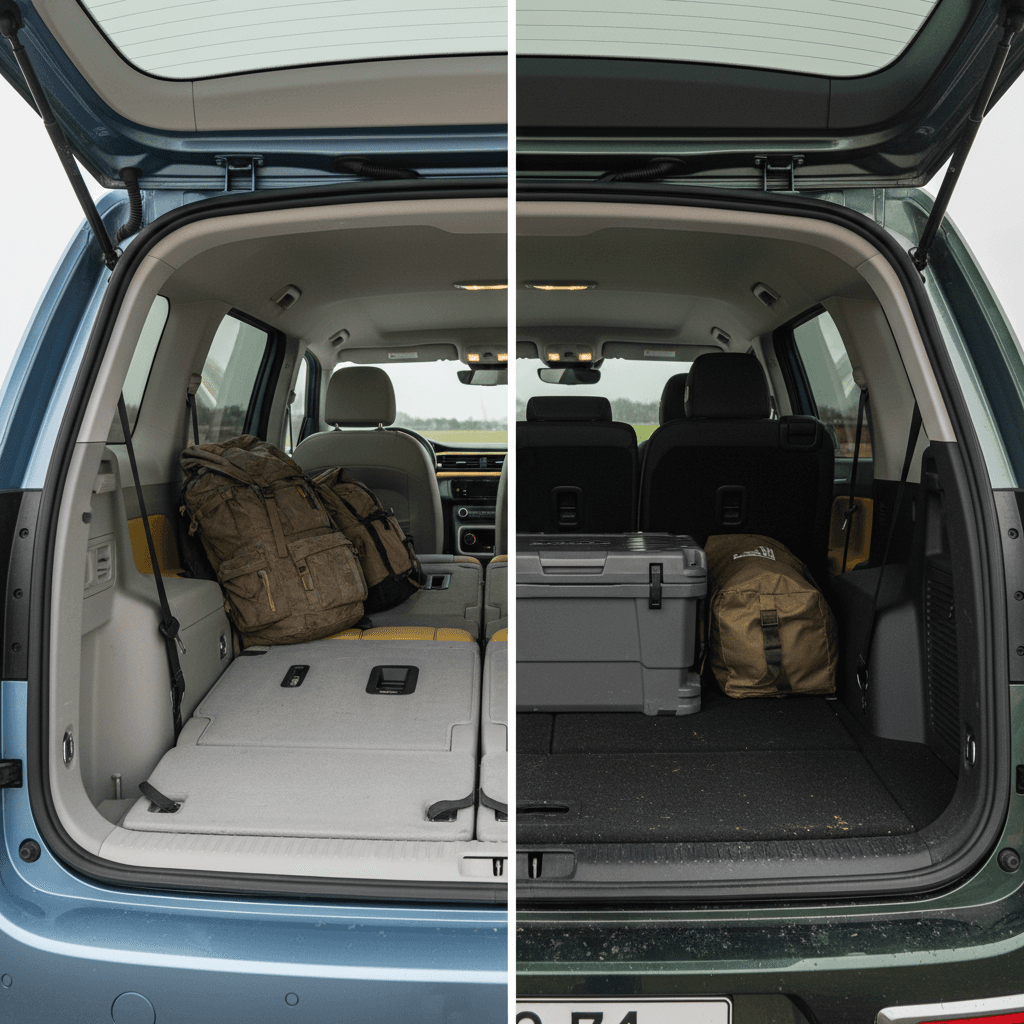
How the ID. Buzz handles family cargo
From Costco runs to camping trips.
Behind the 3rd row
With 3rd row folded
Maximum cargo mode
The only caution is that while the volume is generous, it’s not a low-floor minivan with power-folding magic. You’re still manually folding or removing seats. If you frequently swap between people-hauling and maximum cargo, you’ll want to practice your seat gymnastics before a big trip.
Safety Ratings and Driver Assistance Tech
For most parents, safety isn’t a feature, it’s the starting line. Here the ID. Buzz performs like the modern family vehicle it’s meant to be.
- Strong crash-test performance from major U.S. safety agencies, including solid frontal and side-impact scores.
- Excellent LATCH ease-of-use ratings with multiple rear seating positions ready for child seats.
- Standard blind-spot monitoring, lane-keeping assist, adaptive cruise control, and rear automatic braking on most trims.
- Advanced pedestrian detection and automatic emergency braking to help in busy parking lots and school zones.
Recall doesn’t equal unsafe, but check the paperwork
On the road, the driver-assistance systems do a good job of easing the load on longer drives without feeling overbearing. Lane-centering and adaptive cruise are tuned on the gentler side, which suits family duty: you want help, not drama.
Range, Charging, and Road-Trip Readiness
Here’s where you have to be honest about how your family really drives. Officially, the ID. Buzz delivers an EPA-estimated 234 miles of range for rear-wheel-drive versions and about 231 miles for all-wheel drive. In independent highway testing, real-world range numbers tend to land closer to the 180–190 mile mark, especially at 70–75 mph and in colder weather.
Charging basics for busy families
Great for daily life
- Commutes, errands, and kid shuttles are well within its comfort zone.
- Plug in at home overnight and you’ll almost always wake up with a full "tank."
- Even moderate weekend trips (150–200 miles each way) are easy with a planned fast-charge stop.
Mixed for long road trips
- Once you push beyond about 200 highway miles in a day, the shorter range and extra charging stops start to feel limiting.
- Fast charging works well, but you’re still building your day around DC chargers and kids’ patience.
- If you routinely do 400–600 mile days, you may want a longer‑range EV or a plug-in hybrid as the road-trip specialist.
Make the charging network your friend
Daily Driving, Comfort, and In-Car Tech
Around town and on the highway, the ID. Buzz feels more like a laid-back lounge than a traditional minivan. The electric drivetrain is quiet and smooth, with instant torque that makes merging and passing drama-free even with a full cabin.
- RWD models make 282 hp; AWD versions step up to around 335 hp, plenty for a family van.
- Steering is light and visibility is excellent, thanks to the tall seating position and big windows.
- Ride quality is comfortable and composed; on the highway it has that "magic carpet" feel owners rave about.
Tech that keeps kids occupied
Volkswagen’s software has improved, but it’s still not as slick as a Tesla’s or some Korean rivals’. Expect the occasional menu dig or slow response from the companion app. The good news is that the fundamentals, climate, audio, drive modes, are all easy enough to access once you live with the car for a week.
Costs, Pricing, and Value for Families
Here’s the sticking point for a lot of buyers: in the U.S., the ID. Buzz landed with premium pricing. Early 2025 models started around the low $60,000s and climbed toward $70,000 with options and AWD. Because it’s built in Europe, it has faced higher import costs and, in many cases, hasn’t qualified for the full federal EV tax credit.
VW ID. Buzz family value snapshot (U.S. market)
Approximate new-vehicle reality as of 2025–2026; local pricing will vary.
| Item | What to expect |
|---|---|
| Base price, new | Around $61,000+ before destination and fees |
| Well-equipped family spec | Commonly mid-to-upper $60,000s |
| Federal incentives | Often limited or unavailable due to import status; always check current rules |
| Running costs | Lower fuel and maintenance costs than comparable gas minivans or SUVs |
| Resale value | Early days, but niche appeal and limited supply may help values over time |
Use this as directional guidance, not a dealer quote.
2026 model-year pause
For families, the question is whether the Buzz’s character, space, and electric drivetrain justify its premium over a very good gas minivan. If you’re fine spending SUV money for something distinctive and electric, the answer can be yes. If you’re purely value-driven, more conventional options will look stronger on paper.
Ownership Quirks, Recalls, and Real-World Feedback
Early ID. Buzz owners sound a familiar EV refrain: "We love it, but…" The love is easy to understand. The van turns heads everywhere, rides comfortably, and makes errands feel like a field trip instead of a chore. But owners also report a handful of quirks.
- High curb weight means you need to brake a little earlier than a similar-size SUV.
- Doors and windows occasionally need adjustment, nothing dramatic, but worth checking under warranty.
- Mobile app experience can be slow or glitchy; Android Auto and CarPlay are generally more pleasant ways to interact with the car.
- Range is fine for day-to-day, but several owners wish for a larger battery for true cross-country comfort.
Used or new, check the campaign history
How the ID. Buzz Compares to Other Family EVs
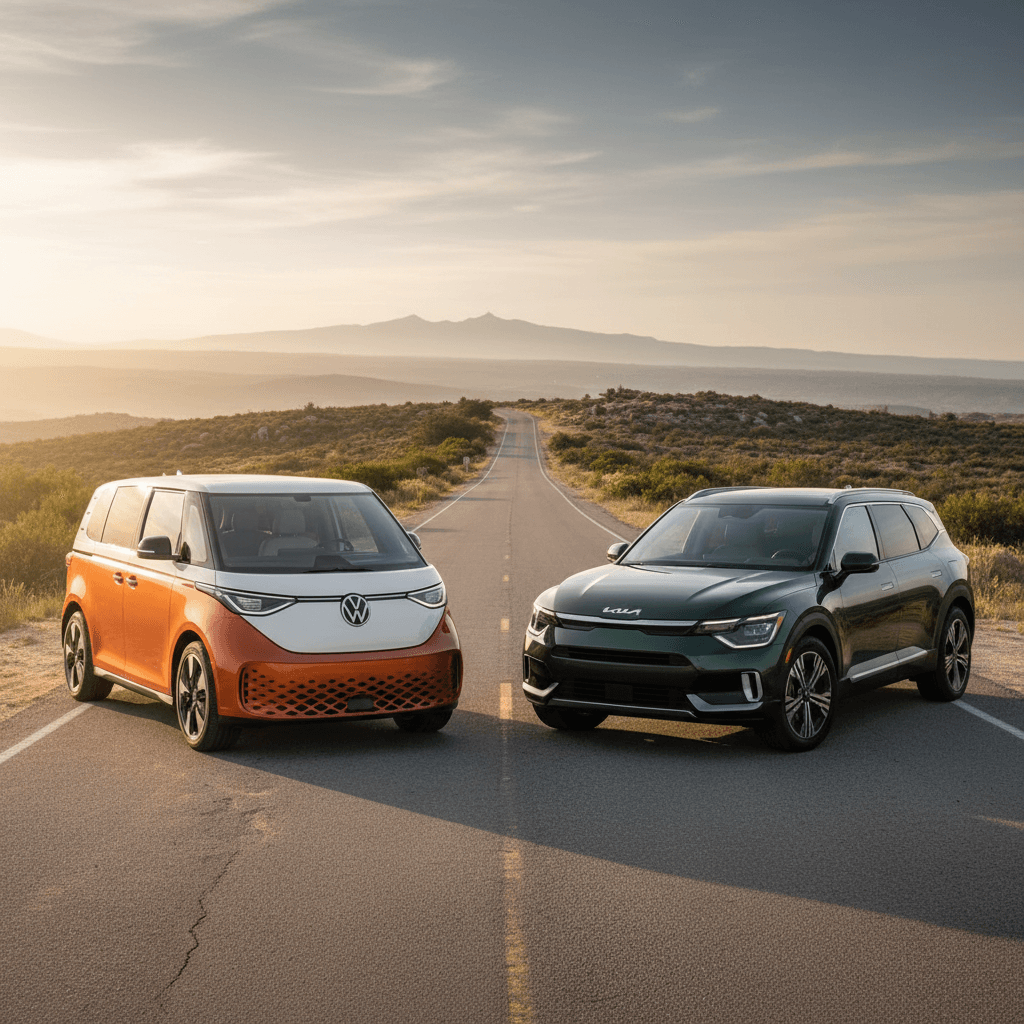
Tesla Model Y / Kia EV9 / Hyundai Ioniq 7 (future)
- More traditional SUV shapes with better highway range than the ID. Buzz.
- Often similar or lower pricing, depending on trim and incentives.
- Less quirky, more mainstream; some offer three rows but pack less vertical cargo space.
Gas minivans (Sienna, Odyssey, Pacifica)
- Usually cheaper to buy and easier to find.
- Much longer range and quick refueling on road trips.
- But higher fuel and maintenance costs, and no EV driving experience.
Other electric vans
- The ID. Buzz is essentially the only mainstream, family-focused electric van in the U.S. right now.
- Some commercial EV vans exist, but they’re not as comfortable or kid-friendly.
- If you want a true EV people carrier with sliding doors, this is it, for now.
Where the ID. Buzz really shines
Buying a Used VW ID. Buzz: What to Watch For
Because the ID. Buzz only reached U.S. driveways in late 2024 and 2025, every used Buzz is still relatively new in 2026. That’s good news for wear and tear, but it also means the U.S. market is small and prices can feel sticky.
Used ID. Buzz family checklist
1. Confirm all recalls are done
Ask for documentation on the third-row seat-width fix and any brake-warning-light campaigns. A clean recall history is table stakes for a family car.
2. Review charging and software history
Make sure the van has the latest software updates. Ask how often the owner used DC fast charging and review any notes about charging issues.
3. Inspect doors, seals, and interior wear
Sliding doors, window seals, and seat mechanisms should operate smoothly. Check for water leaks, rattles, or electrical gremlins (like windows not auto-closing).
4. Evaluate range in your climate
On a test drive, start at a known state of charge and watch the projected range. Consider your typical commute and winter temperatures when judging whether ~200 real-world miles is enough.
5. Look at total cost of ownership
Factor in energy costs, home charging installation, and insurance. A used ID. Buzz might cost more to buy than a gas van but save substantially on fuel and maintenance over 5–8 years.
6. Get a battery health report
Whenever possible, get a <strong>third-party battery health test</strong>. At Recharged, every vehicle includes a Recharged Score report with verified battery health and pricing transparency, so you know exactly what you’re getting.
How Recharged can help
VW ID. Buzz Family FAQs
Common Questions About the VW ID. Buzz for Families
Verdict: Should Your Family Buy an ID. Buzz?
If you wrote up a wish list for a modern family hauler, three rows, sliding doors, strong safety scores, quiet ride, and a sense of fun, the VW ID. Buzz would check almost every box. It’s one of the few EVs that genuinely feels designed around family life instead of merely adapted to it.
The trade-offs are real: a premium price, only average long‑distance range, and a brief model-year pause that may complicate new-vehicle shopping. But for families who do most of their miles close to home, have access to home charging, and are ready to swap gas stops for charge stops, the Buzz is both practical and deeply charming.
If you’re not sure the VW ID. Buzz is the perfect fit, or you’re thinking a used one might be smarter than new, that’s where Recharged comes in. Our EV specialists can help you compare the Buzz with other family EVs, understand battery health and charging needs, line up financing and trade‑in options, and even arrange nationwide delivery when you find the right car. However you configure your family’s next adventure vehicle, make sure it works not just in your imagination, but in your driveway, and on those long, noisy, unforgettable family trips.