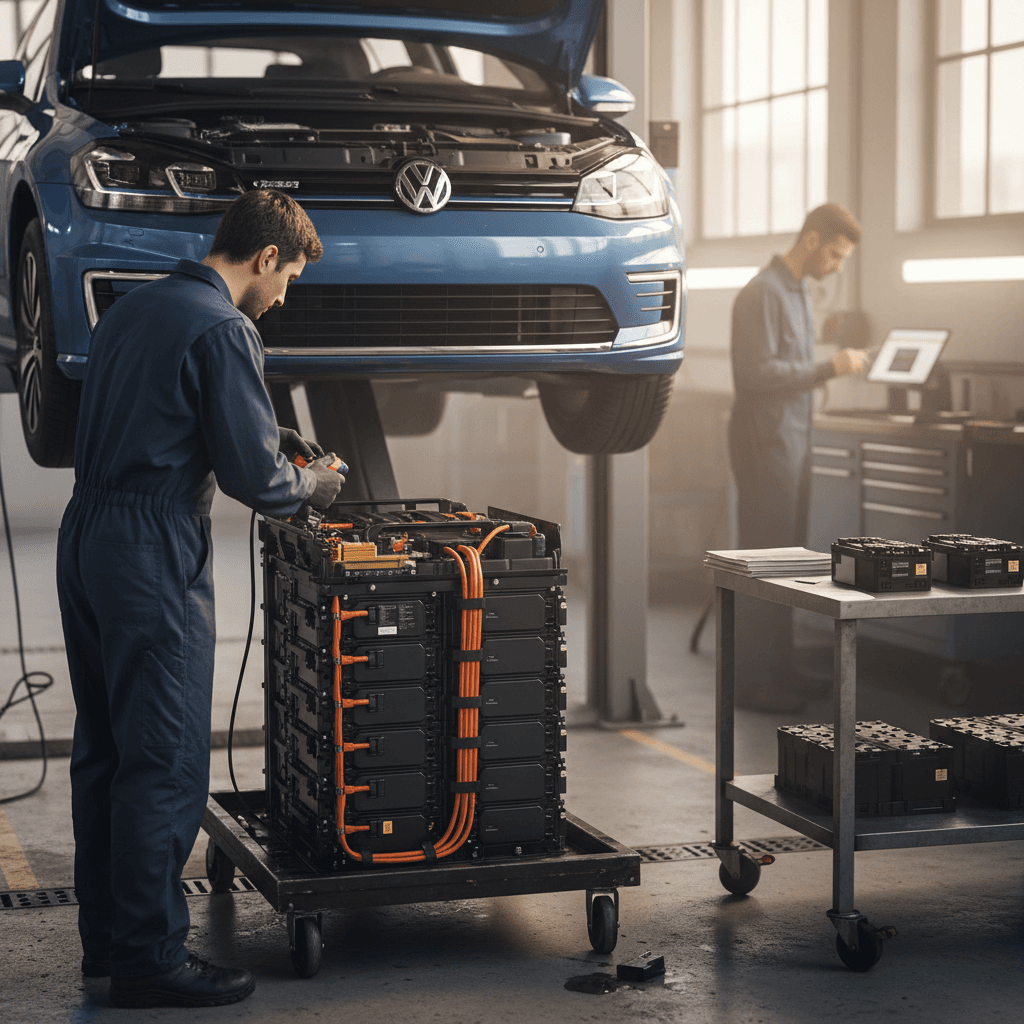
If you own a VW e‑Golf (or are eyeing a used one), you’ve probably wondered about VW e‑Golf battery replacement, how much it costs, how often it’s needed, and whether it ever makes financial sense. The good news: most e‑Golf packs age better than many people expect. The bad news: a brand‑new high‑voltage battery from Volkswagen is still one of the most expensive repairs you can face.
Quick takeaway
VW e‑Golf battery basics: size, range, and warranty
There were two main battery versions of the VW e‑Golf sold in the U.S. and Europe. Knowing which one you have helps you frame any battery‑replacement decision.
VW e‑Golf battery versions at a glance
Key specs for the two main e‑Golf battery packs.
| Model years | Nominal capacity | Usable capacity (approx.) | EPA/WLTP range when new* |
|---|---|---|---|
| 2015–2016 e‑Golf | 24.2 kWh | ~20–21 kWh | ~83 mi EPA |
| 2017–2019 e‑Golf | 35.8 kWh | ~31–32 kWh | ~125 mi EPA (around 200 km+ WLTP) |
Both packs use liquid‑cooled lithium‑ion cells with DC fast‑charging capability.
From the factory, VW backed the high‑voltage battery with an 8‑year / 100,000‑mile warranty (whichever came first) against excessive capacity loss or failure. Today, every e‑Golf is at least a few years into that window, and many early cars are already outside it, exactly when owners start asking if replacing or upgrading the pack is worth it.
Check your specific warranty
How long VW e‑Golf batteries really last
Real‑world data from high‑mileage e‑Golf owners paints a much more optimistic picture than many people expect. Drivers reporting 100,000–180,000 miles (160,000–300,000 km) commonly see 10–20% battery degradation, with some examples around 85–90% state of health after hundreds of DC fast‑charge sessions and years of daily use.
What that looks like in miles
- Most e‑Golfs will not need a traction battery replacement within their first 8–10 years if they’re charged reasonably (mostly Level 2, limited time spent at 100%, avoiding excessive heat).
- You’ll see the first 5–10% of range loss relatively quickly, then degradation typically slows down.
- Daily range needs matter more than capacity percentage: a pack at 80–85% can still be perfectly usable if your round‑trip commute is short.
When to start worrying
VW e‑Golf battery replacement cost in 2025
This is the question everyone eventually asks: what does a VW e‑Golf battery replacement actually cost in 2025? Unfortunately, there’s no single fixed price, but we can outline realistic ranges based on current parts and labor rates.
Typical VW e‑Golf battery replacement price ranges
Approximate 2025 U.S. pricing, before tax and shop fees. Actual quotes vary widely by dealer and region.
| Option | What it includes | Estimated parts cost | Estimated installed cost |
|---|---|---|---|
| New OEM pack via VW dealer | Brand‑new pack, latest revision, installed at Volkswagen dealership | $12,000–$18,000+ | $14,000–$20,000+ |
| Used/salvage e‑Golf pack | Pack removed from a wrecked e‑Golf, capacity unknown until tested | $4,000–$8,000 | $5,500–$9,500 |
| Independent reman/rebuilt pack | Refurbished pack with modules replaced or re‑balanced | $6,000–$10,000 | $7,500–$12,000 |
| Aftermarket upgrade pack (where available) | Non‑VW pack that increases capacity (e.g., ~58 kWh conversions some owners discuss) | ~$5,800+ parts (overseas), plus import & duties | $7,000–$10,000+ if a qualified shop will install |
These numbers are directional, not official VW pricing. Always get a written quote from a repair facility.
At the high end, a dealer‑installed OEM pack can approach or even exceed the current market value of the car. Even many refurbished or salvage‑pack options land in the mid‑four to low‑five figures once you factor in labor, shipping, programming, and shop mark‑ups.
Sticker shock is real
Repair vs full battery replacement
Not every battery problem means you need a full pack replacement. Sometimes you’re dealing with something cheaper and more localized.
Common scenarios that get confused with “dead battery”
Before signing off on a five‑figure repair, be sure you understand which bucket your issue falls into.
12‑volt auxiliary battery failure
The small 12‑volt battery can fail every 4–6 years, just like in a gas Golf. Symptoms can mimic traction‑battery issues: warnings, no‑start, random errors.
Typical cost: $250–$450 installed.
Module or contactor fault
A problem with one module, a contactor, or wiring can trigger high‑voltage errors. In some cases, a skilled EV shop can replace components instead of the whole pack.
Typical cost: low four figures, but highly case‑specific.
Severe capacity loss or damage
When the entire pack is significantly degraded or damaged (for example, after impact or flooding), a full pack replacement may be the only safe option.
Typical cost: see full replacement ranges above.
Insist on a clear diagnosis
Battery upgrade options for the e‑Golf
Because the e‑Golf drives so well, many owners would love to keep the car and simply add more range. A small ecosystem of upgrade options is emerging, but it’s still a niche, early‑adopter space with real trade‑offs.
Aftermarket higher‑capacity packs
Some third‑party suppliers now offer custom battery packs advertised around 58 kWh for the e‑Golf, roughly a 60%+ jump over the 35.8 kWh factory pack. Owners discuss parts pricing in the ballpark of about $5,800 before shipping, import duties, and installation.
That can potentially turn your e‑Golf into a 200‑mile‑plus car, but you’re relying on a non‑VW supplier, international logistics, and a shop willing and able to integrate and support the pack.
Used OEM pack “upgrades”
If you have an early 24.2 kWh e‑Golf, a common idea is to install a later 35.8 kWh OEM pack from a wrecked 2017–2019 car. This is more plug‑and‑play than a fully custom pack, but still not officially supported by VW, and requires the right shop, coding knowledge, and a good donor battery.
Costs vary widely, but it’s easy for the total bill to reach $7,000–$10,000+ once you factor in the pack, labor, and any programming work.
Upgrades can be fantastic, or a science project

Replace the battery or change cars?
In 2025, this is the core economic question. EV technology has moved quickly since the e‑Golf launched, and replacements compete not just with keeping your current car on the road, but with better‑range used EVs that may cost the same or less than a new pack.
Battery replacement vs moving into a newer used EV
Here’s how the decision usually shakes out for most e‑Golf owners.
When a replacement might make sense
- Your e‑Golf is in exceptional condition otherwise and has sentimental or special value.
- You can access a reasonably priced used or refurbished pack with documented health.
- You’ve already invested in home charging and don’t want to change vehicles right now.
- You understand you may not get the money back on resale.
When a newer used EV is smarter
- The dealer quote for a new OEM pack is in the mid‑teens or higher.
- You’d like more than 120 miles of real‑world range anyway.
- You can sell or trade the e‑Golf in its current state and put the money toward a newer EV.
- You value modern safety tech, DC fast‑charging speed, and longer road‑trip range.
How Recharged can help
How to check your e‑Golf’s battery health
Before you spend time pricing battery replacement, you’ll want an honest view of how healthy your current pack really is. The dash’s range estimate (the "guess‑o‑meter") is not precise enough for big financial decisions.
Practical ways to assess your e‑Golf battery
1. Log real‑world range
Do a few full‑to‑low (not necessarily 0%) drives on a consistent route, then compare your actual miles driven and average efficiency (kWh/100 km or mi/kWh) to the original rating. This gives a rough sense of usable capacity.
2. Use an OBD‑II tool
With a compatible OBD‑II dongle and an app that understands VW EV data, you can read estimated state of health (SoH) and pack capacity more directly than the dashboard shows.
3. Ask for a dealer battery report
VW dealers can pull a high‑voltage battery report as part of a diagnostic session. Ask for the print‑out and have them explain what they’re seeing, especially if you’re nearing warranty limits.
4. Get an independent EV inspection
A shop that regularly works on EVs can test charging behavior, inspect the cooling system, and spot issues that may affect battery life. If you’re near a Recharged Experience Center or a partner shop, this can be money well spent.
5. Compare against your needs
Once you have a reasonable idea of your pack’s health, overlay that with your daily and weekly driving patterns. Many owners discover that even an 80–85% pack still easily covers their real‑world use.
Ways to extend your e‑Golf battery life
Whether you decide to keep your e‑Golf long‑term or just want to preserve its value until you sell or trade, smart charging habits can slow degradation and push any talk of replacement further into the future.
- Stay between ~20–80% for daily use. Save 100% charges for longer trips and don’t leave the car sitting at full charge for days on end.
- Use Level 2 for most charging. DC fast charging is fine on road trips, but relying on it daily will add heat and stress to the pack.
- Keep it cool when possible. High ambient temperatures speed up aging. Whenever you can, park in shade or a garage, especially if the pack is near full.
- Avoid deep discharges. Regularly running down to very low state of charge (near 0%) puts extra strain on cells over time.
- Keep software up to date. Factory updates can refine thermal management and charging behavior, which can indirectly help longevity.
Good news for city and commuter use
VW e‑Golf battery replacement FAQ
Frequently asked questions about VW e‑Golf battery replacement
Bottom line: making the right call for your e‑Golf
The VW e‑Golf remains one of the most enjoyable compact EVs to drive, with solid real‑world battery durability. But that durability is precisely why VW e‑Golf battery replacement is so uncommon: by the time a pack truly needs replacement, the cost of a new OEM battery often exceeds the value of the car.
If your e‑Golf still comfortably covers your daily driving, and you’re willing to adjust charging habits, you may be better off enjoying it as‑is and pushing any replacement decision down the road. If the range is no longer working for you, it’s time to do the math: compare dealer and independent quotes against the cost of moving into a newer used EV with more range and modern charging capability.
And if you decide that upgrading cars makes more sense than upgrading batteries, Recharged can help you trade out of your current EV and into one with verified battery health, transparent pricing, and EV‑specialist guidance from start to finish.