If you’ve ordered a Volvo EX90 or you’re shopping for one used, the single smartest upgrade you can make is a solid Level 2 home charger. The EX90 is a big, 3‑row SUV with a roughly 107 kWh usable battery, and without the right charger you’ll spend far too long topping it up. This guide walks through the Volvo EX90’s charging hardware, what “best home charger” actually means in the real world, and the specific specs and setups we recommend for most owners.
Quick answer
Why home charging matters for the Volvo EX90
The EX90’s combination of a large battery and family‑SUV duties makes home charging more than a nice‑to‑have. With a usable capacity of about 107 kWh and real‑world range in the ~250–300 mile ballpark depending on trim, wheels, and driving style, you’ll want a dependable way to add 40–60+ kWh overnight. Relying only on DC fast charging or public Level 2 is inconvenient, more expensive, and harder on the battery over time.
- Daily family use: school runs, commuting, errands, plus weekend trips quickly add 200+ miles per week.
- Time savings: plugging in at home for a few seconds beats detouring to a public charger, waiting, and driving back.
- Cost control: residential off‑peak rates are often far cheaper per kWh than public networks.
- Battery health: regular AC charging at home is gentler than frequent high‑power DC fast charging.
Think like a fuel tank
Volvo EX90 charging basics: what you’re working with
Key Volvo EX90 charging specs
Understanding the car’s hardware makes picking the right home charger much easier.
Battery pack
The EX90 uses a large pack (around 111 kWh gross, ~107 kWh usable on most dual‑motor trims). That’s excellent for range, but it also means there’s a lot of energy to put back in when you recharge.
Onboard AC charger
The EX90’s onboard AC charger is rated at about 11 kW. On a North American 240 V circuit, that’s roughly 48 amps of AC draw when conditions are ideal.
Charging interfaces
In North America, the EX90 supports DC fast charging on the road and AC charging at home using a NACS port. With adapters, it can still use legacy J1772 hardware for home charging as needed.
The limiting factor for home charging speed is this 11 kW onboard charger. Even if you install a gigantic 80 amp wallbox, the EX90 can only convert about 11 kW of AC power into DC for the battery. That’s why “bigger” isn’t always better when it comes to choosing a home EVSE (Electric Vehicle Supply Equipment).
AC vs. DC fast charging
How fast will a home charger refill an EX90?
Typical Volvo EX90 home charging times
In practice, most EX90 owners won’t see the full 11 kW every second of every session, temperature, state of charge, voltage, and charger behavior all play a role. But sizing your home charger and circuit around that 11 kW ceiling ensures that you can comfortably recover a heavy day of driving during an overnight session.
Real‑world efficiency matters
“Best” home charger specs for the Volvo EX90
Instead of chasing brand hype, focus on matching your EX90’s charging hardware, your home’s electrical capacity, and how you actually drive. For most drivers, the best home charger is a reliable, mid‑to‑high‑power Level 2 unit with good software and support, not necessarily the flashiest or most expensive model.
Essential specs for an EX90 home charger
1. 40–48 amp output (on 240 V)
Aim for a charger that can deliver at least <strong>40 amps</strong>, with <strong>48 amps</strong> ideal if your panel and wiring can support it. That aligns with the EX90’s 11 kW onboard limit without overspending on idle capacity.
2. Appropriate circuit and wiring
A 40 amp charger typically goes on a <strong>50 amp breaker</strong>; 48 amps usually requires a <strong>60 amp breaker</strong>, using copper wiring sized per local electrical code. This is where a licensed electrician, and a proper permit, matters.
3. Outdoor rating and cable length
You’ll want at least an <strong>NEMA 3R/IP54‑style weather rating</strong> for outdoor installs and a cable in the <strong>18–25 foot</strong> range so you can reach the EX90’s charge port even if you park nose‑in or back‑in.
4. Smart features you’ll actually use
At minimum, look for scheduled charging and <strong>utility time‑of‑use (TOU)</strong> support. Beyond that, app quality and Wi‑Fi reliability are more important than advanced gimmicks you’ll never touch.
5. Solid warranty and support
A home EVSE is a critical appliance. Prioritize at least a <strong>3‑year warranty</strong>, with clear support channels. With a new‑tech model like the EX90, firmware updates and responsive troubleshooting are a big deal.
Shortlist spec
NACS vs. J1772: which connector should you buy?
NACS home chargers
Current and future U.S.‑market EX90s use the North American Charging Standard (NACS) port, the same compact connector Tesla popularized. Many third‑party home chargers now ship with a native NACS cable rather than J1772.
- Pros: Direct plug‑in to the EX90, no adapter to misplace, compact connector, future‑proof as more brands adopt NACS.
- Cons: Slightly fewer models and installers have long track records, and if you have older J1772 EVs or PHEVs at home, you’ll need an adapter for them instead.
J1772 home chargers
J1772 has been the default AC connector for non‑Tesla EVs for a decade. The hardware ecosystem is mature, and many electricians already know these products well.
- Pros: Huge model variety, proven reliability from long‑standing brands, easier to share with older non‑NACS EVs.
- Cons: Your EX90 will need a small adapter (often bundled by Volvo or sold separately), which adds one more component to keep track of.
Which should an EX90 owner choose?
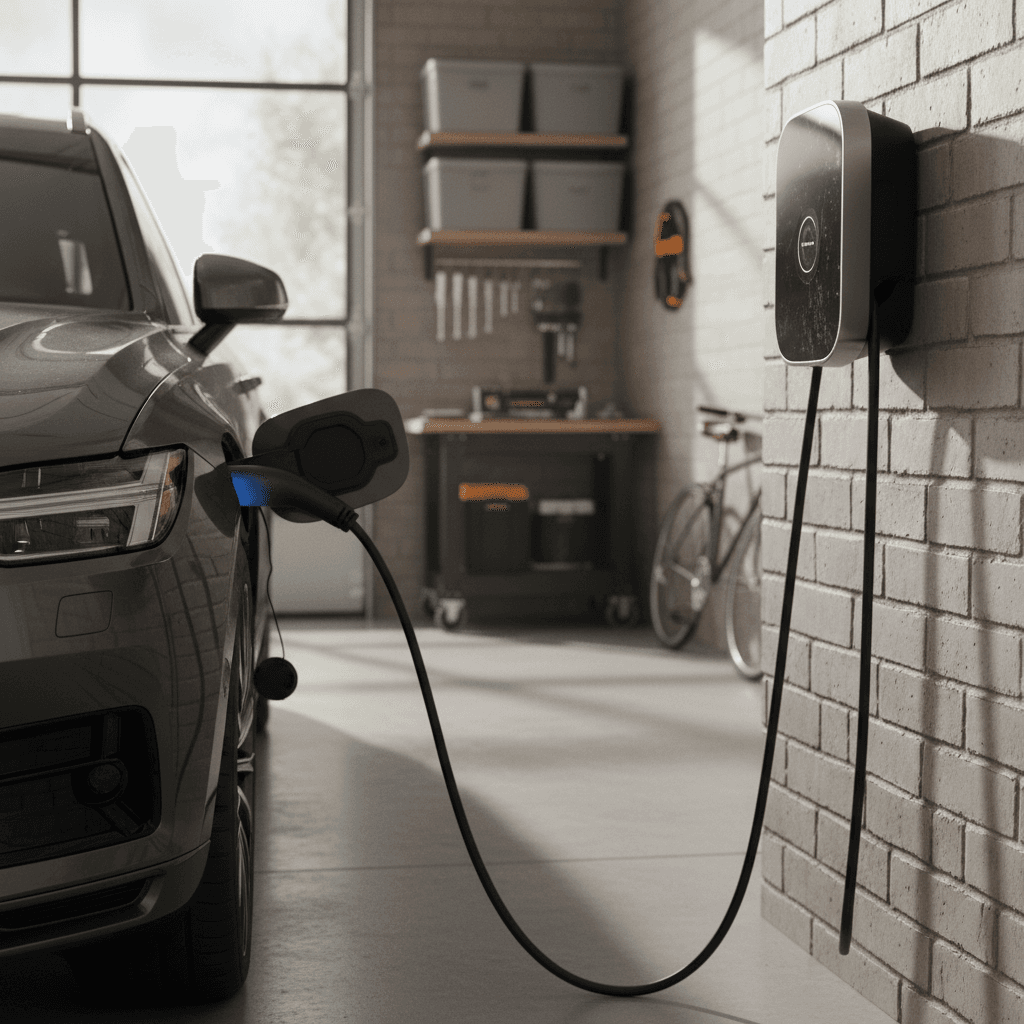
Recommended Volvo EX90 home charger setups
Because panel capacity, climate, and driving habits vary so much, it’s more useful to think in terms of “profiles” than a single one‑size‑fits‑all product. Here are three setups that work well for most EX90 owners in the U.S.
Three practical EX90 home‑charging setups
Match your charger choice to your home and your driving, not just the spec sheet.
1) Suburban commuter, 40A sweet spot
Who it’s for: EX90 owners driving 30–70 miles most days with occasional weekend trips.
- Hardwired 40 amp Level 2 charger on a 50 amp breaker.
- NACS or J1772 connector, depending on your other vehicles.
- Schedule charging for late‑night off‑peak rates.
This setup easily restores a heavy day of driving in 4–6 hours and fits within many existing 200 amp panels.
2) Heavy‑use family, 48A max
Who it’s for: Big families, rideshare drivers, or frequent road‑trippers who routinely log 100+ miles in a day.
- Hardwired 48 amp Level 2 charger on a 60 amp breaker.
- Prioritize robust cable, outdoor rating, and good thermal management.
- Useful if the EX90 turns over quickly between drivers.
You’ll squeeze the most out of the EX90’s 11 kW onboard charger without stepping up to exotic hardware.
3) Panel‑limited or rental, 32A plug‑in
Who it’s for: Condo or rental situations, or homes where the panel can’t handle another large continuous load.
- 32 amp Level 2 charger on a NEMA 14‑50 or 6‑50 outlet.
- Power‑sharing or load‑management features are helpful.
- Charging speed drops, but still 20+ miles of range per hour.
Not ideal for max flexibility, but far better than relying on Level 1 or public charging only.
Used EX90 buyers: budget for charging
Volvo EX90 home charging quirks and compatibility issues
Early EX90 owners have reported a few specific pain points around home charging, especially when trying to reuse existing hardware from older Teslas or J1772 setups. While many owners charge trouble‑free, it’s worth going in with your eyes open.
- Some EX90s have been picky with certain older Level 2 stations, especially legacy ChargePoint and some Tesla‑branded home chargers used with adapters, sometimes defaulting to ~15 amps instead of full power.
- A small number of early vehicles experienced AC charging module faults that required dealer service or updates before charging behavior normalized.
- OTA updates and dealer fixes have improved compatibility over time, but not every third‑party EVSE has been tested with the EX90’s control logic.
If you already have a Tesla wall connector
When you combine a brand‑new vehicle platform with a rapidly evolving charger ecosystem, edge‑case bugs are inevitable. That’s why it’s smart to prioritize chargers with good firmware‑update support and responsive customer service rather than only shopping on price.
Installation, safety, and permitting for an EX90 charger
A Volvo EX90 pulling 40–48 amps for hours is a serious, continuous electrical load. Treating the installation casually is how you end up with nuisance breaker trips, or, in the worst case, overheated wiring. A clean install is part of what makes a “best” home charger actually best.
Key installation decisions for an EX90 home charger
Work through these decisions with a licensed electrician before you buy hardware.
| Decision | Best practice for EX90 owners | What to watch out for |
|---|---|---|
| Panel capacity | Have an electrician calculate available capacity on your main service before adding a 40–48A continuous load. | Older 100A panels may not support a full‑power EX90 charger without a service upgrade or load management. |
| Hardwired vs. plug‑in | Hardwired is preferred for 40A+ loads; it’s cleaner and often required by code at higher amperages. | Plug‑in 14‑50 installs can be fine at 32A, but the outlet and plug are extra points of failure over time. |
| Charger location | Mount the EVSE close to where the EX90 actually parks, with enough cable slack to reach the charge port. | Running the cable across walkways or under garage doors is an accident waiting to happen. |
| Permits and inspection | Pull the proper permit and get an inspection; it protects you with both your utility and your homeowner’s insurer. | Unpermitted work can complicate resale, insurance claims, or future panel upgrades. |
Always follow local code and permitting rules, your EX90 is too valuable to trust to a DIY science project.
Don’t oversubscribe your panel
How home charging affects EX90 running costs and battery health
A thoughtfully chosen home charger doesn’t just add convenience; it also shapes your cost per mile and your long‑term battery health.
Energy costs: home vs. public
On a typical U.S. residential rate, charging an EX90 at home might cost the equivalent of paying $0.10–$0.20 per kWh, with even lower effective rates if you use off‑peak TOU windows. That makes a full 0–100% charge roughly the cost of a single tank of gas in many markets, but delivering 250–300 miles in a large luxury SUV.
Public DC fast charging, by contrast, often prices above $0.30–$0.40 per kWh. An occasional road‑trip stop is fine; using it as your primary “fuel station” adds up fast.
Battery health and charge habits
The EX90’s pack is designed to handle DC fast charging, but, like any large lithium‑ion battery, it’s happiest when you:
- Do most charging on AC Level 2 at home or work.
- Keep routine charge targets around 70–90%, raising to 100% only when you genuinely need the range.
- Avoid frequent 0–100% swings when you can top up more gently.
A reliable home charger makes those “gentle” patterns easy and automatic.
Use smart scheduling
Frequently asked questions: Volvo EX90 home charging
Volvo EX90 best home charger FAQ
Key takeaways: choosing the best home charger for your Volvo EX90
For a vehicle as capable, and energy‑hungry, as the Volvo EX90, the best home charger isn’t about chasing the biggest kW number on a marketing sheet. It’s about pairing your EX90’s 11 kW onboard charger with a well‑installed, appropriately sized Level 2 unit that fits your panel, your driveway, and your daily life.
- Aim for a 40–48 amp Level 2 charger on a dedicated 240 V circuit; that’s the practical sweet spot for the EX90.
- Choose between NACS and J1772 based on your other vehicles, but prioritize quality, support, and firmware updates over connector branding.
- Treat installation as part of the investment: get a load calculation, permit, and inspection rather than tacking a big new load onto a marginal panel.
- Use smart scheduling and moderate charge targets to keep both running costs and battery wear under control.
- If you’re shopping for a new or used EX90, factor in home charging up front, Recharged can help you evaluate options so the car and your home charging plan work together from day one.
Get the home‑charging piece right, and the EX90 turns from a large, occasionally intimidating battery on wheels into what it was meant to be: a quiet, convenient, all‑electric family flagship that’s always ready to go when you are.