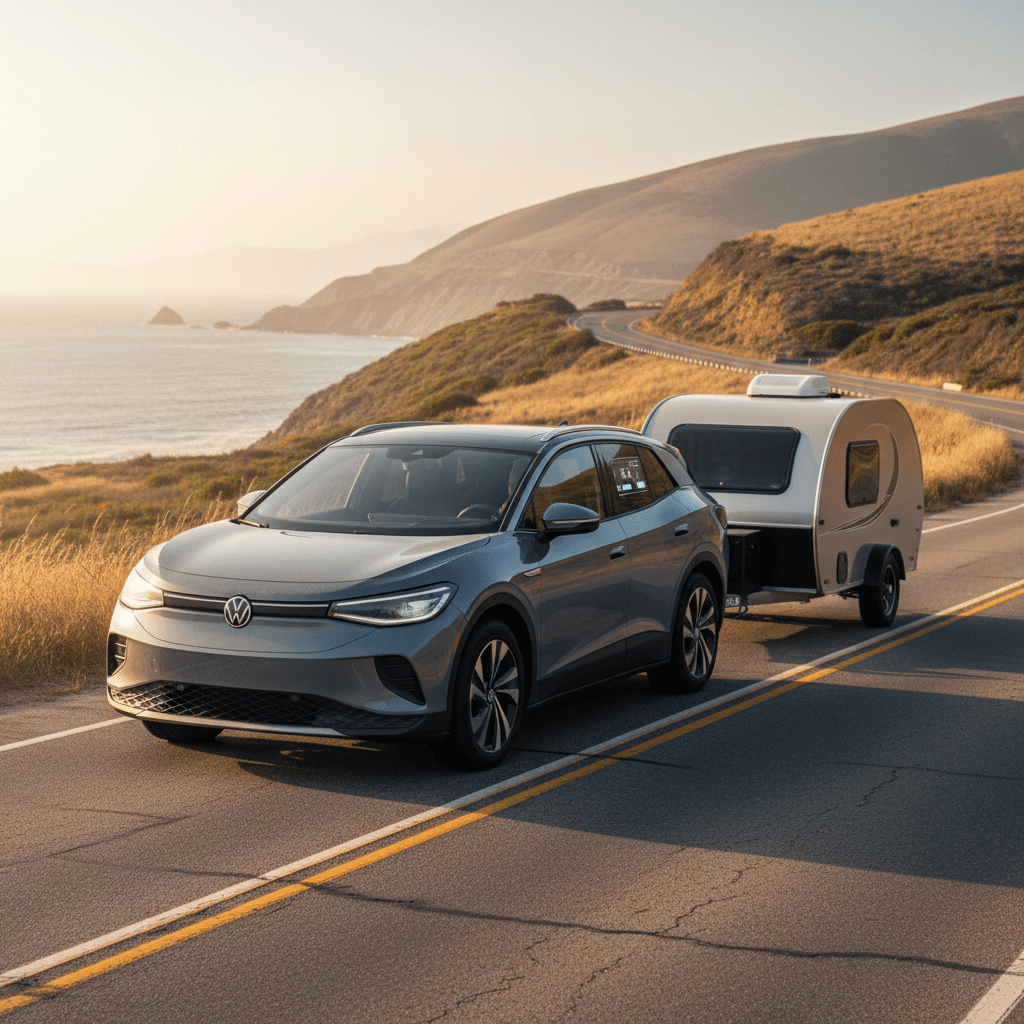
If you’re looking at a Volkswagen ID.4 as a family hauler or road-trip rig, you’ll quickly run into two big questions: how much can it tow, and how much range do you lose with a trailer, camper, or bikes hanging off the back. This guide breaks down real Volkswagen ID.4 towing capacity numbers and what owners actually see for range loss in the real world.
Quick answer
Can the Volkswagen ID.4 Really Tow? Overview by Year and Model
Volkswagen does something many EV makers still avoid: it officially rates the ID.4 for towing in most markets. That said, tow ratings and hardware depend on model year, drivetrain, and where the car was originally sold (U.S. vs. Europe, for example).
- Most U.S.-market ID.4s with a factory tow package are rated to tow between about 2,200–2,700 lb, depending on RWD vs. AWD.
- European-market ID.4s often carry higher published tow ratings, but you should always go by the rating on your car’s VIN label and owner’s manual.
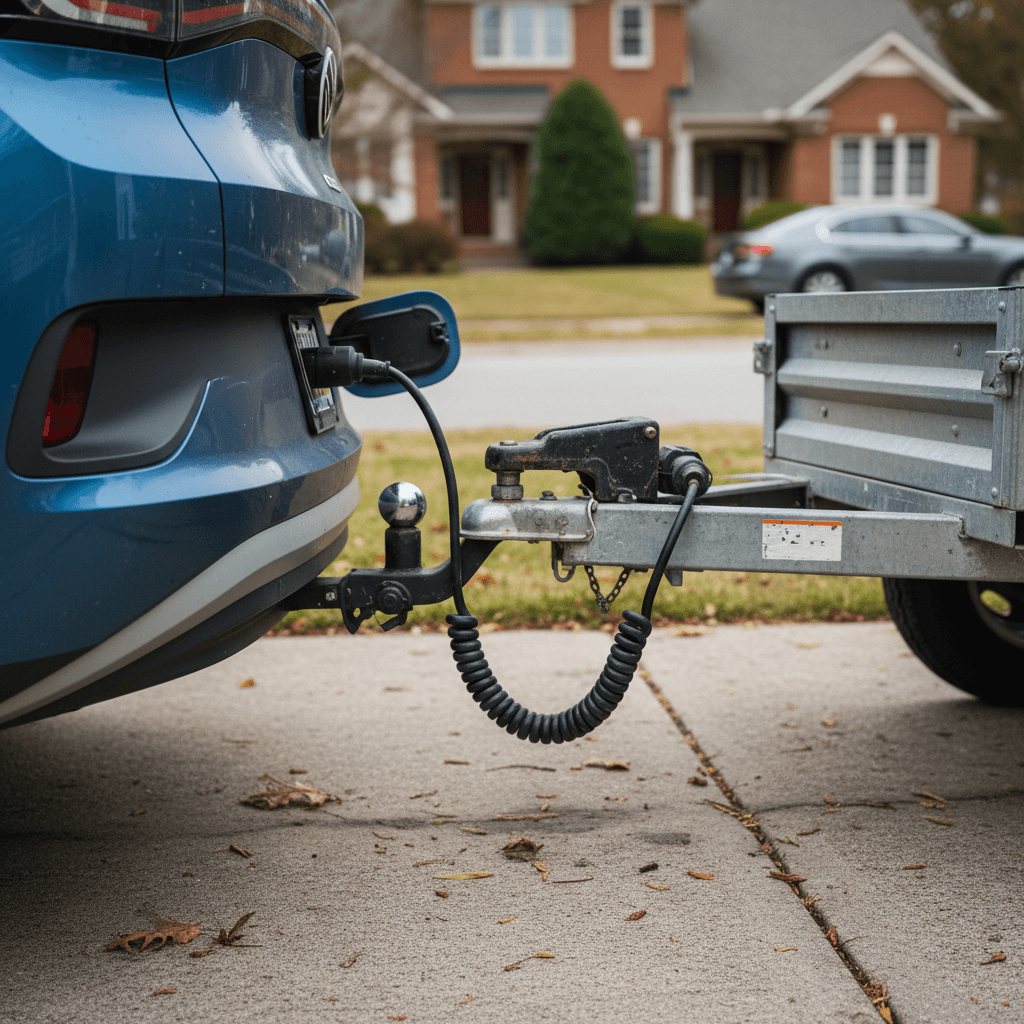
- Volkswagen’s official rating assumes a braked trailer with proper hitch hardware and wiring. Unbraked trailers are typically limited to a lower number.
Watch for non-tow-rated cars
Official Volkswagen ID.4 Towing Capacity Ratings
Exact numbers vary slightly by market and documentation, but the core idea is simple: AWD ID.4s are rated higher than RWD. In the U.S., you’ll typically see the following ballpark ratings when the vehicle is equipped with the factory tow package:
Typical Volkswagen ID.4 Towing Capacity (U.S., when properly equipped)
Always verify the exact rating on your specific ID.4’s door jamb label and in the owner’s manual. These figures are a practical guideline, not a substitute for official documentation.
| Configuration | Model years (U.S.) | Approx. braked tow rating | Approx. unbraked tow rating | Notes | |||||||||||||||
|---|---|---|---|---|---|---|---|---|---|---|---|---|---|---|---|---|---|---|---|
| RWD, 62 kWh battery (Standard/S) | 2023–2025 | ~2,200 lb | ~1,100–1,650 lb | Not all trims got a factory tow package; check your car. | RWD, 82 kWh battery (Pro/Pro S) | 2021–2025 | ~2,200 lb | ~1,100–1,650 lb | Similar rating to small crossovers; payload still matters. | AWD, 82 kWh battery (AWD Pro/Pro S) | 2021–2025 | Up to ~2,700 lb | ~1,100–1,650 lb | Higher rating thanks to dual motors and extra traction. | Non–tow-rated or no factory package | Any | 0 lb | 0 lb | You may still mount a hitch for bikes, but not for towing. |
Towing capacity assumes a braked trailer and factory tow equipment unless otherwise noted.
Never exceed the lowest-rated component
Typical 2024–2025 ID.4 EPA Range Baselines
How Towing Affects ID.4 Range: The Short Version
Think of the ID.4’s range as a budget you’re constantly spending. Towing adds three big expenses: aerodynamic drag, rolling resistance, and weight on hills. Together, they can cut your real-world range dramatically compared with driving the same route unladen.
Typical Volkswagen ID.4 Range Loss While Towing
These are realistic ballpark values based on owner reports and basic physics, not promises.
Small utility trailer (1,000–1,500 lb)
- Low, narrow, usually below roofline
- ~25–35% range loss at highway speeds
- Best-case towing scenario for an ID.4
Pop-up camper or small boat (1,500–2,000 lb)
- Moderate frontal area and weight
- ~35–45% range loss common
- Plan short hops between DC fast chargers
Tall box or big camper (2,000–2,700 lb)
- Big aero penalty above 55–60 mph
- Up to ~50%+ range loss
- Realistic only for shorter, flatter routes
Rule-of-thumb for trip planning
Real-World ID.4 Towing Range: Owner Data
Laboratory data for EV towing is still thin, but ID.4 owners have been logging real-world numbers for years. When you line those stories up, some clear patterns emerge.
- Owners towing a 4x8 U-Haul cargo trailer around 1,500 lb at ~65 mph often see efficiency drop from roughly 3.3–3.4 mi/kWh down to ~2.1–2.3 mi/kWh, about a 30–35% range hit.
- Drivers pulling a light utility trailer or small boat report settling in around 1.8–2.2 mi/kWh, versus ~3 mi/kWh without a trailer. That’s roughly a 35–45% range reduction.
- With a compact pop-up camper around 2,000 lb, many see their practical range drop to about 55–65% of normal, especially on hilly or windy routes.
- The worst case is a tall boxy camper near the tow limit at high interstate speeds; some owners report their range being cut roughly in half compared with solo driving on the same route.
Sample calculation: light trailer
If your 82 kWh AWD ID.4 normally returns about 3.0 mi/kWh at 70 mph, you’d expect roughly:
- Usable pack: ~77 kWh
- Normal range: 3.0 × 77 ≈ 230 miles
- Towing a low 1,500 lb trailer at ~2.1 mi/kWh → 160 miles if you ran it to 0%
In practice, you’ll keep a buffer, so plan ~120–140 mile legs between fast chargers.
Sample calculation: pop-up camper
Same car, but now you’re pulling a 2,000 lb pop-up in mixed terrain and seeing ~1.8 mi/kWh:
- 1.8 × 77 ≈ 140 miles from 100% to 0%
- Leaving a 15–20% buffer gives you a comfortable 100–115 mile usable leg.
That’s still workable if DC fast chargers are spaced every 60–80 miles along your route.
What the ID.4 Can Safely Tow (and What It Can’t)
The ID.4’s tow rating is only part of the story. Trailer shape, brakes, and how you load the car all matter just as much as a single number on a spec sheet.
Common Trailer Types vs. ID.4 Towing
Use this table as a sanity check when deciding what to tow behind your Volkswagen ID.4.
| Trailer type | Typical size/weight | Generally OK for ID.4? | Why / Why not |
|---|---|---|---|
| Small utility trailer | 4x8 ft, 800–1,500 lb | Yes, with brakes preferred | Low frontal area and moderate weight; good starting point for towing with an EV. |
| Single-axle small boat | 16–18 ft aluminum or skiff, 1,500–2,000 lb | Yes, for AWD and higher-rated RWD | Weight is manageable; aero penalty depends on how high the bow sits behind the car. |
| Pop-up camper | 1,800–2,400 lb | Yes, but plan for big range loss | Weight and frontal area are both significant; excellent for short trips near home. |
| Small enclosed cargo trailer | 5x8 or 6x10, 1,500–2,700 lb | Borderline; short hops only | Boxy shape hammers range at highway speeds, especially in a headwind. |
| Full-size travel trailer | 20–25 ft, 3,500–5,000+ lb | No | Too tall and heavy; exceeds ID.4’s tow rating and stresses brakes and stability systems. |
Always verify weights on the trailer’s data plate and stay within the ID.4’s official tow and payload ratings.
Best towing use cases for an ID.4
Trip Planning With an ID.4 and Trailer
Once you accept that your towing range will be roughly cut in half, the ID.4 becomes much easier to live with as a tow vehicle. The key is planning routes around that reality and using the EV’s strengths, like fast, repeatable DC charging, to your advantage.
Planning a Towing Trip in a Volkswagen ID.4
1. Start with honest weight numbers
Know the trailer’s empty weight, your expected cargo, and the tongue weight. Include bikes, coolers, and people inside the car. Compare this to the ID.4’s tow and payload ratings and stay below both.
2. Assume 50% of EPA range at highway speed
Take your ID.4’s EPA highway or combined range and cut it in half as a starting point for towing. If you know you’ll drive slower (55–60 mph) with a low trailer, you can stretch that a bit.
3. Map DC fast chargers in 80–120 mile steps
Use apps like PlugShare, A Better Routeplanner, or network apps to find DC fast chargers every 60–80 miles, and plan your actual stops around <strong>80–120 mile legs</strong> when towing.
4. Favor lower speeds and calmer routes
High speed is range’s worst enemy when you’re pushing a trailer through the air. Taking the 60 mph route instead of a 75 mph interstate can make a dramatic difference in how far you get between charges.
5. Pre-condition and charge smart
If your ID.4 and route planner support it, precondition the battery before fast-charging stops. Aim to arrive around 10–20% and leave around 70–80% to minimize time spent at slower top-of-pack charge rates.
6. Practice emergency maneuvers close to home
Find an empty parking lot and practice gentle braking and steering inputs with your trailer attached. You’ll quickly feel how tongue weight and trailer sway affect the ID.4 and get more comfortable before a big trip.
Aerodynamics beat raw power
Does Towing Hurt the ID.4’s Battery?
The good news is that occasional towing within the published limits is not inherently bad for an ID.4’s battery. Volkswagen engineered the cooling and power electronics to handle sustained highway loads, including hills, heat, and trailers.
Battery Health When Towing an ID.4
Think more about temperature and charging habits than about occasional heavy use.
Watch temperature and sustained fast charging
- Long, hot highway pulls plus repeated DC fast charges will keep the pack warm.
- That’s fine occasionally, but try to give the car an easy day after a big towing trip.
- Parking in the shade and avoiding 100% charges for long storage helps, too.
Battery durability looks strong so far
- Long-term testing of related VW ID-family packs shows modest degradation after high mileage.
- Volkswagen backs the pack with an 8-year / ~100,000-mile capacity warranty in most markets.
- Normal daily driving habits matter more than a few weekends of towing.
What actually shortens battery life
Buying a Used ID.4 for Towing: Checklist
If you’re shopping the used market, you can absolutely find an ID.4 that will tow well, especially if you’re realistic about trailer size. Here’s how to evaluate a used ID.4 with towing in mind.
Used Volkswagen ID.4 Towing & Range Checklist
1. Confirm the car is tow-rated
Check the owner’s manual, door jamb label, and original window sticker (if available) for a tow rating and factory tow package. If it’s not officially rated, treat it as a bike-rack-only car.
2. Inspect the hitch and wiring
Look for signs of a quality install: clean welds or proper bolt holes, grommeted wiring through bodywork, and functional trailer lights. Ask the seller what they towed and how often.
3. Review battery health and DC fast charging history
Ask for service records and charge logs if available. A vehicle with mixed home AC and some DC fast charging is normal; a hard-worked rideshare car that lived on DC fast charging is worth a closer look.
4. Test-drive at highway speed
Take a long enough drive to reach typical highway speeds. Note energy consumption and how the car tracks in crosswinds, it will give you a feel for how confident it might feel with a trailer.
5. Match battery size to your towing plans
If you plan to tow often, prioritize an <strong>82 kWh Pro or AWD Pro</strong> for more range buffer and a higher tow rating. The 62 kWh versions are fine for shorter, local towing tasks.
6. Leverage a third-party inspection
A specialist used-EV retailer like <strong>Recharged</strong> can provide a battery health report, fair-market pricing data, and guidance on whether a specific ID.4 is a good fit for your towing needs. Look for detailed diagnostics rather than just guessing from the dash range estimate.
How Recharged can help
Ready to find your next EV?
Browse VehiclesVolkswagen ID.4 Towing Capacity & Range Loss: FAQ
Frequently Asked Questions
Key Takeaways: Matching Your ID.4 Towing Plans to Its Range
The Volkswagen ID.4 is a capable, quiet, and surprisingly pleasant tow rig, as long as you choose the right trailer and plan for range loss. Properly equipped, it can tow around 2,200–2,700 lb, but your practical highway range with a trailer will usually be only 50–70% of what you see when driving solo.
If your goal is hauling a small camper to a state park 80 miles away, making dump runs with a utility trailer, or towing a boat to a nearby lake, the ID.4 is right in its element. For cross-country trips with a big travel trailer, its range and tow rating will feel limiting. The smart move is to match your use case to the strengths of the platform, and, if you’re shopping used, to lean on tools like the Recharged Score Report to find an ID.4 whose battery, drivetrain, and tow rating line up with the way you actually plan to use it.