You don’t buy a Volkswagen ID.4 because you want to win stoplight drag races. You buy it because you want a calm, rational family crossover that also happens to run on electrons. The obvious question is whether this sensible, slightly square EV can handle a proper American road trip. In this Volkswagen ID.4 road trip review, we’ll talk about what actually happens to range, charging time and comfort when you leave the city and point the nose toward another time zone.
The short version
VW ID.4 road trip at a glance
Volkswagen ID.4 road trip numbers (big-battery models)
The ID.4 isn’t a Taycan or a Tesla Model 3 Performance. It’s closer in mission to an old Passat wagon: long-legged, calm, and modestly quick. For road trips, what matters is usable range between 10–70% and how pleasant the car feels after hour four, not whether it crushes a 0–60 sprint.
Range: what the ID.4 really does on the highway
On paper, the Volkswagen ID.4 with the larger 82 kWh battery posts EPA range figures in the 250–290 mile neighborhood, depending on year, drivetrain and wheel size. In reality, highway driving at American speeds, call it 70–75 mph with some cargo and climate control, sits the car down at a lower number, just like every other EV.
- 82 kWh RWD (Pro / Pro S trims): think ~230–250 miles at 65 mph, more like ~210–230 miles at 70–75 mph when the weather is friendly.
- 82 kWh AWD: AWD’s extra motor and weight cost you a bit of efficiency, real-world highway legs are often ~190–215 miles at 70–75 mph.
- 62 kWh versions: these are more regional commuters; highway legs in the 150–180 mile band are a safer planning number.
Plan legs, not theoretical range
Owners who drive the ID.4 at realistic highway speeds report that, once you stop chasing the EPA sticker, the car is satisfyingly predictable. Keep your cruising to 70 mph, precondition the cabin while plugged in, and you’ll rarely be surprised by the remaining miles. Drive 80 mph into a winter headwind with bikes on the back, and yes, physics will send you a bill.
Charging on the road: DC fast reality for the ID.4
The ID.4 is built for the CCS public charging world, Electrify America, EVgo, ChargePoint and friends. On a good station with modern software, the 82 kWh cars can briefly spike near 175–200 kW, then settle into a plateau around the low triple digits before tapering. The magic range is roughly 10–55%; above that, you’re paying more in time for each extra mile you add.
- On a healthy 150–350 kW DC fast charger, expect about 25–30 minutes to go from ~10% to ~70–80% on newer big‑battery cars once the pack is warm.
- Older software, cold packs or underpowered stations can stretch that to 40–60 minutes, and this is where road-trip stories go bad.
- The 62 kWh versions draw a bit less peak power, but there’s also less battery to fill, so total stop time can feel similar over the 10–70% window.
The Electrify America asterisk
The good news is that once you understand the ID.4’s gently sloping charging curve, you can work *with* it instead of against it. Aim to arrive with 5–15% state of charge, plug into the highest-power, healthiest-looking stall you can find, and set a hard limit, say 70%, unless the next leg truly demands more.
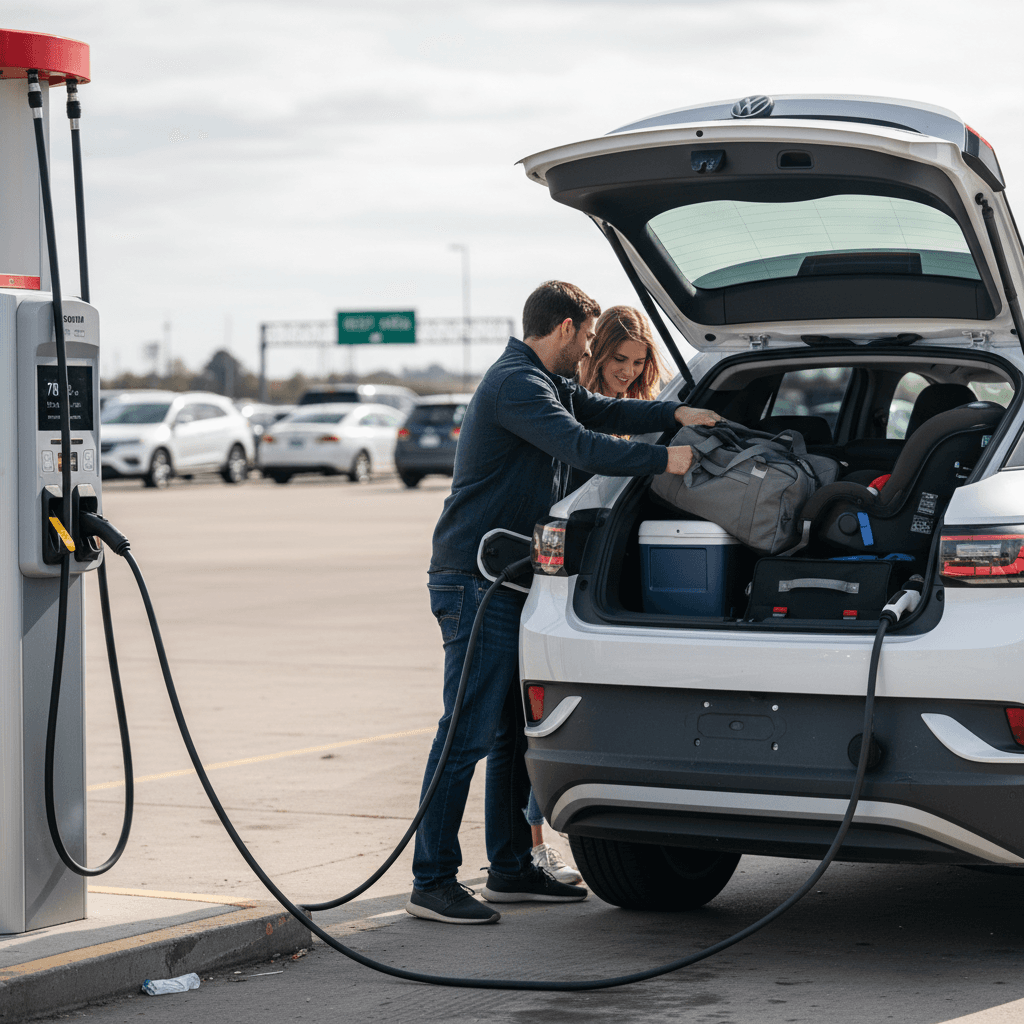
DC fast: the road-trip workhorse
Use DC fast charging primarily to hop between cities. Think of it as your highway fuel pump: arrive low, leave in 25–35 minutes, carry on.
- Best between 10–70% state of charge
- Plan legs of ~170–220 miles for the 82 kWh cars
- Don’t chase 100% unless the next charger is truly distant
Level 2: overnight recovery
At your destination hotel or rental, a Level 2 charger turns the ID.4 into a normal car again. Overnight, even a modest 7–11 kW unit will easily refill the pack.
- Perfect for multi‑day vacations
- Far gentler on the battery than constant DC fast
- Much cheaper per kWh in most regions
Comfort, quiet and fatigue over long days
The great sin of many EVs is that they are visually frantic, origami surfacing, gamer fonts, LED everything, while riding like a pogo stick on coil springs. The ID.4 does the opposite. It looks like a slightly futuristic Golf Plus and moves down the interstate with the unhurried gait of a European family wagon.
How the VW ID.4 feels over 500+ miles
More about what your spine and ears experience than what the spec sheet says
Seats & driving position
The front seats are classic Volkswagen: firm cushions, long thigh support, and enough adjustment for tall drivers. After a 4‑hour stint you feel worked, not wrecked, exactly the right side of firm for long-distance comfort.
Noise & refinement
At 75 mph, wind noise around the mirrors and A‑pillars is present but well controlled, and the absence of engine thrash makes the cabin feel calmer than many compact crossovers. Big wheels and coarse pavement can introduce a low thrum, but nothing deal‑breaking.
Ride & handling
The ID.4 is softly sprung enough to take the edge off expansion joints but tied down enough that crosswinds and truck wake don’t spook it. Think steady and predictable, not playful. On a long day, that’s a compliment.
Rear-seat and cargo praise
If you’re cross‑shopping, the ID.4 feels more relaxed and less stiff than a Mustang Mach‑E, softer and quieter than many Model Y builds, and more substantial than some Korean rivals that chase sporty handling at the expense of serenity.
Tech, navigation and planning your stops
Here is where the ID.4 shows its most German trait: it will absolutely do the job, but the user interface sometimes feels like it was designed by a committee that never met in person. The later 12‑inch infotainment systems are faster and more logical than the earliest cars, yet the built‑in route planning still lags the best third‑party apps.
Best tools for planning an ID.4 road trip
Use the car, but don’t be afraid to outsource the brains
In-car nav as backup
Volkswagen’s built‑in navigation will route you to CCS stations and can estimate arrival state of charge. It’s useful, especially in newer software versions, but it’s not the sharpest knife in the drawer.
Third-party route planners
Apps like A Better Routeplanner (ABRP) or PlugShare let you model your ID.4’s consumption, pick preferred networks, and see live charger status and reviews. For serious road‑trippers, they’re essential.
Charging at your destination
Filter hotel searches for "EV charging" and verify with recent photos or reviews. A slow but reliable Level 2 overnight is worth more than a theoretical fast charger that’s 10 miles away and half broken.
Plan B is part of Plan A
Winter, weather and elevation changes
Cold weather is the villain in every EV road‑trip story, and the ID.4 is no exception. Below freezing, you’re fighting denser air, cold-soaked tires, and a battery that would really rather be in Phoenix. Figure on losing 20–30% of your highway range in sub‑freezing conditions, more if you’re driving into a stiff headwind or climbing.
Summer road trips
- Near‑EPA range is realistic at 65–70 mph.
- Battery warms quickly and holds strong DC fast speeds.
- AC use has a modest but manageable impact.
You can plan legs closer to 200–230 miles in big‑battery trims and arrive with a comfortable buffer.
Winter road trips
- Range can drop into the 150–180 mile band between comfortable stops.
- First DC fast session may be notably slower on a cold pack.
- Cabin heat and defrost add a steady draw.
Shorten your legs, favor chargers with amenities, and precondition the car while plugged in whenever possible.
Don’t gamble in the mountains
So, is the Volkswagen ID.4 a good road-trip EV?
Taken in isolation, no single ID.4 metric will win the group test. Some rivals charge faster, some go farther on a charge, some have glitzier cabins. But on a long‑distance drive, the car’s temperament matters as much as its spec sheet, and temperament is where the ID.4 quietly excels.
- Range is honest and predictable once you learn its habits.
- The charging curve is smooth, no brutal cliffs, so you can plan stops with confidence.
- Ride, noise and seats are tuned for normal human beings, not Nürburgring fantasies.
- The square cargo space and adult‑friendly rear bench make it a genuinely useful family hauler.
Verdict: yes, with realistic expectations
How a used ID.4 from Recharged fits into this picture
On a road trip, the health of the battery and the reliability of fast charging matter more than leather piping or ambient lighting colors. That’s one reason the ID.4 is such a compelling used EV: its calm road manners age better than whatever infotainment theme was fashionable that year.
Every ID.4 sold through Recharged comes with a Recharged Score Report, including verified battery health and a clear picture of how much real‑world range you can expect. If you’re planning cross‑country drives, that’s gold. Instead of guessing whether a three‑year‑old pack has quietly lost 15% of its capacity, you start with hard data and a fair market price to match.
What Recharged adds for road‑trippers
VW ID.4 road trip checklist
Pre‑trip prep for a smooth Volkswagen ID.4 road trip
1. Know your battery and trim
Confirm whether your ID.4 has the 62 kWh or 82 kWh battery and whether it’s RWD or AWD. Your realistic highway range and ideal leg length depend heavily on this.
2. Update software and charging apps
Make sure your ID.4’s software is current and set up accounts for key networks like Electrify America, EVgo and ChargePoint before you leave. Test at least one DC fast session near home.
3. Plan legs around 10–70%
Use a route planner to build a trip based on arriving near 10–20% and leaving around 60–70%. This keeps you in the fast part of the charging curve and aligns nicely with human break needs.
4. Book lodging with Level 2 charging
Whenever possible, choose hotels or rentals with on‑site Level 2 chargers. An overnight top‑up wipes out a day’s worth of energy use and makes the next morning trivial.
5. Pack cables and contingency gear
Bring your included Level 1/2 cable, any adapters you need, and a simple extension cord rated for the load if you expect to use standard outlets. Add a warm layer and snacks in case a station is busy.
6. Build in a 15–20% buffer
Especially in winter or in hilly terrain, don’t plan legs that require you to arrive with under 10%. Give yourself a cushion so headwinds, detours or a closed charger are inconveniences, not emergencies.