If you’re eyeing a long highway drive in your Volkswagen ID.4, you’re asking the right question: how do you get the most range, the least hassle at chargers, and a relaxed trip? With a little planning, the ID.4 is a genuinely capable long-distance cruiser, but it rewards drivers who understand its strengths and limits.
At a Glance
Why the Volkswagen ID.4 Works for Long Trips
ID.4 strengths on the open road
Understanding what the car does well helps you plan smarter trips.
Comfortable and quiet
DC fast charging standard
Built-in EV navigation
The trade-off
Useful ID.4 road-trip ballpark numbers
Know Your ID.4 Battery and Real-World Range
Before you plan any long-distance drive, you need to know which battery pack your ID.4 has and what that means on the highway. In North America, most cars use either a smaller pack around 62 kWh or a larger pack in the 77–82 kWh class. On paper, larger-battery 2021–2024 ID.4s offer roughly 245–291 miles of EPA range, depending on trim, wheels, and drivetrain, but you should plan around less than that at 70–75 mph with people and luggage on board.
Volkswagen ID.4 battery options and realistic highway legs
Use these numbers as a planning baseline, then add weather, speed, and terrain adjustments.
| Battery pack | Typical model years (U.S.) | EPA range ballpark | Realistic highway leg |
|---|---|---|---|
| ~62 kWh | 2023–2024 base trims | Around 200–215 miles | 140–180 miles |
| 77–82 kWh RWD | 2021–2024 Pro / Pro S | Around 250–291 miles | 220–260 miles |
| 77–82 kWh AWD | 2021–2024 AWD trims | Mid- to upper-200s | 210–250 miles |
All ranges assume mild weather, mostly highway driving, and arrival with some buffer (about 10–15% SoC).
Quick way to estimate trip legs
Remember that speed, temperature, and elevation will move those numbers up or down. Driving at 80–85 mph, climbing mountain passes, running winter heat continuously, or bucking a strong headwind can easily consume 15–30% more energy per mile than a gentle 65–70 mph cruise on flat ground.
Plan Your Route Around Realistic Charging Stops
Gas drivers can wing it. EV drivers, especially in a vehicle with decent but not massive range like the ID.4, do better with a plan. The goal isn’t to script every mile, but to have primary and backup chargers every 120–180 miles, depending on your battery size and conditions.
Best tools for planning an ID.4 road trip
Use more than one app so you’re not stuck when a station is busy or offline.
VW navigation & Car-Net
Third-party apps
Network-specific apps
Don’t over-plan yourself into stress
How much buffer should you keep?
For long-distance driving, a good rule is to arrive at chargers with at least 10–15% SoC whenever you reasonably can. That gives you margin for detours, weather shifts, or a surprise station outage.
On sparse routes, think rural interstates or mountain passes, build in even more.
How far between chargers?
On most large-battery ID.4s, stopping every 140–180 miles works well in mixed terrain. On smaller 62 kWh cars, target 100–150 miles between DC fast stops.
Shorter legs also let you stay in the quickest part of the charging curve, reducing your total time spent plugged in.
Smart Charging Strategy for the ID.4
The ID.4’s DC fast charging is perfectly adequate for road trips if you use the battery’s sweet spot. Like most EVs, it charges fastest at lower states of charge and slows down as it approaches full.
- Aim to DC fast charge roughly between 10–15% and 70–80% most of the time, instead of topping all the way to 100% every stop.
- On good 150 kW+ stations, expect your ID.4 to peak in the mid-100 kW range when the battery is warm and SoC is low, then gradually taper off.
- If you must reach a remote area, plan one deliberate 90–100% charge before the longest gap, then go back to shorter charges on the other legs.
- Watch the charger screen and your dash: once speed drops below ~50–60 kW and you already have comfortable range to your next stop, it’s usually time to unplug and go.
- In winter or very hot weather, give the car a few minutes of driving before your first big fast-charge so the pack can warm or cool toward its ideal temperature.
Think miles per minute, not just kW
Drive More Efficiently at Highway Speeds
On long trips, how you drive can easily swing your range by 15–25%. You don’t have to crawl in the right lane, but small changes make a big difference in an ID.4.
Practical efficiency tips that still feel normal
You don’t need to hypermile, just smooth out the big energy drains.
Moderate your speed
Think about aerodynamics
Smooth, predictable driving
- Use Eco or Comfort instead of Sport on long highway stints; the more aggressive response in Sport invites heavier right-foot use.
- Set climate control to a reasonable temperature and use seat and steering wheel heaters instead of cranking cabin heat in winter.
- Check tire pressures before you leave; being several PSI low adds rolling resistance and can cut both range and ride quality.
- If you’re climbing a long grade, don’t panic as your projected range drops. You’ll often earn a chunk of it back on the descent with efficient regeneration.
The sweet spot: comfort vs. range
Using the ID.4’s Tech to Make Trips Easier
Volkswagen built several EV-specific tools into the ID.4 that are worth learning before your first 500-mile day. A little time spent in the menus pays you back every time you hit the highway.
ID.4 features that help on long drives
Set these up at home so they’re second nature on the road.
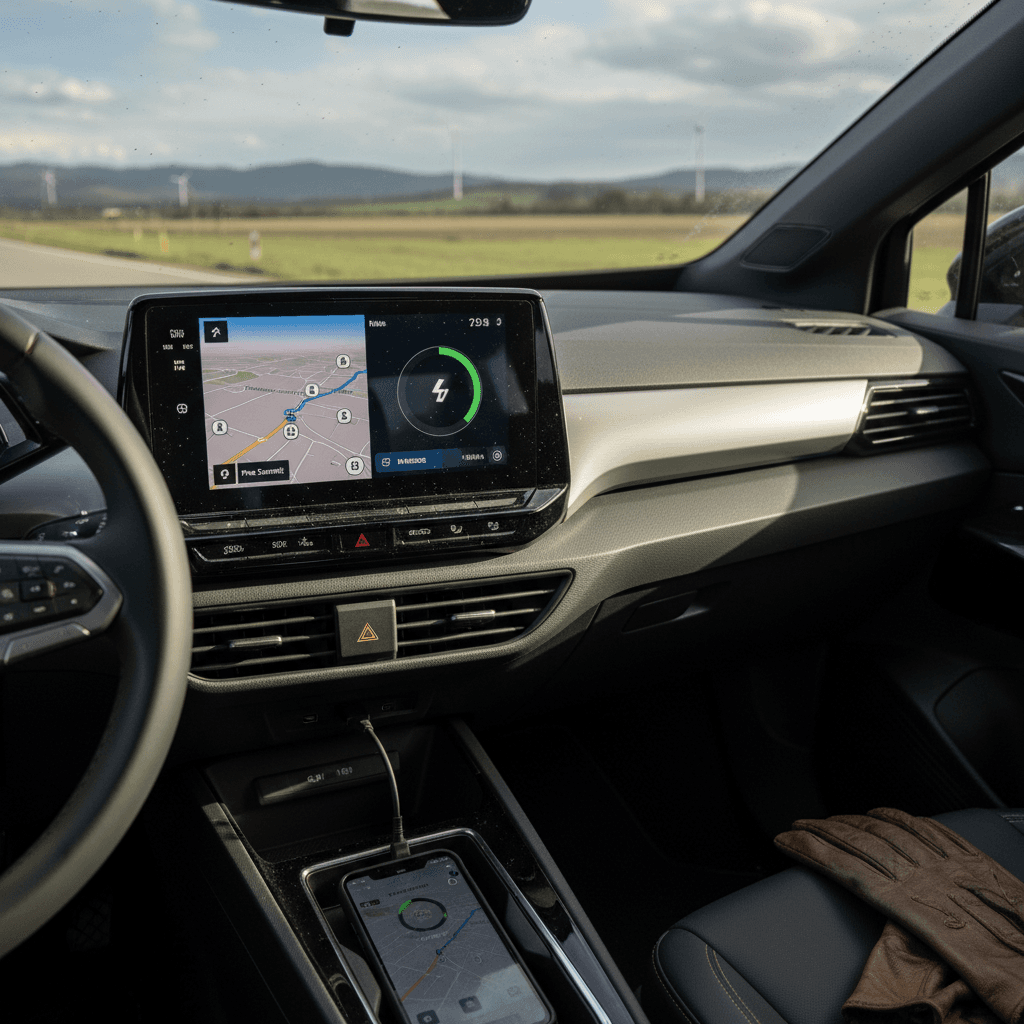
Route guidance with SoC estimates
Preconditioning and climate scheduling
Driver assistance systems
Remote monitoring in the app
Comfort, Cargo, and Passenger Tips
Range and charging get the attention, but a good road trip in any EV is also about how easy it is to live with for hours at a time. The ID.4 is fundamentally a roomy compact SUV; the key is to load it and use it in a way that supports both comfort and efficiency.
- Pack heavier items low and between the axles to keep the ride composed and the car feeling settled at speed.
- If you must use a roof box, keep speeds modest and factor in a noticeable range hit, 20% losses with large boxes at 75+ mph aren’t unheard of in any EV.
- Take advantage of under-floor storage to keep cables, adapters, and emergency gear handy but out of the way.
- Plan charging stops where everyone can actually relax: clean restrooms, decent food, a place to walk around. That makes a 30-minute stop feel like a break, not a penalty.
Think of stops as part of the trip
Battery Health and Long-Trip Prep
A well-cared-for ID.4 battery should easily handle years of road trips, but you’ll get better results, and less anxiety, if you treat it with some care and do a quick health check before your big drives.
Battery-care habits that help on long trips
These habits matter even more if you’re buying or driving a used ID.4.
Daily vs. trip charging
Temperature awareness
Software and recall updates
Don’t rely on a sick battery
Checklist: VW ID.4 Road Trip Prep
Pre-trip checklist for a smoother ID.4 journey
1. Confirm software and charging updates
Check for any pending VW software updates or open recalls, especially those related to the high-voltage battery or DC fast charging. Get these done well before departure day.
2. Inspect tires and set pressures
Look for uneven wear or damage and set pressures to the door-jamb spec when the tires are cold. Proper inflation boosts range, safety, and comfort.
3. Test DC fast charging nearby
If you haven’t fast charged recently, do a trial run at a nearby station. Make sure the car and your preferred network app or payment method work as expected.
4. Map primary and backup chargers
Use a mix of the VW nav, PlugShare, and network apps to mark at least one backup DC fast charger near each planned stop, especially in rural areas.
5. Pack charging accessories
Carry your Level 1/Level 2 cable, any adapters you use regularly, and a small kit with gloves, wipes, and a flashlight for late-night charging stops.
6. Set departure charge and climate
Schedule a full charge to complete close to departure, and precondition the cabin while plugged in so you leave with a warm or cool interior and maximum available range.
FAQ: Volkswagen ID.4 Long-Distance Driving
Common questions about ID.4 road trips
Is a Used ID.4 Right for Your Road Trips?
If you like the idea of quiet, comfortable electric road trips, the Volkswagen ID.4 can absolutely do the job, new or used, so long as you respect its range envelope and plan charging with your eyes open. The payoff is a relaxed, low-stress way to cover serious miles without burning a drop of gasoline.
Where many shoppers get nervous is buying a used ID.4 for long-distance duty. That’s where a platform like Recharged can tilt the odds in your favor. Every vehicle listed includes a Recharged Score Report with verified battery health and fair-market pricing, so you know whether an ID.4 still has the range and fast-charging performance you’re counting on. With nationwide delivery, financing options, and EV-specialist support from the first question to the first road trip, it’s an easy way to move from research to enjoying the drive.