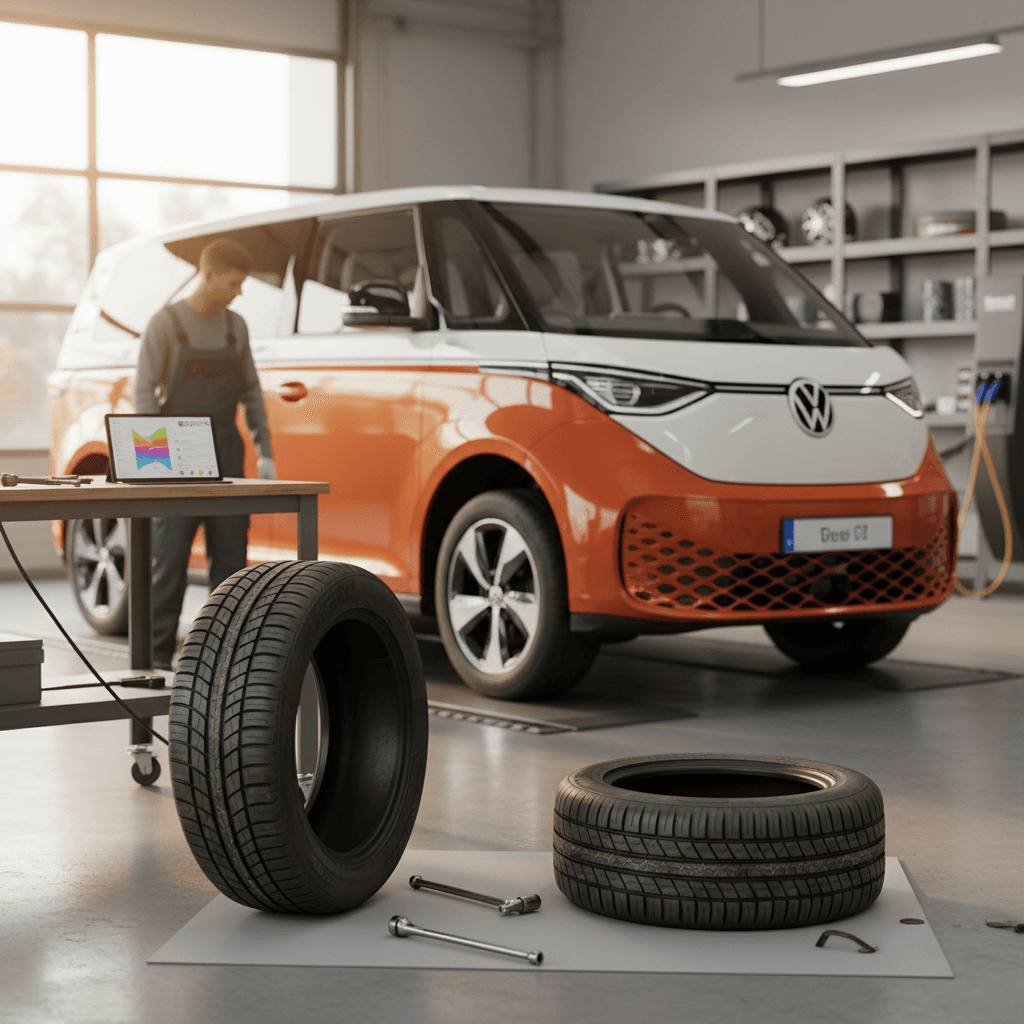
The Volkswagen ID. Buzz is a charming, heavy, torque‑rich electric van. That combination is wonderful for hauling kids and cargo, and absolutely brutal on tires. If you’re budgeting for Volkswagen ID. Buzz tire replacement cost, you’re right to look ahead, because rubber is one of the biggest ongoing expenses on this EV bus.
Big van, big tires, big bills
Volkswagen ID. Buzz tire replacement cost overview
Let’s start with the numbers most ID. Buzz shoppers and owners care about: what you’ll actually pay in 2025–2026 to put fresh rubber on this electric van.
Typical Volkswagen ID. Buzz tire replacement costs (US, 2025–2026)
Those numbers assume you buy mid‑ to upper‑tier all‑season EV‑rated tires that meet Volkswagen’s weight and speed requirements. You can absolutely find cheaper rubber, but on a 6,000‑plus‑pound electric van with kids in the back, that’s a false economy.
Don’t cheap out on load rating
ID. Buzz tire sizes, load ratings, and why they matter
Volkswagen builds the ID. Buzz on the MEB EV platform and outfits it like a premium people‑mover. That means big wheels, wide tires, and serious load ratings. Most passenger Buzz models use a staggered setup: narrower fronts, wider rears. In Europe and other early markets, one common factory fitment is 235/60 R18 front and 255/55 R18 rear with EV‑specific tires.
- US‑spec long‑wheelbase ID. Buzz vans typically ship on 19–20 inch wheels, again with staggered widths (for example, 235‑width fronts and 255–265‑width rears).
- Load index numbers are high, often around the low‑100s for the front and higher for the rear, to cope with the Buzz’s curb weight plus seven passengers and luggage.
- Tires are usually extra‑load (XL) rated and marketed as EV‑compatible or low‑rolling‑resistance to protect efficiency and range.
Find your exact spec in seconds
Because the ID. Buzz uses different sizes front and rear on most trims, you can’t do a traditional four‑corner rotation. That’s part of why rear tires tend to age in dog years compared with the fronts, and why you need to budget for staggered replacements.
OEM vs aftermarket Volkswagen ID. Buzz tires
Out of the box, many ID. Buzz models ship on EV‑optimized tires from brands like Giti, Goodyear, Continental, or Bridgestone, depending on region and trim. These OEM tires are tuned for low rolling resistance and quietness, not heroic wear life. When replacement time comes, you face a familiar dilemma: stick with the factory rubber or shop around.
How OEM and aftermarket ID. Buzz tires compare
Same size on paper doesn’t mean same experience on the road
OEM tires (dealer or factory brand)
- Pros: Matched to the van’s weight, suspension tuning, and noise targets.
- Usually EV‑rated with low rolling resistance.
- Dealer will recognize and support them without argument.
- Cons: Often the priciest option, $300+ per tire installed is common.
- Not always the best tread‑life; some owners report noticeable wear well before 30,000 miles.
Aftermarket EV‑rated tires
- Pros: More choice in tread patterns, noise levels, and price points.
- Can save $30–$70 per tire versus OEM, or upgrade to a longer‑wear compound.
- Top brands now offer EV‑specific lines for heavy vehicles.
- Cons: You must match size, load index, and speed rating exactly.
- Some generic "EV capable" tires still sacrifice range or noise refinement.
Price difference in the real world
If you’re leasing the van or you prize the stock ride and range, OEM makes sense. If you own long‑term or drive high miles, an aftermarket EV‑rated tire with a strong tread‑wear warranty can meaningfully cut your per‑mile cost.
Why the rear tires on an ID. Buzz suffer first
The ID. Buzz is rear‑motor and, on many trims, rear‑wheel drive. That means the back tires are doing the heavy lifting every time you sail away from a light with that instant electric torque.
- Staggered widths: The rear tires are wider to improve traction and stability, but they also carry more of the van’s weight and power load.
- Limited rotation options: You can only swap rear tires side‑to‑side; you can’t move them to the front due to size differences.
- High curb weight: Add seven occupants, luggage, and maybe a bike rack, and those back tires are living a hard life.
- Instant torque fun: One‑pedal driving and frequent full‑throttle launches magnify wear on the driven axle.
No, you can’t mix random tires
All of this leads to a pattern most ID. Buzz owners will recognize: the rear pair usually hits the wear bars first. Budgeting for a rear‑pair replacement every 20,000–30,000 miles and a full set somewhere around 40,000 miles is a conservative, realistic way to plan.
How often you’ll replace ID. Buzz tires in the real world
Official maintenance schedules talk about inspections, not hard replacement mileage, because tire life is a cocktail of driving style, climate, alignment, and tire choice. Still, the physics of a big electric van don’t lie.
Typical ID. Buzz tire life scenarios
Approximate expectations for mixed driving in a temperate climate
| Driving style | Use case | Rear tire life | Front tire life | Notes |
|---|---|---|---|---|
| Gentle | Suburban family duty, mostly under 70 mph | 25,000–35,000 mi | 35,000–45,000 mi | Stick to eco mode, avoid hard launches, keep pressures spot‑on. |
| Average | Mix of city, freeway, weekends away | 20,000–30,000 mi | 30,000–40,000 mi | What many owners will see with OEM or similar tires. |
| Hard | Frequent full loads, high speeds, lots of torque | 15,000–25,000 mi | 25,000–35,000 mi | Think road trips with seven people and cargo, or commercial use. |
Your results will vary, but these ranges are useful for budgeting.
Quick health check, zero tools
Some ID. Buzz owners are already reporting faster‑than‑expected wear, especially on the long‑wheelbase models driven heavily loaded. That doesn’t mean the van is flawed; it means the tires are doing honest work. If you treat them as consumables and budget accordingly, you won’t be shocked when the quote comes back four digits long.
Smart ways to save on ID. Buzz tire replacement
You bought an electric microbus, not a track toy. You’re allowed to care about money. There are smart ways to shave ID. Buzz tire bills without compromising safety or drivability.
Six strategies to tame ID. Buzz tire costs
Small habits and smart shopping beat corner‑cutting every time
1. Shop by spec, not just size
Use the door‑jamb sticker and owner’s manual to note size, load index, and speed rating for front and rear. Then filter by those specs at Tire Rack, Discount Tire, or your preferred retailer.
2. Compare installed quotes
Online prices can look cheap until you add shipping, mounting, and TPMS service. Ask for out‑the‑door quotes from at least two shops for the exact same tire.
3. Time your replacement
Many chains run seasonal promotions, rebates in spring and fall, or free installation events. If your tires are getting close, it can be worth planning a few weeks ahead.
4. Keep alignment in check
An ID. Buzz that’s slightly out of spec can devour the inner edge of a rear tire. A $130 four‑wheel alignment is much cheaper than burning through a $600 pair of rears.
5. Mind tire pressure
Low pressure heats up the carcass, kills range, and accelerates shoulder wear. Check at least monthly, and always use the pressures VW lists on that door sticker, not random forum advice.
6. Consider a harder‑wearing compound
If you drive big miles, pick an EV‑rated all‑season with a strong tread‑wear warranty, even if it costs slightly more up front. The cost per mile can be significantly lower.
Where Recharged fits in
Ready to find your next EV?
Browse VehiclesEV-specific tire issues you can’t ignore
The ID. Buzz isn’t just any van; it’s an EV van. That changes how your tires live and die, and what you should care about beyond sticker shock.
Weight and torque
The ID. Buzz weighs roughly what a nicely equipped pickup weighs, but it hides that mass under cheerful bodywork. Add a battery pack mounted low and instant torque off the line, and each launch is a stress test for the tire’s sidewall and tread.
That’s why the van’s approved tires use stiff constructions, reinforced beads, and specific compounds. A random touring tire with a borderline load rating might survive under a Golf; under an ID. Buzz, it’s being asked to audition for Cirque du Soleil.
Noise, range, and comfort
No engine means every decibel of tire noise is suddenly front‑page news. EV‑focused tires often use noise‑reducing tread patterns or foam liners. Swap to a more aggressive pattern and you may gain grip but lose serenity.
Rolling resistance is the other big lever. A sticky performance tire can wipe tens of miles off your highway range. On a road‑trip van like the Buzz, that starts to feel like a tax.
Test‑drive with your ears
Tire shopping checklist for Volkswagen ID. Buzz owners
When you’re standing in front of a tire rack, or 37 browser tabs deep, use this checklist to stay honest. You’re not buying art; you’re buying the only thing connecting two‑plus tons of electric van to the road.
Volkswagen ID. Buzz tire replacement checklist
1. Confirm front and rear sizes
Write down the exact sizes, including width, aspect ratio, and wheel diameter for front and rear. Don’t trust memory, double‑check the door‑jamb label or owner’s manual.
2. Match or exceed load index and speed rating
Never buy a tire with a lower load index or speed rating than Volkswagen specifies. Matching these numbers matters more than chasing the lowest price.
3. Decide your priority: range, comfort, or longevity
If you’re range‑sensitive, stick with low‑rolling‑resistance EV tires. If you do long highway slogs, low noise and long tread life may matter more than that last sliver of efficiency.
4. Ask about EV‑specific designs
Some modern tires are explicitly engineered for EVs, with reinforced constructions and noise‑reduction features. They may cost a bit more but are often a better match for the ID. Buzz.
5. Get all‑in written quotes
Always compare out‑the‑door prices: tire, mounting, balancing, TPMS service, disposal fees, and alignment if needed. A cheap tire can become an expensive bill once the line items appear.
6. Plan for future rotations and replacements
Because you can’t rotate front to rear on staggered setups, ask the shop how they recommend rotating side‑to‑side and how that affects your tread‑wear warranty.
Where tire costs fit into overall ID. Buzz ownership
Zoom out for a second. Tires are one slice of the ID. Buzz pie chart, but they’re a meaningful one, especially if you’re cross‑shopping it against smaller, lighter EVs.
Tires as part of total cost of ownership
Compared with a compact EV hatchback, you should expect to spend a few hundred dollars more per set on the Buzz, and to replace at least the rears a bit more often. On the flip side, you’re saving thousands over the life of the van on oil changes, timing belts, and other ICE‑era rituals.
If you pencil out five or six years of use, tires may account for a low‑to‑mid four‑figure sum. They’re significant, but hardly catastrophic, especially if you buy smart and keep the alignment and pressures in line.
How Recharged helps you budget ahead
When you shop a used ID. Buzz through Recharged, every vehicle comes with a Recharged Score report that covers battery health and key wear items like tires and brakes. That means you see current tread depth and any uneven wear patterns before you commit.
Our EV‑specialist team can also talk you through realistic tire replacement timing and costs based on how you plan to use the van, family shuttle, camper, or commercial hauler, so your first big maintenance bill doesn’t feel like a surprise twist in the ownership story.
The short version: a full set of Volkswagen ID. Buzz tires lives in SUV territory on price, and heavy‑EV territory on wear. But with careful spec‑matching, smart shopping, and a realistic maintenance budget, tires become a known, manageable expense, one more chapter in the long, weirdly lovable story of owning an electric microbus.