If you’re looking at the retro‑cool electric van, you’re probably wondering what the Volkswagen ID. Buzz real world range in 2026 actually looks like. On paper, VW’s three‑row ID. Buzz posts solid EPA and WLTP numbers, but day‑to‑day reality on American highways and in varying weather can tell a different story. Let’s unpack what you can truly expect before you sign a purchase agreement or click “buy” on a used Buzz.
Why range feels confusing on the ID. Buzz
2026 Volkswagen ID. Buzz range: lab numbers vs real life
Headline range stats for the ID. Buzz
By 2026, the ID. Buzz line has settled into a pattern: long‑wheelbase, three‑row vans with an 80‑plus‑kWh usable battery, rear‑ or all‑wheel drive, and EPA estimates in the low‑200‑mile range for U.S. models. European WLTP numbers are higher, but remember, WLTP is more optimistic than EPA, and both are still more optimistic than a cold, fast run up I‑95 with the family and cargo on board.
Battery packs, wheelbases, and trims that affect range
Before you talk about real world range, you have to pin down which ID. Buzz configuration you’re dealing with. VW has shuffled batteries and motors slightly by region and model year, but for shoppers in 2026 the important pieces look like this:
Common 2025–2026 ID. Buzz configurations and official range
Approximate battery sizes and official range figures for key ID. Buzz variants as of the 2025–2026 model years. Exact numbers vary slightly by market and trim.
| Configuration | Battery (usable) | Drive | Cycle | Official range |
|---|---|---|---|---|
| SWB 5‑seat (Europe, earlier years) | ~77 kWh | RWD | WLTP | ~250–260 mi |
| LWB 3‑row (Europe, Pro/Life) | ~82–86 kWh | RWD | WLTP | ~280–290 mi |
| LWB GTX / AWD (Europe) | ~82–86 kWh | AWD | WLTP | high‑260s to ~280 mi |
| U.S. LWB RWD (2025–2026) | ~86 kWh | RWD | EPA | low‑ to mid‑230s mi |
| U.S. LWB AWD (2025–2026) | ~86 kWh | AWD | EPA | around 230 mi |
Use this table as a directional guide, not a VIN‑decoder, always confirm official figures for the exact van you’re considering.
Don’t assume the van’s size means SUV‑like range
EPA & WLTP ratings vs real world results
What the ratings say
- EPA ratings (for U.S. vans) tend to land around the low‑230‑mile mark for long‑wheelbase ID. Buzz models.
- WLTP ratings in Europe can push close to 290 miles on the larger 82–86 kWh packs in efficient rear‑drive trims.
- Both tests assume moderate temperatures, gentle acceleration, and lower average speeds than our typical American interstate slog.
What owners and tests report
- Independent tests and owner logs often show 2.3–3.0 mi/kWh on highways, depending on speed and weather.
- With ~86 kWh usable, that translates to roughly 200–230 miles if you run the pack deep.
- In cold weather at 70–75 mph, some drivers see highway efficiency dip into the low‑2‑mi/kWh range, trimming usable range toward the 150–180‑mile window.
Put simply, if the window sticker says ~230 miles EPA, treat that as a best‑case blended scenario. Real world highway runs at American speeds and loads will typically undercut that number. Around town, you can often match or exceed it.
Real world range in city and mixed driving
What to expect day‑to‑day in an ID. Buzz
Urban speeds and gentle driving play to the Buzz’s strengths.
Suburban commuting
At 30–50 mph with light traffic and few hills, many drivers report 3.0–3.5 mi/kWh on the energy display. That yields roughly 230–260 miles of usable range on a full charge.
School runs & errands
Lots of short trips let the Buzz recapture energy with regenerative braking, but frequent cold starts keep consumption up. Expect more like 210–240 miles if every drive starts with a cold battery.
Eco‑minded driving
If you run Eco mode, keep speeds down, and anticipate traffic, it’s realistic to see the Buzz meet or slightly beat its official ratings in temperate weather.
The ID. Buzz feels most comfortable in this environment. You sit high, visibility is outstanding, and the big pack acts like a wide safety net. For many families, plugging in every 2–3 days with Level 2 home charging is all they ever need, even when the van rarely sees a DC fast charger.
Real world highway range in 2026
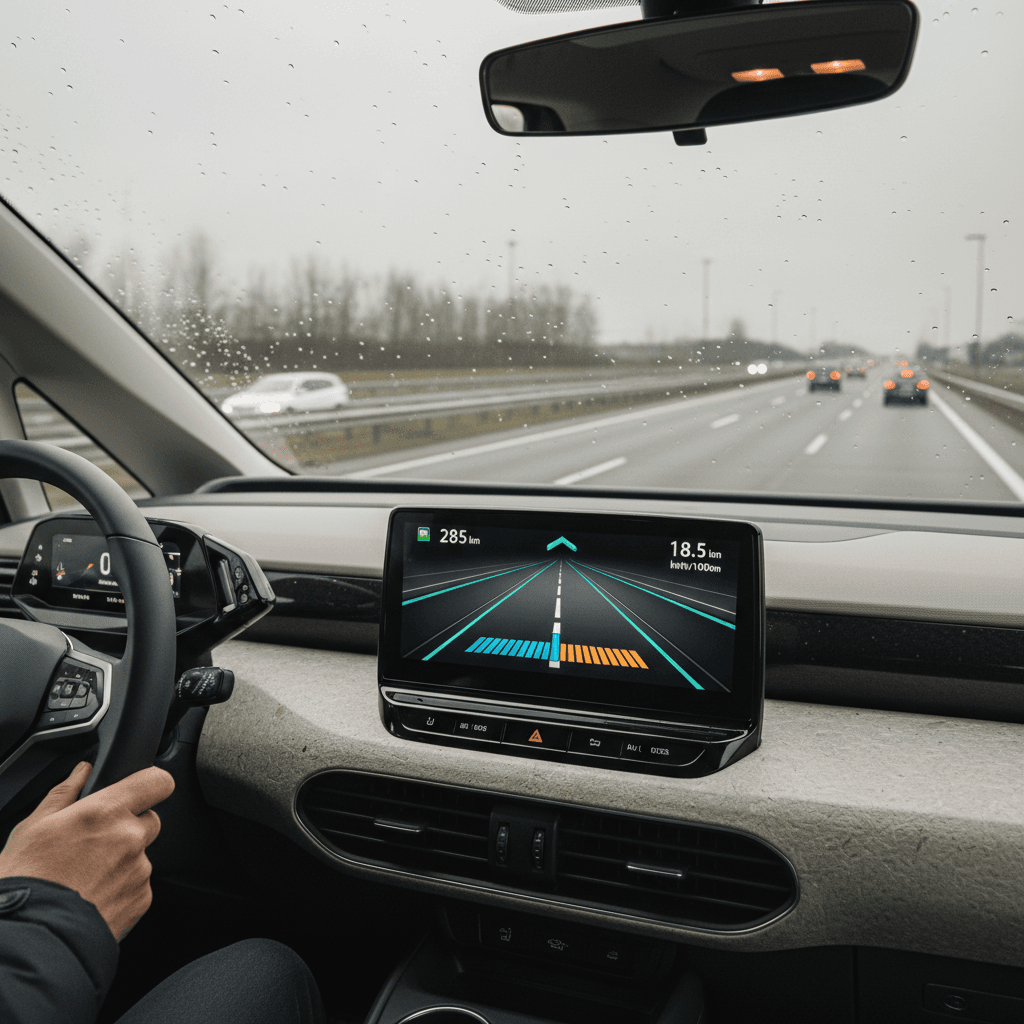
Highway range is where expectations and reality tend to diverge the most. Tests that lock the ID. Buzz at a constant 70–75 mph often produce results that are noticeably lower than the EPA promise, especially in cold or windy conditions.
- At moderate temps (60–75°F) and 70 mph, many long‑wheelbase Buzz drivers see about 2.6–3.0 mi/kWh. That yields roughly 190–230 highway miles if you use nearly the full pack.
- At higher speeds (75–80 mph), consumption often drops into the low‑2‑mi/kWh range, pulling realistic range into the 160–200‑mile band.
- In cold conditions (30–40°F) at 70–75 mph, some owners report seeing 2.0–2.3 mi/kWh with heat on, practically 150–180 miles before you want to fast‑charge again.
- Headwinds, roof boxes, bikes on a hitch rack, and a fully loaded cabin can shave another 10–15% off those numbers.
Watch the combination of cold + speed + wind
How weather, load, and driving style change your range
Key factors that move your range up or down
Think of the ID. Buzz as a rolling billboard: everything that makes it charming also makes aero drag worse.
Speed & aerodynamics
Above ~60 mph, aerodynamic drag becomes the dominant load. Raising cruise speed from 65 to 75 mph in the Buzz can cost you 15–25% of your range, depending on conditions.
Temperature & climate control
Cold batteries are less efficient and heating a big cabin takes energy. In winter highway use, cabin heat can easily eat 10–15% of available range. Preconditioning while plugged in helps a lot.
Passengers & cargo
Weight matters most on hills and in stop‑and‑go. A full load of people and gear might trim range by 5–10%, but it usually isn’t as punishing as high speed or cold weather.
Driving style
Gentle acceleration, maintaining momentum, and using Eco mode when you don’t need full power are simple ways to keep efficiency closer to 3 mi/kWh or better in mixed driving.
Think in mi/kWh, not just miles
Planning road trips in an ID. Buzz
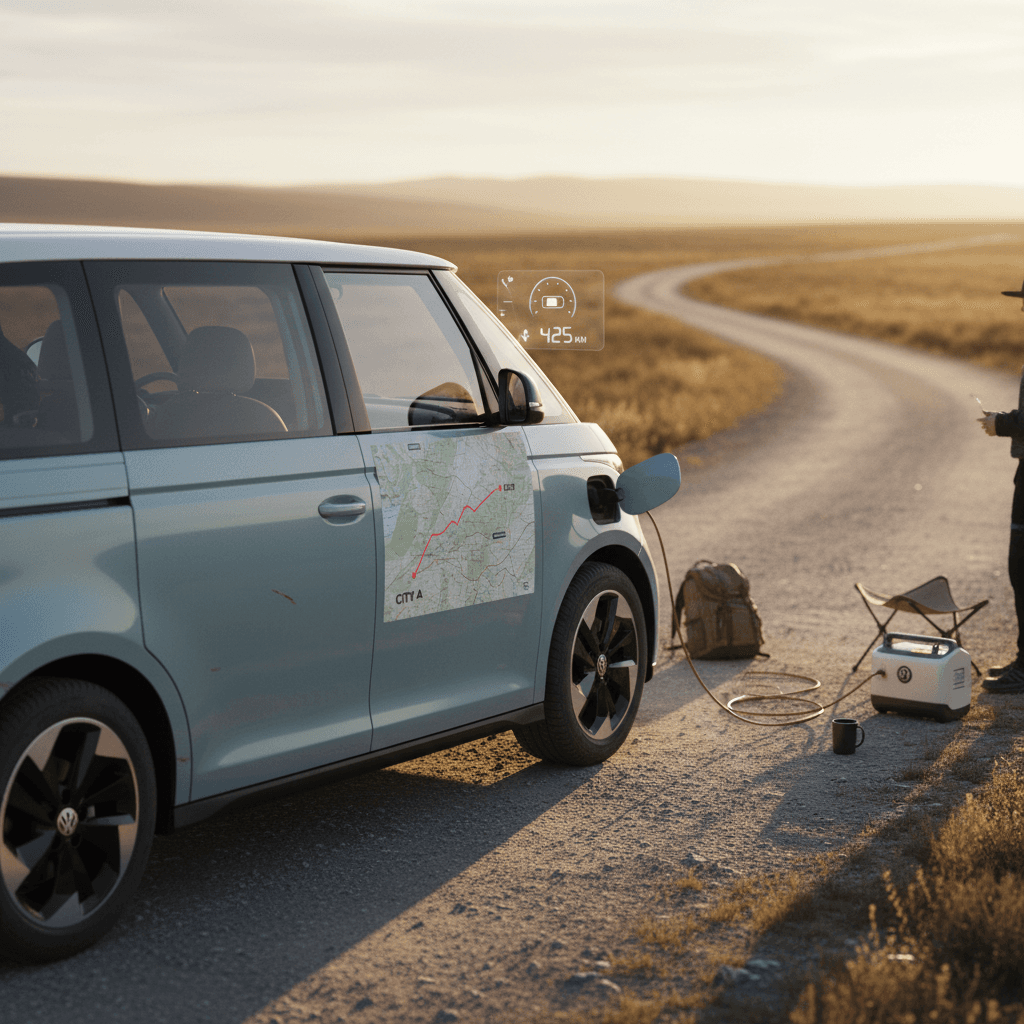
The ID. Buzz can absolutely be a road‑trip machine, but you plan trips differently than you would in a 400‑mile luxury EV sedan. In 2026, North American vans still rely on CCS, though VW owners are gaining access to large third‑party fast‑charging networks and, with an adapter, many Tesla Superchargers. That’s good news, but the Buzz’s range and charging curve still reward thoughtful planning.
Road‑tripping your ID. Buzz without range anxiety
1. Plan for 120–180‑mile legs
On highways, assume you’ll be most comfortable stopping every 120–180 miles, especially in winter or with a full load. That keeps you in the fast part of the DC charging curve and gives you a buffer.
2. Charge from ~10–15% up to 60–80%
Most fast‑charge sessions are most efficient in this band. The ID. Buzz can add a big chunk of range in 25–35 minutes when you’re charging in that sweet spot.
3. Use multiple charging apps
Combine the VW app with apps from major networks (and, when available, the Tesla app with your adapter) to cross‑check station status, pricing, and amenities.
4. Watch elevation and weather
Climbing into mountains or driving into strong headwinds can chew through range. Let your nav app’s consumption estimate guide you, and be willing to stop a little earlier if conditions look ugly.
5. Travel light on the roof
A roof box or bikes on top are range killers at speed. If possible, use a hitch rack and pack inside the cabin to keep drag down.
6. Build in rest time
Think of each fast‑charge stop as a meal, restroom, or leg‑stretch break. With a van this comfortable, turning 400–500 miles into a pleasant two‑stop day is often the right expectation.
Battery health, degradation, and buying a used ID. Buzz
Because the ID. Buzz has only been on sale a few years, we don’t yet have data from decade‑old vans. Still, looking at other VW MEB‑platform EVs and early Buzz owners, the pattern is familiar: the steepest degradation happens in the first couple of years, then it flattens out.
- Many modern EVs lose 5–10% of usable capacity in the first few years, then degrade more slowly.
- Frequent DC fast charging to 100% and sitting at high state of charge in hot climates can accelerate wear.
- Gentle use, mostly AC charging, rarely charging past 80–90%, and avoiding leaving the pack at 0%, tends to keep degradation modest.
How Recharged helps you shop used ID. Buzz vans
Ready to find your next EV?
Browse VehiclesIf you’re evaluating a used ID. Buzz on the open market, ask for recent energy‑use screenshots, long‑trip consumption logs, and any DC fast‑charge history. On a test drive, note what percentage the battery starts and ends at, how many miles you’ve driven, and calculate the implied usable capacity. It’s not as precise as a professional diagnostic like the Recharged Score, but it will flag anything wildly out of line.
Practical ways to improve your real world range
Small habits that add up to more miles
You don’t have to baby the Buzz, but a few tweaks go a long way.
Precondition while plugged in
Use the app or in‑car scheduler to warm or cool the cabin before you leave while the van is still on AC power. That reduces heater or A/C load in the first 15–20 minutes of your drive.
Dial back your cruise speed
Dropping from 75 to 68 mph can save you 10–20% energy in a big, boxy van. Over a full charge, that can easily add 20–30 miles of range.
Use Eco and B modes wisely
Eco mode tempers power demand, while “B” mode increases regeneration. In stop‑and‑go traffic or rolling terrain, both help squeeze extra miles from the pack.
Pack smarter
Avoid roof boxes when you don’t need them, use a hitch rack for bikes, and declutter heavy gear you never use. Less drag and weight equals better efficiency.
Optimize your charging routine
If you don’t need full range daily, living between 20–80% is healthier for the pack long‑term and still gives plenty of usable miles.
Let navigation plan for chargers
Use the built‑in route planner or a third‑party app that factors in elevation and weather. A smart route can turn a white‑knuckle 5% arrival into an easy 18–20%.
Don’t chase the last mile
Volkswagen ID. Buzz real world range 2026: FAQ
Frequently asked questions about ID. Buzz real world range
Bottom line: Is the ID. Buzz’s real world range enough?
For everyday family life, school runs, commuting, weekend errands, the Volkswagen ID. Buzz real world range in 2026 is more than enough. In city and mixed driving, you’re usually looking at 220–260 miles on a full charge, with the convenience of topping up at home overnight. On the highway, you trade some efficiency for character; plan on 150–220 miles between fast‑charge stops depending on speed, weather, and load, and the Buzz becomes a very livable road‑trip van too.
If you’re cross‑shopping used ID. Buzz vans against other big EVs, focus on two questions: Does this range window fit my actual lifestyle, and what’s the battery’s current health? That’s where a data‑driven report like the Recharged Score becomes valuable, translating battery diagnostics and real world range into a simple, comparable number so you can shop confidently. Get that clarity, set realistic expectations for how you’ll use the van, and the ID. Buzz can be one of the most charming and practical electric vehicles you can own.