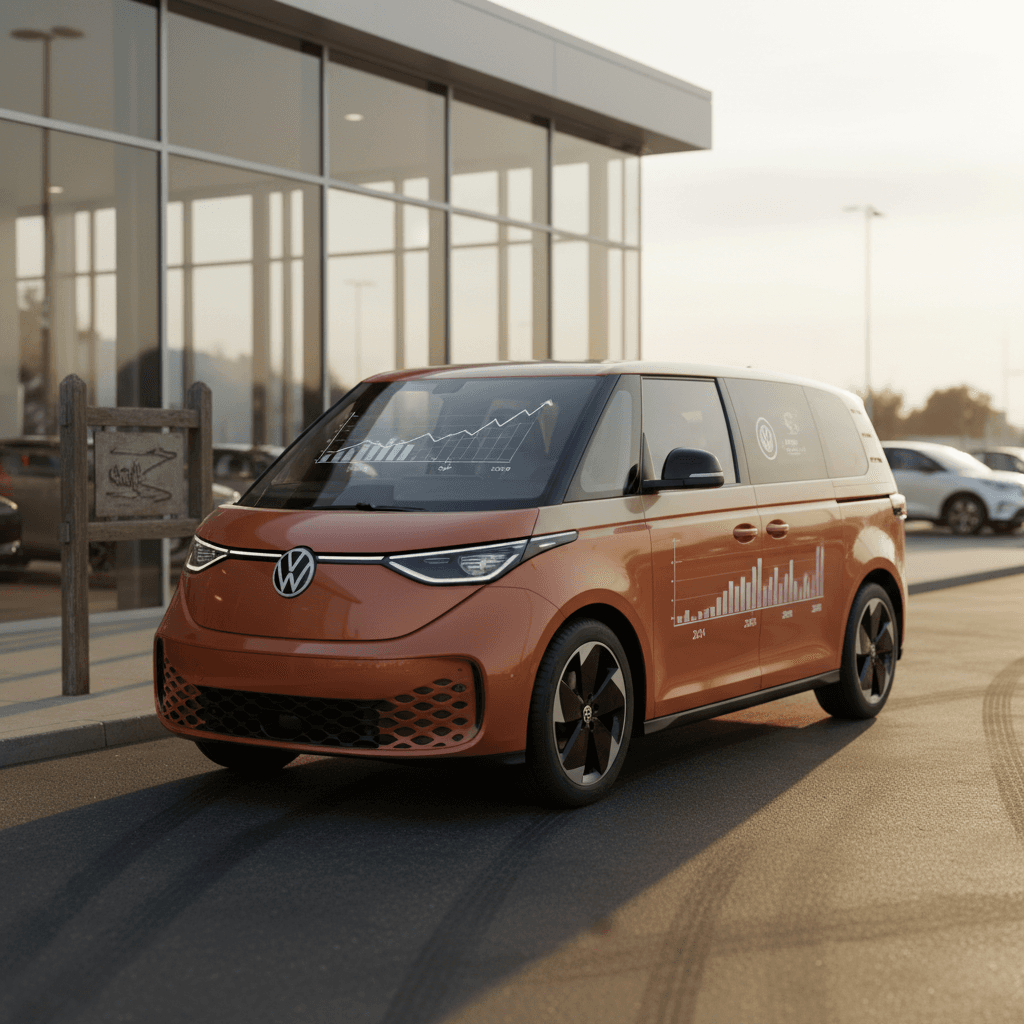
If you’ve been eyeing Volkswagen’s electric microbus revival, you’ve probably noticed something odd: there is no 2026 ID. Buzz on the U.S. order sheet. That makes any Volkswagen ID. Buzz price forecast for 2026 less about a fresh model year sticker and more about how 2025 vans, incentives, and the emerging used market will behave through calendar‑year 2026.
Quick context
Why 2026 is a weird year for the ID. Buzz
Normally, forecasting pricing is as simple as projecting modest year‑over‑year adjustments to MSRP, incentives, and depreciation. With the ID. Buzz, 2026 breaks that pattern for three reasons:
- Volkswagen of America has said there will be no 2026 model‑year ID. Buzz for the U.S.; dealers will sell 2025s through roughly mid‑2026 before a 2027 model arrives.
- U.S.‑spec ID. Buzz launched with high MSRPs in 2025, and demand has been softer than the early hype suggested, leading to discounting in some markets.
- By 2026, we’ll see the first meaningful crop of used ID. Buzz vans, plus a crowded field of three‑row electric crossovers and plug‑in minivans pushing on price.
So when we talk about the 2026 price picture, we’re really talking about three buckets: leftover 2025 inventory, early used ID. Buzz vans, and how those stack up to competing people‑movers in a cooling but maturing EV market.
ID. Buzz market snapshot heading into 2026
Important caveat
Where pricing stands today: 2025 MSRP and real transaction prices
To understand 2026, you have to start with the 2025 baseline. Volkswagen positioned the U.S.‑spec ID. Buzz as a premium, three‑row electric van with pricing to match. Early pricing announcements and dealer order guides put most U.S. models in this ballpark:
Approximate 2025 Volkswagen ID. Buzz U.S. pricing
Representative MSRP bands for common trims (excluding destination and before dealer markups or discounts).
| Trim (U.S. configuration) | Drivetrain | Approx. MSRP band (new) | Typical out‑the‑door reality in 2025 |
|---|---|---|---|
| ID. Buzz Pro S | RWD | Low $60,000s | High‑$50,000s to low‑$60,000s after modest discounts in competitive markets |
| ID. Buzz Pro S Plus | RWD | Mid‑$60,000s | Low‑ to mid‑$60,000s depending on options and fees |
| ID. Buzz 1st Edition / Launch trims | AWD | High $60,000s–low $70,000s | High‑$60,000s after negotiation, or closer to MSRP where supply is tight |
These figures are rounded bands from public pricing announcements and early dealer data, not formal VW quotes for every configuration.
Compared with the retro‑cool image VW spent years building, these numbers landed with a bit of sticker shock. When your price overlaps well‑equipped three‑row EVs, and even undercuts some luxury crossovers, but still feels spendy next to gasoline and hybrid vans, the market tends to push back.
How this compares to mainstream options
2026 Volkswagen ID. Buzz price forecast: new vs. used
Because there’s no 2026 model‑year ID. Buzz for the U.S., your 2026 reality will be a mix of leftover 2025s and used examples. Here’s how we expect each slice of the market to behave if current trends hold.
Our high‑level 2026 ID. Buzz price outlook
Ranges below are directional estimates for typical deals, not guaranteed offers.
Leftover new 2025 ID. Buzz (sold during 2026)
- Forecast deal range: roughly $52,000–$60,000 for common RWD trims in most markets, before tax and fees.
- That implies 8–15% below typical MSRP as VW and dealers work through remaining inventory.
- AWD/launch trims may still sit in the $60,000–$65,000 zone, depending on options and local demand.
Used 2025 ID. Buzz (resold during 2026)
- Forecast retail asking prices: about $48,000–$55,000 for clean, low‑mile vans in desirable specs.
- Higher‑mile or less popular colors/options could slide to the mid‑$40,000s by late 2026 in softer markets.
- Expect wholesale (auction/trade‑in) values to run roughly 10–15% below those retail figures.
Rule of thumb for 2026 shoppers
Discounts, incentives, and leases: what 2026 buyers may see
There are three big levers that could materially change what you pay in 2026 versus the Monroney sticker: factory incentives, dealer discounts, and lease or finance support. All three have been in flux as legacy automakers recalibrate EV production to a cooler demand environment.
Key price levers to watch in 2026
1. Factory rebates and APR offers
If 2025 ID. Buzz inventory remains heavy by early 2026, Volkswagen is likely to lean on <strong>customer cash rebates and subvented APRs</strong>. That could mean several thousand dollars in direct savings or low‑APR financing compared with standard rates.
2. Dealer‑level discounts
High‑priced EVs with lukewarm demand often see <strong>dealer discounts pile on top of factory offers</strong>. In practical terms, you may see aggressive deals in high‑inventory regions, but near‑MSRP pricing where supply is tight and buzz (no pun intended) remains strong.
3. Federal and state EV incentives
As of early 2026, many buyers still structure deals to capture the <strong>federal clean vehicle credit</strong> via leases or in states with strong EV rebates. The ID. Buzz’s eligibility has been nuanced, so always have the dealer spell out how any incentives are being applied in writing.
4. Lease money factors and residuals
Because three‑row EVs are depreciation‑sensitive, the most attractive way into an ID. Buzz in 2026 may be a <strong>subsidized lease</strong>. Strong residual assumptions and low money factors can lower monthly payments more than a headline rebate.
5. Trade‑in and instant‑offer values
If you’re coming out of another EV, or a desirable hybrid or SUV, your <strong>trade‑in or instant‑offer value</strong> is effectively part of the price you’re paying for a Buzz. Getting multiple offers, including from marketplaces like Recharged, can easily swing your net cost by a few thousand dollars.
Where used ID. Buzz shoppers may win big
How the ID. Buzz compares price‑wise in 2026
Even with discounting, the ID. Buzz is not a budget people‑mover. It’s a style‑forward, low‑volume EV that competes on character and cabin flexibility as much as on raw dollars and cents. To understand its 2026 value proposition, you have to zoom out and look at alternatives.
Against gas and hybrid minivans
- Chrysler Pacifica / Toyota Sienna / Kia Carnival: Often undercut the ID. Buzz by $15,000–$20,000 on transaction price.
- They can’t match the Buzz’s vibe or full EV drivetrain, but they offer smoother road‑trip refueling and lower upfront cost.
- For purely dollars‑per‑seat, gas and hybrid vans will still be ahead in 2026.
Against three‑row EV crossovers
- Kia EV9, Hyundai Ioniq 7‑class rivals, Volvo EX90, etc.: Often similar or slightly higher MSRPs, but with longer range or more performance.
- The Buzz counters with upright packaging, heritage design, and a more lounge‑like interior.
- Discount‑for‑discount, the Buzz needs to close at least part of the feature and range gap to win rational shoppers.
Don’t ignore total cost of ownership
Factors that could push ID. Buzz prices up or down
Forecasting is about probabilities, not certainties. Here are the key forces that could shove 2026 ID. Buzz pricing higher or lower than the ranges we’ve outlined.
Key 2026 price drivers for the ID. Buzz
Think of these as the dials that can tighten or loosen pricing power.
Macro EV demand
If interest rates ease and EV demand rebounds faster than expected, remaining Buzz inventory could firm up, trimming discounts on new 2025s and supporting higher used values.
VW inventory strategy
If VW overbuilt 2025s relative to demand, it has two levers in 2026: slow allocation or turn on the incentive firehose. The latter would mean better deals but steeper short‑term depreciation.
Competitive launches
New three‑row EVs or plug‑in vans with better range or lower prices, especially from Asian brands, would put downward pressure on both new and used ID. Buzz pricing.
Policy and incentives
Changes to U.S. or state‑level EV credits could effectively shift prices by several thousand dollars overnight. Leased Buzz vans are especially sensitive to how credits are applied.
Fuel and electricity prices
Higher gasoline prices typically support EV transaction prices, while rising residential electricity or demand charges can soften the economic case, especially for large EVs.
Enthusiast demand
The ID. Buzz has an emotional pull. If it develops a cult following and volumes stay low, certain specs, colors, interiors, AWD, could develop a mini‑premium on the used market.
Buying strategy: should you wait or shop used?
Given that 2026 is a gap year for new U.S. model‑year Buzz vans, your strategy depends on how much you value being in an ID. Buzz specifically versus simply owning a practical electric people‑mover.
Smart paths for would‑be ID. Buzz owners in 2026
You’re emotionally committed to the ID. Buzz
Target late‑2025 through mid‑2026 for <strong>discounted new 2025 inventory</strong>. This is when dealers are most motivated to clear the pipeline before the 2027 model.
Stay flexible on color and options; the best deals tend to be on <strong>in‑stock units</strong>, not custom orders.
If you can tolerate mileage, consider a nearly‑new 2025 with <strong>verified battery health</strong> and remaining factory warranty.
You’re price‑sensitive and cross‑shopping widely
Start with a <strong>total cost of ownership comparison</strong> against plug‑in hybrids and conventional vans, especially if you drive modest annual miles.
Use 2026 to hunt for <strong>used ID. Buzz deals</strong> that sit well below the original MSRP while still carrying plenty of warranty coverage.
Don’t ignore alternative three‑row EVs where incentives or dealer cash make them significantly cheaper to own over five years.
You’re willing to wait for the 2027 refresh
Sit on the sidelines in 2026 and <strong>watch how VW positions the updated 2027 model</strong> on price, range, and equipment.
If VW corrects range and pricing critiques, the 2027 may age better in the used market, even if you pay more at launch.
In the meantime, consider a <strong>short‑term lease or lower‑cost used EV</strong> to bridge the gap without over‑committing capital.
Leverage time, not just price
How Recharged can help you shop the ID. Buzz smartly
If you’re trying to decode ID. Buzz pricing in 2026, the hardest part isn’t finding a van, it’s figuring out whether the one in front of you is a good deal relative to its battery health, mileage, and the broader market. That’s exactly the problem Recharged was built to solve.
Buying an ID. Buzz with Recharged
Data, diagnostics, and EV‑specific support, not just a price tag.
Recharged Score battery diagnostics
Fair market price transparency
Financing, trade‑ins, and delivery
Ready to find your next EV?
Browse VehiclesWhy this matters in 2026
Volkswagen ID. Buzz 2026 price forecast FAQ
Common questions about 2026 ID. Buzz pricing
Bottom line on the ID. Buzz price outlook for 2026
The coming year is unusual for the Volkswagen microbus revival: there’s no 2026 model‑year ID. Buzz for the U.S., but plenty of pricing motion as 2025 vans and the first used examples work their way through the system. For most shoppers, that means aiming 10–15% under original MSRP for either a discounted new 2025 or a clean, low‑mile used van, then letting incentives, interest rates, and local inventory nudge you up or down from there.
If you care more about owning an ID. Buzz specifically than about having the absolute cheapest way to move seven people, 2026 can be a smart time to buy, provided you shop carefully and lean on real battery and market data. Platforms like Recharged exist to give you exactly that: verified battery health via the Recharged Score, transparent fair‑market pricing, and EV‑savvy support from your first search to delivery.
Whether you decide to strike on a discounted 2025, hunt for a value‑rich used Buzz, or wait and see what the 2027 refresh brings, going in with clear price expectations and a firm understanding of your own use case will matter more than any single forecast. The ID. Buzz may not be the cheapest way to haul people and cargo, but for the right buyer at the right price, it’s still one of the most characterful.