The Volkswagen ID. Buzz arrived in the U.S. as a $60,000‑plus electric nostalgia piece, then ran head‑first into a cooling EV market. By early 2026, the question on a lot of minds is simple: **what’s the Volkswagen ID. Buzz depreciation rate in 2026, and is this thing going to hold its value or fall off a cliff?**
What this guide covers
ID. Buzz depreciation in 2026: the short version
Early VW ID. Buzz value signals (2025–2026)
Because the ID. Buzz only reached U.S. driveways in late 2024 and 2025, there isn’t a full 3‑ or 5‑year curve yet. But auction results, dealer listings, and depreciation calculators are all telling a similar story: **steeper‑than‑average early depreciation, especially for buyers who paid markups in 2024–early 2025.**
If you bought early with a markup…
How fast is the VW ID. Buzz depreciating so far?
Let’s start with what we can actually see in 2025–2026 data rather than wishful thinking. A representative early sale: a 2025 ID. Buzz 1st Edition with under 400 miles and an MSRP just under $70,000 changing hands at auction for about $61,500 roughly five months after delivery, **a 15–17% drop from sticker in under half a year.** Similar stories are popping up in dealer trades and online appraisal tools.
Real‑world early depreciation examples
Illustrative 2025–early‑2026 VW ID. Buzz resale snapshots (rounded figures).
| Scenario | Odometer & age | Original MSRP / transaction | Resale or trade price | Approx. depreciation |
|---|---|---|---|---|
| 1st Edition, paid near MSRP | < 500 miles, ~5 months | $69,000 | $61,500 | ~11% vs MSRP, ~15–17% vs out‑the‑door with fees |
| 1st Edition, paid big markup | < 1,000 miles, < 1 year | $75,000+ out‑the‑door | Low–mid $60,000s | 15–20%+ vs what owner actually paid |
| Pro S Plus, discounted new | Brand‑new 2025 stock, 0 miles | MSRP ~$66,000 | Advertised $51,000–$53,000 | 18–23% under MSRP before TTL |
| Typical trade estimate (2025 build) | 5,000–10,000 miles, ~1 year | Sticker $62,000–$70,000 | $43,000–$56,000 | ~20–30% below sticker, depending on miles/options |
These aren’t averages; they’re representative cases that show the pattern of rapid first‑year value loss when the Buzz is bought at or above MSRP.
Those numbers line up with third‑party depreciation forecasts, which currently peg a VW ID. Buzz at roughly **54% depreciation over 5 years** when bought new at typical pricing. That implies an average annual hit in the 10–15% range early on, with the steepest fall in years one and two.
New EV reality check
Why the ID. Buzz depreciates the way it does
Key forces pushing ID. Buzz values around
Some are fixable, some are baked in.
1. Price vs. range
2. EV incentives rollercoaster
3. Niche audience
4. Dealer behavior
5. Rapid EV tech change
6. 2026 U.S. model‑year pause
Put bluntly, the ID. Buzz is an emotional purchase priced like a luxury tool. When that emotion wears off, you’re left with a heavy EV van that goes barely farther than a mainstream compact SUV on a charge. The used market is very efficient at translating that disappointment into dollars.
2026 snapshot: prices, discounts, and used values
By spring 2026, the Buzz’s brief pricing history already looks like a boom‑and‑hangover cycle. Early 1st Edition buyers saw dealer windows with $65,000–$68,000 stickers and, in a few notorious cases, **asking prices nudging $80,000** with add‑ons and markups. Fast‑forward and many dealers are quietly doing the opposite, chopping **$10,000–$15,000 off MSRP** with factory help just to move them.
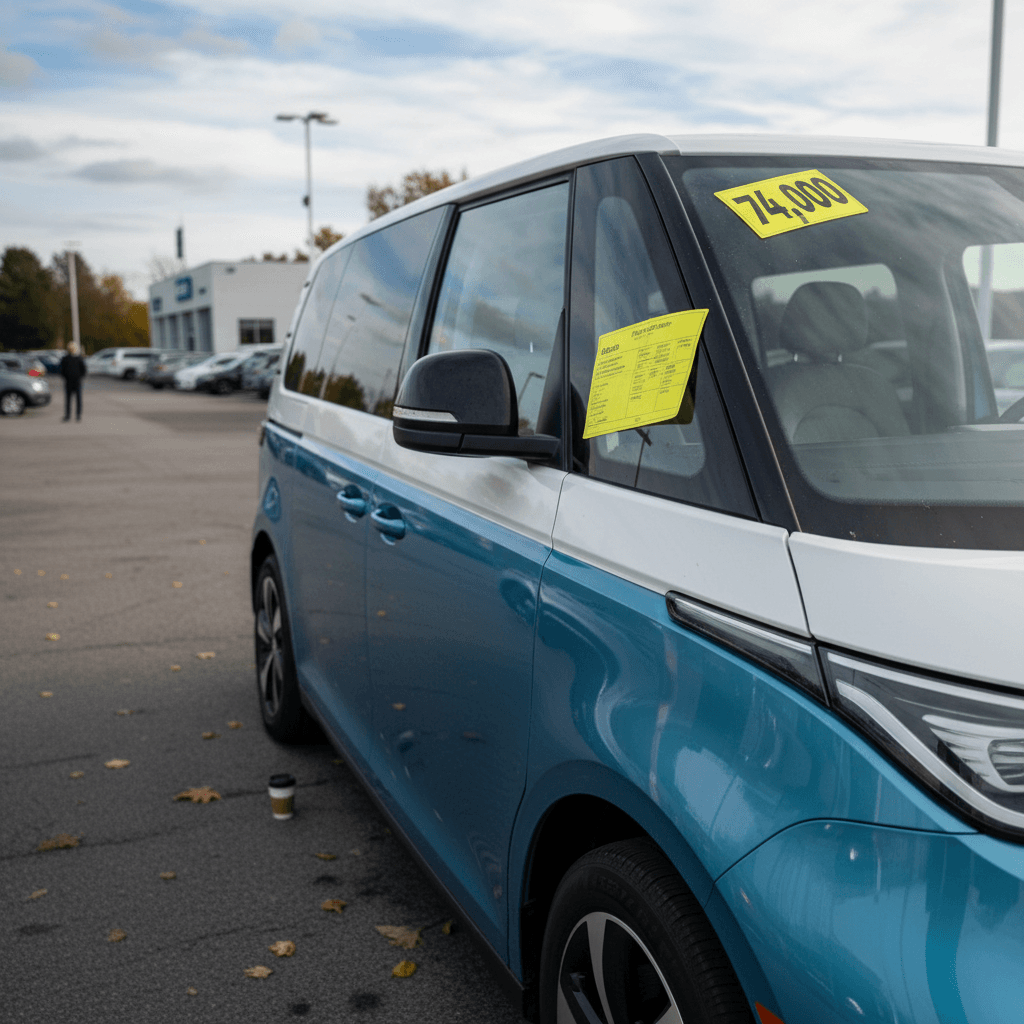
- New 2025 ID. Buzz Pro S and Pro S Plus vans advertised in the **low‑$50,000s** after discounts and incentives.
- Lightly used 2025 1st Edition vans with under 5,000 miles trading in the **mid‑$40,000s to mid‑$50,000s**, depending on options and region.
- Appraisal tools already suggesting **trade‑in offers as low as $43,000** for well‑optioned vans that stickered in the mid‑$60,000s a year earlier.
A silver lining for late buyers
Five‑year depreciation forecast for the ID. Buzz
Forecasts are not destiny, but they’re useful guardrails. A major depreciation calculator currently projects the Volkswagen ID. Buzz to **lose about 54% of its value over 5 years**, leaving an estimated 5‑year resale value around **$30,000–$31,000** for a typical spec if bought new at standard pricing.
Illustrative 5‑year ID. Buzz depreciation paths
Rounded projections for a U.S.‑spec ID. Buzz bought new around $65,000 before taxes and fees.
| Year of ownership | Estimated value | Cumulative depreciation | What it feels like as an owner |
|---|---|---|---|
| Year 1 (2025–2026) | $45,000–$50,000 | ≈25–30% | Sticker shock, particularly if you paid MSRP or a markup. Discounts for new buyers undercut your purchase price. |
| Year 3 (2028) | $35,000–$40,000 | ≈40–45% | The curve flattens a bit; van is now priced like a well‑equipped used minivan with EV quirks. |
| Year 5 (2030) | $30,000–$32,000 | ≈50–55% | Values stabilize; battery health, range retention, and maintenance history matter more than options. |
These are directional scenarios, not guarantees. Real results will vary by mileage, region, condition, incentives, and how much you paid going in.
Europe vs. U.S. Buzz values
How the 2026 U.S. model‑year pause affects values
Volkswagen has already said it will **pause U.S. ID. Buzz imports for the 2026 model year** and return with a revised 2027 model. On paper, that sounds alarming, people throw around words like “canceled” and “failure”, but for depreciation, the effect is more nuanced.
Potential downside
- Confidence hit: Shoppers may worry VW isn’t fully committed, making them cautious about long‑term parts support and resale.
- Spec gap: If the 2027 update brings more range or better pricing, your 2025 Buzz will look older, faster.
- Media narrative: Headlines about “pauses” and “re‑thinks” rarely help used values, even if the product itself is fine.
Potential upside
- Limited supply: With no 2026 model‑year stock, the pool of U.S. Buzz vans stays relatively small. Scarcity can support prices, especially for clean, low‑mile examples.
- Collector appeal: The first‑run, three‑row Buzz may become the one enthusiasts want if VW changes the recipe later.
- Dealer reset: A pause lets VW and its dealers regroup on pricing and incentives, potentially bringing saner, more transparent deals in 2027.
What this means for you
ID. Buzz vs. other EVs and vans on depreciation
To understand whether the ID. Buzz is an outlier or just another EV taking its medicine, you have to compare it to both **other electric vehicles** and **other vans**.
Where the ID. Buzz lands in the depreciation pack
Relative to other EVs and to practical vans.
Versus other EVs
Versus gas minivans
Versus work vans
So no, the ID. Buzz isn’t uniquely cursed, but it’s stuck in a tough neighborhood: an EV market that’s repricing itself in real time, plus a van segment where nostalgia only gets you so far against vans that can tow, seat eight, and run 400 miles on a tank.
Best‑ and worst‑case scenarios for owners
If you’re staring at a Buzz payment in 2026, what should you realistically expect? It depends heavily on **how you bought it and how long you’ll keep it.**
Relatively happy outcome (owner‑friendly)
- You bought in late 2025 or 2026 with **$10,000–$15,000 off MSRP**, or you snagged a gently used example in the low‑$50,000s.
- You keep the van for **6–8 years**, drive a normal 8,000–10,000 miles per year, and maintain it by the book.
- By 2032, you’re selling a well‑documented, clean‑battery Buzz for **high‑$20,000s to low‑$30,000s**, and depreciation feels acceptable for a quirky, lovable family hauler.
Rough outcome (wallet‑hostile)
- You paid a **$10,000+ markup** in 2024–early 2025, landing near $75,000 out‑the‑door.
- You decide after 2–3 years that range or packaging doesn’t work, and you trade with 30,000+ miles.
- Dealers offer **mid‑$30,000s to low‑$40,000s**, and you discover you’ve burned through **nearly half the purchase price** in a short window.
The real risk: short‑term flips
Timing your buy or sell in 2026
With the 2026 model‑year pause and 2027 updates on the horizon, timing matters more than usual. Here’s how to think about it if you’re on either side of the transaction this year.
If you’re buying an ID. Buzz in 2026
1. Lean hard on discounts
Don’t treat MSRP as sacred text. In 2026, it’s routine to see **five‑figure discounts** once you combine factory incentives and dealer markdowns. The more depreciation you capture on day one, the less pain later.
2. Consider nearly new used
Lightly used 2025 Buzz vans with under 10,000 miles often trade for **tens of thousands less** than comparable new units were advertised for at launch. That’s exactly the depreciation you want someone else to eat.
3. Check battery and charging history
Use tools like the <strong>Recharged Score Report</strong> to see real battery health, fast‑charge exposure, and range performance instead of guessing. A healthy pack props up resale; a tired one drags it down.
4. Think beyond 2027
If you buy now, plan to keep the van **at least through the first couple of years of the 2027 refresh**. That way you’re not trying to sell an older spec into a wave of shiny new product.
If you’re selling or trading an ID. Buzz in 2026
1. Shop multiple offers
Don’t accept the first trade‑in number. Get instant online offers, dealer quotes, and valuation tools. Market spreads can be thousands of dollars on a quirky EV like this.
2. Sell before warranty cliffs
Buyers get nervous once factory coverage starts to run out. If you’re close to a **battery or bumper‑to‑bumper milestone**, it may pay to move a little earlier.
3. Highlight the right story
In your listing or when talking to dealers, emphasize <strong>low miles, gentle charging habits, and clean history</strong>. Provide service records and range screenshots; they all help justify a stronger number.
4. Consider consignment instead of immediate trade
If you have time, a marketplace like <strong>Recharged</strong> can list your Buzz at retail prices while handling buyer questions, battery diagnostics, and paperwork, often netting you more than a same‑day trade.
How to protect your ID. Buzz’s resale value
You can’t out‑argue the market, but you can absolutely influence where your particular van lands within the spread. Two otherwise identical Buzz vans can be separated by **$5,000–$8,000** at resale just on condition, history, and presentation.
Four high‑impact ways to defend your Buzz’s value
Simple habits that used‑buyers actually pay for.
1. Be kind to the battery
2. Treat the interior like a living room, not a locker
3. Document everything
4. Get a third‑party battery health report
How Recharged can help
FAQ: VW ID. Buzz depreciation in 2026
Frequently asked questions
The Volkswagen ID. Buzz is the rare vehicle that asks your head to justify what your heart already decided. In 2026, the numbers are clear: it depreciates faster than a sensible gas van and faster than many mainstream EVs, especially if you bought into the early‑adopter frenzy. But depreciation isn’t the whole story. If you buy at the right price, keep it long enough, and protect its battery and condition, the Buzz can still earn its keep, delivering years of slow‑lane charisma even as the spreadsheets grumble. And if you’d like a cooler, calmer way to buy or sell one, a battery‑verified marketplace like Recharged is exactly where that conversation starts.