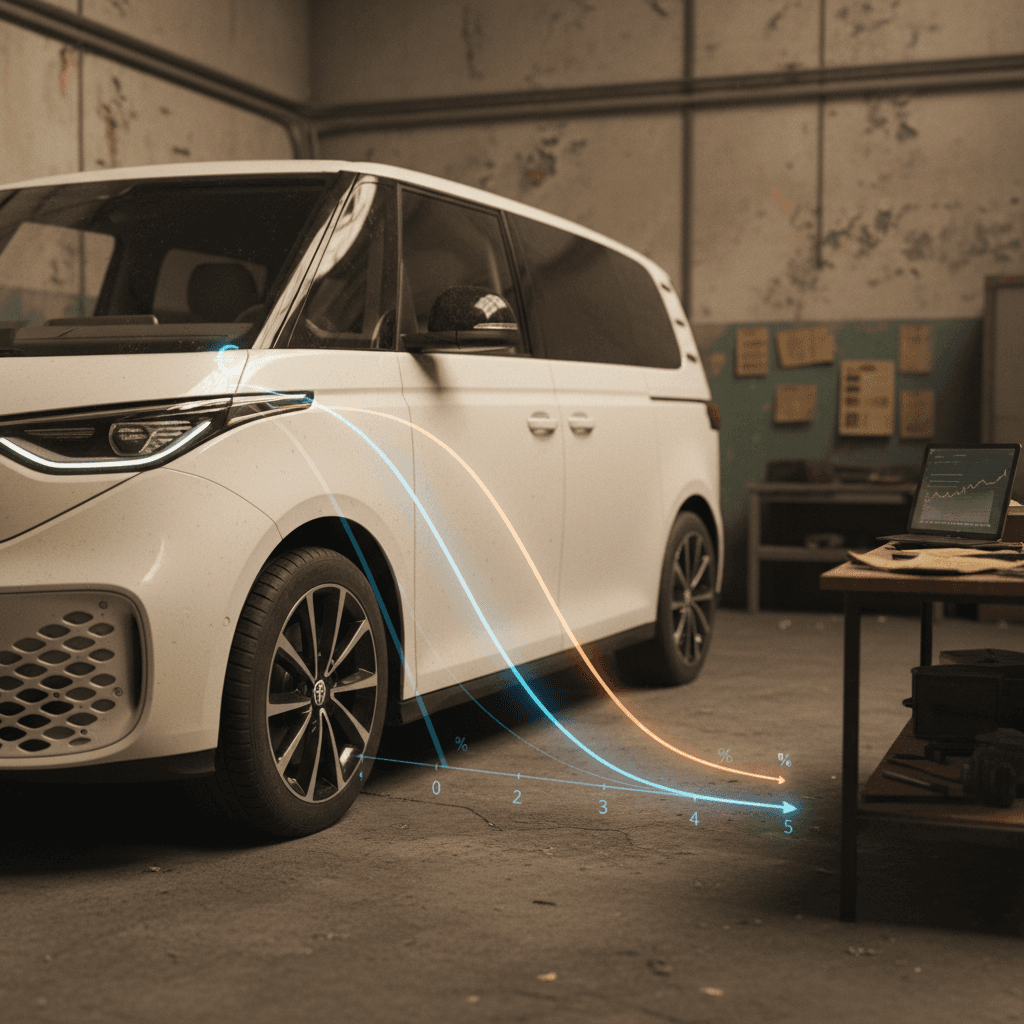
If you’ve fallen for the retro‑cool charm of the Volkswagen ID. Buzz, you’re not alone. But before you put down a deposit, or circle a date to buy one used, you’ll want to understand what the Volkswagen ID. Buzz depreciation curve over 5 years is likely to look like, and how that compares with other EVs and family vans.
A quick note about data
Why ID. Buzz depreciation matters more than you think
Depreciation is the single largest cost of owning almost any vehicle, and the ID. Buzz is no exception. The difference between a van that holds 60% of its value after 5 years and one that holds 45% can easily add up to tens of thousands of dollars. With the ID. Buzz launching at a premium price point, understanding its likely value path is crucial whether you plan to buy new in 2026 or wait and target the used market around 2028–2030.
- It tells you whether buying new or used makes more sense for your budget.
- It helps you choose trims and options that are more likely to hold value.
- It informs whether leasing could be smarter than buying outright.
- It shapes when you might want to sell or trade for your next EV.
Think in total cost of ownership, not just sticker price
How EV and van depreciation typically behaves
To understand the Volkswagen ID. Buzz depreciation curve over 5 years, it helps to look at two overlapping patterns: how electric vehicles depreciate and how vans/people‑movers depreciate.
Typical depreciation patterns: EVs vs. vans
The ID. Buzz sits at the intersection of both worlds
Modern EVs
- Historically steep in the first 2–3 years when new incentives and tech changes hit.
- Recent trend toward slower depreciation as EV demand grows and more buyers go used.
- Battery health and warranty coverage are major value drivers.
Minivans & MPVs
- Generally depreciate faster than compact SUVs but slower than some sedans.
- Family and camper demand can support resale if the vehicle is practical and reliable.
- Brand reputation and interior flexibility matter a lot.
The ID. Buzz combines EV tech with a flexible van body and strong nostalgia. That mix usually supports resale better than a mainstream sedan but might not match the best‑in‑class compact crossovers. Early European resale data suggests a healthy order book and limited supply have kept used values firm, at least in the first couple of years.
Context: how 5‑year depreciation often looks
Beware direct comparisons
Projected Volkswagen ID. Buzz depreciation curve over 5 years
Because the ID. Buzz is new, any 5‑year depreciation curve is, by necessity, a projection. Below is a directional example based on early pricing expectations for the U.S., European used‑market behavior, and how similar EVs have moved. We’ll assume a nicely equipped ID. Buzz with an MSRP around $65,000 for easy math. Real‑world prices will vary by trim, options, and incentives.
Illustrative 5‑year depreciation curve for a Volkswagen ID. Buzz
Example only, based on a $65,000 original MSRP with typical usage and no severe damage. Actual values will vary by market conditions and vehicle condition.
| Time from new | Approx. mileage (US) | Estimated % of original value | Estimated value ($65k MSRP) | Notes |
|---|---|---|---|---|
| Year 1 | 12,000–15,000 miles | 80–85% | $52,000–$55,000 | High demand, low supply, and novelty likely keep early depreciation moderate. |
| Year 2 | 24,000–30,000 miles | 72–78% | $47,000–$51,000 | Market starts to normalize; incentives and new trims can soften values. |
| Year 3 | 36,000–45,000 miles | 63–70% | $41,000–$45,500 | Sweet spot for many used buyers; warranty coverage still strong. |
| Year 4 | 48,000–60,000 miles | 55–63% | $35,750–$40,950 | More competition from newer EV vans and crossovers; condition matters more. |
| Year 5 | 60,000–75,000 miles | 48–58% | $31,200–$37,700 | Values diverge based on battery health, accidents, and interior wear. |
Projected value retention for an ID. Buzz owned from new, years 1–5.
How this compares to a typical EV
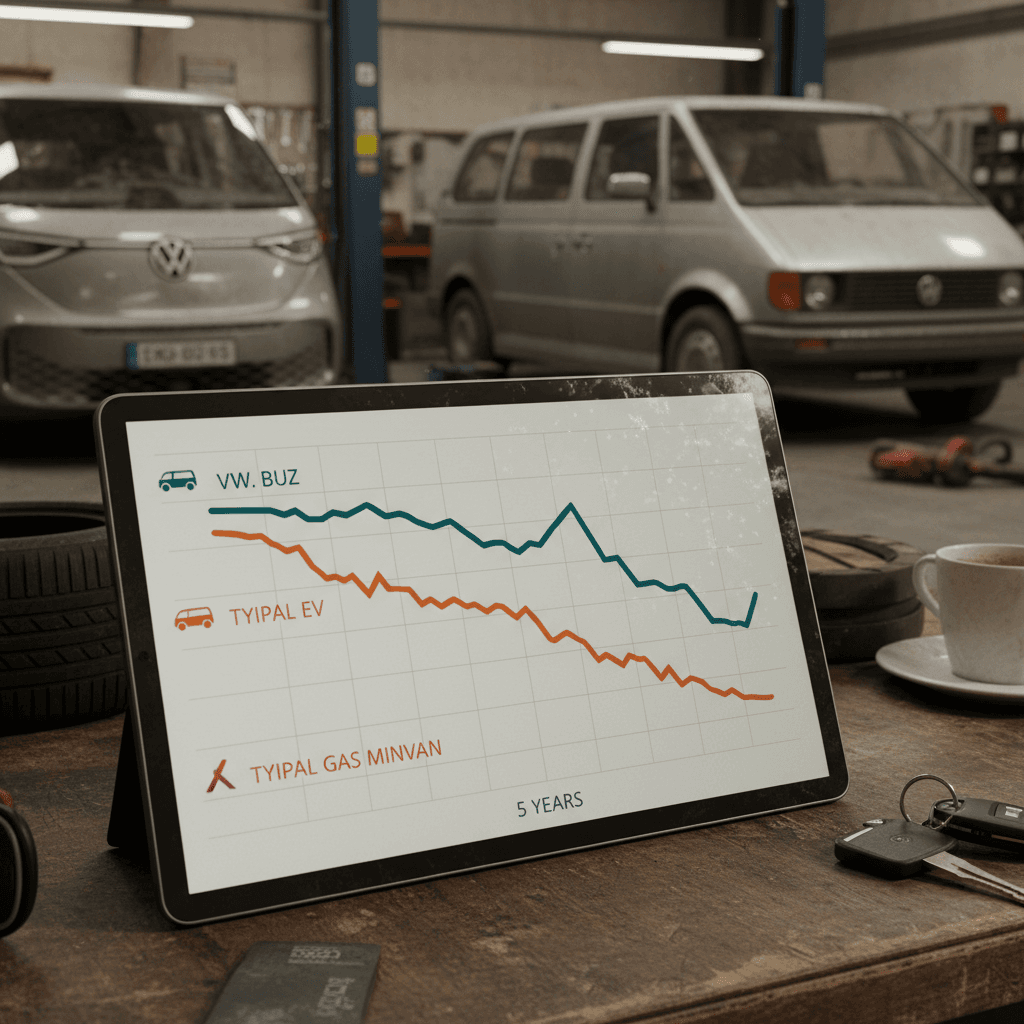
ID. Buzz vs. other EVs and minivans on resale
Against other electric vehicles
- Better than niche small EVs: Lifestyle crossovers and vans with distinctive design often hold value better than small, range‑limited city EVs.
- Competitive with popular crossovers: Expect the ID. Buzz to sit in the same ballpark as strong‑selling EV crossovers in 5‑year retention, especially if demand from families and camper conversions stays high.
- More sensitive to incentives: If future tax credits or price cuts appear, near‑new used prices could adjust quickly.
Against gas minivans and vans
- Higher sticker, similar 5‑year dollar loss: Even if the percentage loss is similar, the ID. Buzz starts from a higher price, so the absolute dollars may be larger.
- Lower running costs: Electricity and simpler EV maintenance can offset part of that higher depreciation over 5 years.
- Demand from niche buyers: Van‑life and commercial upfit communities can support values if the platform proves reliable.
Where the ID. Buzz could shine
Key factors that shape ID. Buzz resale value
Beyond simple age and mileage, several levers will push the Volkswagen ID. Buzz depreciation curve over 5 years up or down. These are the things you can partly control as an owner, or evaluate carefully as a used‑EV shopper.
Major value drivers for a used Volkswagen ID. Buzz
1. Battery health and usable range
A healthy high‑voltage battery with minimal degradation is critical. Buyers will pay more for an ID. Buzz that still comfortably covers family road trips or weekend adventures without frequent charging.
2. Charging speed and network access
If the ID. Buzz supports competitive DC fast‑charging speeds and broad network access (including future NACS support in North America), it will be easier to sell in 3–5 years.
3. Interior wear and configuration
Family vans and people‑movers take a beating. Stains, seat damage, and broken trim pieces drag values down quickly. Flexible seating and popular option packages (panoramic roof, driver‑assist tech) help on resale.
4. Accident history and repairs
A clean Carfax‑style history with no structural damage always helps. EV‑specific repairs, such as battery or high‑voltage components, should have clear documentation from qualified technicians.
5. Software updates and feature support
Over‑the‑air updates, navigation improvements, and continued support for safety and driver‑assist features keep a 5‑year‑old ID. Buzz feeling modern and valuable.
6. Market supply, incentives, and fuel prices
If gas prices stay high or rise and EV incentives remain attractive, used ID. Buzz demand should hold. Oversupply or aggressive new‑vehicle discounts can put pressure on used prices.
Trim and options can help, or hurt
Battery health and how Recharged measures it
Because so much of an EV’s resale value rides on battery health, any realistic view of the ID. Buzz depreciation curve has to put the pack front and center. Two seemingly identical vans, same year, similar mileage, can be worth very different amounts if one has significantly more battery degradation than the other.
Why battery health dominates EV depreciation
And how Recharged turns it into a clear score
Capacity & degradation
Fast‑charging behavior
Recharged Score diagnostics
Use data, not guesses
How to shop smart for a used ID. Buzz
If you’re planning to let someone else take the steepest first‑year hit and then buy an ID. Buzz used in years 2–5, you’ll be shopping right where depreciation and value intersect. Here’s how to tilt that equation in your favor.
Smart steps for evaluating a used Volkswagen ID. Buzz
1. Target the 2–4 year window
This is often the sweet spot where the original owner has absorbed the highest percentage drop, but the van is still well within key warranty coverage and tech feels current.
2. Prioritize battery health documentation
Ask for a recent battery health report, charge history (if available), and any high‑voltage system service records. On Recharged, this is bundled into the Recharged Score.
3. Check for interior and camper conversions
Decide if you want a stock family interior or a van‑life conversion. Some high‑quality camper builds can support value; DIY‑looking work may not.
4. Review software version and features
Confirm that major software updates have been applied and that driver‑assist and infotainment systems are functioning as expected.
5. Compare asking price to modeled value
Use depreciation models like the 5‑year curve in this article as a sanity check. If a 4‑year‑old van is priced like a 1‑year‑old, ask why.
6. Consider nationwide search and delivery
Because the ID. Buzz may be scarce in some regions, it can pay to widen your search. Recharged offers <strong>nationwide used‑EV listings and delivery</strong>, so you’re not limited to your local lot.
Ownership strategies: lease, buy, or wait for used?
With a new, high‑profile EV like the ID. Buzz, the right ownership strategy depends on your appetite for tech change, your cash flow, and how much risk you’re willing to take on residual value. Thinking through that before you sign matters more here than with a mainstream gas vehicle that has decades of resale history behind it.
Leasing an ID. Buzz
- Best if: You want to sidestep early depreciation and tech risk, and you prefer to swap into newer models every 2–4 years.
- Upside: The leasing company takes the residual‑value risk; you just pay the agreed monthly amount.
- Watch for: Mileage limits and excess wear charges, especially if you plan heavy family or camper use.
Buying new
- Best if: You’ll keep the ID. Buzz at least 6–8 years and want full control over spec and options.
- Upside: You enjoy all the newest tech and warranty coverage from day one.
- Watch for: The first 2–3 years of depreciation; it’s the steepest part of the curve.
Waiting for used
- Best if: You’re value‑oriented and comfortable letting early adopters take the biggest hit.
- Upside: A 3–5‑year‑old ID. Buzz can offer much of the same utility for tens of thousands less.
- Watch for: Battery health, accident history, and whether newer model‑year features matter to you.
Where Recharged fits in
Ready to find your next EV?
Browse VehiclesFrequently asked questions about Volkswagen ID. Buzz depreciation
Volkswagen ID. Buzz depreciation: FAQs
Bottom line on the ID. Buzz 5‑year depreciation curve
The Volkswagen ID. Buzz depreciation curve over 5 years will ultimately be written by real‑world buyers and sellers, but the early signs point to a van that should hold its own among modern EVs and family haulers. Expect a meaningful drop in the first 2–3 years, then a more gradual slide as the market settles and the van proves, or fails to prove, its long‑term value.
If you’re set on owning an ID. Buzz from new and you plan to keep it for a long time, depreciation becomes just one piece of a bigger total‑cost‑of‑ownership puzzle that includes energy, maintenance, and how much you actually use the van. If you’re value‑oriented and patient, targeting a well‑documented, 3–5‑year‑old ID. Buzz, ideally with a verified battery health report like the Recharged Score, may give you most of the magic for far less money.
Either way, understanding how this electric icon is likely to age on the balance sheet puts you ahead of the curve. And when ID. Buzz models start hitting the used market in meaningful numbers, Recharged will be ready with transparent battery diagnostics, fair‑market pricing, and expert help to navigate your next EV purchase or trade.