If you’re thinking about a Volkswagen ID. Buzz, or eyeing one on the used market, the big question is obvious: how long will the ID. Buzz battery last before range drops enough to really matter? With a large 79–86 kWh usable pack (depending on version) and family-hauler duty, you want to know if this rolling living room will still be practical in 8, 12, or even 15 years.
Quick answer
ID. Buzz battery lifespan at a glance
Volkswagen ID. Buzz battery life by the numbers
Those numbers don’t mean your ID. Buzz becomes useless the day it crosses 100,000 miles. Instead, think of the warranty as the **floor**, not the ceiling. Real-world experience with Volkswagen’s MEB platform packs, used across the ID. family, shows that they’re proving durable when owners avoid constant DC fast-charging and extreme storage behaviors.
ID. Buzz battery basics: sizes, tech, and chemistry
To understand how long a Volkswagen ID. Buzz battery lasts, it helps to know what’s actually under the floor. The ID. Buzz rides on VW’s **MEB platform**, the same basic architecture as the ID.3 and ID.4, which already have meaningful real‑world longevity data.
Volkswagen ID. Buzz battery configurations
Battery sizes you’re likely to see in U.S. and European ID. Buzz models and what they mean for lifespan conversations.
| Model / Wheelbase | Market (typical) | Gross capacity (kWh) | Usable capacity (kWh) |
|---|---|---|---|
| Standard wheelbase (NWB) | Europe | 82 | ~77–79 |
| Long wheelbase (LWB) | Europe | 91 | ~86 |
| U.S. ID. Buzz (LWB) | U.S. & Canada | 91 | ~85–86 |
Exact specifications can vary by market and model year; always confirm the pack size for the specific ID. Buzz you’re considering.
VW uses a **liquid‑cooled lithium‑ion pack** with a relatively conservative usable window, there’s energy above 100% and below 0% on the dash that you can’t access. That hidden buffer is an important tool for long life: it lets VW absorb some early‑life degradation without you noticing a big step down in displayed range.
Why pack size matters for lifespan
Warranty: what Volkswagen promises on ID. Buzz battery life
Volkswagen’s warranty is your first hard data point on **how long the ID. Buzz battery is designed to last**. For U.S.‑spec ID. Buzz models, VW backs the high‑voltage pack for **8 years or 100,000 miles (whichever comes first)**, guaranteeing at least **70% of original usable capacity** during that period. European coverage is similar in both time and mileage.
- High‑voltage battery: 8 years / 100,000 miles, to at least 70% usable capacity
- New‑vehicle bumper‑to‑bumper: typically 4 years / 50,000 miles (market‑dependent)
- Corrosion and roadside assistance coverage on typical VW terms (varies by region)
What the 70% capacity promise really means
Real-world battery degradation: how fast does an ID. Buzz pack lose range?
The ID. Buzz is still relatively new, so we don’t have 15‑year data. But we do have **hard numbers from other MEB‑platform vehicles**, especially the ID.3 and ID.4, which share core battery tech and software logic with the Buzz.
- A long‑term test of a **77 kWh ID.3** driven over **100,000+ miles in about four years** found the pack still had roughly **91% of its original usable capacity** despite frequent fast‑charging.
- Independent testing by European motoring clubs and early owner data generally shows **single‑digit to low‑teens percent loss** over the first 100,000 miles for MEB packs that are not abused.
- Volkswagen itself points to the ID.3 endurance test as evidence that its 70% / 8‑year guarantee is conservative rather than optimistic.
What that implies for ID. Buzz owners
How many years and miles will an ID. Buzz battery last?
Let’s translate the technical details into something practical: how long can you realistically expect a Volkswagen ID. Buzz battery to be “good enough” for daily use?
Typical lifespan scenarios for an ID. Buzz battery
Realistic expectations, not marketing fantasy.
Daily family hauler
Use case: 8–12k miles per year, mostly local, occasional trips, home Level 2 charging limited to 80–90% most days.
Expect: 15+ years before capacity loss significantly affects usability. After 8 years, many owners will still see 80–90% of original range.
Road‑trip warrior
Use case: 15–20k miles per year, frequent DC fast‑charging, lots of highway miles, pack often charged to high SOC on trips.
Expect: Faster degradation, but still likely 70–80% capacity by 150k+ miles. Battery will probably remain serviceable past 10 years.
Low‑mileage urban use
Use case: 5–8k miles per year, short trips, moderate climate, regular home charging with sensible SOC limits.
Expect: Calendar aging dominates. After 15 years, capacity may still be acceptable for city use even if total miles are low.
In other words, for most households the ID. Buzz battery will **age more like an engine that rarely fails catastrophically** and more like brake pads that slowly wear down. You lose range bit by bit, but the van doesn’t suddenly become unusable at some magic mileage.
Factors that shorten, yet can also extend, ID. Buzz battery life
Modern EV packs are robust, but they’re not invincible. The same chemistry rules that affect a Tesla, Hyundai, or Kia pack also apply to the ID. Buzz. The good news: **your choices as an owner make a meaningful difference.**
Habits that shorten ID. Buzz battery life
- Living at 100% charge day after day, especially in warm climates.
- Frequent DC fast‑charging (especially 150 kW+ sessions back‑to‑back) when it’s not really needed.
- Parking for weeks at very high or very low state of charge (near 100% or near 0%).
- Regularly overheating or freezing the pack, for example, parking in blazing sun at full charge, or unheated storage in extreme cold with low charge.
- Constant high‑speed, high‑load driving (towing at 80 mph, for example) that keeps the pack hot for long periods.
Habits that extend ID. Buzz battery life
- Charging to 70–80% for daily use, reserving 90–100% for trips.
- Relying on Level 2 home charging as your default, using DC fast‑charging sparingly.
- Keeping the van plugged in during long parking stretches at 40–60% SOC, especially in extreme weather.
- Pre‑conditioning while plugged in so the pack and cabin reach temperature on wall power, not battery power.
- Using eco or normal driving modes most of the time rather than treating every on‑ramp like a drag strip.
Biggest risk for a used ID. Buzz battery
How to treat your ID. Buzz battery for long life
Practical habits to maximize ID. Buzz battery lifespan
1. Set a sensible daily charge limit
Use the in‑car or app‑based charging settings to target **70–80%** for your normal commute. Push up toward 90–100% only the night before a road trip and start driving soon after it finishes.
2. Prefer home Level 2 charging
Install a properly sized Level 2 charger on a dedicated circuit and let the van charge slowly overnight. This is easier on the pack than frequent high‑power DC fast‑charging, and it’s cheaper per kWh in most utility territories.
3. Avoid sitting at extremes
Try not to park for days at a time near 0% or 100% state of charge. For long‑term storage, aim for **40–60%** and leave the ID. Buzz plugged in so its systems can manage the pack.
4. Be kind in extreme weather
In very hot or cold conditions, pre‑condition the cabin while plugged in. Use scheduled departure so the pack warms or cools on grid power and doesn’t have to work as hard once you hit the road.
5. Watch fast‑charging behavior
Occasional DC fast‑charging is fine, this is a road‑trip van, after all. But if most of your charging sessions are at high kW, expect somewhat faster degradation over the years.
6. Keep software up to date
Volkswagen continues to refine thermal management and charging behavior via software. Make sure your ID. Buzz is updated so you benefit from those improvements.
Battery replacement costs and resale value
One reason people ask how long the Volkswagen ID. Buzz battery lasts is fear of an eventual four‑ or five‑figure repair bill. Replacement costs for large EV packs are still high, but a few realities are worth keeping in mind.
- The ID. Buzz pack is large, around 79–86 kWh usable, so a full replacement at dealer retail today would likely land in the **five‑figure** range including labor (think more than a typical engine replacement).
- However, full‑pack failures on modern liquid‑cooled EVs are rare, especially within the first decade. Individual module repairs are becoming more common as the aftermarket matures.
- As more MEB‑based vehicles hit high mileage, expect **refurbished or remanufactured packs and modules** to become available at lower cost than brand‑new OEM packs.
- Resale value is more likely to be shaped by overall EV market conditions and the ID. Buzz’s range and charging speed compared with newer competitors, not by catastrophic battery failure. A Buzz with 80% of its original range but strong demand for electric vans will still have a healthy resale market.
Why degradation matters more than failure
Shopping for a used ID. Buzz: how to check battery health
If you’re shopping the used market, the right question isn’t just “Has the battery been replaced?” but **“How healthy is the existing pack, and how was it treated?”** Here’s how to get real answers instead of guesses based on the dash range estimate alone.
Key ways to evaluate a used ID. Buzz battery
Combine these for a full picture, not just a gut feeling.
1. Look at mileage and use pattern
Mileage alone doesn’t tell the whole story, but it sets context. A 90,000‑mile Buzz used gently can be a safer bet than a 30,000‑mile van that lived on fast‑chargers.
Ask directly about charging habits, typical trip length, and whether it spent seasons parked unused.
2. Pull real battery data
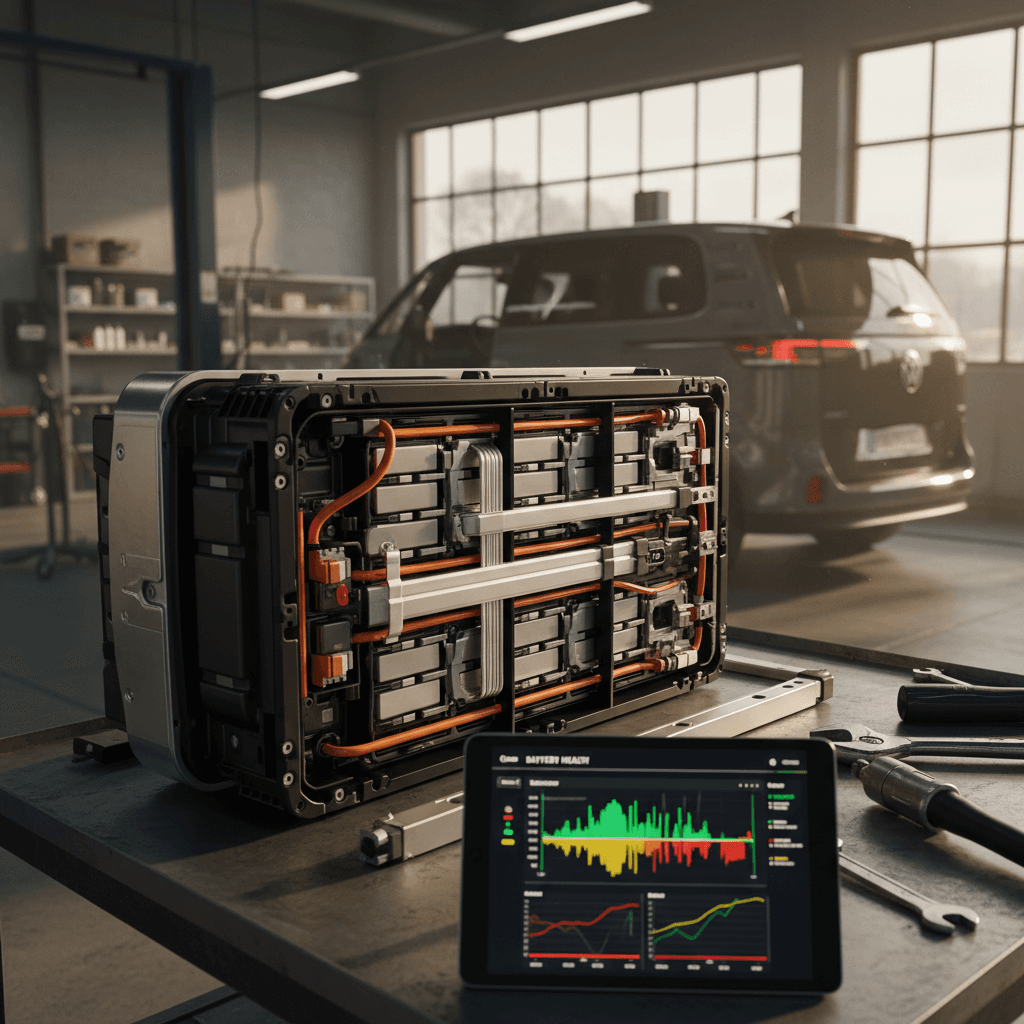
A generic OBD dongle and the right app can often read out state of health, cell balance, and DC fast‑charging history on MEB cars.
If you’re not a DIY‑type, work with a seller who offers a third‑party battery health report rather than trusting guesswork.
3. Use a professional battery diagnostic
At Recharged, every used EV we sell, ID. Buzz included, comes with a Recharged Score Report that includes verified battery health measurements, charging history insights, and fair‑market value analysis.
This takes the uncertainty out of buying a used EV with a big, expensive pack.
How Recharged can help you shop smarter
Ready to find your next EV?
Browse VehiclesFAQ: Volkswagen ID. Buzz battery lifespan
Common questions about ID. Buzz battery life
Bottom line: how long will a Volkswagen ID. Buzz battery last?
When you strip away the anxiety, the story is straightforward: with **sane charging habits** and occasional road‑trips, the Volkswagen ID. Buzz battery is designed to last well beyond its 8‑year / 100,000‑mile warranty. Real‑world data from sibling ID models suggests you can expect **only modest range loss in the first 100,000 miles**, and a useful lifespan that easily stretches into the mid‑teens in years for typical drivers.
If you’re buying new, that means you can treat your ID. Buzz as a long‑term family vehicle, not a short‑term science experiment. If you’re buying used, the key is to focus less on odometer fear and more on **verifiable battery health and charging history**. That’s exactly why Recharged builds every used EV sale, including future ID. Buzz listings, around a comprehensive Recharged Score Report, EV‑savvy guidance, and transparent pricing. When you can see the real state of the pack, the question “Volkswagen ID. Buzz battery lifespan, how long?” becomes a planning exercise, not a gamble.