If you’re considering a Volkswagen ID. Buzz, new or used, it’s natural to worry about **battery degradation per year**. After all, the big, expensive battery pack is the heart of the van’s range and resale value. The good news: data from Volkswagen’s MEB platform (which underpins the ID. Buzz) and independent testing suggests that **degradation is real, but slower than most people fear**, especially if you treat the pack reasonably well.
Key context
ID. Buzz battery degradation per year: the short version
ID. Buzz battery degradation at a glance (best estimates)
Across thousands of electric vehicles, independent studies have found **average EV battery degradation around 2–2.5% per year** when you blend all ages together. For Volkswagen’s MEB platform specifically (ID.3, ID.4 and cousins), long‑term tests and owner data are pointing to **roughly 10–15% loss over the first 4–5 years** under typical use, less than many shoppers assume.
Simple mental model
Volkswagen ID. Buzz battery basics
Before you can make sense of **battery degradation per year**, it helps to know what’s actually in the floor of the van and what the numbers on the spec sheet mean.
Volkswagen ID. Buzz battery options and capacity
Key battery specs for common ID. Buzz configurations. Exact numbers can vary slightly by region and model year, but this is the general picture.
| Variant | Platform | Gross capacity (kWh) | Usable/net capacity (kWh) | Official range (approx.) |
|---|---|---|---|---|
| ID. Buzz SWB (2-row, RWD) | MEB | ~82–84 | ~77–79 | 240–285 miles WLTP/Euro test |
| ID. Buzz LWB (3-row, RWD) | MEB | ~91 | ~85–86 | ~250–280 miles WLTP/Euro test |
| Future AWD / GTX variants | MEB | ~91 | ~85–86 | Lower than RWD due to extra power/weight |
Gross capacity is the physical size of the pack; net/usable capacity is what the software lets you access day‑to‑day.
Volkswagen deliberately **keeps a buffer between gross and usable capacity**. The top and bottom few percent of the pack are hidden from you. That buffer is one of the quiet heroes of battery life: it softens the impact of high states of charge and deep discharges, so that **the rate of usable‑capacity loss you see is slower than the raw cell‑level degradation inside the pack**.
Why buffers matter
What Volkswagen actually warrants on the ID. Buzz battery
No automaker will guarantee “only 1.7% degradation per year,” and Volkswagen is no exception. Instead, VW frames the ID. Buzz warranty the same way it does with other MEB EVs: **a long window with a minimum remaining capacity floor**.
- High‑voltage battery warranty: **8 years or 100,000 miles** in the U.S. market (often 8 years/160,000 km in Europe and other regions).
- Capacity guarantee: the pack is warranted to retain **at least 70% of its original usable capacity** over that period.
- If the pack falls below that capacity threshold (or has a covered defect) within the warranty window, VW will **repair or replace** it under the terms of the policy.
Warranty floor ≠ expected outcome
From a shopper’s perspective, the important takeaway is this: **as long as the battery doesn’t fall off a cliff, VW is signaling confidence that the pack will remain serviceable for at least eight years**. Actual observed degradation on sibling models suggests they’re not just bluffing.
Real‑world MEB platform battery degradation data
Because the ID. Buzz is still young, you won’t find many vans with 150,000+ miles yet. But you *can* look at **ID.3 and ID.4 data**, which use essentially the same MEB battery technology and management strategies, and treat that as a strong proxy.
What we’re seeing from real‑world VW MEB batteries
These aren’t ID. Buzz vans, but they’re closely related under the skin.
ID.3 endurance test (~4 years, ~107k miles)
Europe’s largest motoring club ran a 77 kWh VW ID.3 to roughly 107,000 miles over about four years. At the end, the battery still showed **around 91% of its original usable capacity**, far above VW’s 70% warranty floor.
Owner data: ID.3 & ID.4 packs
Community‑aggregated data from ID.3/ID.4 owners typically shows **5–8% loss in the first 1–2 years**, then about **1–2% per year** afterward under normal use. That aligns with broader EV studies that find ~2–2.3% annual degradation on average.
High‑mileage outliers
There are documented MEB‑platform cars approaching **200,000–250,000+ miles** with usable‑capacity losses in the **15–25%** range. Those are edge cases, but they show that the chemistry can survive taxi‑like duty cycles without instant collapse.
How well does this map to ID. Buzz?
Looking across the first generation of serious mass‑market EVs, Volkswagen’s MEB packs are landing squarely in the “boringly good” category: not the absolute best in the world, but nowhere near the horror‑stories many buyers still imagine.
What speeds up (or slows down) ID. Buzz battery degradation
Battery degradation isn’t a fixed number that happens automatically each year. It’s the outcome of **how the pack has been treated**, temperature, charging habits, storage and duty cycle all matter. With a big, family‑oriented van like the ID. Buzz, the pattern of use can vary a lot, so it’s worth breaking this down.
Factors that accelerate degradation
- Frequent DC fast charging to high states of charge (especially 90–100%) on a hot pack.
- Sitting at or near 100% for days at a time (for example, fully charging on Friday and not driving until Monday).
- Regularly deep‑discharging below ~5–10% before recharging.
- High average pack temperature (un‑garaged in very hot climates, towing or heavy loads in extreme heat).
- Very high annual mileage (ride‑share, shuttle or delivery duty cycles).
Factors that slow degradation
- Mostly AC charging at home or work, with DC fast charging saved for trips.
- Daily charge limits around 70–80%, only going higher when you actually need the range.
- Parking in shade or a garage to keep the pack cooler, especially in summer.
- Moderate annual mileage (10,000–12,000 miles) with mixed use.
- Keeping software up to date so the BMS can apply VW’s latest battery‑care tweaks.
Practical ID. Buzz battery‑care habits
Practical rules of thumb: degradation by year and mileage
Because Volkswagen doesn’t publish a neat “degradation per year” curve for the ID. Buzz, it’s more honest to talk in **ranges and scenarios**. The table below is a reasonable rule‑of‑thumb based on MEB‑platform data, general EV studies, and how large family EVs tend to be used.
Estimated ID. Buzz battery degradation by year and usage
Approximate usable‑capacity loss ranges assuming the pack is healthy and there are no defects. These are not guarantees, but realistic expectations for planning.
| Age / mileage | Gentle use (home AC, moderate temps) | Typical family use | Hard use (frequent DC fast charge, heavy loads, heat) |
|---|---|---|---|
| Year 1 (~10–15k miles) | 2–3% | 3–5% | 5–8% |
| Year 3 (~30–45k miles total) | 4–7% | 7–10% | 10–15% |
| Year 5 (~50–75k miles total) | 7–12% | 10–15% | 15–22% |
| Year 8 (~80–100k miles total) | 10–18% | 15–20% | 20–30% (approaching or crossing VW’s 70% floor) |
Percentages are relative to original usable capacity. Range loss will be broadly similar in percentage terms, all else equal.
What this means in the real world
How to check an ID. Buzz’s battery health, especially on a used one
If you’re buying a used ID. Buzz, battery health isn’t just an abstract worry, it’s a line item in the deal. The challenge is that **VW doesn’t give you a simple, trustworthy “battery health = 92%” readout on the dash**, and research shows manufacturer‑reported state‑of‑health values can be noisy or misleading. You need to triangulate from multiple signals.
Ways to gauge an ID. Buzz battery’s health
Use several of these together for a clearer picture.
1. Range vs. rated figure
Fully charge the van, reset a trip meter, and drive a known route at normal speeds. Compare the energy used and miles driven to what you’d expect from the original rated range. A Buzz that reliably delivers ~80–90% of its original range in mild weather is behaving normally.
2. App and charge‑session data
If you can, look at historical charging sessions (kWh added vs. % change) from the vehicle app or charger logs. Over time, these can hint at how much usable energy the pack still holds at 100%.
3. Professional diagnostic tools
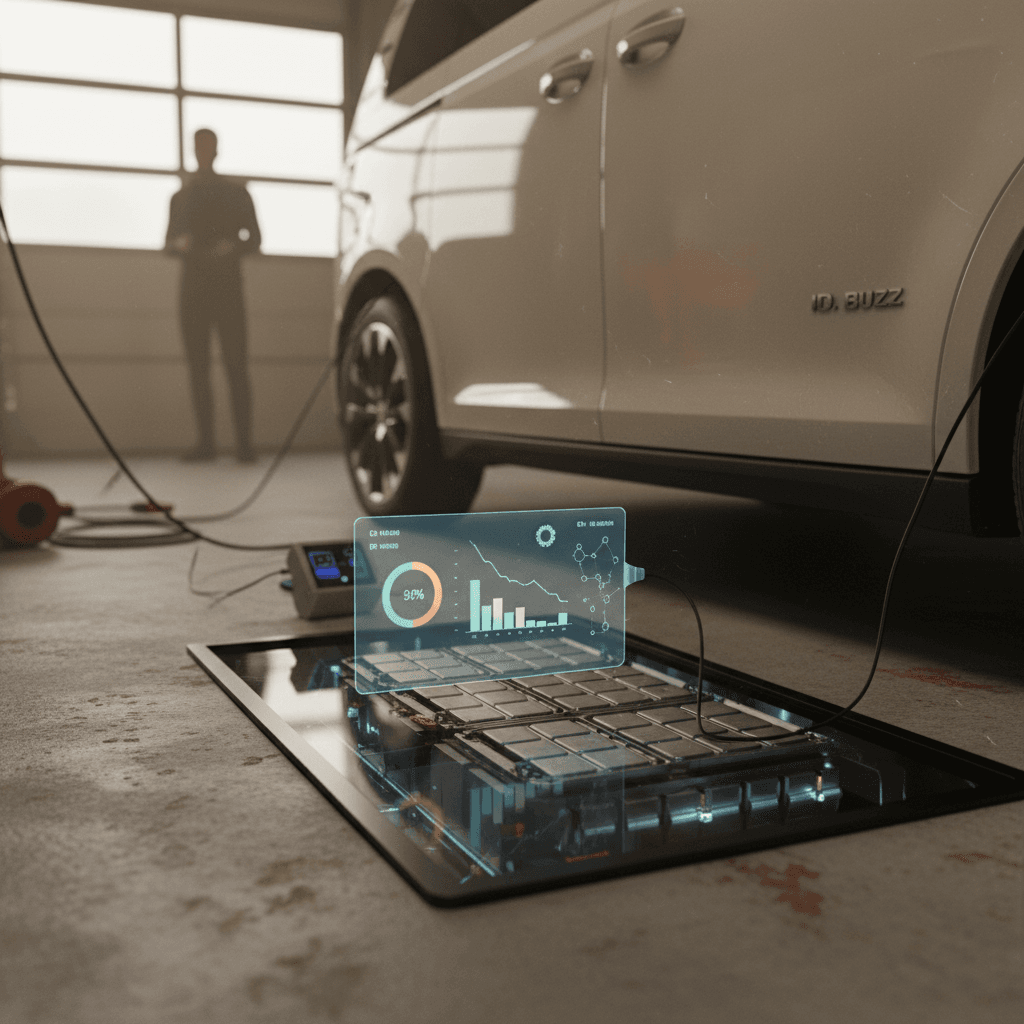
Independent EV shops and platforms like Recharged can use **specialized diagnostic tools** and standardized drive/charge procedures to infer pack health more accurately than a simple dashboard guess.
Be careful with single‑number “SOH” claims
This is exactly why every used EV on Recharged comes with a **Recharged Score Report** that includes an expert‑run battery health assessment. Instead of relying on a single number from the car, we combine diagnostics, usage history, and standardized testing so you can see **how the pack is actually performing** before you buy.
Used ID. Buzz shopping checklist: battery edition
When you’re standing in front of a used ID. Buzz, or scrolling through listings, use this checklist to keep the battery front‑of‑mind without getting paralyzed by fear.
Used VW ID. Buzz battery‑health checklist
1. Confirm age and mileage
Start with the basics. A five‑year‑old Buzz with 40,000 miles has lived a very different life from a three‑year‑old van with 90,000 miles. Use our degradation ranges to decide whether the asking price matches the likely remaining capacity.
2. Ask about charging habits
Specifically: home Level 2 vs. regular DC fast charging, how often they charge to 100%, and whether the van sits fully charged for long periods. A prior owner who mostly charged at home to 70–80% is exactly who you want.
3. Look for climate clues
Hot‑climate, outdoor‑parked vans tend to age batteries faster. A Buzz that’s lived in Phoenix and towed frequently will likely have more degradation than one garaged in Seattle with light family duty.
4. Check remaining battery warranty
Verify the in‑service date so you know how much of VW’s **8‑year/100,000‑mile battery warranty** is left. If you’re within the window and there are signs of abnormally high degradation, that warranty is your leverage.
5. Request a proper battery health report
On Recharged, every ID. Buzz listing includes a **Recharged Score Report** with battery diagnostics, range performance and pricing that already factors in the pack’s condition. If you’re shopping elsewhere, insist on more than a screenshot of a dashboard estimate.
6. Compare range to your real needs
Even with 15–20% degradation, a long‑range ID. Buzz may still comfortably cover your daily commute and weekend errands. Be honest about your routes and charging options before walking away from an otherwise solid van.
FAQs about Volkswagen ID. Buzz battery degradation
Volkswagen ID. Buzz battery degradation: common questions
Bottom line: Is ID. Buzz battery degradation a dealbreaker?
If you’ve heard stories about EV batteries falling off a cliff after a few years, the **Volkswagen ID. Buzz** will probably surprise you. Early data from its MEB siblings suggests that, driven and charged like a normal family vehicle, it’s more likely to lose **10–20% of usable capacity over its first eight years** than to plummet toward the 70% warranty floor. That’s a meaningful change, but not the catastrophe many shoppers imagine.
The more important questions are whether the **degraded range still fits your life**, and whether the price you’re paying fairly reflects the van’s age, mileage and battery health. That’s where a structured battery assessment and transparent pricing matter far more than chasing an extra percentage point or two of theoretical degradation.
If you’re considering a used ID. Buzz, working with a specialist matters. Every vehicle listed on Recharged includes a **Recharged Score Report** with verified battery health, fair‑market pricing and expert guidance, so you can choose your electric van with clear eyes, and spend more time planning road trips, not worrying about chemistry.