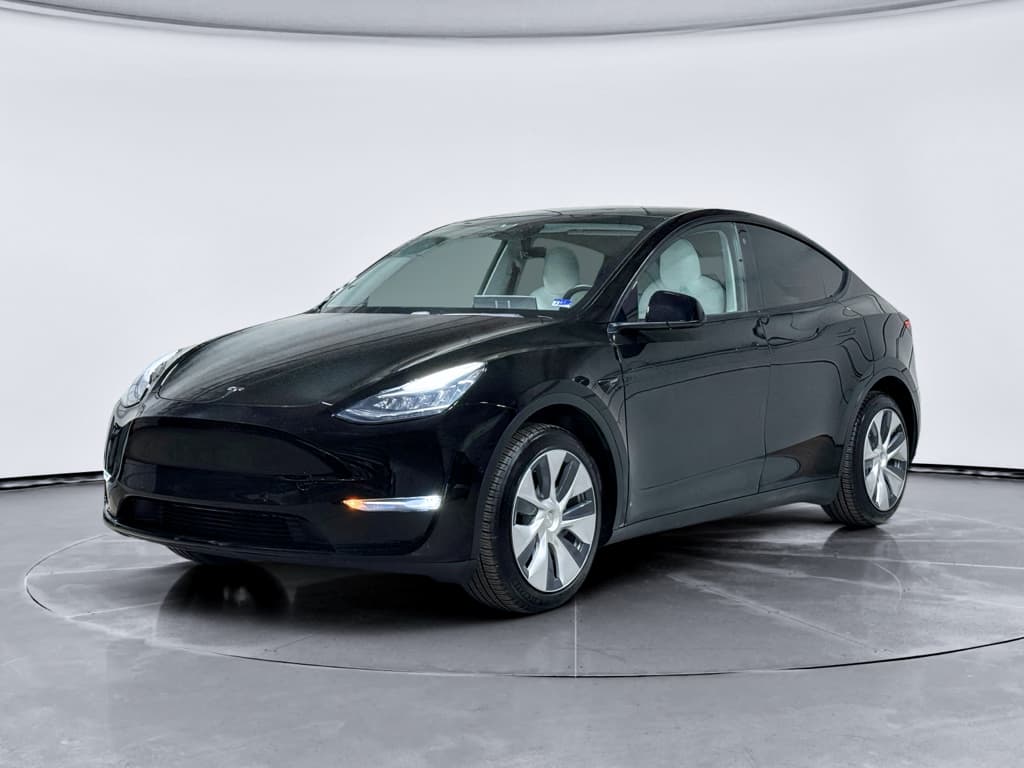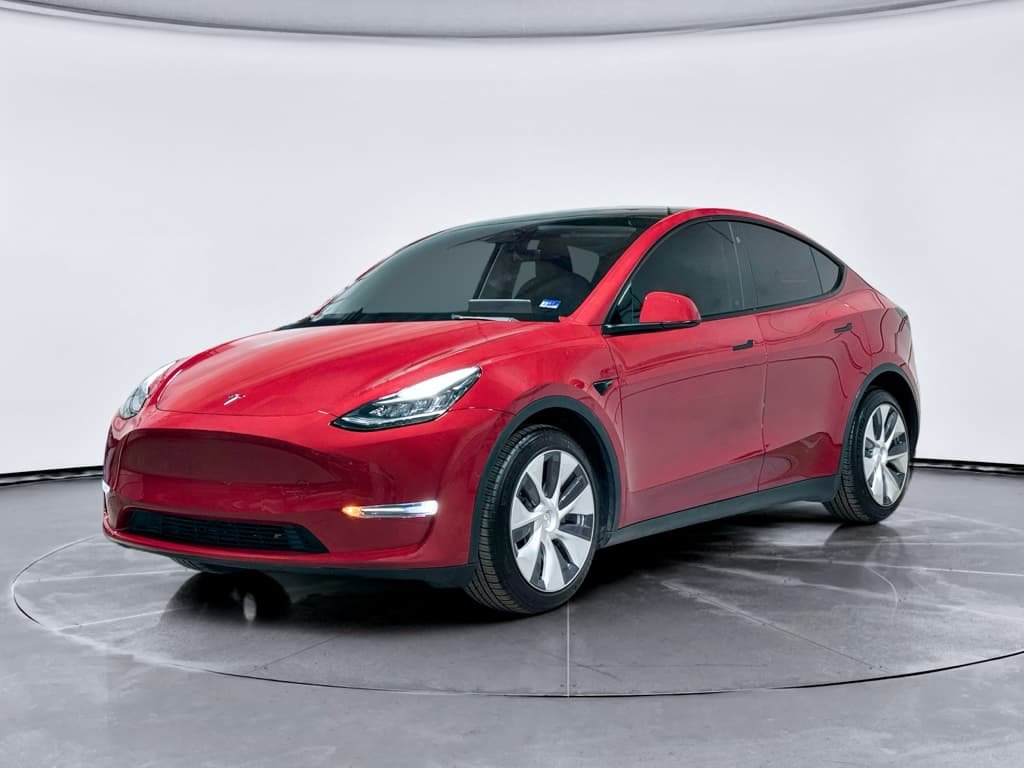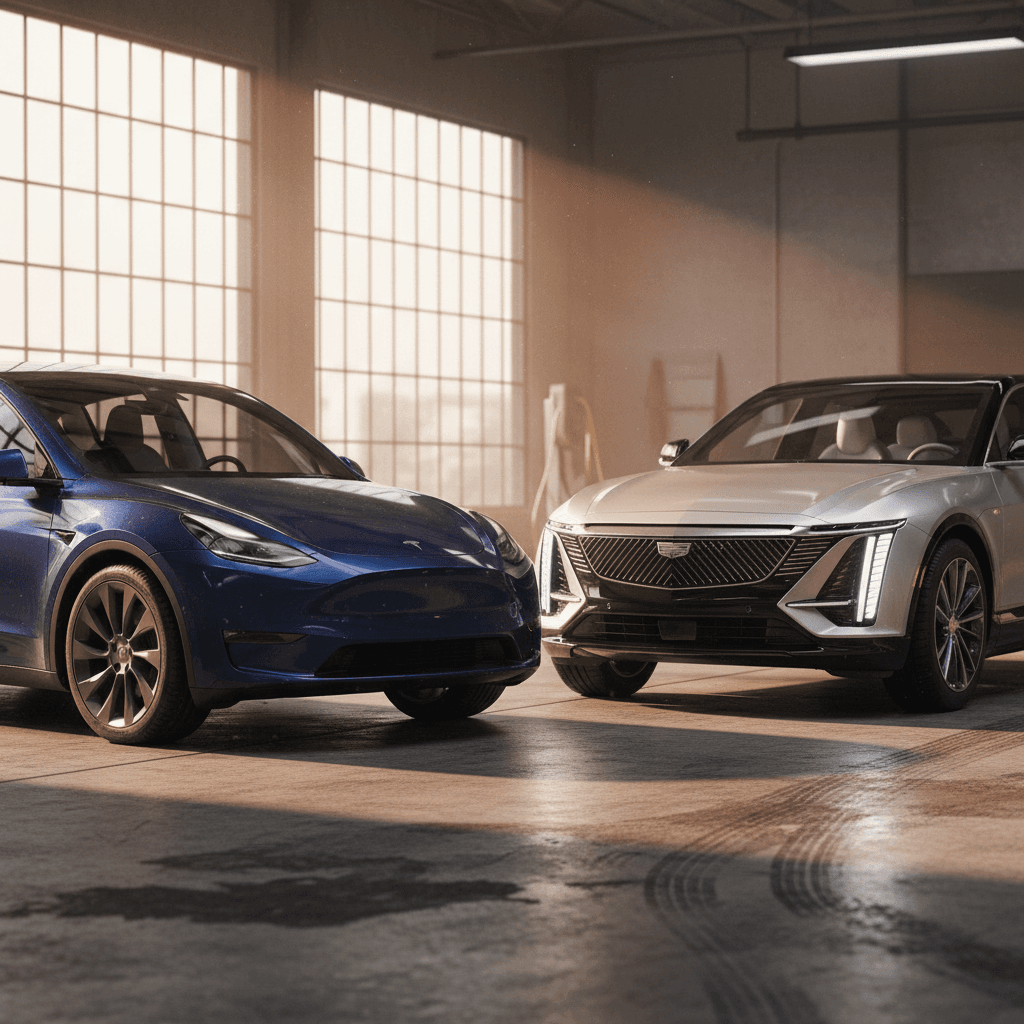
You’re shopping for a used luxury electric SUV in 2026, and the two names that keep coming up are the Tesla Model Y and the Cadillac Lyriq. One is Silicon Valley’s default EV, the other is Detroit’s art‑deco comeback story. Both are compelling, both are fast, and both can make a gasoline crossover feel like a flip‑phone. But as used buys, they are very different animals.
At a glance
Who this Model Y vs Lyriq comparison is for
- Typical used prices and depreciation you’re likely to see.
- Range, charging and road‑trip usability, not just EPA numbers.
- Comfort, space and tech from a family and commuting perspective.
- Long‑term ownership costs and battery health.
Quick take: which used EV SUV fits you?
Used Model Y vs Lyriq: who should buy what?
Both are excellent; the right choice depends on how you live, drive, and charge.
Used Tesla Model Y: best for EV pragmatists
Choose a used Model Y if you want:
- The easiest long‑distance charging experience via the Tesla Supercharger network.
- Lots of inventory and trim choices, from budget RWD to Performance.
- Excellent efficiency and strong real‑world range.
- Minimalist tech‑first cabin and constant over‑the‑air updates.
Most appealing to: commuters, road‑trippers, tech‑leaning families, and anyone who values charging convenience over plush cabin materials.
Used Cadillac Lyriq: best for luxury traditionalists
Choose a used Lyriq if you want:
- A stunning, quiet, comfort‑first cabin with classic luxury cues.
- Strong straight‑line performance and a refined ride.
- More distinctive styling than the “default” EV SUV.
- Traditional dealership experience and Cadillac branding.
Most appealing to: luxury‑brand loyalists, style‑conscious buyers, and anyone coming from a BMW, Mercedes, or Lexus SUV who wants a softer landing into EVs.
How to read this guide
Pricing and depreciation in the 2026 used market
Used pricing highlights for 2026 shoppers (ballpark ranges)
Tesla has been cutting new‑vehicle prices and rolling out cheaper Model Y variants, which pushes used prices down as well. By 2026, you’ll find a broad range of used Model Ys, from early 2021–2022 builds into the latest 2024–2025 cars, at almost every price point above the mid‑$30,000s, depending on mileage, trim and condition.
The Cadillac Lyriq, meanwhile, only really ramps up in volume starting with the 2023 and 2024 model years. That means fewer used examples in 2026 and higher asking prices. On paper, Lyriq’s projected 5‑year depreciation looks steep for a luxury SUV, which may work in your favor if you’re willing to shop higher miles or earlier builds.
Used EV pricing is volatile
Range, battery and real‑world efficiency
Tesla Model Y: efficiency specialist
- Battery sizes: Roughly mid‑60s kWh (RWD) to mid‑70s kWh (Long Range/Performance), depending on year and market.
- EPA range (new, when rated): commonly around 260–310 miles for mainstream trims; specific ratings vary by wheel size and year.
- Real‑world highway range: Owners often see ~230–270 miles at 70 mph in temperate conditions when new; used examples depend heavily on battery health and wheel choice.
- Efficiency: Among the most efficient electric SUVs on sale, lower energy use per mile means lower charging costs and better road‑trip flexibility.
Cadillac Lyriq: big battery, big curb weight
- Battery size: ~102 kWh pack across most trims, significantly larger than the Model Y.
- EPA range (new, when rated): roughly low‑300‑mile estimates for rear‑wheel‑drive Lyriq and slightly lower for all‑wheel drive, depending on wheel size and trim.
- Real‑world highway range: Expect something more like mid‑200s in mixed highway driving for early Lyriq builds; weight and aero work against it a bit versus the Tesla.
- Efficiency: The Lyriq uses more energy per mile than the Tesla. You get strong range thanks to the huge battery, but you also pay more to fill it.
Battery health matters more than brochure range
Tesla has a long track record now: many Model Y packs show modest degradation if charged sensibly and not fast‑charged to 100% every day. Lyriq is newer, but its Ultium pack has been engineered for big‑battery duty. The main difference you’ll feel is efficiency, how far each kWh actually carries you, and here the Tesla is simply better at turning electrons into miles.
Charging experience: home and road‑trip
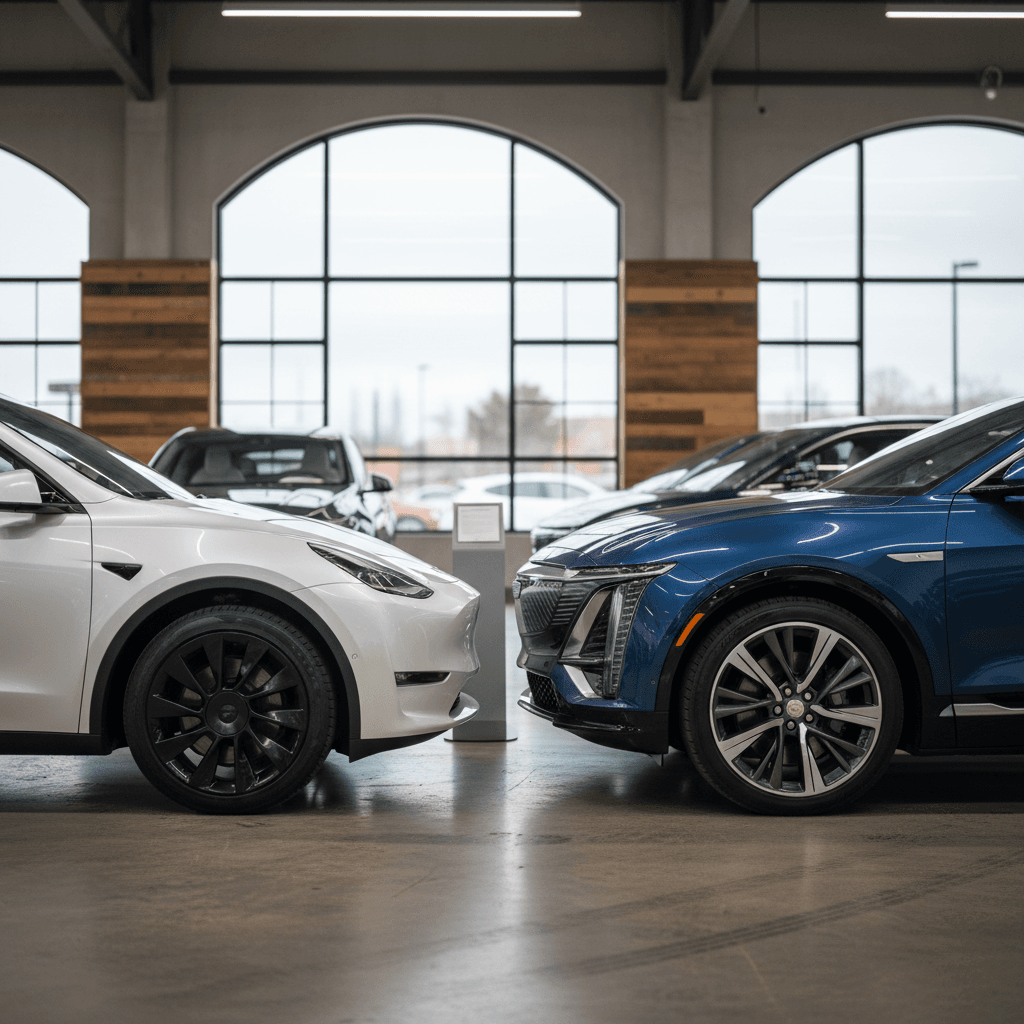
Charging: where the real daily‑life differences show up
Both SUVs can handle road trips; one of them makes planning almost an afterthought.
Tesla Model Y charging
- Connector: Uses Tesla’s NACS port in North America.
- Fast charging: Broad access to the Tesla Supercharger network, plus growing access to third‑party DC fast chargers via NACS adapters and station upgrades.
- Home charging: 11.5 kW onboard charger on recent cars makes Level 2 home charging straightforward; thousands of owners already have setups dialed in.
- User experience: You plug in, walk away. Billing, routing, and stall selection are integrated in the Tesla interface with minimal fuss.
Cadillac Lyriq charging
- Connector: CCS1 port on 2023–2025 models, with 19.2 kW AC capability on some trims and DC fast charging up to an advertised ~190 kW under ideal conditions.
- Fast charging: Uses public networks (Electrify America, EVgo, and others). Real‑world charge curves have been mixed, with some owners noting slower‑than‑expected speeds and sensitivity to station quality and heat.
- Home charging: When paired with a capable Level 2 charger and the higher‑power onboard AC option, Lyriq can add substantial range per hour, great if you have a 240‑V circuit and off‑peak rates.
- Future access: As more networks adopt NACS and offer adapters, Lyriq’s fast‑charging options should expand, but in 2026 it still won’t match the Tesla’s plug‑and‑go simplicity.
Heat and fast charging in the Lyriq
If your life involves frequent interstate road trips, the Model Y has a clear edge. Between the density of Superchargers, automatic trip planning, and simple billing, Tesla has turned fast charging into a solved problem. Lyriq is catching up as the public networks improve and interoperability grows, but the experience is more variable and demands a little more planning on your part.
Space, comfort and luxury feel
Tesla Model Y: airy, practical, minimalist
- Seating: 5‑seat layout is common on the used market, with some 7‑seat (small third‑row) builds also available.
- Cabin vibe: Bright, glassy, and minimal. Some love the clean aesthetic; others find it a bit stark and plasticky versus traditional luxury SUVs.
- Cargo and practicality: Two trunks (front and rear), a very useful hatch opening, and fold‑flat seats make this an excellent family hauler.
- Ride and noise: Depends heavily on wheel size; 19‑inch wheels ride comfortably, 20s and 21s can be harsher and louder.
Cadillac Lyriq: art‑deco lounge on wheels
- Seating: 5 seats with a focus on rear‑seat comfort and legroom.
- Cabin vibe: Rich materials, dramatic lighting, and a sweeping display give the Lyriq a true concept‑car feel that made it to production.
- Cargo and practicality: Less outright cargo volume than Tesla, but still plenty usable for luggage and Costco runs; the focus is more on passenger comfort.
- Ride and noise: Quiet and plush. If you’re downsizing from an Escalade or German luxury SUV, the Lyriq will feel more familiar and indulgent than the Tesla.
If comfort is your north star…
Tech, driver assistance and infotainment
Screens, software, and assistance: where each SUV shines
Both are high‑tech; they simply express that tech very differently.
Tesla Model Y technology
- Interface: Single large central touchscreen running Tesla’s in‑house software; almost all functions live here.
- Driver assistance: Autopilot on most used vehicles, with some equipped with enhanced or “Full Self‑Driving (Supervised)” options. Capable lane keeping, traffic‑aware cruise, and hands‑on highway assistance.
- Updates: Tesla is the benchmark for frequent, meaningful over‑the‑air updates that add features and refine behavior.
- Infotainment: Native streaming, games, video apps, and robust EV trip‑planning baked into the UI. No traditional Apple CarPlay or Android Auto.
Cadillac Lyriq technology
- Interface: Sweeping curved display with a more traditional luxury‑car layout and physical controls mixed with touch.
- Driver assistance: Many Lyriqs feature GM’s excellent hands‑free Super Cruise on certain roads, plus the usual adaptive cruise and lane‑keep assists.
- Updates: Receives over‑the‑air updates, though the cadence and scope have been more conservative than Tesla’s so far.
- Infotainment: Uses a modern infotainment stack with Apple CarPlay and Android Auto support in earlier years (check the specific vehicle), which some buyers prefer to Tesla’s closed ecosystem.
The Tesla is a smartphone you commute in; the Lyriq is a high‑end lounge that happens to be electric.
If you like the idea of your car constantly learning new tricks, the Model Y’s fast‑moving software world is hard to beat. If you prefer a bit more grounding, a volume knob here, a familiar Apple CarPlay map there, the Lyriq will feel less like living in a beta test.
Ownership costs: insurance, maintenance and reliability
Key ownership‑cost questions to ask for each SUV
1. How much will I pay to insure it?
Model Y premiums can be elevated in some markets due to repair costs and crash statistics, but Tesla has been working to improve parts availability and repairability. Lyriq, as a low‑volume luxury SUV with complex bodywork, can also be expensive to fix, in some ZIP codes it may actually insure higher than the Tesla. Get real quotes on VINs before you commit.
2. What does routine maintenance look like?
Both vehicles avoid oil changes and classic engine maintenance. Model Y owners have a large community knowledge base around tire wear, brake‑fluid intervals, and cabin filters. Lyriq shares some components and service networks with other GM vehicles, but EV‑specific parts and software make dealer quality especially important.
3. How mature is the reliability story?
Model Y has been around long enough that early build issues (panel gaps, paint, some electronics) are well documented, and many addressed under warranty. Lyriq is newer; early software wobbles and charging quirks have been improving via updates, but long‑term track records are still forming.
4. What about tires and wheels?
Both SUVs are heavy, powerful EVs. Expect to replace tires more often than on a compact gas crossover, especially if you choose larger‑diameter wheels. The Model Y’s efficiency can help offset tire costs by lowering your energy bill; the Lyriq’s weight and performance lean the other way.
5. How do I check battery and charging health?
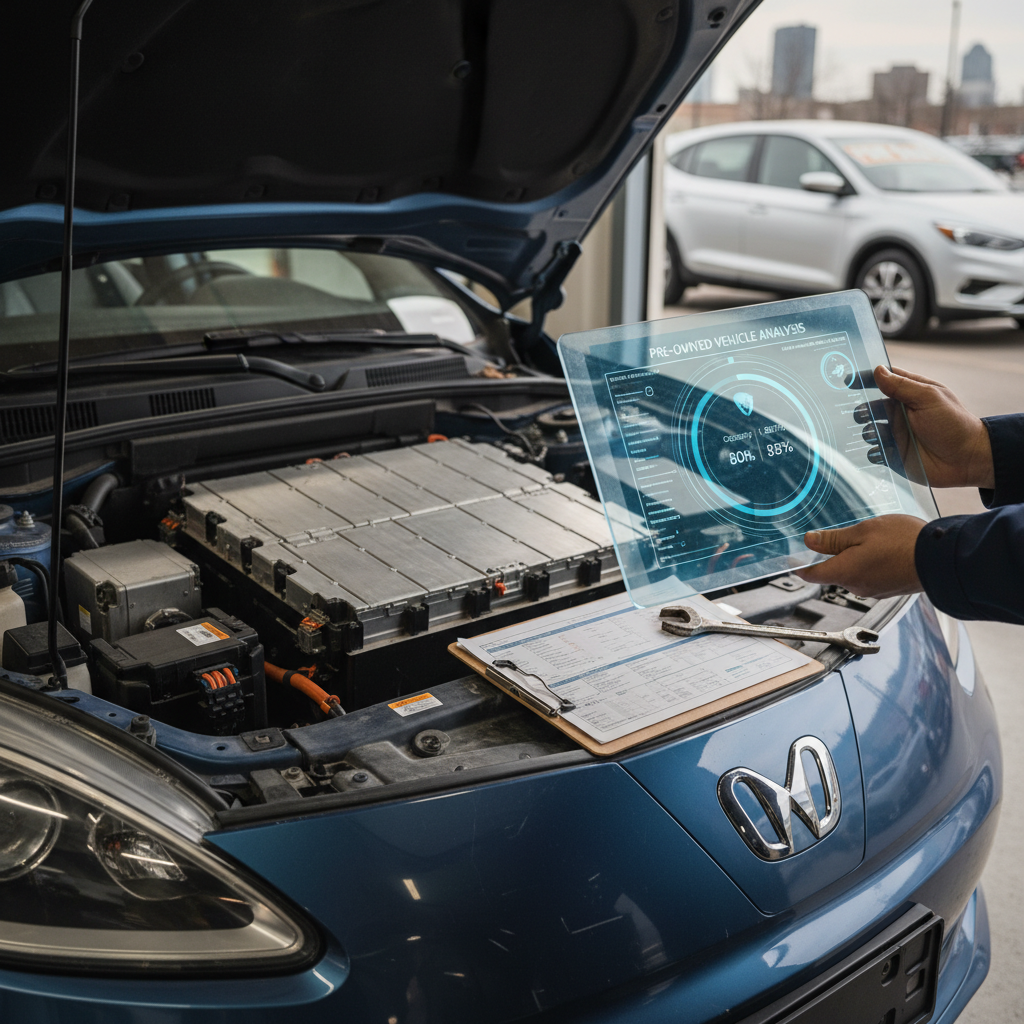
Ask for documented fast‑charging history when possible, review charge‑limit settings in the car, and use third‑party or dealer tools where available. Shopping through <strong>Recharged</strong> means every vehicle comes with a <strong>Recharged Score</strong> and battery‑health verification baked into the listing, so you’re not guessing.
Don’t buy any used EV blind
Shopping used with confidence: battery health and the Recharged Score
With gasoline cars you can half‑guess your way through a purchase: take a test drive, listen for noises, sniff for smoke. With EVs, the single most expensive component, the battery, isn’t something you can inspect with a flashlight. That’s where structured diagnostics matter.
Why battery health matters more on Model Y vs Lyriq
- Fast‑charging habits: A Model Y hammered on DC fast chargers and run to 100% daily will age differently than one charged gently at home. The same is true for Lyriq, especially given its large pack and fast‑charge capability.
- Software and updates: Both vehicles rely heavily on software for thermal management and charging logic. Keeping up with updates can materially impact longevity and performance.
- Resale value: In 2026, smart buyers are already asking about usable battery capacity, not just model year and miles. That directly affects what you’ll get when you sell or trade.
How Recharged helps you de‑risk the decision
- Every EV on Recharged comes with a Recharged Score Report that includes verified battery health and charging behavior.
- We benchmark each vehicle against fair‑market pricing in the used‑EV universe, so you can quickly see whether a given Model Y or Lyriq is priced correctly for its condition.
- EV‑specialist advisors can walk you through which trims, years, and options to target, for example, whether a high‑spec Lyriq with more features is a better fit than a base Model Y, or vice versa.
- With financing, trade‑in, and nationwide delivery, you can comparison‑shop both SUVs online without wandering from dealer to dealer.
Comparison table: used Tesla Model Y vs Cadillac Lyriq
Key differences: used Tesla Model Y vs Cadillac Lyriq (typical 2023–2025 examples)
Approximate specs and characteristics you’re likely to encounter while shopping the 2026 U.S. used market. Always verify exact numbers for the specific vehicle you’re considering.
| Category | Used Tesla Model Y (typical) | Used Cadillac Lyriq (typical) |
|---|---|---|
| Segment | Compact/midsize luxury EV SUV | Midsize luxury EV SUV |
| Common seating | 5 seats (some 7‑seat builds) | 5 seats |
| Battery size | ~60s–70s kWh range depending on trim | ~102 kWh pack |
| EPA range when new | Roughly ~260–310 mi for mainstream trims (varies by year/wheels) | Roughly low‑300s mi RWD, slightly less AWD |
| Real‑world highway range | Often ~230–270 mi at 70 mph when new, depending on spec | Often mid‑200s mi; big pack offsets lower efficiency |
| Fast‑charging ecosystem | Tesla Supercharger network plus growing NACS access elsewhere | Public CCS networks (Electrify America, EVgo, etc.), with variable station quality |
| DC fast‑charge peak (advertised) | High peak power with strong, proven charge curves on Tesla network | Up to ~190 kW claimed, mixed real‑world results and more sensitive to heat/station quality |
| Home charging | 11.5 kW onboard AC, widely supported by home‑charger makers | 11.5–19.2 kW onboard AC depending on trim; can charge very quickly on a strong home circuit |
| Cabin character | Minimalist, tech‑forward, airy; some materials feel more utilitarian | Rich materials, dramatic lighting, quiet, "concept car" feel |
| Infotainment | Tesla proprietary UI, no CarPlay/Android Auto, strong EV‑specific routing | More traditional layout; early years with CarPlay/Android Auto support, check specific car |
| Driver assistance | Autopilot standard on many; some have advanced options | GM suite plus available Super Cruise on equipped roads |
| Used pricing in 2026 (rough sense) | Mid‑$30Ks upward, depending on year, trim, and miles | Mid‑$40Ks upward, with fewer used units and luxury‑brand pricing |
| Best for | Road‑trippers, efficiency hawks, tech‑leaning families | Comfort‑seekers, design‑first buyers, traditional luxury‑SUV owners moving to EVs |
Specs vary with year, trim, wheels, and software updates; treat this as a directional guide, not a VIN‑specific promise.
Frequently asked questions: Model Y vs Lyriq used
Used Tesla Model Y vs Cadillac Lyriq: FAQs
Bottom line: how to choose your used luxury EV SUV
If your EV life will be defined by long drives, lots of miles, and minimal patience for planning, a used Tesla Model Y is the easy recommendation. It’s efficient, ubiquitous, and backed by the most mature charging ecosystem on earth. If, instead, you want your EV to feel like a rolling design object, a quiet, beautifully lit space that happens to run on electrons, the Cadillac Lyriq makes a powerful emotional argument, even if it asks a little more of you at the charger.
The smartest play is to treat them as individuals, not ideas. Look at specific VINs, compare pricing against condition, and, above all, understand battery and charging health before you fall for a paint color or a screen. When you browse on Recharged, every used Tesla Model Y and Cadillac Lyriq comes with a Recharged Score battery‑health report, fair‑market pricing, and EV‑specialist support, so your choice between rational and romantic doesn’t come with any unwelcome surprises.