Shopping for a used Porsche Taycan vs Audi e-tron GT in 2026 puts you in rare air: these are two of the quickest, most capable electric grand tourers on the market. They share the same Volkswagen Group J1 platform, but they don’t feel the same on the road, or on your wallet, once they’ve spent a few years in the real world.
Same bones, different personalities
Overview: Used Taycan vs e-tron GT in 2026
By April 2026, most used examples you’ll see in the U.S. are 2021–2024 model-year cars, with a few early 2025 Taycan facelifts and 2025 S / RS e‑tron GT updates starting to trickle into inventory. The headline improvements for the Taycan facelift are longer range, higher peak DC charging (around 320 kW) and more power, while Audi’s midcycle update focuses on more power, revised suspension and range bumps of its own.
Used Taycan & e-tron GT at a Glance (U.S. Market, 2026)
From a distance, the two cars look like twins. The differences emerge when you zoom into range, charging behavior, reliability reputation, and depreciation, all of which matter much more when you’re buying used than when you’re spec’ing a new car.
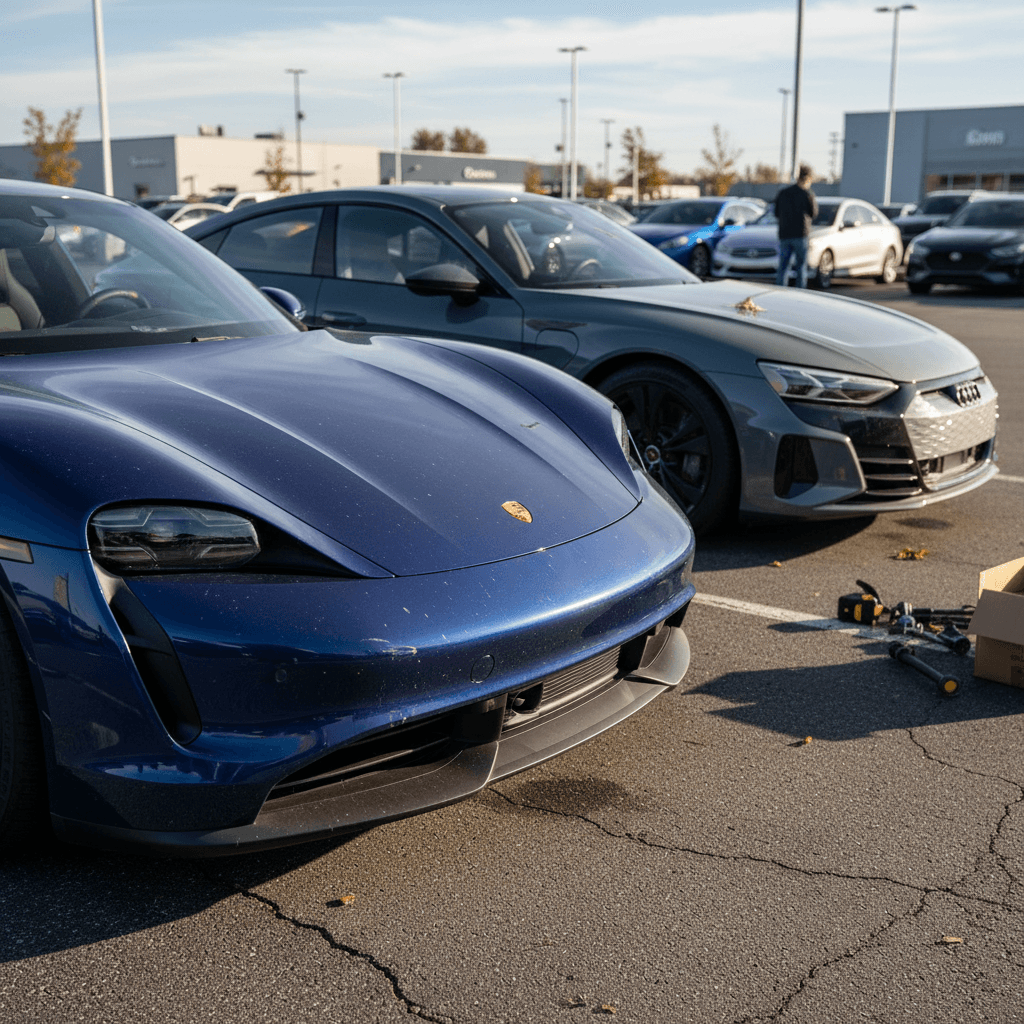
Key Specs: Used Porsche Taycan vs Audi e-tron GT
Used Porsche Taycan vs Audi e-tron GT: Core Specs (Typical U.S. trims)
Approximate headline specs for common dual‑motor trims you’re likely to see used in 2026. Exact numbers vary by model year, wheel size and options.
| Spec | Porsche Taycan 4S / GTS (Performance Battery Plus) | Audi e-tron GT / RS e-tron GT |
|---|---|---|
| Platform / Voltage | J1 platform, 800‑V architecture | J1 platform, 800‑V architecture |
| Usable battery capacity | ~82–97 kWh depending on battery option | ~83–93 kWh depending on trim |
| Peak DC fast charge | Up to ~320 kW on newer cars | Up to ~320 kW on newer S & RS models |
| 0–60 mph (typical) | ~3.5–4.0 sec (4S), quicker for Turbo/Turbo S | ~3.9 sec (e-tron GT), ~3.1 sec (RS) |
| EPA range window | Roughly 206–246 miles for many early U.S. trims | Roughly 218–249 miles on many U.S. trims |
| Drive layout | RWD available on base, AWD on most trims | AWD only |
| Body style | 4‑door coupe / sedan | 4‑door coupe / sedan |
Always confirm exact specs against the VIN and original window sticker for the specific car you’re considering.
Used-market sweet spots
Range and Efficiency Compared
Range is where the used‑EV story really starts. The good news: both cars have improved over time. The catch: early model years, especially on big wheels, can feel underwhelming if you expect 300‑mile road trips on a single charge.
Range Reality: Taycan vs e-tron GT
What you can reasonably expect on U.S. roads from used cars in 2026
Porsche Taycan (used)
- Early U.S. cars (2021–2023) often land in the 200–230 mile real‑world highway range band for 4S / GTS trims.
- The 2025‑on facelifted models add significant efficiency; owners report roughly 30–35% more range in similar driving vs early cars.
- RWD base Taycan on smaller wheels is the efficiency champ if you can find one used.
Audi e-tron GT (used)
- EPA ratings tick slightly higher than some Taycans in a few trims, but real‑world range is similar given shared hardware.
- RS cars trend lower due to power and wider rubber, so plan for high‑100s to low‑200s highway miles per charge.
- Later S / RS updates improve range modestly but not dramatically yet in U.S. data.
Don’t buy the brochure number
If you prioritize range above all else, a newer facelifted Taycan with the larger battery has the edge in 2026. But if you’re choosing among 2021–2023 cars, treat range as roughly a draw and focus more on wheel size and how the previous owner drove and charged the car.
Charging Speed and Road-Trip Ability
Both of these cars were built to crush fast‑charging tests. In the lab, they’re some of the quickest‑charging EVs on sale. In the wild, what matters for you is how they behave on U.S. CCS and NACS infrastructure in 2026.
Charging Comparison: Used Taycan vs e-tron GT
How the two cars typically behave on DC fast‑chargers and at home.
| Charging Aspect | Porsche Taycan | Audi e-tron GT |
|---|---|---|
| Peak DC rate | Up to ~320 kW on newer packs; many earlier cars briefly peak 260–270 kW, then taper | Similar peak capability (~270–320 kW on updated S/RS), with broadly similar taper behavior |
| 10–80% DC time (ideal) | About 18–20 minutes on a high‑power charger in good conditions | Also roughly 18–20 minutes in ideal conditions |
| Home AC charging | Typically 9.6–11 kW onboard charger, ~9–11 hours 0–100% on 240‑V Level 2 | Similar AC rates and overnight full charges on 240‑V |
| Route planning | Porsche’s native planner is competent, but many drivers lean on third‑party tools | Audi’s MMI + smartphone apps work well, though not as EV‑focused as Porsche’s latest software |
Charging performance can be affected by software updates and prior owner habits, so always test‑charge a used EV before signing.
Think in minutes, not kW
In owner testing and independent charging indexes, the Taycan often edges ahead slightly in average charging power over the full 10–80% window. But by 2026, both cars are so quick that your charger and traffic will slow you down more than the car. From a used‑buyer perspective, charging is effectively a tie, unless you find an abused car that’s been DC‑fast‑charged to 100% constantly, which is where a battery‑health report really matters.
Performance and Driving Character
You won’t struggle to merge in either of these EVs. The real question is what kind of personality you want when you’re not flooring it. Here’s how they tend to differ once you’ve driven a few back‑to‑back.
Porsche Taycan: The sharper tool
- Steering and chassis tuning feel more immediate and communicative, especially on 4S, GTS and Turbo trims.
- Sport Chrono and Performance Battery Plus unlock huge overboost power and launch control that feels closer to supercar territory.
- Ride can be firm on large wheels, especially on early cars without the very latest adaptive damper software.
- Noise insulation is good but not quite as hushed as the Audi; this is the "driver’s car" of the pair.
Audi e-tron GT: Grand tourer vibe
- More relaxed steering and a slightly softer, more compliant ride, even on RS models with big wheels.
- Cabin focuses on design and ambiance; RS models still hit brutal acceleration but wrap it in more refinement.
- Some drivers prefer the Audi for daily commuting because it feels calmer in traffic.
- Styling, inside and out, is more concept‑car‑like, an emotional choice for many buyers.
Enthusiast verdict
Comfort, Practicality and Technology
Both cars share the same basic fastback shape, so you’re not picking between an SUV and a sedan. But subtle packaging and tech differences will matter if you use the car as your only vehicle.
Living With a Used Taycan vs e-tron GT
Interior space, usability and tech feel
Interior space
- Both cars technically seat four, with very similar rear legroom.
- Some owners find the Taycan’s seating position slightly more accommodating for taller adults in back.
- Low rooflines mean rear headroom is tight in both; try the back seat yourself before buying.
Cargo & practicality
- Both offer a trunk and small front "frunk", enough for weekend bags, not a family move.
- Taycan Cross Turismo and Sport Turismo wagons (if you find one used) add meaningful practicality.
- If you haul skis, dogs or strollers often, hunt for a Taycan wagon; Audi doesn’t offer an equivalent GT wagon in the U.S.
Tech & UX
- Taycan’s latest software (on 2023–2025 cars) feels more EV‑centric, with better energy and charging visuals.
- e‑tron GT leans into Audi’s familiar MMI: intuitive for existing Audi owners, but slightly less EV‑nerdy.
- Both offer robust driver‑assist suites; verify that adaptive cruise and lane‑keeping are actually present, not just "pre‑wired."
Reliability, Battery Health and Known Issues
Neither of these cars is a low‑tech Corolla. They’re dense with software, sensors and high‑voltage hardware. On the used market, the right inspection is the difference between a dream driveway and a very expensive science project.
Porsche Taycan reliability themes
- Early‑build Taycans saw scattered reports of 12‑V battery issues, charging errors and software gremlins that improved with updates.
- Because many Taycans were leased or heavily optioned, some owners drove them hard and leaned on DC fast‑charging frequently.
- Battery chemistry itself is robust, but degradation and fast‑charge behavior depend heavily on owner habits.
- Repairs at Porsche dealers can be expensive; extended warranties are common on used cars sold through franchised stores.
Audi e-tron GT reliability themes
- Built on the same hardware, but ownership volumes are lower, so fewer issues reach the headlines.
- Community chatter often paints the e‑tron GT as slightly less trouble‑prone in daily use, particularly around charging software.
- Audi’s parts and labor rates are still premium, but sometimes slightly lower than Porsche for comparable work.
- RS models with big wheels can see quicker wear on tires and brakes, which matters when you’re budgeting.
Battery health is the make-or-break metric
Because both cars share similar battery tech and cooling, there’s no clear long‑term durability winner yet. Until more 8–10‑year data comes in, the smarter play is to compare individual cars: How often were they DC‑charged? Do they still hit their expected fast‑charge power? Has the pack ever been replaced under warranty?
Depreciation, Pricing and Total Cost of Ownership
Depreciation is where the used‑EV story turns in your favor. Both the Taycan and e‑tron GT took big hits new, which means 2021–2023 cars today often list far below their original six‑figure MSRPs. But they don’t fall at the same rate across trims.
Used Market Snapshot: Taycan vs e-tron GT (Typical U.S. Asking Ranges, 2026)
Approximate asking-price bands for clean‑title cars with average mileage. Local markets and individual specs can vary widely.
| Vehicle / Trim | Original New MSRP (approx.) | Typical 2026 Used Asking Range |
|---|---|---|
| Porsche Taycan 4S (Perf. Battery Plus) | $110k–$130k with common options | $70k–$95k depending on miles & spec |
| Porsche Taycan Turbo / Turbo S | $150k–$200k+ | $95k–$140k+ |
| Audi e-tron GT | $100k–$115k with common options | $65k–$90k |
| Audi RS e-tron GT | $140k–$160k+ | $85k–$120k+ |
Use this as directional guidance only; always compare multiple listings and condition reports in your region.
Depreciation dynamics
Total cost of ownership goes beyond the purchase price. Insurance and maintenance for a Taycan can run higher in some zip codes; the Audi may be cheaper to insure and slightly cheaper to repair after minor body damage. On the flip side, Porsche residual strength may help if you sell or trade out in a few years, especially if you keep mileage low and service history clean.
Which One Fits You? Buyer Profiles
Once you adjust for shared hardware, this comparison stops being about raw numbers and becomes about use case and personality. Here’s how the decision usually breaks down in real‑world used‑market conversations.
Who Should Buy a Used Taycan vs e-tron GT?
Match the car to your priorities
Choose a used Porsche Taycan if…
- You care most about driver feel, chassis balance and track‑day capability.
- You want access to RWD trims or Cross Turismo wagons for more variety and practicality.
- You’re okay paying a touch more for the Porsche badge and potentially higher insurance.
- You plan to keep the car long‑term and value Porsche’s residual‑value reputation.
Choose a used Audi e-tron GT if…
- You prioritize ride comfort, design and daily refinement over on‑edge performance.
- You’re drawn to the RS e‑tron GT’s mix of brutal acceleration and relaxed cruising.
- You want a bit more value per dollar on the used market today.
- You prefer Audi’s interior design language and MMI interface.
Inspection Checklist for Used Taycan and e-tron GT
Because these are complex, high‑performance EVs, a generic used‑car once‑over isn’t enough. Here’s a focused checklist to bring to any Taycan or e‑tron GT test drive or pre‑purchase inspection.
Critical Checks Before You Buy
1. Battery health and charging history
Ask for a <strong>formal battery‑health report</strong> showing state of health (SoH), recent DC fast‑charge behavior and any history of pack‑related warranty work. With Recharged, this data is baked into the Recharged Score so you aren’t buying blind.
2. DC fast-charging test
If possible, visit a public fast‑charger and observe peak power and taper. A healthy Taycan or e‑tron GT should ramp up quickly and hold strong power through the mid‑SoC band, not plateau at low numbers immediately.
3. Software and recall status
Confirm the car is on the latest manufacturer software and that all <strong>TSBs, recalls and campaign updates</strong> have been completed. These cars receive meaningful drivability and charging improvements over the air or at the dealer.
4. Suspension, wheels and tires
Inspect for curb rash on big alloys, uneven tire wear and any knocks over bumps. Air‑suspension and adaptive damper repairs can be costly, so a quiet, composed test drive matters.
5. Brake wear and regeneration behavior
Both cars lean heavily on regen. Check rotor condition, listen for noises and ensure pedal feel is consistent. Stuck calipers or heavily corroded rotors on low‑miles, low‑use cars are red flags.
6. Interior electronics and screens
Cycle every screen, camera, seat adjustment and driver‑assist system. Multiple high‑resolution displays plus complex ambient‑lighting and audio systems mean more potential failure points.
7. Charging hardware and cables
Verify that all <strong>charging cables, adapters and wall‑charger documentation</strong> included at delivery are still present, particularly if you’re buying from a private seller.
Leverage EV‑specific diagnostics
FAQ: Used Porsche Taycan vs Audi e-tron GT
Frequently Asked Questions
Bottom Line: How to Decide in 2026
If you strip away the badges, the used Porsche Taycan and Audi e‑tron GT are more alike than different: blisteringly quick, ultra‑fast‑charging 800‑volt EVs that make road trips and commutes feel special. The Taycan leans into driver engagement, variant breadth and future range improvements, while the e‑tron GT plays to comfort, design and used‑market value.
In 2026, your smartest move is to compare individual cars, not just models. Battery health, charging behavior, software history and prior ownership patterns will matter more to your experience than a few tenths in a 0–60 sprint. If you want help sorting the gems from the science experiments, shopping through Recharged gets you a Recharged Score Report, EV‑savvy inspectors and a fully digital buying flow, from financing and trade‑in to nationwide delivery, that’s built around how electric vehicles actually age.
Decide whether you’re a Porsche person or an Audi person, but then let the data on each individual car, especially its battery, make the final call.