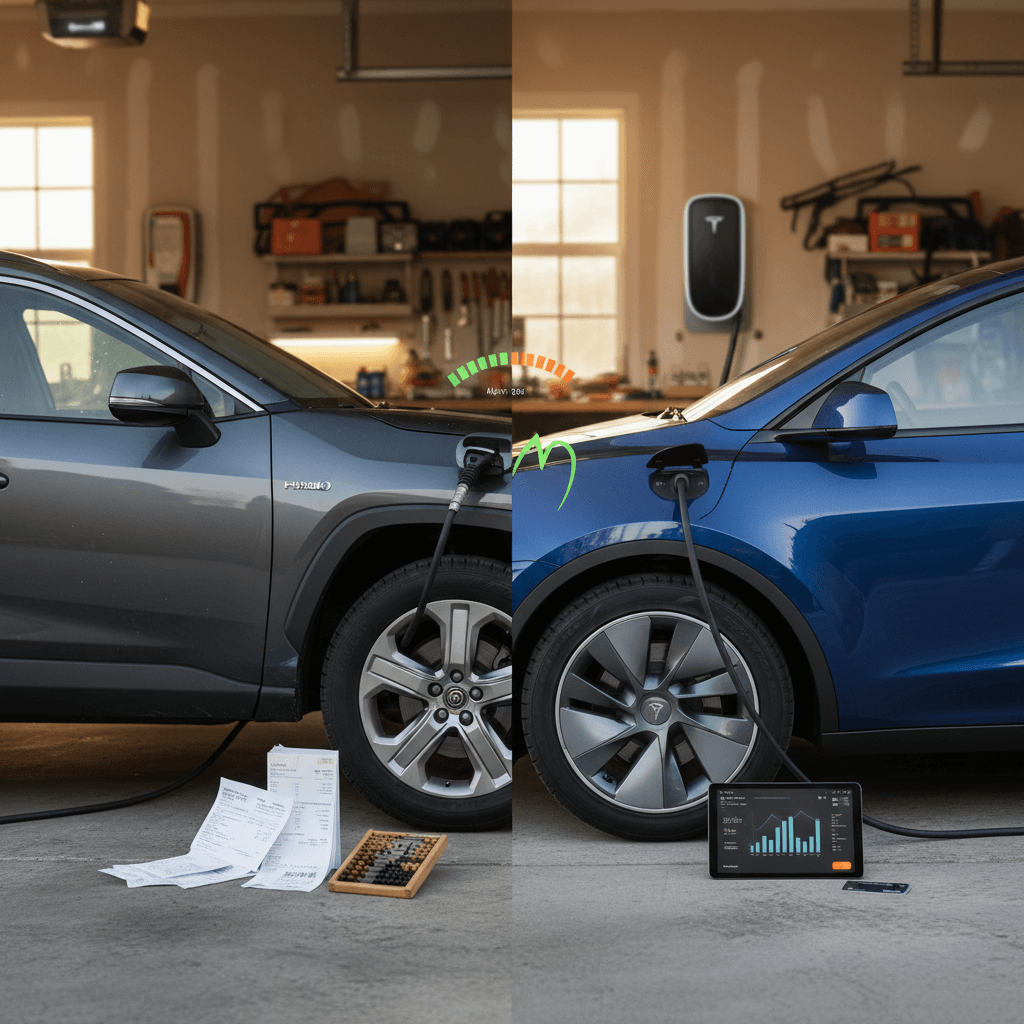
You don’t cross-shop a Toyota RAV4 and a Tesla Model Y because they look alike. You compare them because they both promise affordable, practical family transport, and you want to know which one actually costs less to own once the new‑car smell has worn off. That’s where a honest look at Toyota RAV4 vs Tesla Model Y total cost of ownership becomes more important than stickers and hype.
What “total cost of ownership” actually includes
Why total cost of ownership matters more than MSRP
If you only look at MSRP, the RAV4 looks like the sensible shoes and the Model Y looks like the designer sneaker: roughly the same purpose, very different price. But your bank account doesn’t care what you paid on day one; it cares what leaks out every month for years. Fuel at $4 a gallon, tire rotations, full‑coverage insurance, surprise repairs, that’s where the real story lives, especially if you’re comparing a gas crossover and an EV.
Typical 5‑year ownership profile (U.S.)
How we compared Toyota RAV4 vs Tesla Model Y
To keep things honest, you have to nail down assumptions. The RAV4 comes in gas and hybrid flavors; the Model Y is all‑electric. Here we focus on configurations shoppers most often compare in the U.S.:
- Toyota RAV4 Hybrid (around 40 mpg combined, AWD, mid‑level trim)
- Tesla Model Y Long Range AWD (around 28 kWh/100 mi, mid‑level configuration)
- 13,500 miles per year, mixed city/highway
- Home charging for the Tesla most of the time, with occasional DC fast charging on trips
- Recent national averages for gas and electricity, no extreme‑rate outliers
These are realistic, not universal numbers
Headline takeaways: RAV4 vs Model Y total cost
RAV4 vs Model Y at a glance
Who “wins” depends on what you pay upfront, and what you pay for gas or electricity later.
Toyota RAV4 / RAV4 Hybrid
- Lower sticker price and cheaper insurance for most drivers.
- Gas or hybrid fuel costs that rise and fall with the pump.
- Historically excellent reliability and modest maintenance costs.
- Depreciation is gentle by SUV standards but not spectacular.
Tesla Model Y
- Higher sticker price but potentially offset by EV tax credits (new or used).
- Much lower energy cost per mile if you can charge at home.
- Very low routine maintenance; no oil changes, fewer wear items.
- Depreciation can be steeper early but used values have stayed strong.
The short version
Purchase price, incentives and financing
Let’s talk about the part you negotiate: the price on the window, and how much the government is willing to help. New, a well‑equipped Toyota RAV4 Hybrid often lands in the mid‑$30,000s out the door, while a comparably equipped Tesla Model Y Long Range commonly ends up in the low‑to‑mid $40,000s after destination and typical options. That’s a five‑figure gulf before you even pull off the lot.
Typical new purchase economics (illustrative)
Representative, rounded numbers for a mid‑trim RAV4 Hybrid vs Tesla Model Y Long Range in the U.S. Actual prices and incentives vary by configuration and date.
| Item | Toyota RAV4 Hybrid | Tesla Model Y Long Range |
|---|---|---|
| MSRP + destination | ~$34,000 | ~$45,000 |
| Typical transaction price | $33,000–$35,000 | $42,000–$46,000 |
| Federal tax credit (new) | Usually $0 (hybrid) | Up to $7,500 if vehicle and buyer qualify |
| Federal tax credit (used) | N/A for most hybrids | Up to $4,000 on eligible used EVs |
| Net effective price after incentives | Still mid‑$30Ks | Can fall into high‑$30Ks if max credit applies |
Assumes both buyers finance for 60 months at similar interest rates.
Where used EVs can flip the script
Financing multiplies these differences. A $10,000 gap in amount financed at typical 5‑year rates is roughly $190–$200 extra per month before fuel or electricity. If you’re stretching to afford the Tesla payment, it can take years of cheaper charging to claw that back.
Energy costs: gas vs electricity
This is where the EV does its best work. The RAV4 Hybrid is a fuel miser by SUV standards. The Model Y is a miser on an entirely different grid.
RAV4 Hybrid fuel costs (illustrative)
- Real‑world efficiency: about 40 mpg combined for many owners.
- Assume 13,500 miles/year.
- Annual gallons: 13,500 ÷ 40 ≈ 337 gallons.
- At $4.00/gal, that’s roughly $1,350 per year in gasoline.
- Over five years: about $6,750 in fuel.
Tesla Model Y energy costs (illustrative)
- Efficiency: around 28 kWh/100 miles (roughly 3.6 mi/kWh).
- 13,500 miles/year uses about 3,780 kWh of electricity.
- At 17¢/kWh home rate, annual cost ≈ $640.
- Even if 15–20% of miles are on pricier fast charging, typical blended cost stays well under comparable gas.
- Over five years, many owners see $3,200–$3,800 in electricity costs.
Energy savings in plain English
Insurance, maintenance and repairs
Energy isn’t the only ongoing cost. The RAV4 has the actuarial advantage of familiarity; insurers and mechanics have known this car since the Clinton administration. The Model Y is newer tech, fewer moving parts but pricier bodywork and an attention‑getting badge for underwriters.
Insurance costs
- Studies comparing 2023 models have found Model Y full‑coverage premiums roughly 60–80% higher than comparable RAV4 coverage for similar drivers.
- In dollar terms, it’s not crazy to see something like:
- RAV4: around $1,800–$2,400/year for full coverage.
- Model Y: around $3,000–$4,000/year for similar coverage.
- Multiply that out and a Model Y can easily cost $5,000–$7,000 more in insurance over five years than a RAV4 for the same driver profile.
Maintenance and repairs
- RAV4 Hybrid:
- Oil changes, engine service, transmission fluid, belts, etc.
- Independent estimates for 5‑year maintenance commonly land in the $4,000–$7,000 range depending on miles and dealer vs independent shops.
- Tesla Model Y:
- No oil changes, fewer fluids, regen braking that is kind to pads and rotors.
- Maintenance is mostly tires, cabin filters, brake fluid checks and the occasional alignment.
- Five‑year maintenance spend can be several thousand dollars lower than a comparable gas SUV, though out‑of‑warranty repairs and cosmetic fixes are pricey.
Bodywork and glass: the Tesla asterisk
Depreciation and resale value
Depreciation is where the car silently pays you back, or doesn’t, when it’s time to sell or trade. Historically, Toyotas do not so much depreciate as they gently glide down the slope. The RAV4 has been a poster child for slow, steady value loss.
The Model Y’s story is more dramatic. Early in its life, demand outstripped supply and used values were bizarrely strong. Then as production ramped, prices cooled. Over a normal five‑year window, you can expect the Tesla to lose more dollars of value simply because it starts higher, even if its percentage drop is comparable to the RAV4’s. A big swing in EV incentives or energy prices can push these curves around in either direction.
Why used shoppers have the edge
Illustrative 5‑year cost comparison
Pulling the big pieces together, here’s an illustrative, rounded 5‑year picture for a typical U.S. driver buying new. These are not promises, but they’re in the same ZIP code as what many owners actually see.
Illustrative 5‑year total cost of ownership
Representative numbers assuming 13,500 miles/year, typical U.S. gas and electricity prices, and mainstream insurance/maintenance scenarios. Dollar amounts rounded for clarity.
| Cost component (5 years) | Toyota RAV4 Hybrid | Tesla Model Y Long Range |
|---|---|---|
| Upfront price (incl. taxes/fees) | ≈ $36,000 | ≈ $47,000 |
| Federal/state EV incentives | Usually $0 | –$0 to –$7,500 (new) or –$4,000 (used EV credit) |
| Fuel/electricity | ≈ $6,750 | ≈ $3,500 |
| Insurance | ≈ $10,000–$12,000 | ≈ $16,000–$20,000 |
| Maintenance & repairs | ≈ $5,000–$7,000 | ≈ $3,000–$4,500 |
| Depreciation (value lost) | ≈ $14,000–$17,000 | ≈ $20,000–$25,000 |
| Estimated 5‑year out‑of‑pocket* | Low‑$70Ks | High‑$70Ks to low‑$80Ks |
Your results will vary based on local prices, incentives, driving style and financing terms.
*Out‑of‑pocket includes down payment and loan payments, energy, insurance, maintenance and estimated depreciation. In many realistic scenarios, the RAV4 still comes out a bit cheaper to own over five years, largely because of lower insurance and a smaller loan. Stretch the window to 8–10 years, drive more miles than average, or snag strong EV incentives, and the Model Y’s cheaper energy and maintenance start to close, and sometimes erase, that gap.

Which one makes more sense for you?
Buyer profiles: where each vehicle shines
Match your real life, not your fantasy life, to the right powertrain.
Suburban commuter, 10–12k miles/year
- Lots of short trips, mix of errands and commuting.
- Home charging: possible but not guaranteed.
- Budget: payment sensitivity matters.
Leaning RAV4 Hybrid. Lower payment, forgiving insurance and excellent efficiency without needing a charging plan.
High‑mileage family, home charger
- 15–20k miles/year, frequent road trips.
- Garage or driveway with Level 2 charging.
- Comfortable with tech and EV planning.
Leaning Model Y. Energy and maintenance savings pile up with every mile, and the Supercharger network earns its keep.
Urban apartment, street parking
- Limited access to reliable overnight charging.
- Short hops, ride‑share, occasional road trips.
- Street parking risk factors appreciated by insurers.
Leaning RAV4 (gas or hybrid). Until public charging is as predictable as the corner gas station, the RAV4’s flexibility wins here.
Tips for shopping used RAV4s and Model Ys
On the used market, the math changes again. Depreciation has already taken a bite, and condition matters more than model‑year bragging rights. A clean, well‑cared‑for 3‑year‑old Model Y or RAV4 can be a far better economic decision than a heavily optioned new example of either.
Checklist: keeping your TCO in check when buying used
1. Compare out‑the‑door prices, not asking prices
Taxes, dealer fees, doc fees and add‑ons can swing thousands of dollars. Always negotiate based on total drive‑away price.
2. Look at battery health on any used EV
On a Model Y, usable battery capacity and DC fast‑charging history matter. A platform like Recharged includes a <strong>Recharged Score</strong> battery report so you know what you’re really getting, not just what’s listed.
3. Price insurance quotes before you fall in love
Get actual quotes for the VINs you’re considering. Many shoppers are surprised by the premium gap between a Tesla and a Toyota, even used.
4. Check service and recall history
For RAV4s, confirm routine services were done on time. For Model Ys, confirm software updates and any recall work were completed, and that collision repairs (if any) used qualified shops.
5. Adjust your energy math to your reality
If you’ll be relying on pricey DC fast charging instead of cheap home charging, revise your Model Y cost per mile up. If your local gas is above the national average, adjust the RAV4’s fuel line item accordingly.
6. Run an apples‑to‑apples TCO comparison
Don’t just compare monthly payments. Lay out 5–7 years of estimated energy, insurance and maintenance. Recharged’s team can walk you through that math on any used EV you’re considering.
FAQ: Toyota RAV4 vs Tesla Model Y ownership costs
Frequently asked questions
Bottom line: look past the pump (or plug)
The Toyota RAV4 and Tesla Model Y are two answers to the same question: how do you move a family around America without turning your budget into a bonfire? The RAV4 makes its case with familiarity, low insurance, and the kind of quiet durability that built Toyota’s reputation. The Model Y counters with cheap electrons, low day‑to‑day maintenance and access to the best fast‑charging network in the country.
If your priority is the lowest possible monthly nut and you live somewhere gas is easy and cheap, the RAV4, especially the Hybrid, is still the conservative, rational choice. If you drive a lot, can charge at home, and you value the EV driving experience, the Model Y’s higher sticker can be amortized away by energy and maintenance savings over a long enough timeline.
Either way, the smart move is to compare them on the full spreadsheet, not just the showroom sticker. When you’re ready to run those numbers on a real VIN, battery health, fair market pricing and all, Recharged is built to make that total‑cost picture clear before you sign anything.