If you’re eyeing a used electric SUV, the question of Toyota bZ4X value after 3 years isn’t academic, it’s the difference between a smart buy and an expensive experiment. Early bZ4X models have already put a full depreciation cycle under their belt, so we can stop guessing and start talking about what they’re actually worth in the real world.
Quick take
Why 3‑year value matters for the Toyota bZ4X
Three years is a sweet spot in the EV life cycle. Most factory warranties are still in play, batteries are nowhere near end‑of‑life, and the steepest part of the depreciation curve has usually done its damage. For the Toyota bZ4X, a first‑generation EV from a brand known for bulletproof hybrids, the 3‑year mark is where expectations and reality finally meet.
- Original buyer: 3 years is when you start to see how hard depreciation has hit and whether you’d do it again.
- Second owner: 3 years is often the best mix of price, remaining warranty, and real‑world reliability data.
- Leaser: 3 years is the classic lease term, so this is when off‑lease bZ4X inventory hits the used market.
Think in life stages, not model years
How much is a Toyota bZ4X worth after 3 years?
Toyota bZ4X value snapshot after 3 years
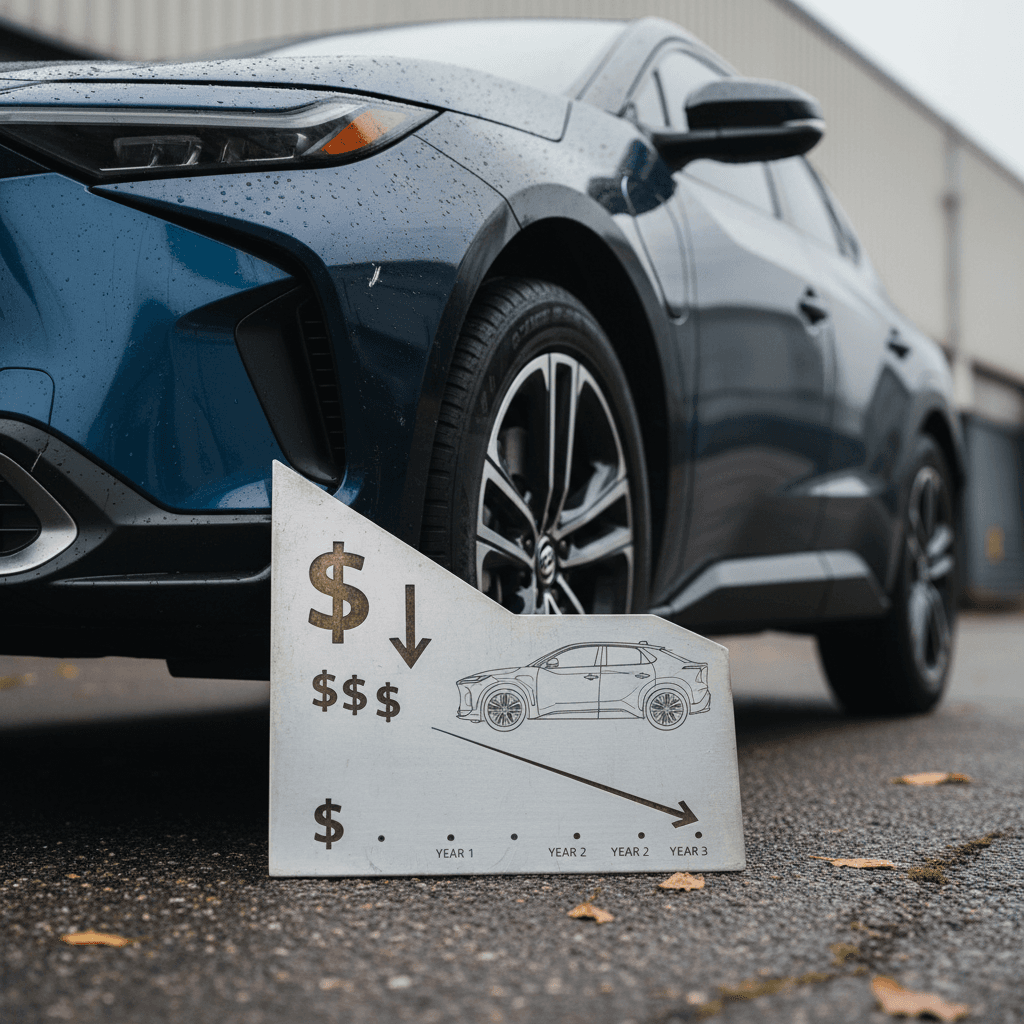
Public valuation tools and early resale data line up on one thing: the bZ4X sheds value quickly at first. Tools like Kelley Blue Book and other depreciation calculators show the bZ4X losing roughly half of its value in the first 3–4 years, with some early 2023 examples trading hands at about 50% of MSRP by year three.
If you’re looking at a bZ4X that originally stickered in the low‑to‑mid $40,000s, a realistic 3‑year resale range often falls around the low‑to‑upper $20,000s, assuming average miles and clean condition. Highly loaded Limited trims or low‑mileage one‑owner examples can sit at the upper end of that band, while ex‑fleet or high‑mileage cars slide to the bottom.
Don’t take any one number as gospel
How bZ4X 3‑year value compares to other Toyotas and EV rivals
3‑year value: bZ4X vs. usual suspects
The bZ4X doesn’t behave like a typical Toyota, yet it’s right at home among first‑gen EVs.
Vs. other Toyotas
Historically, Toyota has been a resale superstar. Many gasoline and hybrid Toyotas keep well over 70% of their value after three years, topping industry charts for low depreciation.
By contrast, the bZ4X’s roughly 45–55% value retention at three years is far softer. It behaves more like a mainstream EV than a Camry or RAV4 when it comes to resale.
Vs. other compact EV SUVs
Park the bZ4X next to rivals like the Hyundai Ioniq 5, Kia EV6, or VW ID.4, and its 3‑year value doesn’t look quite so dramatic. Many first‑wave EV crossovers lose close to half their MSRP in the first few years as incentives, tech updates, and competition pile on.
The bZ4X lands in the same ballpark as other early‑generation EV SUVs, not dramatically worse, but not better, either.
Vs. older EVs
Compare the bZ4X to older EVs like early Nissan Leafs or first‑gen compliance cars, and it actually looks relatively stable. Those models often cratered in value due to limited range and thin demand.
With usable real‑world range, SUV packaging, and Toyota’s strong brand, a 3‑year‑old bZ4X is unlikely to fall into true bargain‑bin territory as quickly.
The Toyota effect is muted, not missing
What drives Toyota bZ4X depreciation in the first 3 years
Main forces pushing value down
- Aggressive new‑car incentives and price cuts: Toyota has used heavy discounts and lease deals to move new bZ4X inventory. When someone can lease a new one cheaply, used prices have to adjust down to make sense.
- First‑generation jitters: This is Toyota’s first dedicated BEV. Shoppers remember the early wheel‑bolt recall and scattered owner complaints about software bugs, HVAC issues, and 12‑volt batteries. Even if most cars are fine, that noise suppresses demand.
- Rapidly improving competition: Each new model year brings EVs with faster charging, more range, and slicker infotainment. That makes a 3‑year‑old bZ4X a tougher sell at a premium price.
Forces supporting value
- Long battery coverage: Toyota backs the high‑voltage battery for years, and in some markets with annual battery checks, coverage can stretch to around a decade with a 70% capacity retention target. That’s confidence you can monetize in the used market.
- Toyota’s broader reliability story: Even when new‑EV reliability is just “average,” buyers bring a lot of trust to the badge. That keeps a floor under values that some lesser‑known EV brands don’t enjoy.
- Practical SUV packaging: The bZ4X isn’t a science‑experiment hatchback; it’s a roomy compact SUV. That shape and size stay in demand, which helps 3‑year‑old examples find homes.
Watch out for software and charging history
Real‑world price examples for 3‑year‑old bZ4X models
Illustrative 3‑year‑old Toyota bZ4X pricing scenarios
These are representative examples based on recent market data and typical mileage patterns as of early 2026. Actual prices vary by region and equipment.
| Original MSRP | Age/Miles | Trim & Drivetrain | Condition | Likely Retail Asking | Likely Trade‑In Range |
|---|---|---|---|---|---|
| $43,000 | 3 yrs / 24,000 mi | XLE FWD | Clean, 1‑owner | $25,000–$27,000 | $21,000–$23,000 |
| $46,000 | 3 yrs / 36,000 mi | XLE AWD | Minor wear, complete service history | $24,000–$26,000 | $20,000–$22,000 |
| $49,000 | 3 yrs / 18,000 mi | Limited AWD | Loaded, excellent cosmetics | $27,000–$29,000 | $23,000–$25,000 |
| $45,000 | 3 yrs / 45,000 mi | XLE FWD (ex‑fleet) | High miles, basic features | $21,000–$23,000 | $18,000–$20,000 |
Think of these as ballpark stories, not exact offers, always check live listings and get a professional valuation.
Use tools, but confirm with the car in front of you
3‑year lease vs. buy: deciding how to own a bZ4X
3‑year bZ4X: should you lease or plan to keep?
1. If you worry about tech aging, lean toward leasing
The bZ4X’s fast‑moving competitive set, new EV SUVs with more range, faster charging, and better software, means a 3‑year lease can be a smart way to let technology leapfrog without you taking the full resale hit.
2. If you drive moderate miles, buying can work
Put 8,000–10,000 miles per year on a bZ4X, keep up maintenance, and protect the interior, and the 3‑year value hit looks big on paper but spread out over years of use. Plan to drive it well past year five to make the math kinder.
3. Watch the money factor and residuals
Toyota and its finance partners have used strong lease deals to move the bZ4X. A high residual value on paper plus low monthly payments can shield you from real‑world depreciation if you simply turn the car in at 36 months.
4. Buying late in the cycle can be a value play
If you’re shopping in 2026 or 2027, consider a well‑priced 3‑year‑old bZ4X instead of a heavily incentivized new one. The early depreciation is already baked in, and you can leverage the remaining warranty term.
5. Consider your charging situation first
If home charging is uncertain or you rely heavily on DC fast‑charging, you’ll feel any shortcomings in charging speed or reliability more acutely. In that case, a lease (with an easy exit at three years) can be a smart safety valve.
Where Recharged fits in
Ready to find your next EV?
Browse VehiclesProtecting your Toyota bZ4X value over the first 3 years
- Keep fast‑charging reasonable. Occasional DC fast‑charging is fine; living on a fast‑charger diet is harder on the pack and can put off future buyers who know what to look for in charge logs and battery health reports.
- Prioritize home Level 2 charging. A stable, moderate‑power home charger and a regular charging routine are easier on the battery than constant high‑power top‑offs.
- Stay on top of software and recalls. Early bZ4X models have seen software updates and campaign work for charging and HVAC behavior. Completed updates and clean recall history are value‑positive for a used buyer.
- Document everything. Service records, tire rotations, brake checks, and any warranty work create a paper trail that supports the upper end of 3‑year‑old value bands.
- Protect the interior and exterior. A clean, odor‑free cabin and straight bodywork are still the first impression. Curb‑rashed wheels and fast‑food smells will cost you long before anyone talks kilowatt‑hours.
- Avoid extreme storage habits. Long periods at 100% charge in hot climates, or deep storage at near‑empty, aren’t kind to any EV battery. Aim to park in the 30–80% middle ground when you can.
Leverage Toyota’s battery checks
Buying a used 3‑year‑old bZ4X: what to look for
Your 3‑year‑old bZ4X buying checklist
These are the questions that separate a good deal from a regret.
Battery health & range reality
- Ask for any available battery health report or capacity estimate, not just the dash range guess.
- Test drive with a mix of city and highway to see real‑world efficiency and how quickly the percentage drops.
- Compare displayed range at 100% charge to what the car claimed when new, some loss is normal; dramatic loss is not.
Charging behavior & history
- Confirm that both AC and DC charging work as they should and that the car recognizes common networks.
- Ask the seller how often they fast‑charged and whether they primarily charged at home.
- Look for any service history related to charge‑port doors, on‑board chargers, or charging error codes.
HVAC and cold‑weather performance
- Early owner feedback includes HVAC quirks and cabin‑heat recalls. Make sure this particular bZ4X has had any relevant campaigns completed.
- On a test drive, check how quickly the cabin heats or cools and whether there are any strange noises from the compressor or fans.
Recalls, software & warranty
- Run the VIN for open recalls and confirm that wheel‑bolt, HVAC, and software campaigns are closed out.
- Verify remaining basic and battery warranty coverage by in‑service date, not model year alone.
- Ask for receipts or dealer printouts documenting software updates; they’re easy to forget but important for long‑term behavior.
Skip the mystery history
How Recharged evaluates used bZ4X models
The toughest part of buying a 3‑year‑old Toyota bZ4X isn’t judging the paint or the tire tread, it’s understanding the battery and how the car has lived. That’s exactly where Recharged leans in.
1. Recharged Score battery diagnostics
Every bZ4X we list gets a Recharged Score Report with verified battery health and charging behavior, not just a generic “EV OK” sticker. That gives you a clear view of usable capacity and how it compares to similar‑age EVs.
2. Fair, data‑driven pricing
We blend auction data, retail listings, and valuation tools to price each used bZ4X against the market. Because we focus on EVs, we’re not guessing at what a 3‑year‑old battery‑electric Toyota should be worth, we track it.
3. EV‑specialist guidance
Our team lives in this world. They can walk you through how a particular bZ4X’s history, trim, and charging profile affect its 3‑year value and what that means if you plan to own it for another five.
End‑to‑end, without leaving your couch
FAQ: Toyota bZ4X value after 3 years
Frequently asked questions about 3‑year‑old bZ4X value
Bottom line: is a 3‑year‑old Toyota bZ4X a good value?
If you bought a Toyota bZ4X new, the 3‑year depreciation story may sting. This compact electric SUV behaves less like a rock‑solid Camry and more like a typical first‑wave EV, with much of its value falling away early. But if you’re shopping used, that’s where the opportunity lies. A 3‑year‑old bZ4X can deliver modern comfort, Toyota engineering, and years of battery coverage at a price the original buyer could only dream of.
The key is to treat each bZ4X as an individual, battery health, software history, and day‑to‑day use matter more than the badge on the grille. Whether you’re trading out of your own bZ4X or hunting for a well‑priced three‑year‑old example, Recharged is built to make that decision easier with transparent pricing, verified battery diagnostics, and EV‑savvy support from first click to driveway delivery.