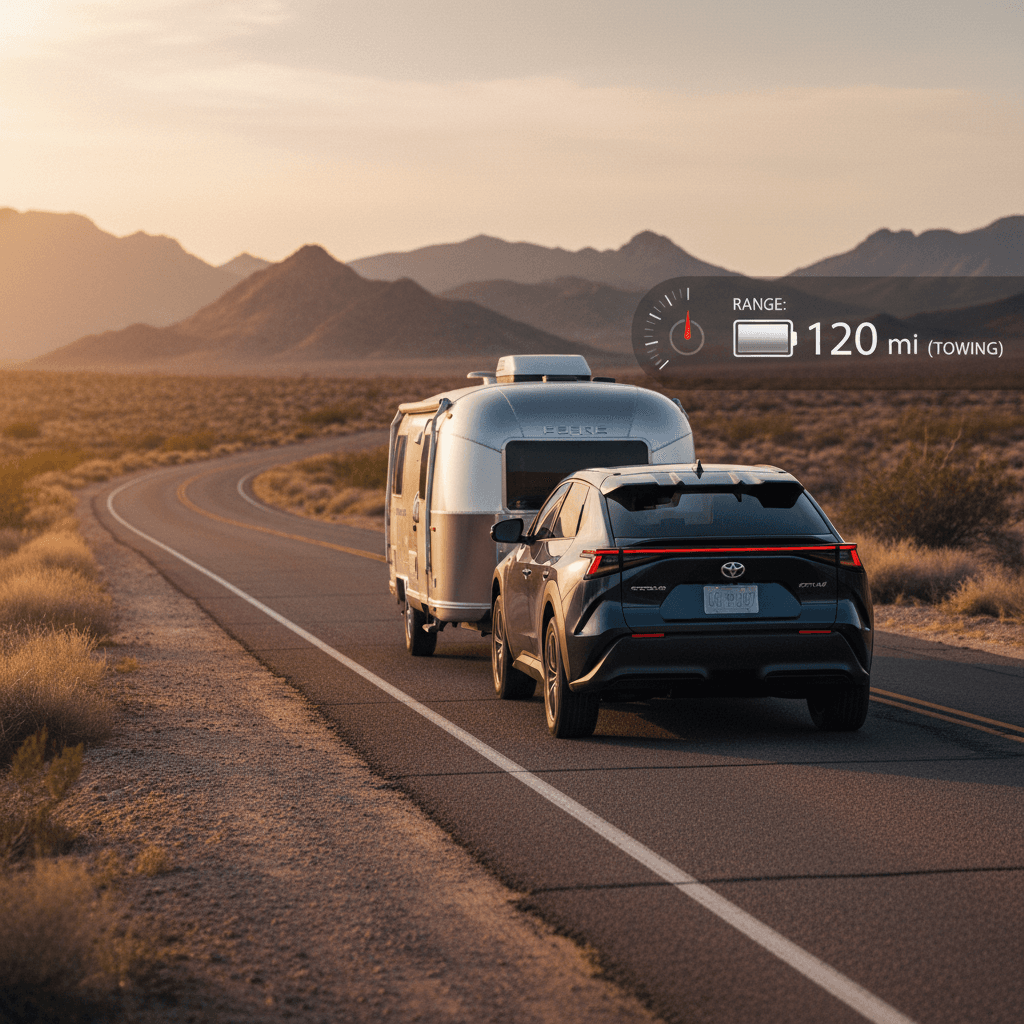
If you’re considering a Toyota bZ4X and plan to tow a small trailer, bikes, or a cargo box, you’re asking the right question: what is the Toyota bZ4X towing capacity and range loss in the real world? On paper it’s a light‑duty tow vehicle at best, and in practice the bigger story is how quickly range drops once you add weight and aerodynamic drag.
Quick answer
Toyota bZ4X towing overview
The bZ4X sits in a tricky middle ground. It’s a compact crossover with decent space and comfort, but its battery is relatively small and its aero is tuned for efficiency, not pulling a big box through the air. That means two things for you as a prospective tower:
- You’re limited to light‑duty towing only, think small utility trailers, lightweight campers, or bike platforms.
- Your effective highway range can drop into the low‑ to mid‑100‑mile band pretty quickly once a trailer is involved, especially with all‑wheel drive.
Market differences matter
Official Toyota bZ4X towing capacity by market
Let’s separate what Toyota has officially published from what’s technically possible or commonly done with aftermarket hitches.
Toyota bZ4X towing capacity snapshot
Approximate published tow ratings by region and powertrain, plus what they actually mean for everyday use.
| Region / market | Model years & nameplate | Official towing stance | Typical max braked trailer rating | Notes |
|---|---|---|---|---|
| United States (early bZ4X) | 2023–2025 bZ4X | Toyota does not recommend towing | 0 lb (no tow rating) | Some third‑party sites mention 1,500 lb, but Toyota’s own literature and dealer communication have been clear: no towing and no Toyota tow package. |
| United States (updated "bZ") | 2026+ “bZ” (renamed) | Tow figures pending for U.S. at time of writing | Likely light‑duty only | Toyota has signaled upgraded hardware and improved range; early dealer material hints at light towing but final numbers aren’t yet widely published. |
| Europe / UK | 2022–2025 bZ4X | Officially tow‑rated | ~750 kg (≈1,650 lb) braked | European technical specs list 750 kg towing capacity on many variants, typical for compact EV crossovers. |
| Other markets (example data) | Japan, some global variants | Often similar to EU | Up to ~750 kg | Exact figures vary by trim; some markets forbid towing entirely. |
Always confirm tow ratings and restrictions in the owner’s manual for your specific bZ4X model year and market.
Warranty and legal risk
bZ4X range basics before you tow
To understand range loss when towing, you first need a realistic baseline for how far a bZ4X goes without a trailer.
Toyota bZ4X EPA and real‑world range
So even before you add a trailer, a realistic planning number for an AWD bZ4X on the highway is often 160–190 miles per full charge, and less in winter. That’s the context you’re working within when you start piling on extra drag and weight.
How much range you lose when towing with a bZ4X
Toyota doesn’t publish official consumption figures for towing, and there aren’t many controlled U.S. tests yet. But physics and early owner reports point in the same direction: the bZ4X behaves a lot like other compact EVs with similar battery size when you tow.
Typical bZ4X range loss scenarios when towing
Approximate real‑world impacts, assuming moderate weather and 65–70 mph cruising.
Light utility trailer
Load: ~1,000–1,500 lb open utility or low‑profile cargo trailer.
- Mostly extra weight, modest aero drag
- Expect 25–35% range loss
- Highway range can drop from ~180 mi to ~120–135 mi on AWD.
Small camping trailer
Load: ~1,500–2,000 lb teardrop or compact camper.
- Weight + much higher aero drag
- Expect 35–45% range loss
- Highway range often falls into the 90–120 mi window.
Roof box or bike rack only
Load: Bikes or box, no trailer.
- Aero hit matters more than weight
- 10–30% range loss depending on speed
- Cheaper and often simpler than towing if you just need gear space.
Use conservative planning numbers
5 factors that magnify bZ4X towing range loss
Two bZ4X owners can tow the same trailer and see very different consumption. These five variables have an outsized impact on how far you’ll actually get per charge.
Key drivers of bZ4X towing efficiency
1. Speed is your biggest lever
Aerodynamic drag increases with the square of speed, and trailers amplify that effect. Dropping from 75 mph to 60–65 mph can claw back a surprising amount of range, often 10–20%, with almost any EV, and the bZ4X is no exception.
2. Trailer shape and frontal area
A long, low teardrop trailer can be much more efficient than a tall, square camper at the same weight. For the bZ4X, <strong>frontal area and how cleanly the air flows</strong> off the back of the car matter as much as trailer weight.
3. Total load and grade
Steep grades and mountain passes punish smaller‑battery EVs. A 1,500 lb trailer behind a bZ4X in the Rockies will burn through energy much faster than the same combo on flat interstate. Elevation gain hurts; regen on the way back down only recovers part of that cost.
4. Temperature and climate control
Cold weather thickens battery chemistry and adds HVAC load. When it’s near freezing, a bZ4X towing at highway speeds can see <strong>stacked penalties</strong> from aero drag, cabin heat, and battery conditioning. Pre‑condition when plugged in, and keep the cabin setpoint reasonable.
5. Drivetrain choice: FWD vs AWD
Front‑wheel‑drive bZ4X trims are more efficient. If you live in a mild climate and don’t need constant all‑wheel traction, FWD will give you a bit more usable towing range from the same battery.
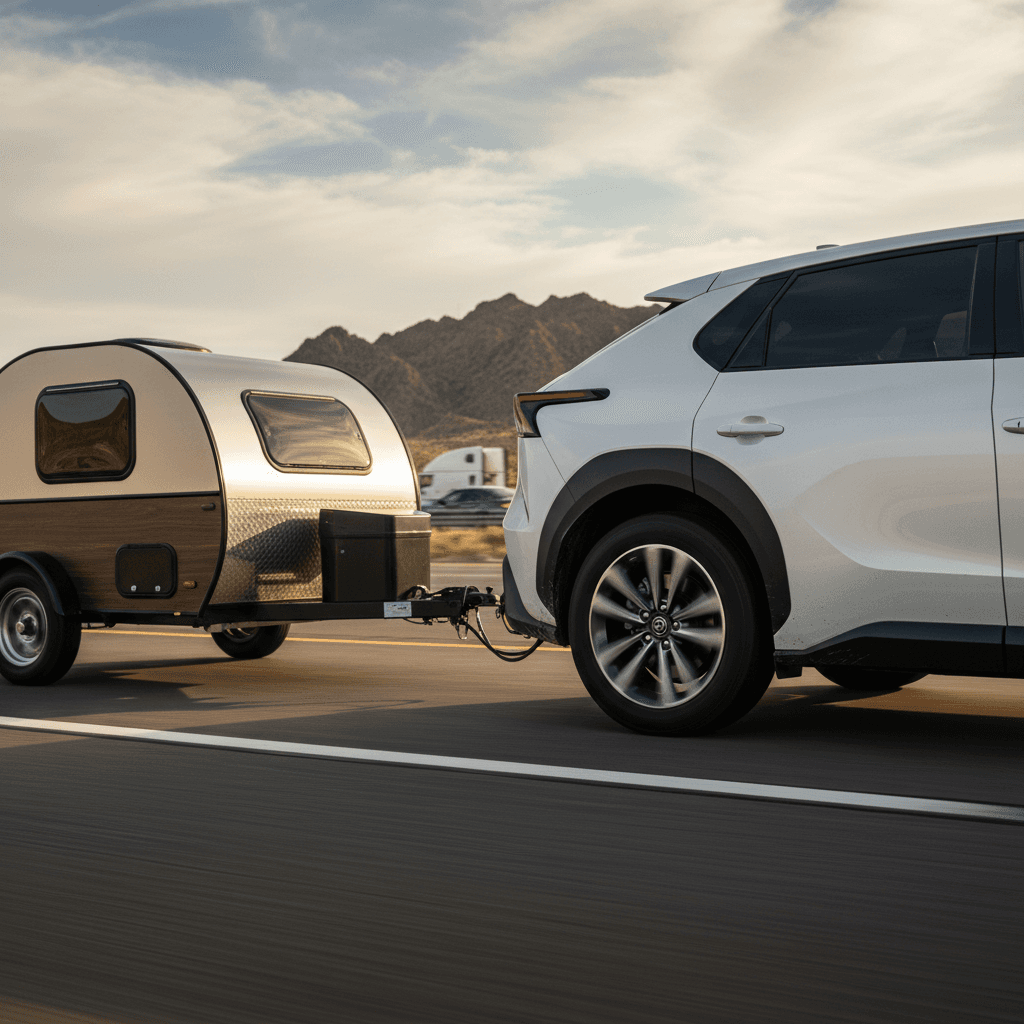
Trip‑planning example: bZ4X towing a 1,500 lb trailer
To make this less abstract, let’s walk through a realistic scenario for a U.S.‑spec bZ4X owner who decides to tow anyway. This isn’t an endorsement, just a practical illustration of why planning is so important with a relatively small battery pack.
The setup
- 2023 bZ4X AWD, usable battery in the mid‑60 kWh range.
- Aftermarket 2" receiver hitch, platform‑style bike rack + small enclosed trailer loaded to ~1,500 lb.
- Summer highway road trip, mostly 65–70 mph, mild temps.
Baseline (no trailer)
- Realistic highway consumption: ~2.6–3.0 mi/kWh.
- Effective highway range: ~170–190 miles per full charge.
- Comfortable fast‑charge spacing: 120–140 miles to leave buffer.
Hook up that 1,500 lb trailer and consumption might climb toward, say, 1.7–2.0 mi/kWh at 65–70 mph. With roughly mid‑60s kWh usable, your full‑charge range drops to the 110–130 mile zone, and now your comfortable fast‑charge spacing is more like 70–90 miles if you want a buffer for detours or headwinds.
What this means on a map
Hardware, hitches, and warranty considerations
Because Toyota hasn’t sold a factory tow package for the bZ4X in the U.S. to date, most owners interested in towing or bike racks turn to the aftermarket. That adds a few wrinkles you’ll want to think through carefully.
Common bZ4X rear‑carrier and hitch approaches
From Toyota‑approved accessories to fully aftermarket solutions.
Hitch‑mounted bike rack only
Many owners install a 1.25" or 2" hitch purely to carry bikes or a cargo platform.
- Lower aero penalty than a tall roof rack.
- Less stress on roof structure.
- Still technically a gray area if Toyota says “no hitch.”
Light utility trailer
Where towing is allowed (or if you choose to tow anyway), a small open trailer is generally easier on range than a big camper.
- Keep weight within rated limits.
- Watch tongue weight and hitch load.
- Use high‑quality wiring and brakes where required.
Overloading & warranty
Because the bZ4X powertrain and cooling system weren’t engineered for heavy tow duty, long grades at high load can stress components.
- Overheating or drivetrain damage may be treated as misuse.
- Documented operation outside Toyota’s towing guidance can complicate warranty claims.
Read your manual and warranty booklet
How the bZ4X compares to other EVs for towing
Within the broader EV market, the bZ4X takes a conservative approach to towing. That’s not necessarily a bad thing, it’s simply optimized more for efficiency and cost than for heavy‑duty capability.
bZ4X vs popular EVs for towing
Approximate maximum tow ratings and high‑level range context for common electric crossovers and SUVs.
| Model | Approx. max tow rating (U.S.) | Battery size (usable, approx.) | Highway range while towing (rough rule of thumb) | Best use case |
|---|---|---|---|---|
| Toyota bZ4X (U.S., early years) | 0 lb official (no towing) | Mid‑60 kWh | If towing anyway, many owners plan for <50% of solo range. | Urban/suburban driving, occasional light gear carrying. |
| Toyota bZ4X / bZ (EU light‑duty) | ~1,650 lb (750 kg) | Mid‑60 to mid‑70 kWh depending on refresh | Often 40–50% of solo highway range with a small camper. | Short‑to‑medium trips with compact trailers. |
| Hyundai Ioniq 5 | 2,000–2,300 lb | High‑70 kWh usable | Commonly 40–50% of solo range with a modest trailer. | Versatile family EV that can credibly tow light campers. |
| Kia EV6 | Up to ~3,500 lb (select trims) | Similar to Ioniq 5 | Still sees big range hits, but larger tow window. | Better match for frequent towing in this class. |
| Tesla Model Y | Up to 3,500 lb | High‑70 kWh usable | Often around half its solo range with a trailer. | Road‑trip‑oriented EV with robust fast‑charge network. |
Towing ratings and range figures are rounded and can vary by trim and model year, always confirm exact specs for the vehicle you’re considering.
Where the bZ4X still works well
Shopping a used bZ4X if you plan to tow
On the used market, the bZ4X can be an excellent value play, particularly if you don’t need long‑distance towing. If you are planning to tow, though, you’ll want to be a bit more selective and diligent in your inspection.
Used bZ4X buyer checklist for light towing
1. Clarify your towing use‑case
Write down what you actually plan to tow: trailer type, approximate weight, how many days per year, and typical trip length. If you routinely need to pull more than about 1,500–2,000 lb or drive more than 150–200 miles per day with a trailer, consider a different EV that’s more tow‑oriented.
2. Verify market‑specific tow guidance
Ask the seller for the <strong>owner’s manual</strong> and look for the towing section. For U.S. bZ4X models that say “no towing,” factor that into your decision, you may want to treat hitch use as bike‑rack‑only.
3. Inspect for previous hitch use
Look under the rear bumper for signs of removed or existing hitch hardware, wiring splices, or damage. Excessive rust, bent mounting points, or hacked wiring can be red flags that the vehicle has been used in ways Toyota didn’t intend.
4. Prioritize strong battery health
Towing stresses the battery more than normal driving, so you want as much usable capacity as possible. With Recharged’s <strong>Recharged Score</strong>, every used EV listing includes an independent battery health report, so you can see how much capacity remains before you ever show up for a test drive.
5. Confirm fast‑charging behavior
On a test drive, fast‑charge the car if possible or review data logs. Healthy bZ4X packs should charge briskly up to a moderate state of charge. Sluggish or inconsistent DC charging can be a sign of thermal issues that towing might aggravate.
6. Factor in charging network quality
Because towing shortens your effective range, you’ll rely more heavily on DC fast chargers. When you shop used EVs on <strong>Recharged</strong>, our specialists can help you think through real charging options on the routes you actually drive, not just what’s on the map in theory.
Toyota bZ4X towing & range loss FAQ
Frequently asked questions about bZ4X towing and range loss
Key takeaways if you plan to tow with a bZ4X
- In many U.S. model years, the Toyota bZ4X is not officially tow‑rated; in Europe and some other markets it’s cleared for roughly 750 kg (about 1,650 lb) of light‑duty towing.
- Regardless of what’s on the spec sheet, you should expect 30–50% range loss at highway speeds when towing a small camper or enclosed trailer with a bZ4X.
- Speed and trailer shape matter as much as weight, slowing down a bit and choosing a low, aerodynamic trailer can noticeably extend your usable range.
- If towing is a core part of your life, consider cross‑shopping EVs with larger batteries and higher tow ratings, then compare real‑world range data before you decide.
- When you’re shopping used, tools like Recharged’s Recharged Score give you verified battery health and pricing transparency so you can judge whether a particular bZ4X is a smart match for your towing and travel plans.
The Toyota bZ4X is first and foremost an efficient, comfortable urban and suburban EV, not a towing workhorse. Used thoughtfully, with realistic expectations and careful trip planning, it can handle occasional light trailers or gear‑hauling duty, especially in markets where Toyota has officially signed off on towing. But if your calendar is packed with long‑distance camping trips and heavy loads, you’re better served by an EV whose capabilities and range envelope line up cleanly with that lifestyle. The key, as always, is to be honest about your use‑case, and to buy the EV that matches it, not the one you hope it might become with enough compromise.