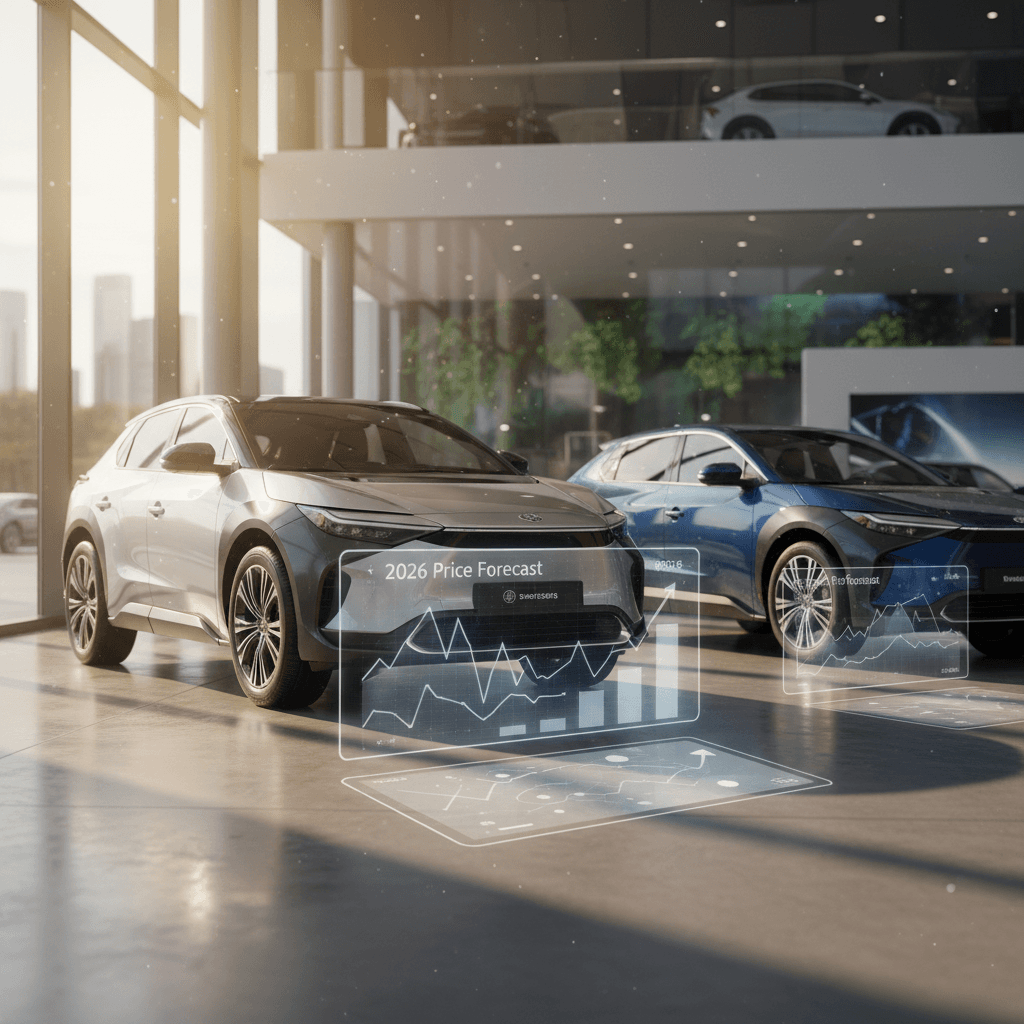
If you’re eyeing a Toyota bZ4X in 2026, you’re looking at one of the most aggressively discounted mainstream EVs on the market. Toyota has already slashed new bZ4X pricing, and the model’s rapid depreciation is creating unusually low used values. In this guide, we’ll unpack the data and offer a realistic Toyota bZ4X price forecast for 2026 so you can decide when, and whether, this electric SUV is the right value play for you.
Big picture
Why bZ4X pricing is such a big story for 2026
Most recent‑generation Toyotas hold their value extremely well. The bZ4X is an exception. Slower sales, middling DC fast‑charging performance, and tough competition have forced Toyota to trim prices and stack on incentives much earlier in the life cycle than usual. On the used side, listings and valuation tools already show steep three‑year depreciation, with some mainstream guides projecting bZ4Xs worth around half their original MSRP after roughly three model years in service.
For shoppers, that divergence from “typical Toyota” behavior matters. If you want to buy new and keep the car a long time, you need to understand the hit you might take in resale. If you’re willing to buy used, though, the same dynamic can make the bZ4X one of the more affordable ways to get into a modern electric SUV, especially in 2026 as the next‑gen bZ model arrives.
Toyota bZ4X pricing snapshot heading into 2026
Where prices stand today: 2023–2025 baseline
To forecast bZ4X prices in 2026, you have to start with what buyers actually paid, and are paying, for 2023–2025 models in the U.S.
- 2023–2024 new MSRPs: Early U.S. models typically stickered in the low‑to‑mid $40,000s for XLE FWD and high‑$40,000s for Limited FWD, with all‑wheel drive adding roughly $2,000.
- 2025 new MSRPs: By late 2024, Toyota had announced substantial cuts, with 2025 XLE FWD dropping to the high‑$30,000s and Limited trims falling into the low‑$40,000s including destination. That reset was a clear acknowledgment that the original pricing wasn’t competitive.
- Real‑world transactions: Because the bZ4X doesn’t qualify for the federal clean vehicle credit when purchased new, Toyota and its dealers have leaned on heavy lease cash and dealer discounts. Many shoppers report five‑figure effective discounts on new or nearly‑new inventory, pulling effective transaction prices far below sticker.
- Used values: Industry depreciation tools and real‑world sales show a 2023–2024 bZ4X often trading near half of its original MSRP after around three years, putting many clean examples in the low‑$20,000s, and sometimes less with higher mileage or weaker equipment.
Why the depreciation is so sharp
2026 Toyota bZ4X new MSRP forecast
Toyota is already rolling out its next‑generation "bZ" crossover for the 2026 model year, essentially replacing today’s bZ4X with a more efficient, longer‑range, and more competitive SUV. That has two implications for your 2026 price forecast:
- The current bZ4X is likely to see limited remaining new‑vehicle inventory in calendar‑year 2026, mostly leftover 2025 models.
- Toyota and dealers generally prefer to clear aging EV inventory quickly, even at aggressive discounts, rather than sit on them while a newer model takes the spotlight.
Scenario 1: Rapid sell‑down
If the 2026 successor launches with clearly better range and charging, Toyota dealers may choose to clear remaining 2025 bZ4Xs quickly. In that case, you could see:
- Advertised discounts of $8,000–$12,000 off sticker on leftover stock
- Effective prices for new XLE FWDs dipping into the low‑to‑mid $30,000s
- Limited AWD models occasionally advertised in the high‑$30,000s with aggressive incentives
Scenario 2: Gradual tapering
If supply of the new model is tight or Toyota staggers the rollout, dealers may keep bZ4X incentives strong but not fire‑sale dramatic. In that case, expect:
- Typical discounts around $6,000–$9,000 off MSRP
- Most new XLE FWD deals landing in the mid‑$30,000s
- Well‑equipped Limited AWD examples in the low‑$40,000s before taxes and fees
Forecast takeaway for new buyers
Used Toyota bZ4X price forecast for 2026
For most shoppers visiting Recharged, the real opportunity is on the used side. Because the bZ4X is depreciating faster than the typical Toyota, 2026 should be a buyer‑friendly year, especially if you’re realistic about range and charging speed.
Illustrative U.S. used Toyota bZ4X price forecast for 2026
Approximate retail asking‑price ranges for well‑equipped XLE and Limited trims at franchised dealers and reputable used‑EV retailers. Local supply, mileage, and condition can move these numbers up or down.
| Model year | Typical mileage (2026) | Expected asking range (XLE) | Expected asking range (Limited) | Notes |
|---|---|---|---|---|
| 2023 | 25,000–40,000 miles | $20,000–$24,000 | $21,000–$25,000 | First wave off‑lease and early purchases; heavier miles and more supply create deals. |
| 2024 | 10,000–30,000 miles | $23,000–$28,000 | $24,000–$30,000 | Many one‑ or two‑year‑old units coming off leases; good balance of price and remaining life. |
| 2025 | Under 20,000 miles | $26,000–$32,000 | $28,000–$34,000 | Youngest, lowest‑mileage bZ4Xs; discounts depend on how quickly the next‑gen bZ gains traction. |
These ranges are directional, not guarantees. Always compare multiple listings in your area and factor in mileage, options, and battery health.
Important caveat
In addition to the raw numbers, remember that many off‑lease and fleet units may run higher annual mileage or carry basic specs. A low‑mileage, well‑optioned Limited with strong battery health can justifiably command the upper end of these ranges, and in some markets, even more.
How the bZ4X compares to rivals on price
Price doesn’t exist in a vacuum. By 2026, mainstream electric SUVs like the Hyundai Ioniq 5, Kia EV6, Volkswagen ID.4, Chevrolet Equinox EV, and Tesla Model Y will all be hunting in the same shopper pool as the bZ4X, and many will have advantages in range, charging, or tax‑credit eligibility.
Where bZ4X is likely to sit versus key rivals in 2026
Assuming current trends continue and new bZ pricing holds as expected.
Versus Tesla Model Y
On the new side, a discounted bZ4X XLE should undercut a comparable Model Y on drive‑off price, especially if Tesla keeps trimming content to hit lower MSRPs. On the used side, however, Tesla’s stronger brand pull and Supercharger access often support higher resale values.
Versus Hyundai Ioniq 5 / Kia EV6
Expect bZ4X asking prices to sit 10–20% below similarly aged Ioniq 5 or EV6 models with comparable mileage and equipment. The trade‑off: those Korean EVs typically offer faster DC charging and, in some trims, longer range.
Versus VW ID.4 & Equinox EV
The ID.4 and Equinox EV are likely to be fiercest direct rivals. In many markets, you may find bZ4Xs priced slightly below VW and roughly in line with incentivized Equinox EVs, reflecting Toyota’s desire to stay in the mass‑market EV game despite lacking U.S. assembly for tax credits.
Where bZ4X can still shine
Factors that could push bZ4X prices up or down
Forecasts are only as good as the assumptions behind them. Here are the key forces most likely to move Toyota bZ4X prices in 2026, in either direction.
Key drivers of 2026 Toyota bZ4X pricing
1. Federal and state incentive changes
Because the bZ4X is built in Japan, it has struggled to qualify for the federal clean vehicle credit when purchased new. If rules change to reopen credits to more imported EVs, or if major state‑level rebates tighten, demand, and thus pricing, could shift.
2. Strength of the 2026 successor model
If Toyota’s next‑generation bZ SUV delivers a major leap in range and charging at competitive prices, used bZ4X values may soften further as shoppers gravitate toward the newer design. A lukewarm response, by contrast, could support the older model’s resale.
3. Interest rates and EV inventory levels
Higher interest rates tend to pressure monthly payments, pushing dealers to discount slower‑moving EVs. If rates ease and inventory tightens in 2026, some of today’s deep discounting could moderate.
4. Public charging build‑out
The bZ4X’s biggest knock is DC fast‑charging speed. If charging infrastructure gets denser and more reliable, especially at moderate power levels, shoppers may become more comfortable living with that limitation, which would help resale.
5. Used‑EV sentiment and supply
A wave of off‑lease EVs across brands is hitting the market in 2025–2027. If shoppers grow more confident in used EV batteries, and tools like battery‑health reports become standard, better transparency could support stronger residuals for good examples.
Don’t forget regional differences
Buying strategies if you want a bZ4X in 2026
Whether you’re considering a leftover new bZ4X or a used one, 2026 is shaping up as a year where patience and data will be rewarded. Here’s how to tilt the odds in your favor.
Strategy for new or nearly‑new bZ4X
- Target outgoing 2025 stock. That’s where Toyota and dealers are most likely to stack incentives once the successor model gains traction.
- Compare lease vs. purchase. Even without a purchase tax credit, lease subsidies can quietly bake in thousands of dollars in support from Toyota Financial Services.
- Watch for "must‑move" inventory. Aged units, unpopular colors, or heavily optioned Limiteds are the first to get aggressive discounts.
Strategy for used bZ4X
- Lean into depreciation. Focus on 2023–2024 models where the first big value drop has already happened.
- Prioritize battery health over mileage alone. A lower‑mileage car that saw a lot of DC fast‑charging could age faster than a higher‑mileage one primarily charged at home.
- Use multiple price references. Compare dealer listings, private‑party ads, and pricing tools to avoid overpaying just because you like a specific unit.
Quick checklist before you commit to a bZ4X in 2026
Confirm your real‑world range needs
Map your daily commute and typical weekend driving against the bZ4X’s usable range, leaving extra buffer for weather, HVAC use, and aging. If you consistently need every mile, consider stepping up to a newer‑generation EV.
Compare total monthly cost, not just price
Fold in insurance, charging costs, and any financing or lease incentives. A slightly higher sale price with a lower interest rate or stronger lease support can be cheaper to live with than the lowest advertised sticker.
Check battery health and warranty coverage
Ask for <strong>verified battery‑health data</strong>, not just a dashboard guess, and confirm how much time and mileage remain on Toyota’s battery warranty in your state.
Look closely at charging behavior
If possible, test the car on a DC fast‑charger or, at minimum, confirm its charging history. Consistent charging to 100% or repeated high‑power fast‑charging can accelerate degradation over time.
Negotiate with data in hand
Bring printouts or screenshots of comparable listings and third‑party valuations. The bZ4X’s track record of steep depreciation gives you a solid footing to push back on unrealistic asking prices.
How Recharged evaluates bZ4X value for used buyers
One of the challenges with rapidly evolving EVs is separating a genuinely bad deal from a misunderstood one. That’s where structured diagnostics and transparent pricing data matter more than ever.
What Recharged looks at on every used bZ4X
So you understand exactly what you’re getting, and why the price makes sense.
Recharged Score battery health
Every bZ4X sold through Recharged includes a Recharged Score Report, with verified battery‑health diagnostics rather than just a generic state‑of‑charge bar. You see how that pack compares to similar EVs and what it means for long‑term usability.
Fair‑market pricing
We benchmark each vehicle against live nationwide listings, auction data, and depreciation curves specific to the bZ4X. That helps keep asking prices realistic, and makes it easier for you to see when a unit is genuinely well‑priced.
End‑to‑end EV support
From trade‑in or consignment options to financing and nationwide delivery, Recharged pairs EV‑specialist advisors with a fully digital buying experience. If a bZ4X isn’t the right fit after we walk through your driving and charging habits, we’ll say so and point you toward better options.
Ready to find your next EV?
Browse VehiclesThinking about selling instead?
FAQ: Toyota bZ4X price forecast for 2026
Frequently asked questions
By 2026, the Toyota bZ4X is poised to be an outlier in the broader Toyota lineup: a vehicle that didn’t fully hit the mark new, but may turn into a sleeper value on the used‑EV market. If you understand its strengths and limitations, and buy at a price that reflects its rapid early depreciation, it can be a smart way to get into a modern electric SUV without paying top‑tier money. Use battery‑health data, market‑based pricing, and a clear view of your own driving needs as your guide, and the numbers can work in your favor.