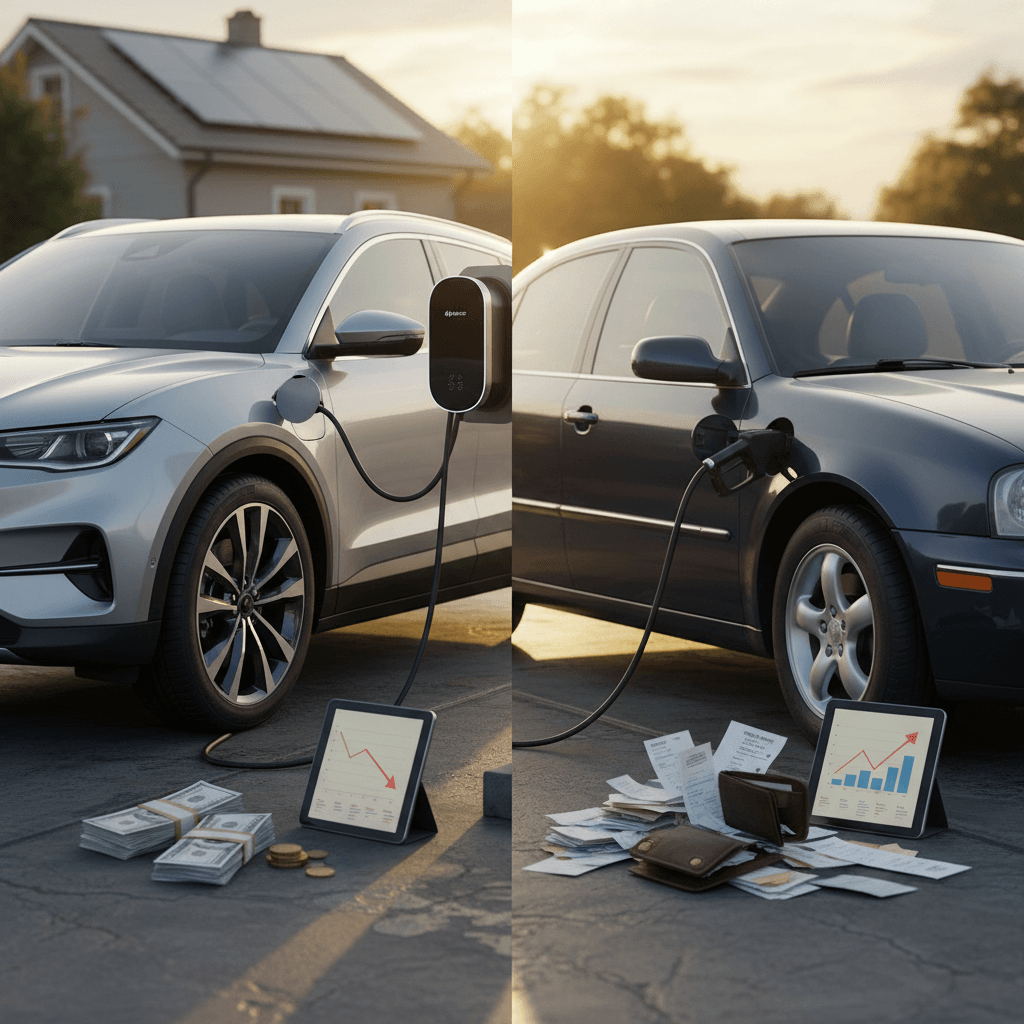
When you compare an electric vehicle to a gas car, the sticker price rarely tells the full story. Over a 5-year period, the **total cost of ownership (TCO)** for an EV vs a gas car includes fuel or electricity, maintenance, insurance, depreciation, taxes, and financing. In many cases, especially if you buy used, an EV can be cheaper to own over 5 years, even if it costs more upfront.
5-year TCO in one sentence
Why a 5-year total cost of ownership matters
Most people keep a vehicle for at least five years, which makes a **5-year total cost of ownership** window a practical way to compare an EV vs a gas car. Shorter than that and upfront price and early depreciation dominate. Longer than that and repair risk and lifestyle changes start to muddy the waters. Five years is also the period many cost-of-ownership studies use, so you can lean on real data instead of marketing promises.
- It captures the bulk of **depreciation** without requiring you to predict 10 years out.
- It matches common **loan terms** (60–72 months), so you can compare monthly and total outlay.
- It covers enough miles for **fuel and maintenance differences** to show up clearly.
- It’s long enough for **EV incentives and running-cost savings** to outweigh a higher sticker price in many cases.
Think in cost per year, not just monthly payment
The 5 key cost buckets in a 5-year EV vs gas comparison
To compare the total cost of ownership of an EV vs a gas car over 5 years, you need to look at the same buckets side by side. At a high level, every TCO model comes down to five things:
The main ingredients of 5-year total cost
EVs win big on some, lose on others
1. Purchase price & incentives
MSRP minus discounts, dealer markups, and EV tax credits or rebates. This is where many EVs still look more expensive on paper, unless you buy used.
2. Fuel vs electricity
Gasoline vs kWh over your annual miles. EVs are typically 2–3x cheaper per mile to “fuel,” especially if you mostly charge at home.
3. Maintenance & repairs
Oil changes, brakes, tune-ups, and unplanned repairs. EVs avoid many of the routine items that keep service bays in business.
4. Insurance, taxes & fees
Insurance tends to be a bit higher for EVs, and some states add EV registration fees, but these are usually smaller pieces of the 5-year pie.
5. Depreciation & resale
How much value the vehicle loses over 5 years. Many EVs depreciate faster than gas cars right now, which can hurt TCO for new buyers and create bargains for used buyers.
6. Financing costs
Interest you pay on a loan or the money you tie up in a cash purchase. Higher EV prices can mean slightly higher finance charges.
What recent data says about 5-year EV vs gas ownership
Beware of averages
Fuel vs electricity: cost per mile over 5 years
Fuel is where EVs do the most obvious damage to gas cars’ budget. As of late 2025, the U.S. national average for regular gas dipped back under $3 per gallon, while residential electricity averages around 13–17 cents per kWh in many states. Translating that into cost per mile is where things get interesting.
Typical U.S. fuel vs electricity cost per mile
Illustrative averages for a mainstream compact SUV class vehicle driven 12,000 miles per year.
| Vehicle type | Assumed efficiency | Energy price | Cost per mile | 5-year fuel cost (60k miles) |
|---|---|---|---|---|
| Gas compact SUV | 28 mpg | $3.00/gal | ~$0.11 | ~$6,600 |
| Efficient gas sedan | 35 mpg | $3.00/gal | ~$0.09 | ~$5,100 |
| EV crossover (home charging) | 3.5 mi/kWh | $0.15/kWh | ~$0.04 | ~$2,400 |
| EV crossover (off-peak TOU) | 3.5 mi/kWh | $0.10/kWh | ~$0.03 | ~$1,700 |
| EV crossover (mostly DC fast charge) | 3.5 mi/kWh | $0.35/kWh | ~$0.10 | ~$6,000 |
Your actual costs will vary by local prices, vehicle efficiency, and how much you rely on public fast charging.
At average prices and mostly home charging, an EV typically costs **about one-third to one-half as much per mile** to fuel as a comparable gas vehicle. Over 5 years and 60,000–75,000 miles, that easily becomes **$4,000–$7,500 in energy savings** for many drivers.
Want a quick back-of-the-napkin estimate?
Maintenance and repairs: where EVs quietly win
EVs eliminate a long list of routine services, oil changes, spark plugs, timing belts, exhaust repairs, many transmission services, and rely heavily on regenerative braking, which extends brake life. Real-world data from 2024–2025 puts EV maintenance consistently below gas vehicles.
Typical 5-year maintenance and repair costs
Approximate averages for mainstream vehicles driven ~12,000 miles per year.
| Vehicle type | Est. cost per mile | Annual cost (12k mi) | 5-year total |
|---|---|---|---|
| Battery electric vehicle | $0.06–$0.07 | $720–$840 | ~$3,600 |
| Gasoline vehicle | $0.10–$0.11 | $1,200–$1,320 | ~$6,000 |
| Difference (EV savings) | , | ~$450–$600 | ~$2,250–$3,000 |
These are broad averages; luxury and performance models can be higher for both EVs and gas cars.
What EVs still need
The battery replacement fear
Insurance, taxes, and fees: small edges that add up
Insurance tends to be somewhat higher for EVs because they’re often more expensive to buy and can be pricier to repair after a crash. But the gap is smaller than many shoppers assume, often a couple hundred dollars per year, not thousands.
Insurance costs
Recent analyses of full-coverage policies show EVs typically costing $100–$300 more per year to insure than comparable gas vehicles. Over 5 years, that’s roughly $500–$1,500 extra for the EV, often less than a single year of fuel savings.
Taxes & fees
Some states offset lost gas-tax revenue with EV-specific registration fees, while others still offer local incentives like reduced registration costs or HOV lane access. These sums are modest in the 5-year picture, usually hundreds, not thousands, but they’re worth checking in your state’s DMV and utility websites.
Depreciation and resale value: EVs’ double-edged sword
Depreciation, the value a vehicle loses over time, is the single largest cost in most 5-year TCO calculations. This is where EVs have struggled the most in the last few years, thanks to rapid technology change, aggressive price cuts on new models, and shifting incentives.
- Many mainstream gas vehicles lose roughly **45–55%** of their value over 5 years.
- A lot of recent EVs have been closer to **55–65%** depreciation over 5 years, with some outliers doing worse.
- Tesla’s repeated new‑car price cuts, for example, have dragged used values down across the segment, even as batteries have held up well mechanically.
Bad news for new EVs, great news for used EVs
Example: 5-year total cost of ownership – EV vs gas crossover
To make this concrete, let’s compare a typical electric compact crossover and its gas counterpart over 5 years and 60,000 miles. These aren’t exact quotes for any one model, but a realistic snapshot using current U.S. averages.
Illustrative 5-year TCO: electric vs gas compact crossover
Assumes 60,000 miles over 5 years, mostly home charging, average U.S. energy prices, and mainstream models in the same size/feature class.
| Cost bucket (5 years) | Electric crossover (new) | Gas crossover (new) |
|---|---|---|
| Purchase price minus incentives | $40,000 EV – $4,000 incentives = $36,000 | $32,000 (no incentives) |
| Fuel / electricity | ~$2,400 (mostly home charging) | ~$6,600 (gas at ~$3/gal, 28 mpg) |
| Maintenance & repairs | ~$3,500 | ~$6,000 |
| Insurance | ~$9,750 | ~$8,500 |
| Taxes & fees | ~$1,200 (incl. some EV fees) | ~$1,000 |
| Financing cost (interest) | ~$3,000 | ~$2,600 |
| Depreciation (5 years) | ~$21,000 lost value | ~$17,000 lost value |
| Estimated 5-year TCO | ≈ $75,850 | ≈ $73,700 |
Numbers are rounded for clarity; your specific vehicles and local prices will change the details, but the pattern is typical.
In this example, the **new EV and new gas crossover end up with very similar 5-year total cost of ownership**, with the gas car only slightly ahead. The EV’s higher upfront price and heavier depreciation eat up much of its fuel and maintenance advantage. Change a few assumptions, local gas at $4+, off‑peak charging, or a more favorable EV deal, and the EV can easily come out cheaper over 5 years.
Tweak the variables that matter most

How buying a used EV changes the 5-year equation
The same depreciation that hurts new EV buyers is a massive advantage if you’re willing to buy used. Because many EVs lose a big chunk of value in their first 3–4 years while their batteries still have plenty of life and warranty left, the 5-year TCO shifts dramatically in favor of used EVs.
Scenario A: New gas, kept 5 years
- Buy a new gas crossover for $32,000 and keep it 5 years.
- Spend ~$6,600 on fuel and ~$6,000 on maintenance over 60,000 miles.
- Lose around $17,000 to depreciation.
- Total 5-year cost: roughly mid‑$70k before financing.
Scenario B: 3-year-old EV, kept 5 years
- Buy a 3-year-old EV for, say, $24,000 (down from a $40,000 MSRP).
- Still have 5+ years of battery warranty left in many cases.
- Spend maybe $2,400–$3,000 on electricity and ~$3,000–$3,500 on maintenance.
- Depreciation from years 3–8 is often slower than the first three years.
Where Recharged fits in
Checklist: When a used EV is likely to beat a gas car on 5-year TCO
1. You drive at least 10,000 miles per year
The more you drive, the more value you get from the EV’s lower electricity and maintenance costs. Below 7,500 miles a year, fuel savings matter less and other factors dominate.
2. You can charge at home or work most of the time
If 70–90% of your charging is at home or a low-cost workplace charger, your electricity cost per mile stays far below gasoline. If you’ll rely heavily on DC fast charging, run the numbers carefully.
3. The EV still has strong battery warranty coverage
Look for at least several years and tens of thousands of miles of remaining battery warranty. Recharged’s battery health diagnostics and Recharged Score help you compare vehicles confidently.
4. Purchase price reflects current market reality
Because new EV prices and incentives are shifting quickly, make sure the used price has already “baked in” recent markdowns on new models. Overpaying for a used EV can erase its TCO advantage.
5. You plan to keep it the full 5 years
The more of that 5-year window you own the EV, the more its low running costs can work in your favor. Flipping in 1–2 years exposes you to the steepest part of the depreciation curve.
Other “costs”: your time, emissions, and driving experience
Pure dollars matter, but so do the less tangible parts of ownership. Some push the EV equation further in EVs’ favor; others may push you back toward gas depending on your situation.
Non-monetary costs and benefits to factor in
These won’t show up on a spreadsheet, but they affect your real cost of ownership.
Time spent fueling vs charging
Home charging turns “fueling” into something that mostly happens while you sleep. You trade gas station stops for plugging in at home, but you may spend more time planning on rare long trips.
Emissions and air quality
Even accounting for battery production, recent lifecycle analyses show EVs outperform gas cars on emissions within the first 1–2 years of driving, and the gap widens as the grid gets cleaner.
Driving experience
Instant torque, quiet operation, and one‑pedal driving are hard to quantify but matter for many owners. If you enjoy the experience more, you’re getting extra value beyond the raw TCO math.
How to estimate your own 5-year EV vs gas total cost
You don’t need a PhD in transportation economics to compare the 5-year total cost of ownership for an EV vs a gas car. You just need your own inputs and a consistent method.
Step-by-step: build your personal 5-year TCO comparison
1. Lock in your mileage assumption
Estimate realistic annual miles (commute, weekend trips, road trips). Multiply by 5, this drives both fuel and maintenance cost differences.
2. Get real-world efficiency numbers
For gas, use EPA combined MPG or owner-reported averages. For EVs, use mi/kWh from reputable tests or owner reports. Avoid optimistic marketing numbers if they don’t match your climate and driving.
3. Use your actual energy prices
Look up your utility rate (and off‑peak rate if you have it) and your local gas price over the last year. Use realistic blends: for example, 80% home charging, 20% public fast charging.
4. Add maintenance estimates
You can use per‑mile averages or quotes from local shops. As a shortcut, assume mainstream EVs cost 30–40% less to maintain over 5 years than comparable gas cars, then sanity‑check with your mechanic.
5. Research depreciation for specific models
Use used‑car listings and residual value guides to see how similar 3–5‑year‑old vehicles have held up. EV depreciation varies a lot by brand and model; don’t assume they’re all the same.
6. Compare both new and used EV options
Even if a new EV doesn’t beat your gas option on 5-year TCO, a <strong>used EV with verified battery health</strong> often will. That’s where platforms like Recharged can tilt the math strongly in your favor.
FAQ: 5-year EV vs gas ownership costs
Frequently asked questions about 5-year EV vs gas costs
Bottom line: when an EV wins on 5-year total cost
Over a 5-year window, **EVs and gas cars can land surprisingly close on total cost of ownership**, but for very different reasons. EVs shine with low fuel and maintenance costs, while gas cars lean on lower purchase prices and, for now, somewhat stronger resale. If you drive a lot, can charge at home, and are open to buying used, the scales often tip decisively toward an EV.
The most reliable way to make the right call is to plug your own numbers into a simple TCO framework: miles, energy prices, purchase price, and depreciation expectations. From there, consider a used EV with verified battery health if you want to stack the deck in your favor. Recharged was built to make exactly that move easier, pairing **transparent battery diagnostics, fair market pricing, expert EV guidance, and flexible financing** so you can choose the car that makes sense not just emotionally, but economically over the full 5-year journey.