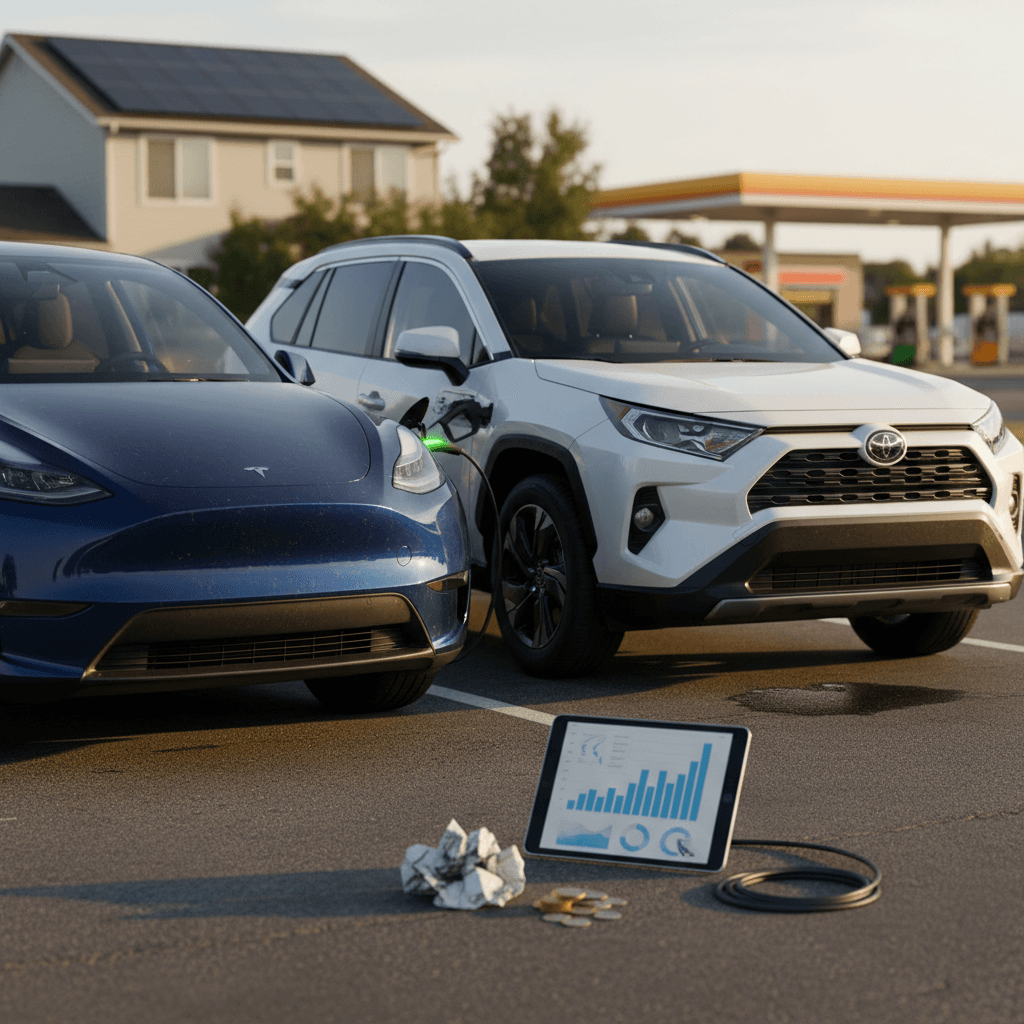
You don’t buy a family SUV in 2025 without asking a hard question: **Is a Tesla Model Y actually cheaper to own than a similar gas car?** Sticker prices only tell part of the story. Once you factor in fuel, maintenance, insurance, taxes, and resale value, the cost comparison looks very different, and often tilts in the Model Y’s favor, especially if you consider a used one.
Short answer
Why compare the Tesla Model Y to a gas SUV?
Tesla designed the Model Y to compete directly with mainstream compact crossovers, think Toyota RAV4, Honda CR‑V, Hyundai Tucson, or Subaru Forester. That’s why this **Tesla Model Y vs gas car cost comparison** focuses on a popular gas SUV peer, not sports sedans or luxury flagships. Shoppers cross-shop them in the real world, and families use them the same way: commuting, school runs, weekend trips, and long highway drives.
What are we actually comparing?
A realistic match-up for real families
Gas benchmark: mainstream compact SUV
- Example: Toyota RAV4 or Honda CR‑V
- New price: roughly $32,000–$38,000
- Real-world fuel: ~30 mpg combined
- Regular maintenance: oil changes, transmission service, exhaust, etc.
EV benchmark: Tesla Model Y
- Model Y RWD or Long Range
- New price: roughly $45,000–$52,000 before incentives
- EPA range: roughly 260–330 miles
- Maintenance: tires, cabin filters, brake fluid checks
New vs used matters
Key assumptions behind this cost comparison
Every cost comparison lives or dies on its assumptions. To keep this analysis grounded and transparent, we’ll spell out the key inputs we’re using. You can adjust them mentally to match your own situation.
Baseline assumptions for Model Y vs gas SUV costs
These are not best‑case scenarios, just realistic U.S. averages for 2025.
| Category | Assumption | Model Y (EV) | Gas SUV |
|---|---|---|---|
| Annual mileage | Typical U.S. driver | 12,000 miles/year | 12,000 miles/year |
| Energy use | Realistic efficiency | 0.28 kWh/mile (≈ 3.6 mi/kWh) | 30 mpg |
| Energy prices | Average U.S. 2025 estimate | $0.15 per kWh home charging | $3.50 per gallon gas |
| Ownership period | What we compare | 5 and 10 years | 5 and 10 years |
| Charging mix | Home vs public | 80% home, 20% public fast charging | N/A |
| Discount rate | Time value of money | Not modeled (straight dollars) | Not modeled |
Adjust these assumptions for your own electric rates, gas prices, and annual mileage.
Your numbers may vary
Purchase price, incentives, and used options
Start with the part you can see on the window sticker: **purchase price**. A new Tesla Model Y usually carries a higher MSRP than a mainstream gas SUV, but federal and state incentives plus the used market complicate this picture.
Up-front cost snapshot
New Tesla Model Y
- MSRP: Roughly $45,000–$52,000 depending on trim and options.
- Tax credits: Some buyers qualify for a federal clean vehicle tax credit plus state or utility rebates, effectively knocking thousands off the net cost.
- Financing: EVs qualify for standard auto loans; some lenders offer EV‑specific promos.
New gas compact SUV
- MSRP: Typically $32,000–$38,000 in well‑equipped trims.
- Incentives: Usually limited to dealer discounts, special APR deals, or small rebates.
- Financing: Traditional loans or leases, with plenty of competition from franchised dealers.
Why used Model Y changes the equation

Fuel vs electricity: where most savings come from
Fuel is where EVs usually win big. Even when electricity isn’t cheap, **moving a vehicle with electrons is more efficient than burning gasoline.** Let’s run the numbers using our baseline assumptions.
Annual and 5-year fuel vs electricity costs
Model Y home charging vs a 30‑mpg gas SUV at U.S. average prices.
| Metric | Model Y (Electric) | Gas SUV |
|---|---|---|
| Energy use | 0.28 kWh per mile | 30 miles per gallon |
| Energy price | $0.15 per kWh (home) | $3.50 per gallon |
| Cost per mile (energy only) | ≈ $0.042/mile | ≈ $0.117/mile |
| Annual fuel/energy cost (12,000 miles) | ≈ $504 | ≈ $1,404 |
| 5-year fuel/energy cost | ≈ $2,520 | ≈ $7,020 |
Public DC fast charging can be 2–3x more expensive than home charging, but most owners still do the bulk of charging at home.
Blend in some fast charging
At our baseline, the Model Y saves roughly **$900 per year** in energy alone versus a comparable gas SUV. Over five years, that’s more than **$4,000** back in your pocket, money that can offset a higher purchase price or higher insurance.
Maintenance and repairs: EV simplicity vs gas complexity
Under the skin, a Tesla Model Y is dramatically simpler than a gas SUV. There’s no engine oil, no transmission fluid changes, no spark plugs, and no exhaust system. That doesn’t mean “maintenance‑free,” but it does mean **fewer things to service and fewer parts to break.**
Typical maintenance needs over 5 years
Basic maintenance only, no major accidents or rare failures.
Tesla Model Y
- Tires (EVs can be heavier and torquier)
- Cabin air filters
- Brake fluid checks
- Coolant system inspections (infrequent)
- Software updates (over‑the‑air)
No regular oil changes or transmission service.
Gas compact SUV
- Oil and filter changes 2–3x per year
- Transmission fluid service
- Engine air filter, spark plugs
- Exhaust and emissions system repairs
- Belts, hoses, and more complex cooling systems
Total maintenance cost picture
Over a 5‑year period, it’s realistic to see a **4‑figure maintenance advantage** for the Model Y, even after assuming slightly higher tire costs. Over 10 years, the gap can widen further as gas vehicles age into more expensive repairs that EVs simply don’t have (timing belts, exhaust, complex transmission failures).
Insurance, taxes, and fees
Insurance is where some shoppers get surprised. Teslas often **cost more to insure** than a modest gas crossover, thanks to higher repair costs and advanced materials. On the other hand, some states add **extra registration fees** for EVs to make up for lost gas tax revenue.
- Insurance: It’s common for a Model Y to run a few hundred dollars more per year to insure than a conventional compact SUV, depending on your driving record and ZIP code.
- Registration fees: A handful of states add $100–$250 per year in EV registration surcharges, while others treat EVs like any other vehicle.
- Taxes: In the U.S., sales tax is based on purchase price. A more expensive EV will generate more tax up front, but may also unlock federal or state tax credits that a gas SUV can’t touch.
Don’t skip an insurance quote
Resale value and depreciation
Depreciation is the quiet giant in total cost of ownership. It’s also one of the hardest to predict, especially as EV technology and incentives evolve. But recent used‑vehicle data offers a few useful patterns.
How Model Y and gas SUVs tend to depreciate
Actual percentages vary by market, trim, and mileage.
Years 1–3
Steepest drop for both. New‑car buyers take the biggest hit here. EVs and gas SUVs alike can lose 20–35% of MSRP in the first 3 years.
Years 4–7
Well‑kept Model Ys with healthy batteries have, so far, held value as well or better than many gas crossovers, helped by strong EV demand and OTA software support.
Battery concerns
Battery health is the main question mark buyers have about used EVs. That’s why reports like the Recharged Score, which verify remaining battery capacity, can protect your resale value and buyer confidence.
For used buyers, the Model Y’s value story hinges on what’s happening under the floorpan. If the battery is healthy and documented, it can compete head‑to‑head with, or even outperform, mainstream gas SUVs on resale.
5-year and 10-year total cost comparison
Let’s pull everything together into a simplified **5‑year and 10‑year total cost of ownership** view. These numbers are illustrative, not guarantees, but they show how the pieces interact.
Illustrative total cost of ownership: Model Y vs gas SUV
All figures are rounded estimates based on our earlier assumptions for a typical U.S. driver.
| Category (5 years) | Tesla Model Y (new) | Gas compact SUV (new) |
|---|---|---|
| Purchase price (after incentives, est.) | $45,000 | $35,000 |
| Fuel/energy | $2,500 | $7,000 |
| Routine maintenance | $2,000 | $4,000 |
| Insurance (incremental vs each other) | + $1,500 | Baseline |
| EV fees / gas taxes | $750 EV fees | Included in fuel |
| Estimated resale value after 5 years | -$25,000 | -$17,000 |
| Approx. 5‑year total cost | ≈ $26,750 | ≈ $29,000 |
Up‑front price gaps can fade quickly when you add fuel and maintenance into the equation, especially if you buy a used Model Y instead of new.
What this 5-year snapshot implies
Stretch the view to 10 years, and the Model Y’s fuel and maintenance advantages usually compound. Gas SUVs accumulate more and more mechanical wear, while EV drivetrains often age more gracefully, provided the battery holds up and is documented.
When a used Model Y tilts the math even further
If you’re cost‑sensitive, the **used EV market** is where the Tesla Model Y really starts to shine. That’s especially true when you can verify battery health rather than guessing based on mileage alone.
How a used Model Y can beat a new gas SUV on cost
1. Similar purchase price
A 2–3‑year‑old Model Y with reasonable mileage often lands in the low‑to‑mid $30,000s, the same neighborhood as a brand‑new gas SUV.
2. Fuel and maintenance savings still intact
The core efficiency advantages don’t fade with age. You’re still saving on every kWh vs gallon and skipping oil changes and major engine service.
3. Depreciation curve has flattened
Much of the early depreciation has already happened. If you buy in years 3–5 of the vehicle’s life, your own depreciation hit over the next 5 years may be modest.
4. Battery health verified
With tools like the <strong>Recharged Score</strong>, you can see real battery diagnostics and pricing benchmarks so you know whether a used Model Y is fairly valued, or a bargain.
5. Flexibility to finance or pay cash
Because the entry price is lower, you have more flexibility in how you structure the deal, loan term, down payment, or even pairing a trade‑in with a shorter loan.
How Recharged fits in
Checklist: Is a Tesla Model Y cheaper than a gas SUV for you?
Numbers on a page are helpful, but your life is more complicated than a spreadsheet. Use this quick checklist to see whether a Model Y is likely to win on total cost for your situation.
Personal cost-fit checklist
You drive at least 10,000 miles per year
The more you drive, the more you benefit from lower per‑mile energy and maintenance costs. Low‑mileage drivers see smaller savings.
You can charge at home most nights
Home charging is usually the cheapest way to run an EV. If you’ll rely heavily on public fast charging, your cost advantage shrinks.
Your local electricity rate is reasonable
If you’re paying around $0.10–$0.18/kWh, the math often favors EVs. At $0.30+/kWh, you’ll need strong gas prices or other savings to offset that.
You live in a state with EV incentives, not heavy EV fees
Tax credits, rebates, or HOV access offset some costs. Extra EV registration fees cut into savings but rarely erase them entirely.
You’re open to a used Model Y
A verified‑battery used Model Y can give you most of the EV benefits at a gas‑SUV price, often the best of both worlds for cost‑focused shoppers.
You plan to keep the vehicle 5+ years
Short‑term leases blunt the EV advantage. The longer you own the car, the more fuel and maintenance savings can outgrow the price premium.
Frequently asked questions: Tesla Model Y vs gas car costs
Model Y vs gas SUV cost FAQs
Bottom line: who actually saves with a Model Y?
If you drive a normal amount, can charge at home most nights, and keep your vehicles for at least five years, a Tesla Model Y is very likely to **match or beat** the total cost of owning a similar gas SUV, especially if you buy a well‑vetted used Model Y instead of new. The higher sticker price is only the opening move; fuel, maintenance, and resale value play the long game.
On the other hand, if you drive very few miles, face high electricity rates, or rely heavily on public fast charging, the cost advantage narrows and the choice becomes more about driving experience, performance, and emissions than pure dollars. That’s why a transparent view of real costs, including battery health and fair pricing through tools like the Recharged Score, is critical before you sign anything.
Either way, run the numbers for your own commute, energy rates, and time horizon. When you do, you may find that the Model Y, and the broader used EV market, has moved from “future tech” to **smart financial decision** a lot faster than the pump prices on your corner would suggest.