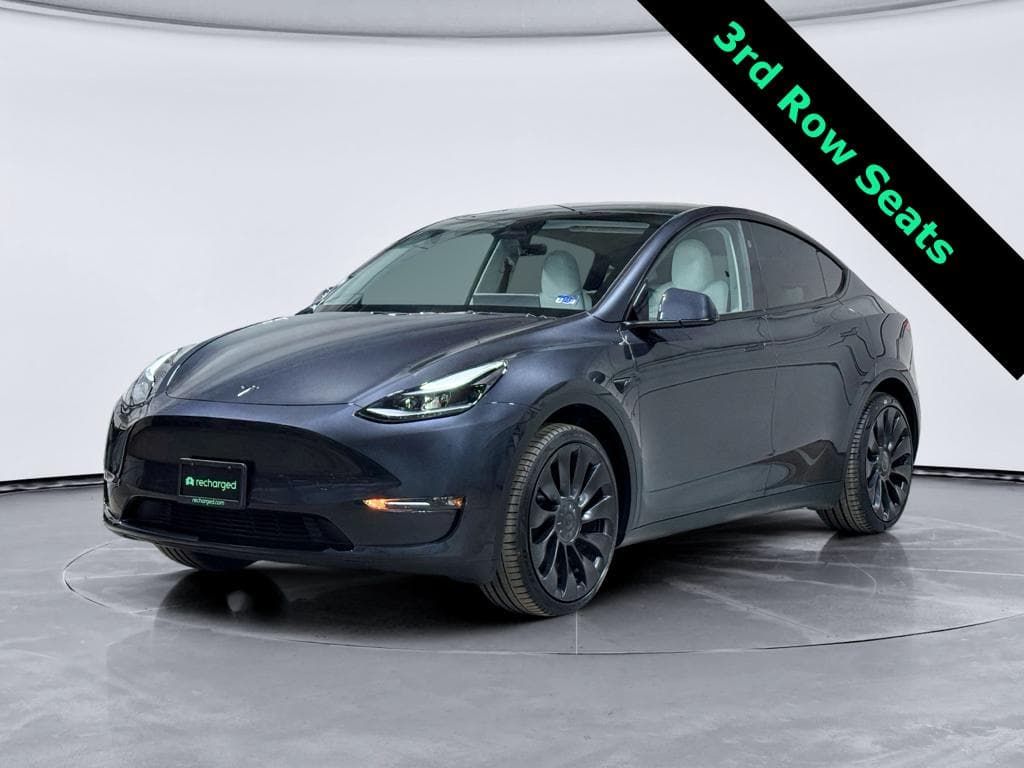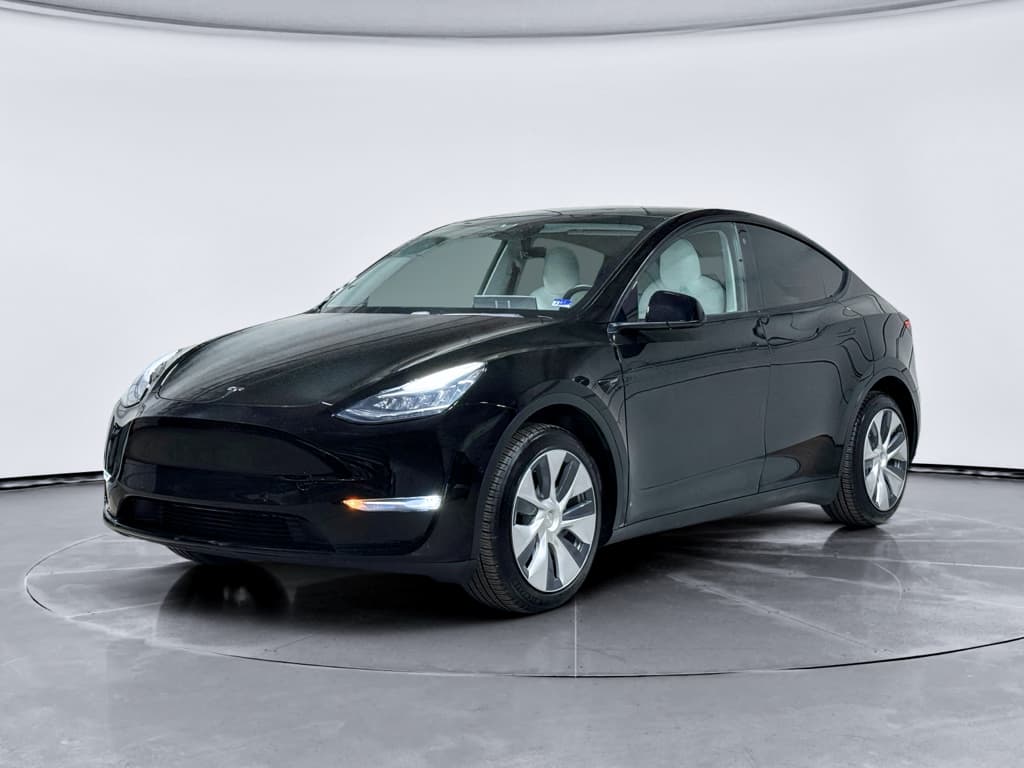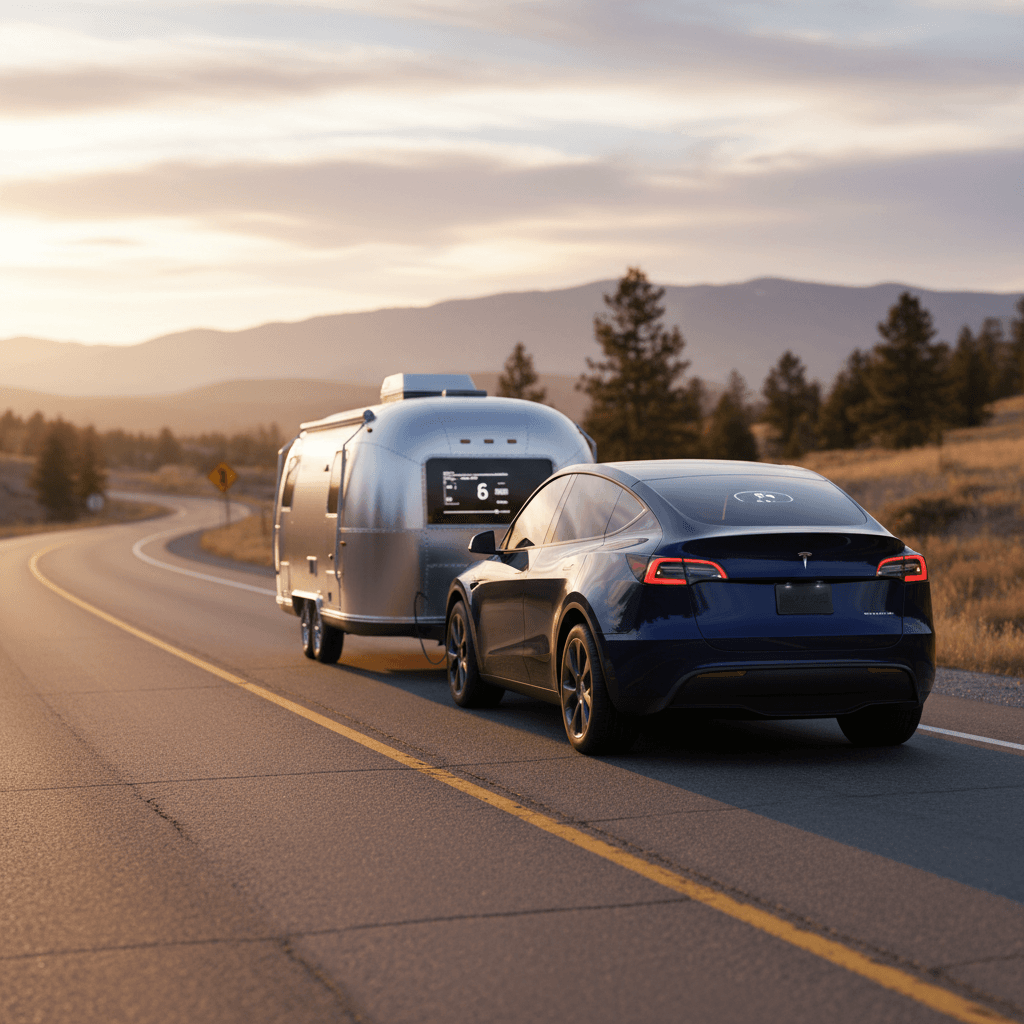
If you’re looking at a Tesla Model Y as a family SUV that also pulls a camper, boat, or utility trailer, the spec sheet only tells half the story. The headline number is the 3,500‑pound towing capacity; the part that actually governs your life is how much range you lose when you start towing.
Why tow ratings don’t tell the whole story
Overview: Model Y towing and range loss
The Tesla Model Y is one of the most capable electric crossovers you can buy, and that extends to towing. Properly equipped with Tesla’s factory tow package, every current US Model Y variant is rated to tow up to 3,500 lbs with a braked trailer. In practice, though, most owners discover that towing range is often 40–60% lower than the EPA number, depending on the trailer and conditions.
- Official tow rating (with factory package): 3,500 lbs / 350 lbs tongue weight
- Comfortable, stable tow vehicle for small campers and utility trailers
- Real‑world range while towing can drop to 90–160 miles per charge at highway speeds
- Best suited for shorter trips and frequent stops, not 400‑mile interstate hauls with a big RV
Used Model Y tip
Official Tesla Model Y towing capacity
Tesla keeps it simple: when a US‑spec Model Y is equipped with the official tow package, the published towing capacity is 3,500 lbs (1,588 kg) with a braked trailer and a tongue weight limit of 350 lbs (159 kg). That applies broadly across Long Range and Performance trims in the US market; always double‑check the door‑jamb label and owner’s manual for your specific year and region.
Tesla Model Y towing specs (US, properly equipped)
These are typical US‑market figures for Model Y with the factory Tesla tow package. Always confirm for your specific VIN and region.
| Item | Specification |
|---|---|
| Maximum braked trailer weight | 3,500 lbs (1,588 kg) |
| Maximum unbraked trailer weight | Typically 1,650–2,000 lbs (region dependent) |
| Maximum tongue weight | 350 lbs (159 kg) |
| Hitch receiver size | 2" Class II |
| Electrical connector | 7‑pin RV style |
| Tow package availability | Factory option or Tesla Service install (select years/regions) |
Official ratings don’t change much across trims, but your range absolutely does.
Aftermarket hitch warning
How towing actually hits your range
Range loss in an EV is mostly a story about air and speed. A boxy trailer can double your effective frontal area and wreck the careful aero work Tesla did on the Model Y. The heavier the trailer, the more energy you spend getting it moving and dragging it uphill; the taller and squarer it is, the more you pay in continuous aerodynamic drag, especially above 60 mph.
Main factors that crush Model Y range while towing
Weight matters, but shape and speed usually matter more.
Aerodynamic drag
Speed
Terrain & weather
Typical Model Y towing range loss in the real world
Think in energy, not just miles
Real-world range estimates by trailer type
Numbers will always vary with speed, weather, and how much you like the left lane, but you can still build a realistic playbook. Below are ballpark ranges for a Long Range Model Y that might be EPA‑rated around 310–330 miles, driven at 60–65 mph with a full charge and a bit of buffer.
Model Y towing range loss by trailer type (highway estimates)
Approximate highway ranges for a Long Range Model Y starting from a ~320‑mile EPA rating. These are planning numbers, not promises.
| Trailer type & example | Approx trailer weight | Estimated range loss | Usable highway range window* |
|---|---|---|---|
| Small utility trailer with yard waste, lumber, or gear | 800–1,500 lbs | ~30–40% loss | 190–225 miles |
| Pair of jet skis / small boat on low trailer | 1,500–2,500 lbs | ~35–45% loss | 175–210 miles |
| Low teardrop or pop‑up camper | 2,000–2,800 lbs | ~40–50% loss | 155–190 miles |
| Small full‑height travel trailer (17–20 ft) | 2,500–3,500 lbs | ~50–60% loss | 125–160 miles |
| Tall cargo trailer loaded near max tow rating | 3,000–3,500 lbs | ~55–65% loss | 110–145 miles |
If it’s tall and boxy, plan for the deeper end of the loss range. If it’s low and sleek, you’ll do better.
Why the EPA number doesn’t matter when towing
Trip planning and charging when towing
Towing with a Model Y flips the usual EV road‑trip rhythm on its head. Instead of 200‑mile stints with a snack in between, you’re thinking in 80–140‑mile chunks, depending on your trailer. The upside: Superchargers are built for quick in‑and‑out stops, and the Model Y is an easy, stable tow rig when you respect its limits.
Step‑by‑step: Planning a towing trip in a Model Y
1. Map around fast chargers, not destinations
Start with Superchargers (and high‑speed CCS if you have an adapter). Draw your trip as a series of 80–140‑mile hops that line up with chargers, then stretch or shrink based on terrain and weather.
2. Add a 30–40% buffer to your best guesses
If you think a leg will take 40% of the battery, plan for 60–70% instead. Extra margin is cheap; running out of charge with a trailer attached is not.
3. Dial back the cruising speed
Every 5 mph over ~60 mph with a boxy trailer makes a visible dent in range. Drive it like a heavy SUV on a family road trip, not a sports sedan.
4. Use navigation energy predictions
Tesla’s trip planner will estimate arrival state‑of‑charge; when towing, treat its forecast as the optimistic scenario. If your Wh/mi is creeping above the estimate, slow down early.
5. Plan how you’ll park and charge with a trailer
Many charging sites aren’t trailer‑friendly. Scout layout in satellite view, look for pull‑through spots, or be prepared to briefly drop the trailer if needed.
6. Have a ‘Plan B’ charger and a bail‑out speed
On each leg, know your backup charger and at what point you’ll slow down 5–10 mph to guarantee you make it. This keeps stress out of the cabin.
Supercharger etiquette with a trailer
Towing packages, hitches, and weight limits
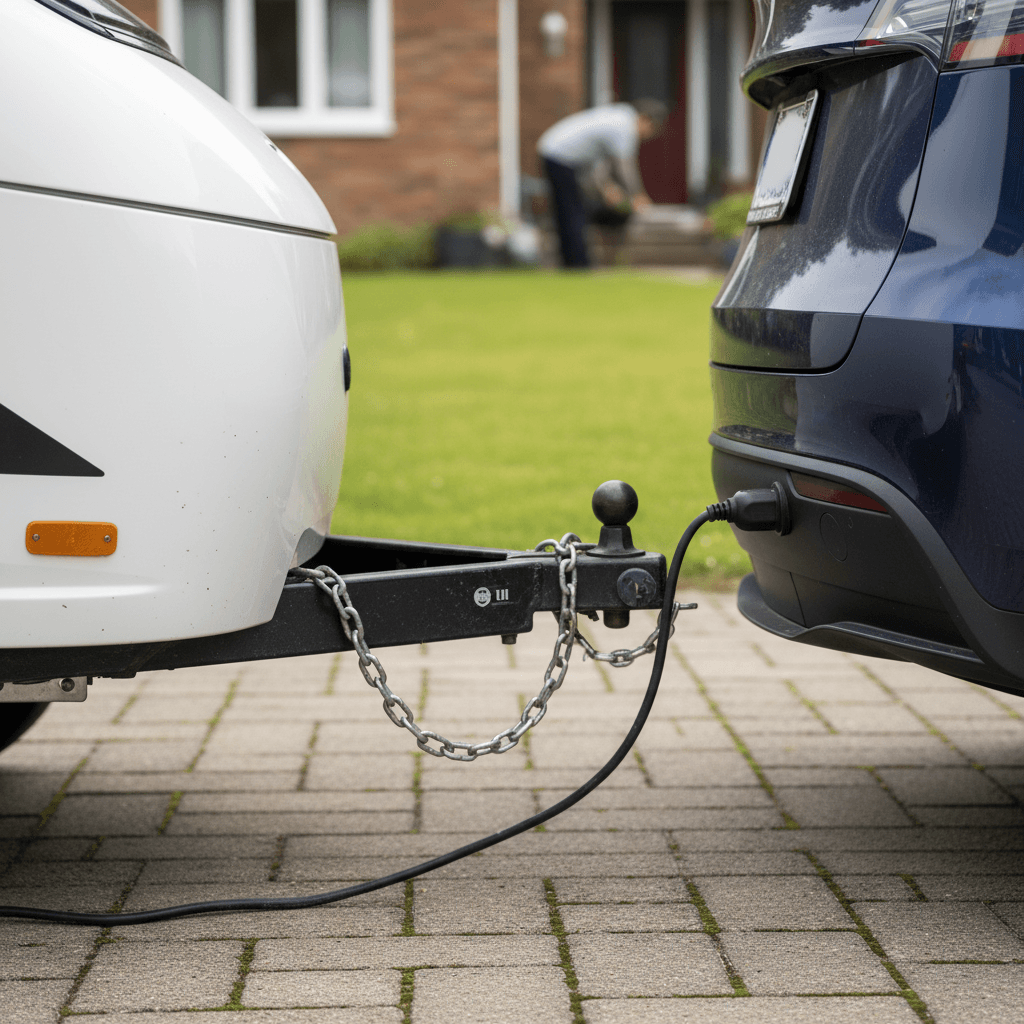
The difference between a Model Y that tows well and one that scares you isn’t just the trailer, it’s the hardware and software between them. Tesla’s tow package is more than a hole in the bumper; it’s a system.
What you get with the Tesla Model Y tow package
More than just a receiver welded under the bumper.
Hardware upgrades
- 2" Class II receiver integrated into the rear structure
- 7‑pin trailer wiring connector
- Mounting hardware and trim pieces engineered for crash safety
Software & control
- Trailer Mode for stability control and regen behavior
- Trailer light monitoring and warnings
- Modified ABS and traction control tuned for towing
Stay mindful of tongue weight, the vertical load on the hitch. Tesla’s 350‑lb tongue‑weight limit means you want roughly 10–15% of the total trailer weight on the hitch, but not more. A 3,000‑lb trailer should have around 300 lbs on the ball; a 3,800‑lb trailer is both over the tow rating and very likely over the tongue limit once you load the front storage.
Don’t ‘just try it’ over the limit
Protecting your battery when towing
Towing is one of the most demanding things you can ask of any EV battery. The Model Y is engineered for it within Tesla’s limits, but a little mechanical sympathy goes a long way, especially if you’re buying used and want the pack to age gracefully.
- Avoid repeated 100% to near‑0% cycles while towing; stick to roughly 15–85% where possible on long trips.
- Use preconditioning before fast charging so the car doesn’t have to heat the pack while you’re already pulling a heavy load.
- If you smell hot brakes on long descents, you’re riding them too hard, downshift with regen and let the motors do the work.
- In extreme heat, accept slower legs and longer breaks. Let the car finish post‑drive cooling before shutting it down with a trailer attached.
What a healthy towing pattern looks like
Should you buy a Tesla Model Y if you tow?
Whether a Model Y is the right tow vehicle for you comes down to the size of your trailer and the kind of trips you actually take, not the ones you daydream about over coffee. If your calendar is full of regional weekends away and tow weights under 3,000 lbs, the Model Y makes a compelling, efficient alternative to a gasoline crossover.
Great fit for a Model Y
- You tow a few times a month, mostly under 200 miles round‑trip.
- Your trailer is a small camper, teardrop, boat, or utility trailer under about 3,000 lbs loaded.
- You’re happy planning around frequent fast‑charge stops on longer trips.
- You value quiet, stable towing and low running costs the rest of the year.
Better served by something else
- You own a big, tall travel trailer near 3,500 lbs or above.
- You want to knock out 300–400‑mile days at 75 mph without thinking about chargers.
- You tow in very remote areas with sparse fast‑charging.
- You need payload for a full family, cargo, and big tongue weight simultaneously.
How Recharged can help if you tow
FAQ: Tesla Model Y towing capacity and range loss
Frequently asked questions about Model Y towing
Bottom line: What to expect from Model Y towing
Towing with a Tesla Model Y is a bit like bringing a sprinter to a backpacking trip. It’s not the brute‑force, 10,000‑lb workhorse that a heavy pickup is, but within its 3,500‑lb envelope, it’s composed, quiet, and remarkably efficient, as long as you accept that your range shrinks and your planning needs to grow.
If your world is small boats, teardrops, pop‑ups, and utility trailers under roughly 3,000 lbs, the Model Y is more than up to the job, and your charging stops turn into pleasant breaks instead of crises. If your life revolves around big, boxy travel trailers and 400‑mile interstate days, it’s the wrong tool, and it’s better to know that before you sign anything.
Looking at a used Tesla Model Y with towing in mind? Start with the factory tow package, then get the battery story. At Recharged, every vehicle includes a Recharged Score Report with verified battery health, pricing transparency, and EV‑specialist support, so you can match the car’s real‑world range, and real‑world towing ability, to the trips you actually take.