If you’re looking at a Tesla Model Y in 2026, you’ve probably noticed a big gap between the glossy EPA range numbers and what owners report in the real world. Understanding true Tesla Model Y real‑world range in 2026, by trim, speed, weather, and age, is the difference between a relaxed road trip and white‑knuckle charging stops.
EPA vs. real life
Why “real‑world” Model Y range matters in 2026
By 2026 the Tesla Model Y is one of the most common EVs on American roads, both new and used. That means more owners taking frequent highway trips, dealing with winter cold snaps, and stretching batteries that are now three to six years old. If you’re cross‑shopping the Model Y against other EV SUVs, or deciding between trims, knowing realistic range is more useful than memorizing the window‑sticker number.
- You plan regular highway drives at 70–80 mph.
- You live in a region with very hot summers or cold winters.
- You’re considering a used Model Y and want to understand the impact of battery age.
- You’re trying to choose between Long Range and Performance trims.
- You’re comparing Model Y to other used EVs on marketplaces like Recharged.
How to read this guide
2026 Model Y trims and EPA range: quick snapshot
Tesla reshuffles trims and names often, but as of 2026 in the U.S., the Model Y lineup centers on three familiar configurations, all using NACS fast‑charging and a heat‑pump HVAC system.
Approximate 2025–2026 Tesla Model Y EPA range ratings (U.S.)
These are rounded EPA “official” numbers you’ll see on window stickers or Tesla’s website. Real‑world range is covered in the next section.
| Trim (AWD unless noted) | Battery size (usable, approx.) | EPA range (18–19" wheels) | EPA range (20–21" wheels) |
|---|---|---|---|
| Model Y RWD / Standard Range | ~60–65 kWh | 260–280 miles | 240–250 miles |
| Model Y Long Range | ~75–78 kWh | 310–330 miles | 290–305 miles |
| Model Y Performance | ~75–78 kWh | 285–305 miles | 270–290 miles |
Always check the specific car’s Monroney label or Tesla account for the exact EPA rating, it can shift slightly year to year.
Why these numbers move around
Real‑world range by trim and speed
On real highways at American speeds, you won’t see the full EPA number. Independent 70‑mph tests and large owner data sets consistently show most Model Ys returning about 70–85% of their EPA range on the open road in mild weather, depending on wheels, elevation, and wind.
Highway vs. EPA: what Model Y drivers see
Approximate 2026 Model Y real‑world range by trim and speed (mild weather, flat roads)
These are single‑leg highway estimates starting near 100% and stopping around 5–10% state of charge, with light cargo and no extreme winds.
| Trim | 60 mph realistic | 70 mph realistic | 75–80 mph realistic |
|---|---|---|---|
| RWD / Standard Range (18–19") | 230–245 mi | 200–215 mi | 180–195 mi |
| Long Range (19") | 260–280 mi | 220–250 mi | 200–225 mi |
| Performance (21") | 235–255 mi | 205–230 mi | 185–210 mi |
Use these as planning baselines, then add a buffer for hills, weather, and headwinds.
Why Performance isn’t a range killer
Why 70 mph feels “expensive”
Above about 55 mph, aerodynamic drag rises rapidly. Going from 60 to 75 mph doesn’t just add 25% more speed, it can increase energy use by 30–40%, especially with a boxier SUV like the Model Y. That’s why your highway range shrinks faster than your speedometer climbs.
City driving tells a different story
In stop‑and‑go use, regenerative braking and lower aero drag help efficiency. Many owners see effective city ranges near or even above EPA numbers in mild weather, as long as they aren’t constantly flooring the accelerator or blasting the HVAC.
How weather and heating change Model Y range
Temperature is the silent partner in every range conversation. The Model Y’s heat pump makes it better than many EVs in the cold, but you’ll still see noticeable swings between a July road trip and a January one.
Model Y range behavior by temperature band
Assuming steady 65–70 mph cruising and moderate climate‑control use.
Warm (65–85°F)
Best‑case scenario. Battery and cabin are easy to manage. Expect:
- Highway range near the table values above
- City range sometimes close to EPA
- Minimal preconditioning needed
Cool (35–60°F)
Moderate impact. Battery and cabin heating use extra energy, but the heat pump helps:
- Plan on 10–20% less range than warm weather
- Preheat while plugged in to minimize loss
- Seat heaters are more efficient than cranking cabin heat
Cold (10–32°F and below)
Biggest range hit. Short trips and repeated warm‑ups are especially costly:
- 30–40% loss vs. warm‑weather range isn’t unusual
- Highway legs once the pack is warm can be closer to −25–30%
- Preconditioning and slower speeds pay big dividends
Short winter trips are the worst case
Owner data and winter comparison tests routinely place the Model Y among the better EVs for cold‑weather range retention, often holding onto around 80–86% of its mild‑weather range once everything is warmed up. The catch is the warm‑up itself, if you don’t precondition while plugged in, that energy comes straight out of your usable range.
Range on road trips vs. around town
One of the easiest mistakes to make is assuming the same range number applies everywhere. In practice, your Model Y behaves like two different vehicles: a long‑legged highway cruiser and an efficient city runabout.
Highway road‑trip scenario
Imagine a 2025–2026 Model Y Long Range on 19" wheels:
- Start: 100% charge on a 70°F day
- Speed: 70 mph, mostly flat, light cargo
- Target: Arrive with 10% buffer
In this scenario, planning for about 230–250 real‑world miles between Superchargers is sensible. You might squeeze more out in perfect conditions, but that buffer lets you handle hills and headwinds.
Everyday commuting and errands
The same car driven mostly at 30–50 mph with gentle acceleration can feel like a 300‑mile EV in mild weather. You’re using regen instead of friction brakes, speeds are lower, and you can precondition while plugged in at home. Range anxiety tends to vanish after a few weeks of this pattern.
Use Tesla’s trip planner, not mental math
Battery age, degradation, and used Model Y range
By 2026, early Model Ys are six years old, and even 2022–2023 examples are out of their honeymoon phase. Naturally, shoppers worry that a used Model Y’s battery might have “lost its range.” The reality has been encouraging so far, most cars show modest degradation, but not the horror stories many fear.
Typical Model Y battery degradation pattern (real‑world owner data)
Exact numbers vary by climate, charging habits, and mileage, but this is what we commonly see.
Year 0–2
Initial drop: It’s normal to see 3–7% loss in the first 20–30k miles as the pack settles.
Year 3–5
Slow decline: Many owners report total loss around 8–12% by 60–80k miles with mixed DC fast charging and home charging.
Beyond 5 years
Use‑case dependent: High‑mileage ride‑share cars that live on fast chargers can see higher loss, while garage‑kept, mostly home‑charged cars often remain close to that ~10% band.
How Recharged measures used Model Y battery health
From a range perspective, that 8–12% drop means a 2021 Model Y Long Range originally rated at ~326 miles might behave more like a new car rated around 285–300 miles. On the highway at 70 mph, you’re still very much in that 200–230 mile per‑leg window we discussed earlier, just with a bit less headroom.
How to estimate your own 2026 Model Y range
You don’t need spreadsheets to get a realistic handle on your Model Y’s real‑world range. Here’s a simple, conservative method you can apply whether you’re test‑driving a used Model Y or planning your first road trip.
5‑step quick estimate for Model Y range in 2026
1. Start from your EPA rating
Find the car’s EPA range on its original window sticker, Tesla’s app, or the online listing. Example: 330 miles for a 2025 Model Y Long Range.
2. Adjust for age and mileage
For a 3–5‑year‑old car with typical usage, subtract 8–12%. That 330‑mile Long Range becomes roughly 290–305 miles of usable new‑car‑equivalent range.
3. Apply a speed factor
For primarily highway use at 70 mph, multiply by about 0.75–0.8. Our 300‑mile example now looks like roughly 225–240 miles of realistic highway range in mild weather.
4. Apply a weather factor
If it’s 65–80°F, you can usually keep that estimate. For 35–50°F, knock off another ~10–15%. For true winter (below ~25°F with cabin heat on), plan on another 15–25% cut.
5. Add a comfort buffer
Don’t plan to run to 0%. Aim to arrive at chargers with at least 10–15% left, especially in unfamiliar territory. That might turn a theoretical 230‑mile leg into a practical 190–200‑mile plan.
Rule of thumb for 2026
Practical tips to maximize Model Y real‑world range
You don’t need to hypermile to see good numbers from a Model Y. A few simple habits can easily give you an extra 20–40 miles of usable range on a given day.
Small changes, big range gains
Start with the easy wins; save the nerdy stuff for later.
Drive smoother, a bit slower
On the highway, dropping from 77 to 70 mph can be worth 10–20 miles of range on a long leg. Use Autopilot to keep things smooth instead of “accordion” driving.
Mind your tires
Check tire pressure monthly, especially in fall and spring. Under‑inflated tires can quietly shave 5–10% off your range. If you don’t need aggressive all‑terrain or winter tires year‑round, stick with efficient all‑seasons.
Optimize climate control
Use seat and steering‑wheel heaters instead of blasting cabin heat. Precondition while plugged in. In summer, precool the cabin before you start driving to avoid an AC power spike when you first pull out.
- Avoid sitting at 100% state of charge in extreme heat whenever possible, charge to full shortly before departure instead.
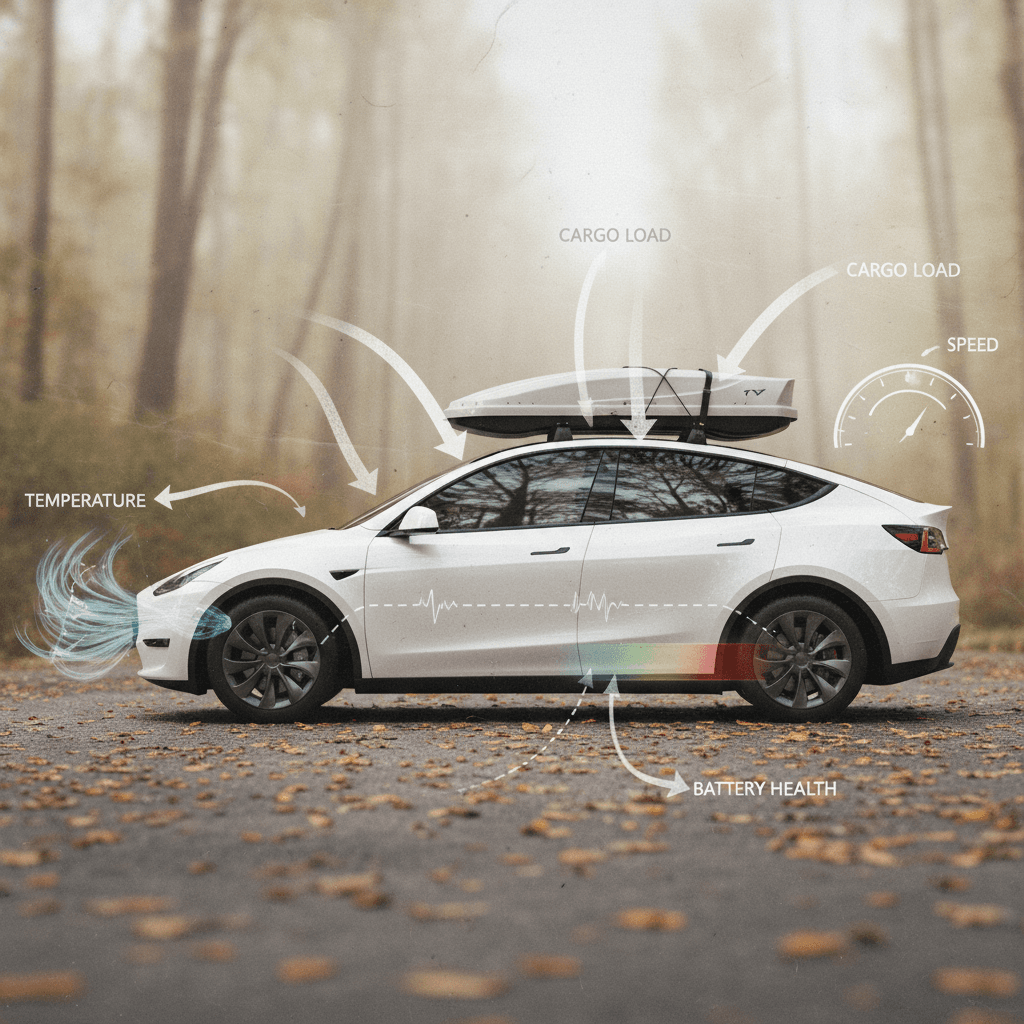
- Remove unused roof racks and cargo boxes that add wind drag.
- Use Tesla’s “Trip” energy graph to watch how hills, wind, and speed change your projected arrival state of charge.
- In winter, group errands into one longer drive rather than many short ones to avoid repeated cold‑start losses.
Don’t chase the EPA number
Should you worry about range when buying a used Model Y?
For most shoppers in 2026, the bigger questions around a used Model Y are price, build quality, and previous owner habits, not absolute range. The platform starts with enough battery that even after some degradation, real‑world usability remains strong. The key is separating a healthy car with normal loss from one that’s been truly abused.
When range is likely “fine”
- Car shows roughly 88–95% of original rated range at 100% charge.
- Odometer is under ~80k miles with mostly home charging.
- Trip planner and energy graph behave predictably on a long test drive.
- Your typical day uses well under half the available battery.
When to ask more questions
- Range display seems 15–20% below what similar‑age cars report.
- The seller fast‑charged almost exclusively on road trips and for daily use.
- The car lived in very hot climates without garage parking.
- There’s a mismatch between displayed range and what you actually see on a 50–100 mile test drive.
Leaning on third‑party diagnostics
Bottom line: in 2026, a Tesla Model Y is still one of the most range‑efficient electric SUVs you can buy, new or used. Just remember that real‑world range is a moving target shaped by speed, weather, terrain, and age. If you plan around a conservative 70–80% of the EPA rating for highway trips, learn how your car responds in your climate, and use tools like battery‑health reports when shopping used, you’ll find the Model Y’s real‑world range far more than a number on a sticker, it becomes a predictable, manageable part of daily life.