
If you’re eyeing a Tesla Model X as a family hauler or tow rig, you’ve probably seen the 5,000‑lb towing figure in the brochure and wondered what it really means on the road. This guide breaks down the true Tesla Model X towing capacity in the real world, how much you can safely pull, what happens to range, and what to watch for if you’re shopping used.
Key takeaway
Overview: Tesla Model X towing capacity at a glance
Tesla Model X towing & range snapshot
Those headline numbers tell the story: the Model X can absolutely tow, but you need to size your trailer correctly and plan your charging stops more carefully than you would in a gasoline SUV.
Official Tesla Model X towing capacity & hardware
Tesla doesn’t offer a long menu of tow ratings the way truck makers do. For North American Model X SUVs from the current generation, the rule of thumb is simple: with the factory towing package installed, the maximum rated towing capacity is about 5,000 lbs (roughly 2,250 kg), regardless of trim.
Recent Tesla Model X factory tow ratings
Approximate factory‑specified towing capability for North American Model X models with the towing package.
| Model year / trim | Max braked trailer weight | Approx. tongue weight limit | Notes |
|---|---|---|---|
| 2022–2025 Model X (dual motor) | 5,000 lbs | ~500 lbs | Standard tow package in U.S. market |
| 2022–2025 Model X Plaid | 5,000 lbs | ~500 lbs | Same tow rating as dual‑motor in U.S. specs |
| 2016–2021 Model X (20" wheels) | Up to 5,000 lbs | ~500 lbs | Early cars sometimes spec 4,960 lbs; check label |
| European‑market Model X | ~2,250–2,300 kg | 90–100 kg | Metric ratings vary slightly by wheel/tire |
Always confirm the exact rating on your vehicle’s door placard and in the owner’s manual.
Don’t trust the hitch alone
From the factory, the Model X tow package includes a 2‑inch receiver, wiring, and software changes (including Trailer Mode and trailer sway control). Without that package, Tesla does not approve the Model X for towing, even if you install an aftermarket hitch.
Real‑world range: How far can a Model X tow?
On paper, a recent Model X can deliver an EPA‑rated 335–352 miles of range on a full charge when it’s not towing. Start pulling a trailer and that number drops fast. The main culprits are aerodynamic drag from the trailer and higher weight, especially at highway speeds.
Solo driving (no trailer)
- Typical highway energy use: roughly 330–360 Wh/mi in mild weather for a recent Model X.
- Real‑world highway range around 280–310 miles from a full charge if you run down near empty.
- Plenty of margin between Superchargers on most interstates.
With a trailer attached
- Energy use can jump to 600–800+ Wh/mi depending on trailer size and speed.
- Effective range often falls to 130–200 miles between charges.
- You’ll stop more often and need to use more of the battery each leg.
What early tow tests showed
Sample Model X real‑world towing range scenarios
These are ballpark figures, your actual numbers will depend on speed, weather, terrain, and trailer setup.
Small cargo trailer (~1,200–1,800 lbs)
- Energy use: ~500–650 Wh/mi.
- Highway range: roughly 170–220 miles per charge.
- Best for local moves, light duty, and modest speeds.
Mid‑size camper (~2,500–3,500 lbs)
- Energy use: ~650–800 Wh/mi.
- Highway range: roughly 130–180 miles.
- Plan short hops between high‑speed chargers.
Boat or low‑profile trailer (~2,000–3,000 lbs)
- Energy use: ~550–700 Wh/mi.
- Highway range: roughly 160–210 miles.
- Streamlined shapes tend to perform a bit better.
Rule of thumb for trip planning
How different trailers change your Model X range
Not all 4,000‑lb trailers are created equal. A 4,000‑lb boat on a low trailer hits the air differently than a 4,000‑lb boxy camper that sits taller than your Model X. When you’re trying to protect range, the trailer’s shape and frontal area often matter more than its exact weight.
How trailer style affects Tesla Model X range
Approximate impact of weight and aerodynamics on energy use and range for a recent‑generation Model X on flat highway at moderate speeds.
| Trailer type | Example weight | Aero profile | Estimated energy use | Approx. highway range |
|---|---|---|---|---|
| Open utility trailer with gear | 1,000–1,500 lbs | Low, partially open | ~500–600 Wh/mi | 190–230 miles |
| Small enclosed cargo trailer | 1,200–2,000 lbs | Boxy, moderate height | ~550–650 Wh/mi | 170–210 miles |
| Mid‑size travel trailer | 2,500–3,500 lbs | Tall, very boxy | ~650–800 Wh/mi | 130–180 miles |
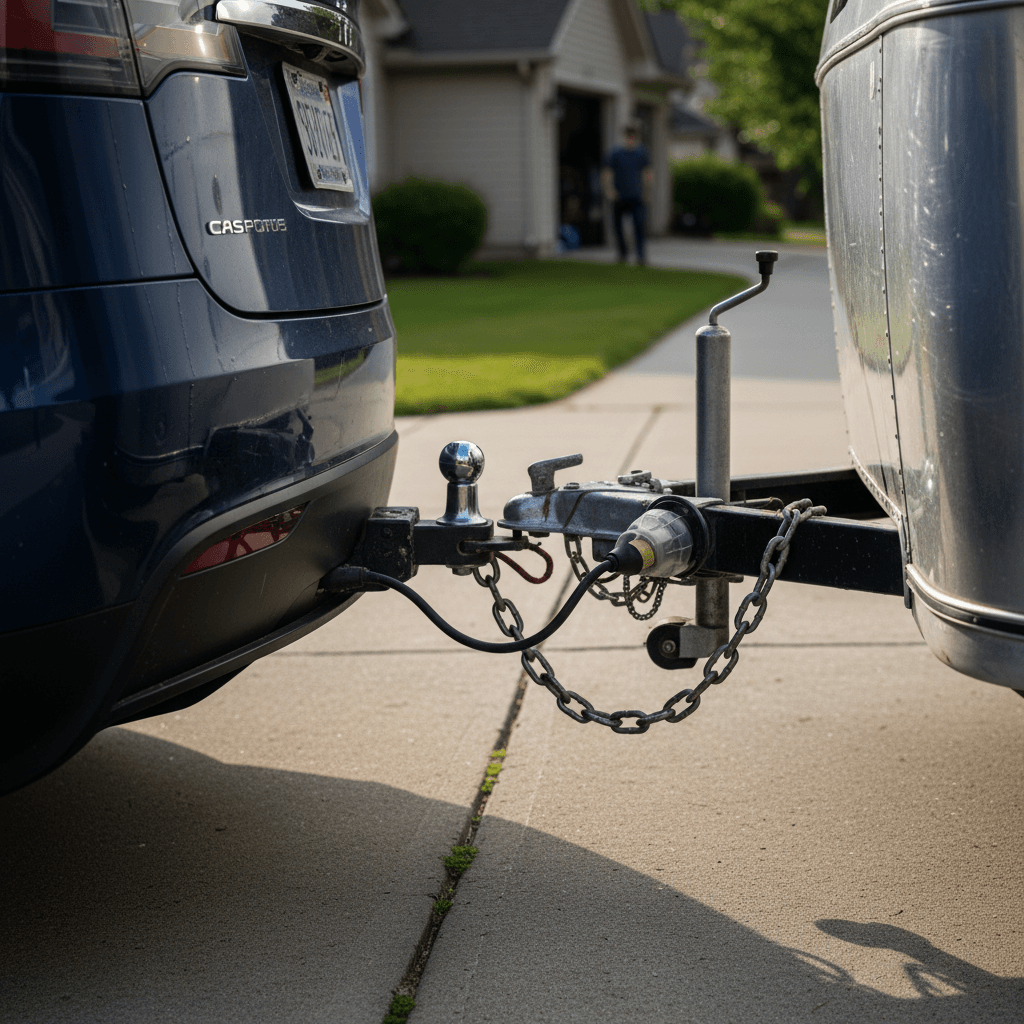
| Streamlined camper (Airstream‑style) | 2,500–3,000 lbs | Rounded, aerodynamic | ~600–700 Wh/mi | 150–200 miles |
| Boat on trailer | 2,000–3,000 lbs | Tapered, low front area | ~550–650 Wh/mi | 170–210 miles |
Assumes good weather, moderate speeds (55–65 mph), and a healthy battery. Always leave extra margin for hills, heat, or cold.
Best‑case scenario for towing
Driving techniques to stretch range while towing
The Model X has the power to yank a trailer up to highway speeds very quickly, but just because it can doesn’t mean you should, at least if you care about range and comfort. Small changes in how you drive can easily unlock an extra 20–40 miles of usable range per charge when towing.
Range‑friendly towing habits for your Model X
1. Slow down to 55–60 mph
Highway drag skyrockets with speed. Dropping from 70 mph to 60 mph can keep energy use hundreds of Wh/mi lower while towing, extending your range and decreasing charging stops.
2. Use Chill Mode and smooth throttle
Aggressive acceleration burns energy quickly and can unsettle the trailer. Use <strong>Chill Mode</strong> or a soft right foot to keep things smooth and efficient.
3. Plan around terrain and wind
Headwinds and long climbs are range killers. Build in extra buffer before steep grades, and don’t be afraid to take a slightly longer but flatter route if it means more reliable charger spacing.
4. Limit HVAC use when needed
Cabin heat and A/C take a bigger bite out of range when you’re already working the battery hard. Pre‑condition while plugged in and lean on seat and steering‑wheel heaters to stay comfortable.
5. Keep tire pressures at tow specs
Under‑inflated tires add rolling resistance and heat. Set tire pressures to the towing recommendations in the Model X owner’s manual before a big trip, and recheck them when the weather changes.
6. Avoid unnecessary roof and rear cargo
Roof boxes, bike racks, and gear hanging off the back create extra drag and leverage on the hitch. Put as much as possible inside the trailer or cabin and keep the exterior clean.
Autopilot while towing
Setup basics: Weights, tires, and safety limits
Towing safely with a Model X is less about brute strength and more about staying within the fine print: tow rating, tongue weight, axle loads, and tire capabilities. With an EV, you also need to think about how those loads affect battery cooling and braking.
Essential weight terms for Model X owners
You don’t need to be a truck engineer, just learn these basics before you hitch up.
Gross Vehicle Weight Rating (GVWR)
The maximum allowed weight of your Model X itself, vehicle, passengers, cargo, and tongue weight combined. Exceeding GVWR is unsafe and illegal.
Gross Trailer Weight (GTW)
The actual weight of your loaded trailer. That means trailer + water + propane + gear, not just the brochure dry weight.
Tongue weight
The downward force the trailer puts on the hitch. Tesla typically allows around 10% of max tow rating (~500 lbs) as tongue weight.
Axle loads & tires
Heavy tongue weight pushes down on the rear axle and tires. Follow Tesla’s towing tire‑pressure chart and never tow on a damaged or temporarily repaired tire.
Critical safety checks before towing
- Aim for 10–15% of trailer weight on the tongue for stability, but never exceed Tesla’s specified tongue‑weight limit for your exact vehicle.
- Load heavy items low and over the trailer axles to minimize sway and steering lightness.
- Use a properly sized hitch ball, torque it to spec, and double‑check that the coupler is locked before moving.
- If your trailer is over about 1,000 lbs loaded, use functioning trailer brakes as required by local law.
Charging and route planning with a trailer
The good news is that the Model X gives you access to Tesla’s dense Supercharger network. The catch: not every site is trailer‑friendly, and you’ll be unplugging and re‑parking more often than in a pickup with a long‑range diesel tank.
Supercharging with a trailer
- Most Supercharger stalls are nose‑in, meaning you’ll need to drop the trailer or block multiple stalls if you back in.
- Look for stations with pull‑through parking or empty end stalls where you can stay relatively straight.
- In bad weather, budget extra time for hitching and unhitching at stops.
Using apps and planning tools
- Manually shorten the default range assumptions in your route planner to reflect your towing penalty.
- Aim to arrive at chargers with at least 15–20% state of charge, not low single digits, to leave buffer for headwinds or detours.
- Consider a slightly denser charging route than what the Tesla nav suggests for solo driving.
Think like a trucker, not a commuter
Buying a used Tesla Model X for towing
A used Model X can be a fantastic tow vehicle if you choose carefully. You get huge interior space, strong acceleration, and access to Tesla’s charging network, but you also inherit how the previous owner used and maintained the vehicle, including any heavy towing duty.
What to check on a used Model X if you plan to tow
These items go beyond a standard test drive and matter a lot when you’ll be pulling a trailer.
1. Factory tow package presence
Make sure there’s a 2‑inch receiver, 7‑pin wiring, and that Trailer Mode appears in the menus. A clean factory setup is preferable to an aftermarket hitch of unknown quality.
2. Battery health and fast‑charge history
Heavy towing and frequent DC fast charging can stress a pack. A Recharged Score Report includes verified battery diagnostics so you know you still have the capacity you’re paying for.
3. Suspension and braking
Check for uneven tire wear, clunks, or warning lights. Air suspension and big brakes are assets for towing, but only if they’re in good shape.
4. Towing history and usage
Ask how often the vehicle towed, what it pulled, and where it traveled. Occasional boat‑ramp duty is different from cross‑country camper hauls every month.
5. Hitch, wiring, and corrosion
Inspect the receiver, safety‑chain mounts, and wiring harness for rust, damage, or hacky splices. Confirm all trailer lights work during your inspection.
6. Pricing vs. non‑towing examples
Two identical Model X SUVs can be worth different amounts if one did heavy tow duty and the other didn’t. Recharged’s fair market pricing tools help you understand the spread.
How Recharged can help
Frequently asked questions about Model X towing
Model X towing: quick answers
Is the Tesla Model X a good tow vehicle?
If you’re expecting heavy‑duty pickup‑truck behavior, the Tesla Model X will fall short. It isn’t designed to drag 9,000‑lb trailers over mountain passes all day. But if you stay within its 5,000‑lb tow rating, pair it with a reasonably sized and shaped trailer, and plan your charging stops with its reduced range in mind, the Model X can be a remarkably capable tow companion for families and weekend adventurers.
The payoff is a quiet, powerful electric SUV that can haul people, gear, and a camper without the fuel bills or maintenance of a traditional truck. And if you’re shopping the used market, working with a platform like Recharged, with verified battery health, transparent pricing, financing options, and EV‑specialist support, can make it much easier to find a Model X that’s truly up for the job you have in mind.