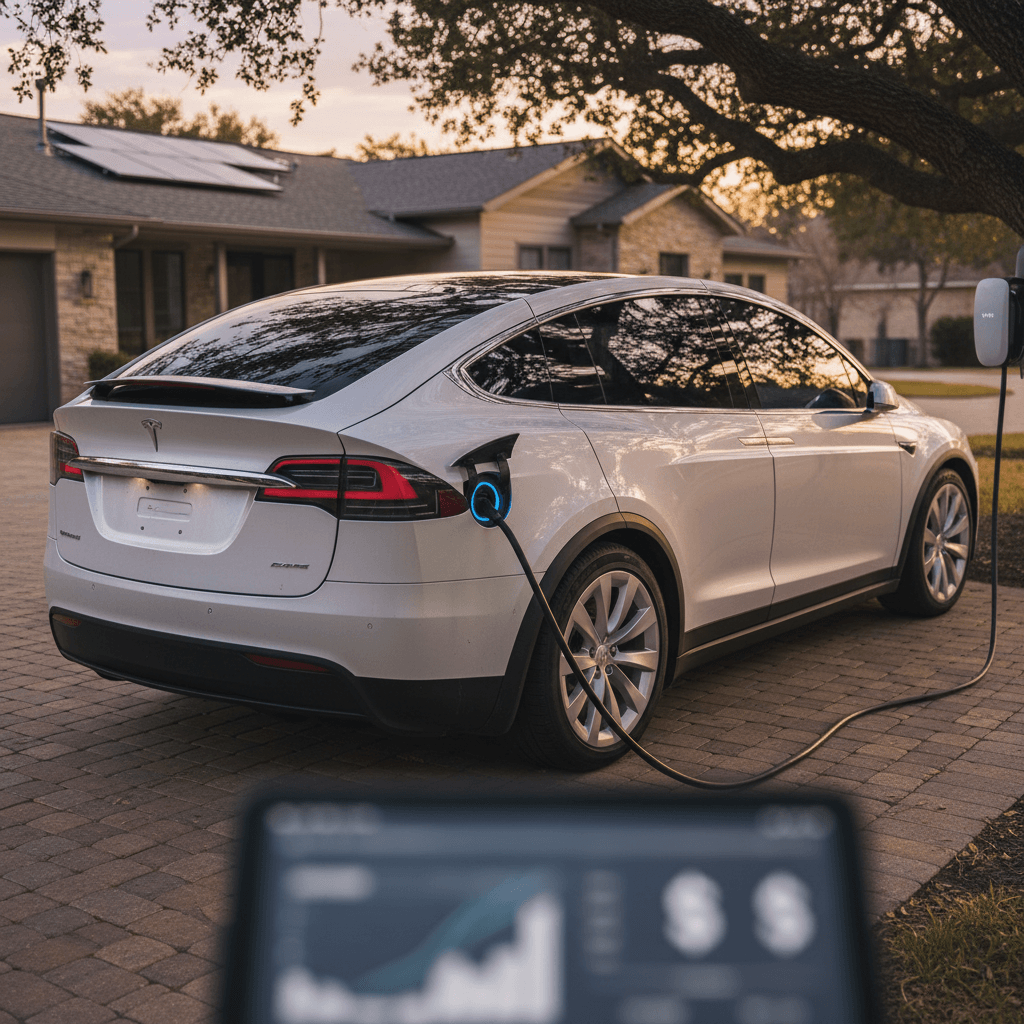
If you’re cross-shopping luxury SUVs, the Tesla Model X flips the script on running costs. Instead of asking “what MPG does it get?”, the real question is: what’s the Tesla Model X charging cost per mile at home and on road trips, and how does that compare to a gas SUV? Let’s put actual numbers to it, using up‑to‑date U.S. electricity prices and real-world efficiency.
The short answer
Why Tesla Model X charging cost per mile matters
EVs don’t have fuel economy stickers the way gas SUVs do. Instead, you’re juggling kWh per mile, electricity rates, time‑of‑use plans, and whatever your local Supercharger decides to charge on a Tuesday afternoon. The Model X adds another twist: it’s big, fast, and heavy, so it’s not the efficiency champ of Tesla’s lineup. Understanding its charging cost per mile helps you: (1) compare it honestly with a BMW X5 or Mercedes GLS, (2) budget road‑trip energy costs, and (3) evaluate a used Model X with some miles already on the clock.
Tesla Model X energy and cost at a glance
Model X efficiency: kWh per mile in the real world
Before you can calculate charging cost per mile, you need a feel for how much energy a Tesla Model X actually uses. The EPA publishes MPGe and kWh/100 miles figures, but real drivers inevitably do worse, especially in a nearly 6,000‑lb SUV with supercar acceleration.
Typical Tesla Model X efficiency (energy use)
Approximate real‑world energy usage for common Model X variants. Your numbers will vary with speed, temperature, and load, but these are solid planning baselines.
| Scenario | Example trims | Approx. mi/kWh | kWh per 100 miles |
|---|---|---|---|
| Best‑case highway cruising | Long Range on mild day, 65 mph, light load | 3.4 | 29 |
| Typical mixed driving | Long Range / Plaid mix of city + highway | 3.0 | 33 |
| Heavy SUV reality | Short trips, higher speeds, cargo or passengers | 2.7 | 37 |
| Cold‑weather worst case | Freezing temps, heat on, short hops | 2.3 | 43 |
We’ll use 3.0 mi/kWh as the main "normal" benchmark throughout this guide.
Cold weather hurts
For the rest of this article, we’ll treat 3.0 mi/kWh as a sensible, real‑world average for a Tesla Model X driven by a reasonably sane adult. Aggressive driving or harsh winters can pull you down to 2.3–2.5 mi/kWh; patient long‑range cruising can push you up into the low‑3s.
Home charging: Tesla Model X cost per mile
At home, the Tesla Model X is at its best. You’re buying power by the kWh, not the minute, and you’re not subsidizing prime real estate along the interstate. The U.S. residential average in 2025–2026 hovers around $0.17–$0.19 per kWh, but some states are below $0.12 and others are well above $0.25. We’ll walk through a few examples so you can plug in your own rate.
- Find your electricity rate on a recent bill. Look for a line that shows $/kWh or cents per kWh.
- Estimate your efficiency. Use 3.0 mi/kWh as a starting point unless you know your typical figure from the Tesla app.
- Use the formula: Cost per mile = (Electricity price per kWh) ÷ (Miles per kWh).
Example 1: Lower‑cost power (≈$0.13/kWh)
If your home rate is about $0.13/kWh and your Model X averages 3.0 mi/kWh:
- Cost per mile = 0.13 ÷ 3.0 ≈ $0.043 per mile
- 100 miles of driving costs ≈ $4.30
- 1,000 miles per month costs ≈ $43
That’s economy‑car money to move something roughly the mass of a mid‑size moon.
Example 2: Higher‑cost power (≈$0.25/kWh)
In a high‑rate market, think coastal cities, say you pay $0.25/kWh and still see 3.0 mi/kWh:
- Cost per mile = 0.25 ÷ 3.0 ≈ $0.083 per mile
- 100 miles of driving costs ≈ $8.30
- 1,000 miles per month costs ≈ $83
Even at expensive home rates, the Model X usually undercuts a comparable gas SUV on fuel spend.
Watch your time‑of‑use clock
Supercharger and public fast charging cost per mile
Superchargers and other DC fast chargers are convenience stores of the kilowatt world: fast, everywhere, and unapologetically more expensive. You’re paying not just for electricity, but also for infrastructure, land, and the privilege of defying the clock on your way to Grandma’s.
Real‑world Tesla Supercharger pricing in the U.S. jumps around by state, time of day, and station load, but $0.35–$0.55 per kWh is a realistic 2025–2026 window, with many locations clustering around $0.40–$0.45. Other networks (Electrify America, EVgo, etc.) are often in the same ballpark, especially if you don’t have a membership discount.
Example 3: Supercharger at $0.40/kWh
Assume a Model X efficiency of 3.0 mi/kWh on a highway trip:
- Cost per mile = 0.40 ÷ 3.0 ≈ $0.13 per mile
- 300‑mile road‑trip day ≈ $39 in energy
Still cheaper than feeding a thirsty V8, but nowhere near the bargain of home charging.
Example 4: Supercharger at $0.50/kWh
At a busy or high‑cost station charging $0.50/kWh with the same 3.0 mi/kWh efficiency:
- Cost per mile = 0.50 ÷ 3.0 ≈ $0.17 per mile
- 300 miles ≈ $51 in electricity
You’re now in the neighborhood of a strong‑MPG hybrid SUV in fuel cost per mile.
Don’t judge the car by road‑trip math
How driving style and weather change your cost per mile
EVs are ruthlessly honest about how you drive. You don’t hear the engine working harder; you simply see the Wh/mi figure in the corner of the screen creeping up. For the Model X, the difference between saintly and sinful driving can easily swing your charging cost per mile by 30–40%.
How your right foot (and the weather) change the numbers
Same electricity price, three very different realities for a Model X owner
Calm commuter
Scenario: 65 mph highways, gentle acceleration, mild weather.
- Efficiency: ~3.4 mi/kWh
- Home rate: $0.19/kWh
- Cost per mile: 0.19 ÷ 3.4 ≈ $0.056
Real‑world mix
Scenario: Stop‑and‑go, some 75+ mph, family + cargo.
- Efficiency: ~3.0 mi/kWh
- Home rate: $0.19/kWh
- Cost per mile: 0.19 ÷ 3.0 ≈ $0.063
Winter warrior
Scenario: Freezing temps, heater blasting, short trips.
- Efficiency: ~2.4 mi/kWh
- Home rate: $0.19/kWh
- Cost per mile: 0.19 ÷ 2.4 ≈ $0.079
Use the car’s own data
Tesla Model X vs gas SUV: cost per mile comparison
The real party trick is not that a Tesla Model X is cheap on electrons, it’s that it’s cheap for the size and performance you’re getting. Think of what you’d normally have to feed a 3‑row luxury SUV with 500‑plus horsepower.
Model X electricity vs gas SUV fuel cost per mile
Approximate fuel costs with U.S. 2025–2026 price levels. Gas and electricity prices both move, but the relationship tends to look like this over time.
| Vehicle | Energy price assumption | Efficiency | Fuel cost per mile |
|---|---|---|---|
| Tesla Model X (home charging, avg) | $0.19/kWh | 3.0 mi/kWh | ≈ $0.06 |
| Tesla Model X (Supercharger‑heavy) | $0.40/kWh | 3.0 mi/kWh | ≈ $0.13 |
| Efficient gas crossover | $3.75/gal | 30 mpg | ≈ $0.13 |
| Typical luxury gas SUV | $3.75/gal | 20 mpg | ≈ $0.19 |
| Thirsty performance SUV | $3.75/gal | 15 mpg | ≈ $0.25 |
These figures ignore maintenance, which usually further favors the EV over the long term.
Where the Model X really saves
Buying a used Model X? What charging cost per mile tells you
Shopping for a used Model X is where the fuel‑savings story meets real‑world complexity. On paper, the electricity cost per mile looks fantastic. In practice, you want to understand how battery health and efficiency change with age, and what that means for your long‑term running costs.
Key cost questions to ask about a used Model X
1. What’s the current efficiency?
Ask the seller for a screenshot of recent <strong>Wh/mi</strong> from the car or Tesla app over the last 1,000+ miles. If it’s consistently much higher than 350 Wh/mi (≈2.9 mi/kWh), factor that into your cost per mile.
2. How much battery degradation is present?
Most well‑cared‑for Model X packs lose a modest amount of capacity over time. Less capacity doesn’t usually change cost per mile much, but it affects <strong>how often</strong> you need to charge and whether you rely more on expensive DC fast charging.
3. What’s the previous owner’s charging pattern?
A car that lived at <strong>home Level 2</strong> and only hit Superchargers on trips is ideal. A car that lived on DC fast charging might still be fine, but you’ll want credible battery‑health data.
4. Have electricity prices changed in your area?
If your state’s kWh prices have climbed sharply since the car was new, your <strong>cost per mile</strong> won’t match old blog posts. Plug in today’s local rate, not yesterday’s national average.
5. How many miles do you actually drive?
The more you drive, the more your lower fuel cost per mile matters relative to a gas SUV. For low‑mileage households, the ownership story may hinge more on convenience and performance than on energy savings.
Where Recharged fits in
7 ways to lower your Model X charging cost per mile
You can’t control wholesale energy markets, but you have more levers than you’d think. Small tweaks to how and where you charge can move your Model X from “pretty good” to “shockingly cheap” on a cost‑per‑mile basis.
Practical ways to cut your Model X electricity bill
1. Shift as much charging as possible to home
Every kWh you buy at home instead of at a Supercharger is usually a win. Install a Level 2 charger or use a 240V outlet so you can recover a full day’s driving overnight without relying on public stations.
2. Use off‑peak or EV‑specific utility rates
Ask your utility if they offer a <strong>time‑of‑use plan</strong> or dedicated EV rate. Charging after 9–10 p.m. can drop your per‑kWh cost enough to shave several cents off each mile.
3. Precondition while plugged in
In cold or hot weather, preheat or precool the cabin while the car is still plugged in. That energy comes from the wall instead of the battery, improving your on‑road efficiency and effective cost per mile.
4. Be reasonable with speed
You don’t have to hypermile, but driving 75–80 mph everywhere in a 3‑row performance SUV is like throwing twenties out the window. A small reduction in cruising speed can yield a big gain in mi/kWh.
5. Keep tires inflated and aligned
Under‑inflated or mis‑aligned tires increase rolling resistance, hurting efficiency. Check pressures regularly and get an alignment if you see uneven wear or strange steering behavior.
6. Plan road‑trip charging stops
Use the in‑car planner and third‑party apps to hit reasonably priced fast chargers and avoid expensive last‑resort stops. Arriving with a warm battery and a low state of charge also lets you charge faster and more efficiently.
7. Start with a well‑vetted used Model X
If you’re buying used, choosing a car with <strong>documented battery health</strong> and a clean charging history sets you up for years of predictable, low per‑mile costs. Recharged’s battery diagnostics and expert support are built for exactly this decision.
FAQ: Tesla Model X charging cost per mile
Frequently asked questions about Model X charging costs
Bottom line: what you should budget per mile
If you strip away the hype and look at the math, a Tesla Model X is a big, quick, family‑hauling EV that typically costs about $0.05–$0.08 per mile to run on home electricity, and roughly $0.12–$0.18 per mile if you lean heavily on Superchargers. That’s compact‑car money to move a luxury spaceship, and usually a clear win over gasoline once you stack up a few tens of thousands of miles.
The key variables are simple: your local electricity rate, how often you use DC fast charging, and your driving efficiency. Get those under control and the Model X isn’t just fast, it’s financially rational. And if you’re looking at a used Model X, that’s where platforms like Recharged shine, pairing verified battery health with transparent pricing and EV‑specialist support so you know exactly what each mile will cost long after the test drive is over.