
If you’re wondering, “Tesla Model X battery lifespan – how long does it really last?” you’re not alone. The battery pack is the single most expensive part of the car, and if you’re shopping used, its health matters more than the shade of white leather or whether the falcon-wing doors still dazzle the neighbors.
Quick answer
How long does a Tesla Model X battery last?
Let’s define “lasts.” For EVs, battery life usually means the point where the pack has lost enough capacity that range becomes annoying, or where it drops below the manufacturer’s warranty threshold (often 70% of original capacity).
Tesla Model X battery lifespan at a glance
In the real world, most Tesla batteries lose a little capacity early, then settle into a slow decline. Large packs like the Model X’s roughly 90–100 kWh units are especially robust. For a typical U.S. driver doing 12,000–15,000 miles a year, you’re looking at well over a decade of daily usability before degradation becomes a major story.
Think in range, not years
Tesla Model X battery warranty: what it actually promises
Tesla’s warranty is a useful floor, not a prediction of failure. For recent U.S. Model X vehicles, the Battery and Drive Unit Limited Warranty covers the pack for 8 years or 150,000 miles, whichever comes first, and guarantees at least 70% battery capacity during that period.
- If capacity drops below ~70% within 8 years/150,000 miles, Tesla may repair or replace the pack under warranty.
- Earlier Model X years had similar 8‑year coverage, sometimes without an explicit mileage limit but still anchored around that 70% capacity idea.
- The warranty is about defects and abnormal degradation, not about preserving factory‑fresh range forever.
Warranty ≠ guaranteed replacement at 8 years
Real‑world Model X battery degradation: what owners see
Across Tesla’s lineup, long‑range packs show a familiar pattern: an initial drop of a few percent in the first couple of years, then a long, gradual glide path. Independent analyses of large Tesla data sets show many packs still at 90%+ capacity after around 100,000 miles, with projections of 70% capacity out beyond 300,000–400,000 miles in reasonable use.
The early dip
In the first 20,000–40,000 miles, you may see your displayed range fall by 5–8%. That’s normal "forming" behavior as the battery settles into its long‑term chemistry. Owners sometimes panic here, but this is just the pack finding its resting heart rate.
The long plateau
After that early dip, most packs degrade much more slowly, often only a few more percentage points over the next 80,000–100,000 miles, assuming you aren’t fast‑charging like a long‑haul trucker. That’s why so many high‑mileage Teslas still report 80–90% of their original range.
What about older Model X packs?
What really shortens or extends Model X battery lifespan
Key factors that affect Model X battery life
The chemistry is complicated; the habits are not.
Fast charging frequency
Occasional DC fast charging is fine. Living on Superchargers is not. Constant high‑power charging stresses the cells and accelerates wear, especially in hot climates.
Heat and climate
Extreme heat is the natural enemy of lithium‑ion. Teslas have active thermal management, but repeated high‑temp use (for example, towing at high speed in summer) will still add wear over time.
State of charge habits
Spending most of your time at 100% or near empty is harder on the pack. The sweet spot for longevity is living between roughly 20–80% for everyday use.
Time and calendar age
Batteries slowly age even when the car sits. A 2016 Model X with 40,000 miles will have some degradation simply because chemistry keeps its own calendar.
Cold weather use
Cold doesn’t usually damage the pack long‑term, but it temporarily reduces range and can encourage deeper discharges if you don’t plan around it.
Towing and heavy loads
Using the Model X as the family pack mule (or tow rig) is what it’s built for, but sustained high loads at high speeds will create more heat and modestly faster wear.
Worst‑case scenario behaviors
Habits that help your Model X battery last longer
Simple Model X battery‑friendly habits
1. Use 80–90% as your daily target
For everyday use, set your charge limit to around <strong>80–90%</strong>, not 100%. Save full charges for long trips where you’ll start driving soon after reaching 100%.
2. Keep it plugged in at home
Tesla actually recommends keeping your car plugged in when parked. The car manages the pack automatically and avoids deep discharges from “vampire” drain.
3. Don’t live on Superchargers
Use DC fast charging when you need it, not as a lifestyle. If you can, do the bulk of your charging on Level 2 at home or at work, which is gentler on the pack.
4. Avoid sitting at 0% or 100%
Try not to leave the car parked near empty or at 100% for long stretches. If you need a full charge for a trip, time it so it finishes close to your departure.
5. Precondition in extreme weather
Use the app to warm or cool the cabin while plugged in. That energy comes from the wall instead of pulling the pack down and asking it to manage big temperature swings alone.
6. Stay current on software
Tesla frequently tweaks <strong>thermal management and charging behavior</strong> via software updates. Staying up to date ensures the car is using the latest battery‑friendly logic.
Good news for used buyers
Tesla Model X battery replacement costs in today’s market
Let’s talk about the elephant in the room: if the battery does need replacement outside warranty, what are we looking at? Exact numbers depend on model year, region, and whether you’re buying new, remanufactured, or refurbished packs, but realistic estimates for a full Model X pack replacement today tend to fall in the $18,000–$25,000 range at Tesla service centers, sometimes less with third‑party specialists.
Typical Model X battery replacement scenarios
Ballpark numbers based on current U.S. market conditions. These are estimates, not quotes.
| Scenario | Who does the work? | What’s replaced? | Estimated owner cost |
|---|---|---|---|
| Pack failure inside 8 yrs / 150k mi | Tesla service | Defective modules or full pack | Often $0–$2,000 (warranty‑dependent) |
| Pack failure just outside warranty | Tesla service | Full pack (new or reman) | Roughly $18,000–$25,000 |
| Out‑of‑warranty range loss, still drivable | Third‑party specialist | Refurbished or module repair | Often $10,000–$18,000 |
| Minor issue (BMS, contactors, wiring) | Tesla or specialist | Small components, not full pack | Can be under $5,000 |
Battery failures inside Tesla’s warranty window may be repaired or replaced at much lower out‑of‑pocket cost.
Why replacement is still rare
Buying a used Model X? Battery health checklist
If you’re shopping for a used Model X, the right question isn’t “How old is the car?” It’s “How healthy is the battery?” Here’s a practical checklist you can run through before you fall in love with the falcon‑wing doors.
Used Model X battery checks before you buy
1. Compare displayed range to the original EPA figure
Charge the car to a known percentage (ideally 90 or 100%) and compare the displayed rated range to the original EPA rating for that trim. A reasonable amount of loss (for example, 8–12% on an 8‑year‑old car) is normal; huge drops are a red flag.
2. Ask for charging history
Look for clues about whether the previous owner fast‑charged constantly or mostly used Level 2 home charging. Frequent Supercharger use isn’t an automatic no, but it’s context for any degradation you see.
3. Look at mileage and climate
A 120,000‑mile Model X from a cool coastal climate can have a healthier battery than a 50,000‑mile example that spent its life fast‑charging in extreme heat. Mileage is one variable, not the whole story.
4. Check for high‑voltage warnings
Any persistent warnings about the battery, charging system, or reduced power mode deserve immediate professional diagnosis before you buy.
5. Get a professional battery health report
Tools that can read pack State of Health (SoH), module voltages, and charge history give you x‑ray vision into what’s really happening inside the pack. This is standard operating procedure at <strong>Recharged</strong>.
6. Confirm remaining warranty
If the car is young enough, verify how much of the <strong>8‑year / 150,000‑mile battery warranty</strong> remains. That coverage has real dollar value.
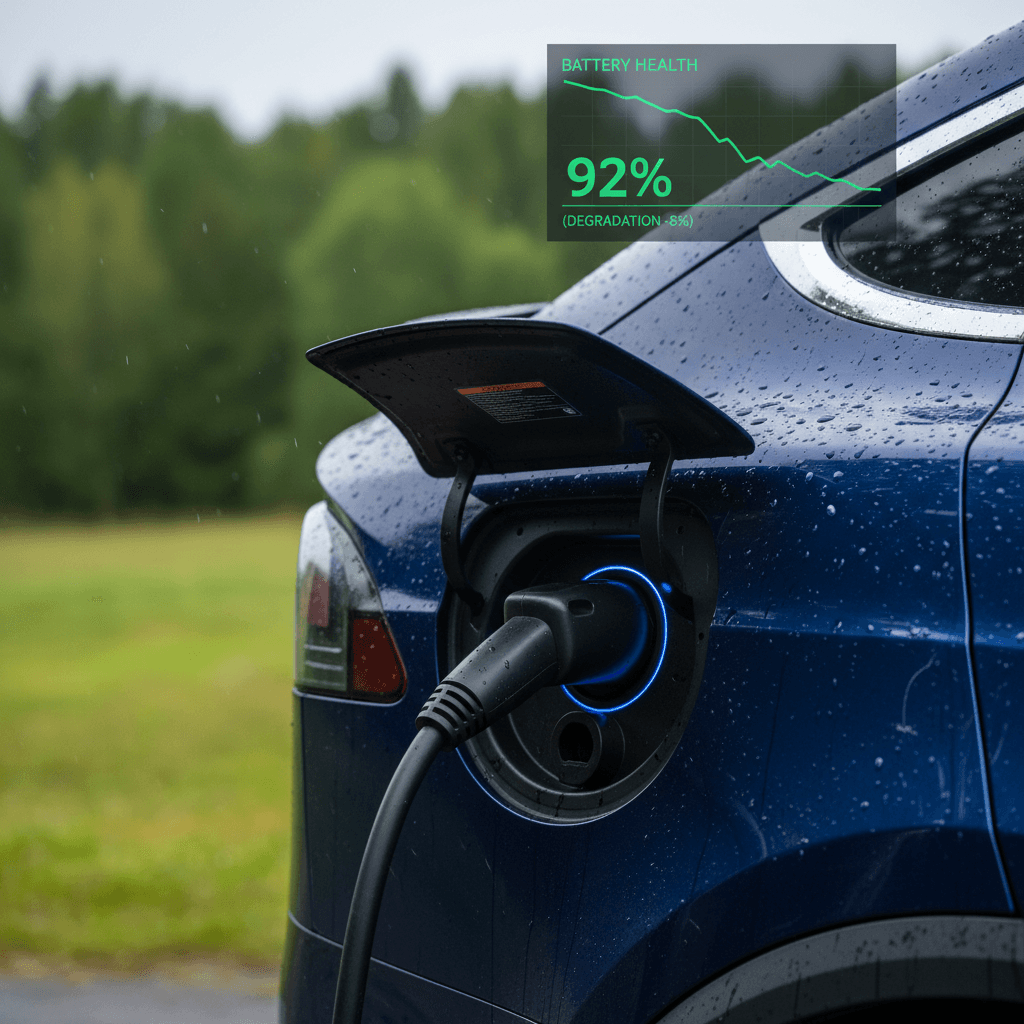
How Recharged evaluates Model X battery health
Because the battery is so central to the value of any used EV, Recharged treats it as the main character, not a supporting actor. Every Tesla Model X on our platform includes a Recharged Score Report with verified battery health so you’re not guessing based on a range screenshot and a handshake.
Inside a Recharged Model X battery evaluation
What happens before a used Model X ever gets listed.
Deep‑dive diagnostics
We use professional‑grade tools to read pack State of Health, module balance, error histories, and charging behavior, far beyond what the in‑car display shows.
Charging behavior analysis
We look for patterns that suggest heavy fast‑charging or abuse versus healthy Level 2 use, and we factor that into the Recharged Score and pricing.
Transparent reporting
You see the results in plain language: estimated remaining capacity, notes on any past faults, and how the pack compares to similar Model X vehicles.
Ready to find your next EV?
Browse VehiclesWhy this matters for you
Tesla Model X battery lifespan: FAQ
Common questions about Model X battery life
Bottom line: how long a Model X battery really lasts
Underneath the theatrics of the doors and the cinema‑scale windshield, the Tesla Model X is fundamentally a big battery on wheels. The good news is that this battery is built for the long haul. For most owners, a Model X pack will deliver well over a decade and 200,000+ miles of useful range before degradation becomes a genuine headache, especially if you avoid abusing it with constant fast charging and extreme heat.
If you’re considering a used Model X, don’t be spooked by the battery, just be disciplined. Focus on verified battery health, clear history, and fair pricing. That’s exactly what Recharged was built to surface: every vehicle on our platform comes with a Recharged Score Report that pulls the battery out of the shadows and puts the numbers in front of you. Do that, and the question stops being “Tesla Model X battery lifespan, how long?” and becomes “How many years of quiet, electric miles do I want to enjoy before I move on to the next one?”